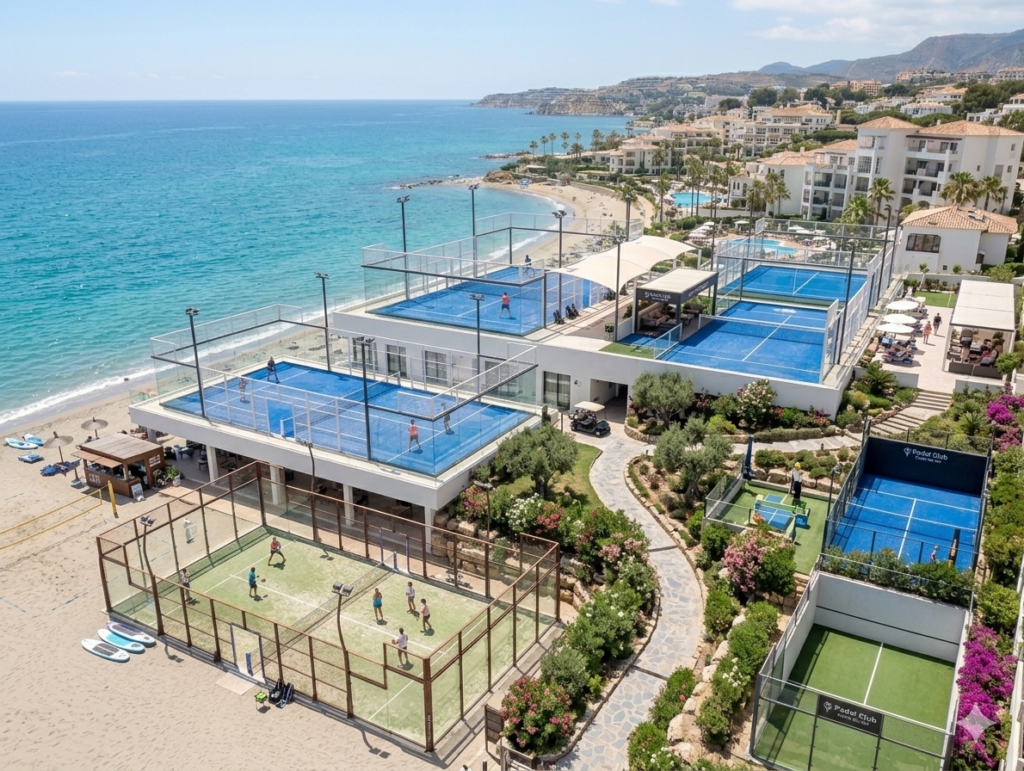
A panoramic padel court can make a new club look more premium, more open and more attractive to players. Its wide glass design improves visibility for spectators, supports social-media content and gives members a higher-quality playing experience.
However, investors should not choose a Cancha de pádel con vistas panorámicas based only on appearance or the lowest quotation. The correct specification depends on where the court will operate.
For an indoor padel club, the key buying decisions are lighting, artificial turf and glass integration. For an outdoor padel club, the priority shifts to corrosion protection, structural rigidity, wind load and anchoring.
This guide explains how to choose the right Indoor Padel Court, Outdoor Padel Court, Panoramic Padel Court or Super Panoramic Padel Court without spending budget on specifications that do not add practical value. As a China padel court manufacturer, PANO Court supplies complete systems including steel structures, tempered glass, KDK fibre artificial turf, LED lighting, mesh, net posts, accessories and installation guidance.
What Is the Best Panoramic Padel Court Configuration for a New Club?
The best panoramic padel court is not the one with the highest specification in every category. It is the one designed for your venue, climate, booking frequency and business positioning. For most indoor commercial clubs, a 4 × 400W IP65 lighting system and 52,500-stitch KDK turf offer strong value. For most outdoor clubs, 3 mm hot-dip galvanized steel with two-layer protection and reinforced anchor bolts is the practical starting point.
A regulation padel court measures 20 × 10 metres, equal to 200 m² of playing area. Investors should normally allow around 21 × 11 metres per court during early layout planning to accommodate structural space, access and installation tolerance. Final dimensions must be confirmed against the site, building layout and local requirements. See PANO Court’s Padel Court Design Guide for Clubs for broader layout and circulation planning.
Before confirming a Panoramic Padel Court, establish whether the project is fully indoor, semi-covered or fully outdoor; how many bookings it expects each day; whether it is for social play, coaching, premium membership or tournaments; whether it faces salt air, rain or wind; and whether the court must be permanent or relocatable.
How Should You Choose an Indoor Panoramic Padel Court?
For an indoor panoramic padel court, prioritize lighting quality, turf performance and glass-installation precision. A fully enclosed venue does not usually need a coastal anti-corrosion upgrade or a high-wind structural package. Invest instead in what players notice every day: clear visibility, comfortable footing, stable ball bounce and a clean, premium visual experience.
Indoor clubs can operate more consistently because rain, direct sun and strong wind have less impact on bookings. That makes indoor padel particularly attractive for commercial clubs, coaching centres and multi-court facilities.
Which LED Lighting System Is Best for an Indoor Padel Court?
For most indoor commercial padel clubs, PANO Court recommends 4 × 400W IP65 LED lights. This configuration provides 1,600W installed power per court and is usually sufficient for club play, coaching and premium daily operation when the lighting layout, installation height and beam angle are correctly designed.
Lighting should never be selected by wattage alone. The final result depends on the fixture optical design, mounting height, aiming angle, court colour, ceiling reflection and court spacing. A practical target is 300–500 lux for regular club operation and coaching. Competition-oriented venues may require a higher target according to local standards and event requirements.
| Lighting option | Total power per court | Main advantage | Best application | PANO recommendation |
|---|---|---|---|---|
| 8 × 200W LED lights | 1,600W | More light points and potentially broader distribution | Large halls or layouts requiring more fixture points | Optional |
| 4 × 400W LED lights | 1,600W | Cleaner layout, fewer fixtures and easier maintenance | Most indoor clubs with suitable installation height | Recommended |
| 6 × 400W LED lights | 2,400W | Higher output for special layouts or higher-light targets | Competition-oriented or unusual venues | Project-specific only |
Both 8 × 200W and 4 × 400W systems have the same 1,600W installed power. Eight 200W lamps create more lighting points, but also more fixtures, wiring points and maintenance items. For most indoor panoramic courts, 4 × 400W IP65 lights provide a cleaner solution when matched to the correct beam angle and mounting position.
What Lighting Data Should a Club Investor Request?
Request total wattage, average lux, uniformity, beam angle, IP rating, anti-glare design, flicker-free driver details and a lighting layout drawing. These values show whether the court will provide even ball visibility, player comfort and maintainable daily operation. Do not pay for extra lighting power unless the venue demonstrably needs it.
How Should You Choose Artificial Turf for an Indoor Padel Court?
For indoor padel courts, higher turf density is not always better. The correct surface depends on booking frequency, player level, maintenance capability and budget. For most new commercial clubs, PANO Court recommends 52,500 stitches/m² KDK fibre turf with 9,500 Dtex, 12 mm pile height and PU backing.
All PANO Court turf options use KDK fibre grass designed to support stable ball response, wear resistance and a professional padel appearance. The key is to select a compatible system rather than simply the highest stitch count.
| PANO Court turf option | Stitch density | Dtex | Pile height | Backing | Recommended use |
|---|---|---|---|---|---|
| Commercial club option | 52,500 stitches/m² | 9,500 | 12 mm | PU backing | Most indoor clubs |
| High-traffic option | 58,800 stitches/m² | 9,500 | 12 mm | PU backing | Busy clubs and coaching centres |
| Premium option | 63,000 stitches/m² | 9,500 | 12 mm | PU backing | Flagship venues and intensive use |
Why Is 52,500-Stitch Turf the Recommended Indoor Choice?
52,500 stitches/m² KDK turf gives most investors the right balance of performance, durability and investment cost. Its 9,500 Dtex fibre, 12 mm pile and PU backing are suitable for the majority of indoor commercial clubs because the surface is protected from UV exposure, rain and outdoor temperature changes.
Select 58,800-stitch or 63,000-stitch turf only where there is a clear reason: very high daily occupancy, intensive professional coaching, tournament positioning, premium membership pricing or a flagship court with a long-term high-use plan. The saved budget from a mainstream specification can often be better invested in lighting, ventilation, reception space, branding or member acquisition.
Why Does PU Backing Matter for Padel Turf?
PU backing helps improve turf stability under repeated stops, turns and acceleration near the net, glass and back corners. A stable backing system supports the turf structure and helps reduce premature deformation. The recommended approach is not to buy the densest turf; it is to buy a turf system that matches real booking frequency and maintenance practice.
What Glass Specification Should an Indoor Panoramic Court Use?
A panoramic padel court needs high-quality tempered safety glass, accurate fabrication and correct installation details. PANO Court commonly uses 12 mm tempered glass for panoramic court systems. Investors should review glass thickness, hole positions, edge treatment, brackets, gaskets, fasteners, separation of metal and glass, and future replacement access.
A Super Panoramic Padel Court provides a more open, pillar-reduced visual effect. It can suit showcase courts, premium clubs, tournaments and venues prioritizing broadcast-quality visibility. For many multi-court clubs, however, a standard panoramic court is the stronger investment choice because it retains premium visibility while keeping structure and cost controlled.
How Should You Choose an Outdoor Panoramic Padel Court?
For outdoor projects, PANO Court recommends a practical structural solution: 3 mm hot-dip galvanized steel structure, two-layer anti-corrosion protection and reinforced-rib anchor bolts. This configuration balances structural strength, corrosion resistance, installation efficiency and project budget for most permanent outdoor padel clubs.
Outdoor courts face rain, humidity, UV exposure, wind and temperature changes. Investors should protect the structural system correctly, but should not assume that more coating layers always mean better protection. Refer to PANO Court’s Padel Court Wind Load engineering guide when evaluating open, coastal or roof-level sites.
What Steel Structure Is Recommended for an Outdoor Padel Court?
| Structural item | Recommended outdoor specification |
|---|---|
| Main steel structure | 3 mm steel tube |
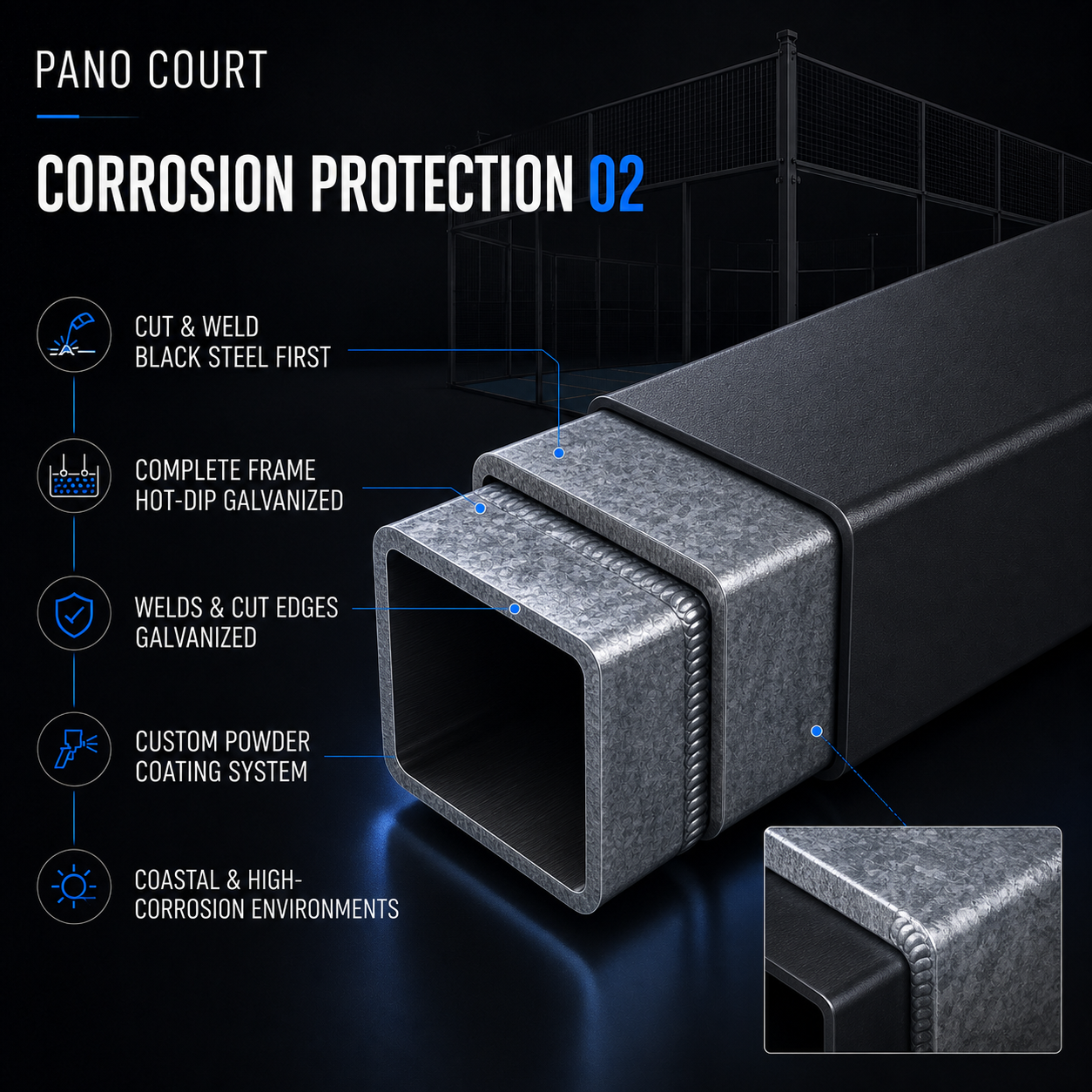
| Steel treatment | Hot-dip galvanizing after fabrication |
| Anti-corrosion system | Two-layer protection: hot-dip galvanizing plus powder coating |
| Corner reinforcement | Double corner-pillar option for higher wind exposure |
| Heavy-duty corner option | 120 × 120 × 4 mm reinforced corner structure when required |
| Fastening | Reinforced-rib anchor bolts |
| Final design | Confirmed according to wind load and foundation conditions |
The two-layer system combines hot-dip galvanizing, which protects the steel substrate, welds and cut edges, with powder coating, which adds protective surface finish and colour consistency.
Why Not Add Too Many Anti-Corrosion Layers?
More treatment layers do not automatically mean better corrosion resistance. If additional coatings are not designed as a compatible system, they can create adhesion problems, inconsistent curing or difficulty inspecting the galvanized layer. For most standard outdoor club projects, hot-dip galvanizing plus quality powder coating is sufficient. In aggressive coastal, high-salinity or extreme-humidity sites, the final corrosion package, fastener selection and maintenance plan need project-specific review.
How Do Double Corner Pillars Improve Outdoor Court Stability?
Wind load transfers through the glass, mesh, frame, columns, base plates, anchors and concrete foundation. The corner is one of the most important load-transfer zones in an outdoor panoramic court. For higher exposure projects, PANO Court can provide double corner pillars, reinforced connection details, larger 120 × 120 × 4 mm corner steel and a project-specific foundation and anchor layout.
This reinforcement is not necessary for every outdoor project. It is most valuable for open sites, coastal areas, rooftops, regions with seasonal storms or locations with stronger wind-design requirements. Local qualified professionals remain responsible for final loads, foundations, anchors, drainage, permits and site compliance.
What Is the Recommended Outdoor Anchoring Solution?
For most permanent outdoor panoramic padel courts, PANO Court recommends reinforced-rib anchor bolts. With the correct concrete foundation, anchor spacing and structural layout, this solution provides a practical balance of load capacity, installation efficiency and future maintenance.
| Anchor option | Main feature | Suitable for | PANO recommendation |
|---|---|---|---|
| Reinforced-rib anchor bolts | Strong, practical and easier to install | Most permanent outdoor courts | Recommended standard solution |
| Chemical anchors | Resin-bonded threaded rods in drilled holes | Special structural conditions or engineer-specified projects | Use when required |
| Portable foundation system | Designed for relocation and temporary use | Mobile or event projects | Choose a dedicated portable court |
Chemical anchors are not automatically necessary for every project. If the business model requires relocation for exhibitions, hotels, temporary tournaments or shopping-centre installations, choose a purpose-designed Portable Padel Court or Mobile Padel Court. A permanent court with fixed anchors and a concrete foundation should not be treated as repeatedly movable.
Indoor vs Outdoor Panoramic Padel Court: What Should You Spend Money On?
| Componente | Indoor recommendation | Outdoor recommendation |
|---|---|---|
| Iluminación | 4 × 400W IP65 LED lights | Confirm layout according to site and operating hours |
| Césped | 52,500 stitches/m², 9,500 Dtex, 12 mm, PU backing | Select turf for UV and climate performance |
| Vidrio | 12 mm tempered glass | 12 mm tempered glass with structural coordination |
| Steel treatment | Standard protected solution for enclosed buildings | 3 mm hot-dip galvanized steel plus powder coating |
| Wind reinforcement | Usually not required in enclosed halls | Double corners or 120 × 120 × 4 mm corners if exposure requires |
| Anchoring | Based on slab and building design | Reinforced-rib bolts for most permanent projects |
| Budget priority | Player experience and operating quality | Long-term durability and structural safety |
Panoramic vs Super Panoramic Padel Court: Which Is Better?
| Característica | Cancha de pádel con vistas panorámicas | Super Panoramic Padel Court |
|---|---|---|
| Viewing experience | Premium and open | Maximum pillar-reduced view |
| Costo | More controlled | Más alto |
| Structural practicality | Strong and suitable for most clubs | Requires more precise production and installation |
| Best use | Commercial clubs and multi-court facilities | Flagship courts, tournaments and premium venues |
| Outdoor suitability | Excellent with correct structural package | Possible with project-specific engineering |
For most new clubs, a Panoramic Padel Court offers the best balance between investment cost, player experience and structural reliability. A super panoramic model is best used as a premium showcase court when the club positioning, membership price and event strategy justify the upgrade.
What Is the Final Recommendation for New Padel Club Investors?
For a standard indoor panoramic padel club, PANO Court recommends 4 × 400W IP65 anti-glare LED lights, 52,500 stitches/m² KDK fibre turf, 9,500 Dtex, 12 mm pile height, PU backing, 12 mm tempered glass and a standard panoramic court structure.
For a standard outdoor panoramic padel club, PANO Court recommends 3 mm hot-dip galvanized steel structure, a two-layer galvanizing-plus-powder-coating system, reinforced-rib anchor bolts, a properly designed concrete foundation, wind-load review by project location, and double corner pillars or 120 × 120 × 4 mm reinforcement only when exposure requires it.
The right Panoramic Padel Court is not the most expensive court. It is the court that gives the club reliable performance, a professional player experience and controlled long-term operating costs.
Preguntas frecuentes
Is 4 × 400W lighting enough for an indoor padel court?
For most indoor commercial padel clubs, 4 × 400W IP65 LED lights are sufficient when the lighting layout, beam angle and mounting height are correctly designed. Confirm lux and uniformity targets before final selection.
Is 8 × 200W better than 4 × 400W?
Both options use 1,600W total power. Eight 200W lights provide more lighting points, while four 400W lights create a cleaner layout with fewer fixtures. For most indoor clubs, PANO Court recommends 4 × 400W.
Which artificial turf is best for an indoor padel club?
For most commercial indoor clubs, 52,500 stitches/m² KDK fibre turf with 9,500 Dtex, 12 mm pile height and PU backing provides a balanced commercial specification.
Is 63,000-stitch turf always better?
No. It is a premium option for higher traffic, flagship venues and intensive use. For a normal indoor club, 52,500 stitches/m² is usually enough when it matches the expected booking volume.
Does an outdoor court need three anti-corrosion layers?
Not necessarily. For most outdoor projects, hot-dip galvanizing plus powder coating is an effective two-layer protection system. Extra layers are valuable only when technically compatible and justified by the site environment.
What steel thickness is recommended for an outdoor panoramic court?
For most outdoor projects, PANO Court recommends a 3 mm hot-dip galvanized steel structure. Higher reinforcement can be selected for high-wind or exposed sites after project-specific review.
Are chemical anchors necessary for every outdoor court?
No. For most permanent outdoor projects, reinforced-rib anchor bolts are suitable when paired with the correct concrete foundation and structural design. Chemical anchors are used when a site or engineer specifies them.
Do I need double corner pillars for an outdoor court?
Double corner pillars are recommended for stronger wind exposure, coastal conditions, rooftops or open sites. They are not automatically needed for protected locations.
Can I use a permanent outdoor panoramic court as a portable court?
No. A permanent court uses fixed anchors and a concrete foundation. For relocation or temporary events, choose a dedicated portable padel court system.
Start Your Padel Club Project With PANO Court
PANO Court is a China-based padel court manufacturer supplying panoramic, super panoramic, classic and portable court systems for clubs, contractors, resorts and sports-facility investors worldwide.
Send us your project location, venue type, number of courts and target opening date. Our team can recommend the right court structure, turf, lighting, corrosion protection and anchoring solution for your project.
For tournament projects, consult the Federación Internacional de Pádel and local requirements before confirming final specifications.