Padel court lighting is one of the most impactful—and most frequently under-specified—decisions in costruzione di campi da padel. Wrong lighting choices cost club operators $3,000–$8,000 per court in energy annually, generate player complaints that drive membership cancellations, and may require complete fixture replacement within 3–5 years. Right lighting choices deliver 15+ year operational life, superior player experience, and energy costs 40–60% below legacy metal halide systems.
This guide covers everything buyers need to know about padel court LED lighting: international standards, performance specifications, energy calculations, product evaluation criteria, and how leading produttori di campi da padel differ in their lighting specifications. Whether you’re sourcing courts as a complete system or specifying lighting separately, this is the reference you need.
Why Padel Court Lighting Matters More Than You Think
Padel is a fast, ball-tracking sport played in a glass enclosure. The visual demands on players are significant: tracking a ball traveling at 80–140 km/h against rapidly changing background (glass panels, adjacent courts, spectators) requires both high illuminance and high visual uniformity. Poor lighting quality has measurable commercial impacts:
- Player survey data from Playtomic’s 2025 club satisfaction research shows “lighting quality” as the #4 factor in padel club member satisfaction (behind location, court condition, and booking availability)
- Clubs that upgrade from below-standard to FIP Class II lighting report 12–18% improvement in peak-hour booking rates as players specifically seek better-lit facilities
- Insufficient lighting prevents evening and night-time operation — the highest-revenue hourly slots at most clubs (18:00–22:00)
- Energy cost of non-LED lighting on a 4-court outdoor facility: $12,000–$24,000 per year vs. $5,000–$9,000 for equivalent LED systems — a difference of $7,000–$15,000 annually
The FIP and EN 12193 Padel Lighting Standards Explained
Two standards govern padel court lighting specification in professional and commercial contexts:
EN 12193: Lighting of Sports Installations
The European standard EN 12193 defines illuminance requirements by sport class. For padel, the classifications are:
| Class | Application | Horizontal Illuminance (Eh avg) | Uniformity (U1) | Uniformity (U2) |
|---|---|---|---|---|
| Class III | Recreational / training | 200 lux | 0.4 | 0.6 |
| Class II | Club competition, fitness classes | 300 lux | 0.5 | 0.7 |
| Class I | Regional/national competition | 500 lux | 0.6 | 0.75 |
Uniformity ratio U1 = Emin/Eavg; U2 = Emin/Emax. Higher uniformity means more consistent illumination across the campo da padel playing surface—important because areas of shadow/brightness contrast impair ball tracking and create player safety risks.
For most commercial clubs, Class II (300 lux, U1 ≥ 0.5) is the correct specification target. Class I is relevant if tournament hosting is planned. Class III is insufficient for serious club operation and should not be specified in commercial procurement.
FIP Lighting Requirements
The International Federazione Padel (FIP) specifies lighting requirements for sanctioned tournament courts beyond EN 12193 Class I:
- Horizontal illuminance: minimum 1,000 lux average for TV broadcast courts
- Vertical illuminance: minimum 750 lux at 1.5m height on all four vertical plane orientations
- Uniformity: U1 ≥ 0.70 horizontal
- Color rendering index: CRI ≥ 90 Ra
- Color temperature: 5,700–6,500K (neutral-daylight spectrum for camera color accuracy)
Tournament-grade FIP lighting specification costs $15,000–$35,000 per court in fixture + installation. This is relevant for the tiny fraction of courts hosting Premier Padel or national federation events—not the commercial club buyer making standard procurement decisions.
LED vs Metal Halide: Why LED Has Won
Before 2020, metal halide (MH) luminaires were common in padel courts. The comparison today is not competitive:
| Parametro | Metal Halide (400W) | LED (150–200W equivalent) |
|---|---|---|
| Luminous efficacy | 80–100 lm/W | 140–175 lm/W |
| Fixture lifetime | 12,000–20,000 hours | 50,000–100,000 hours |
| Power consumption per court | 3,200–4,800W | 1,200–2,400W |
| Warm-up time | 3–5 minutes | Instant |
| Dimming capability | Limitato | 0–100%, programmable |
| Maintenance cost (10yr) | $3,000–$6,000 per court | $200–$600 per court |
| Annual energy cost per court | $1,800–$3,500 | $700–$1,400 |
LED payback vs. metal halide replacement: typically 18–30 months. On a 15-year ownership horizon, the LED advantage is overwhelming. Any fornitore di campi da padel or manufacturer quoting metal halide lighting in 2026 is offering outdated technology.
Complete LED Lighting Specification for Padel Courts
Luminous Efficacy: The Key Efficiency Metric
Luminous efficacy (lm/W) determines how much light output you get per watt of electrical input. Higher efficacy = lower energy cost for equivalent illuminance. Standards for padel court LED fixtures:
- Minimum acceptable: 130 lm/W
- Good quality: 140–160 lm/W
- Premium: 160–175 lm/W
- High-efficacy specialist sports fixtures: 180–200 lm/W (available from Musco, Philips/Signify, Osram at premium)
Budget manufacturers frequently supply fixtures rated at 90–110 lm/W — these consume 40–60% more energy than premium equivalents to achieve the same lux levels. Ask your produttore di campi da padel for IES photometric files and efficacy data, not just fixture wattage and lux claims.
Color Rendering Index (CRI)
CRI measures how accurately a light source renders colors compared to natural daylight (CRI 100). For padel courts:
- Minimum specification: CRI ≥ 80 Ra (EN 12193 minimum for sports)
- Recommended specification: CRI ≥ 85 Ra (better ball color contrast against glass background)
- Premium specification: CRI ≥ 90 Ra (required for TV broadcast; excellent for high-end commercial)
Color Temperature
Color temperature (Kelvin) affects the visual atmosphere of the court and player perception of ball speed. For outdoor padel courts: 5,000–6,500K (cool daylight) is standard—matches ambient daylight in evening hours and improves ball tracking contrast. For indoor courts where ambient light is fully artificial: 4,000–5,000K (neutral white) creates a warmer, more comfortable environment while maintaining adequate contrast.
Glare Control: UGR Rating
Glare (uncomfortable brightness in the visual field) is a serious problem in padel courts—players looking up to track overhead lobs can be directly exposed to bright LED fixtures. The Unified Glare Rating (UGR) scale measures this:
- UGR ≤ 22: Acceptable for most sports applications (EN 12193 threshold for indoor sports)
- UGR ≤ 19: Good quality sports lighting, minimal glare complaints
- UGR ≤ 16: Premium specification; used in professional broadcast venues
Glare control is achieved through fixture optical design (lens asymmetry, deep anti-glare baffles, precision beam angle control) rather than simply reducing fixture brightness. High-quality padel court LED fixtures will specify UGR values—absence of UGR data in a product specification is a red flag.
IP and IK Ratings for Protection
Protection ratings for padel court lighting fixtures:
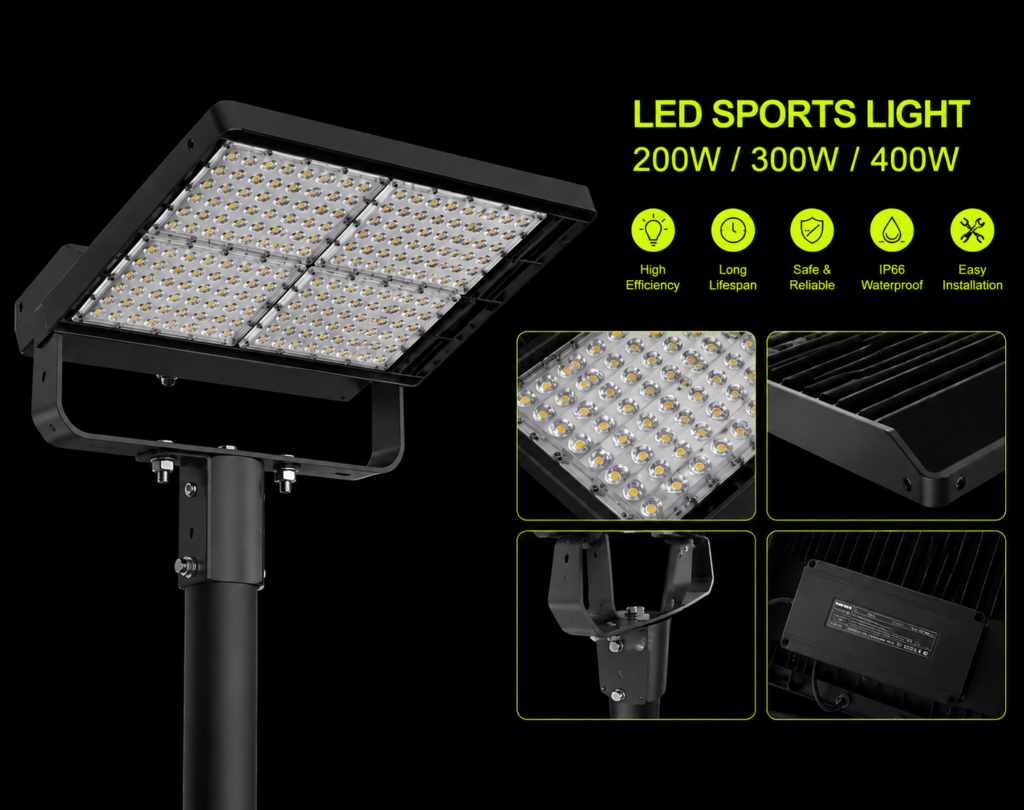
- IP (Ingress Protection) — for outdoor courts: IP65 minimum (dust-tight, rain-proof); IP66 for exposed coastal or high-rainfall environments
- IP for indoor courts: IP44 acceptable (splash-proof); IP65 if courts have open-air sections
- IK (Impact Protection): IK08 minimum for fixtures mounted below 6m where ball strike risk exists; IK10 for fixtures in ball trajectory zones
Driver Lifetime and Warranty
LED driver (power supply) lifetime is often the binding constraint on fixture service life. Standard specification:
- L80B10: 80% lumen maintenance (fixture delivers ≥80% of initial lumens) at 50,000 hours, with ≤10% fixture failure rate
- Driver warranty minimum: 5 years; quality manufacturers offer 7–10 year driver warranties
- Mean Time Between Failure (MTBF): minimum 100,000 hours for driver electronic components
Lighting Layout Design: Mounting Positions and Coverage
Standard lighting layout for a FIP-compliant outdoor campo da padel panoramico:
- Number of fixtures: 4–8 per court (varies with fixture lumen output and mounting height)
- Mounting height: 6–8m above playing surface (balances coverage uniformity and glare angle)
- Mounting positions: Top of court frame at rear wall areas; mid-height on side columns for supplementary vertical illuminance
- Aiming angle: Downward asymmetric distribution directed toward center of court, avoiding direct upward glare
Require a Dialux or Relux photometric simulation report from your padel court supplier before order confirmation. This report, generated from your court dimensions and proposed fixture type, predicts lux levels at multiple points across the playing surface and confirms EN 12193 compliance. It’s a 2-hour task for a competent lighting designer—any supplier who can’t provide it is not equipped for professional padel court lighting specification.
Smart Controls and Dimming: The Operational Efficiency Opportunity
Modern LED padel court lighting should integrate with smart control systems:
- Dimming capability: 0–100% continuous dimming per court; set to 50% for warm-up/casual play, 100% for competition and recorded sessions
- Scheduling: Time-based control matching court booking schedule; automatic switch-off 15 minutes after booking end
- Occupancy sensing: Motion detection to prevent energy waste when courts are unbooked
- Booking system integration: API connection between lighting control and court booking software (Playtomic, Smash, Matchi) for automatic lighting activation/deactivation with bookings
Smart control payback: energy savings of 20–35% over simple on/off control systems, typically recovering control system cost in 18–24 months. For a full padel court investment framework: How to Open a Padel Club in 2026: Complete Business Plan Guide.
How PanoCourt Specifies Lighting in Our Court Systems
PanoCourt’s standard lighting specification for all court systems:
- LED fixtures: minimum 140 lm/W efficacy, CRI ≥ 80 Ra, CCT 5,000–6,000K
- Protection: IP65 for all standard outdoor courts; IP66 for coastal orders
- Impact: IK08 standard, IK10 available for vulnerable positions
- Driver warranty: 5 years minimum; 7-year drivers available as upgrade
- Photometric report: Dialux simulation provided for all orders as standard
- Post-installation lux verification: measurement protocol provided for buyer’s acceptance testing
Advanced Padel Court Lighting System
At PANO COURT, our lighting system is independently designed and engineered specifically for professional padel courts, delivering superior visibility, player comfort, and long-term reliability.
Optimized Lighting Coverage
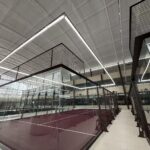
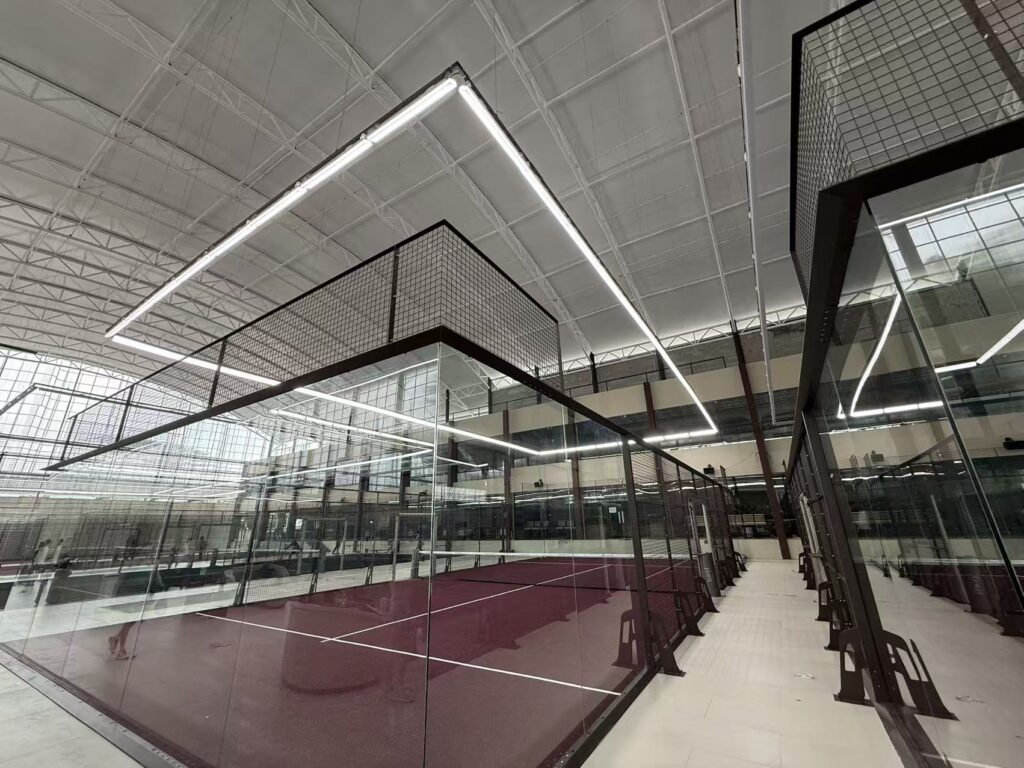
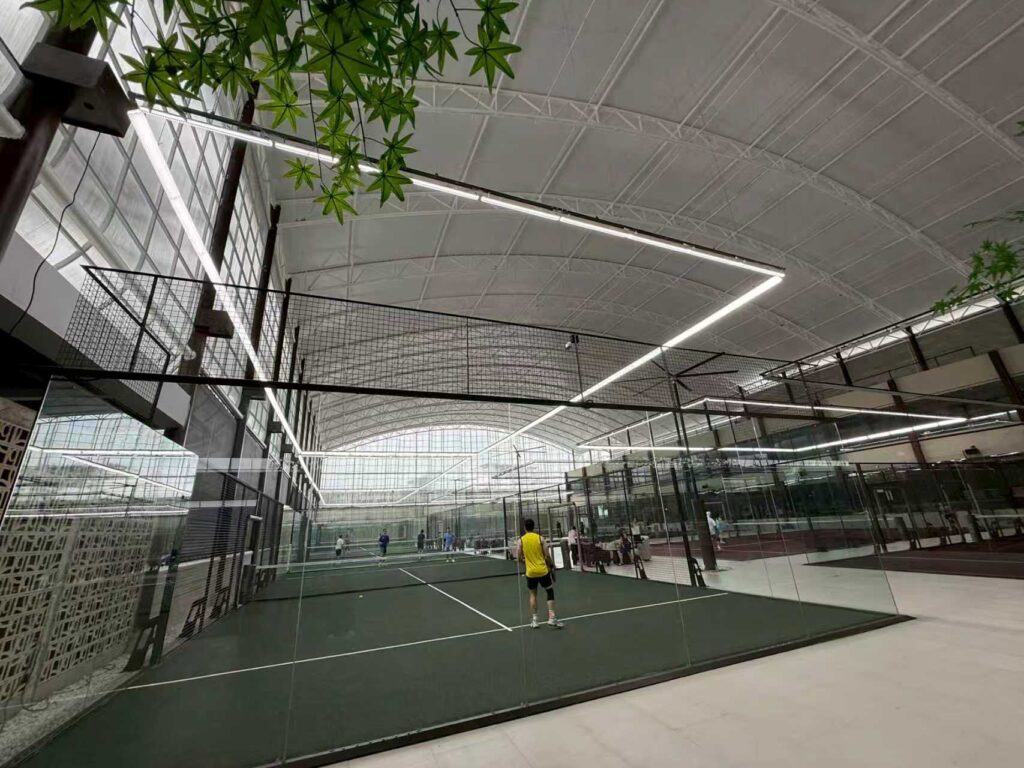
Unlike conventional lighting structures, our customized light pole design ensures that fixtures do not extend beyond the inner playing area. This intelligent configuration maximizes light distribution across the entire court, eliminating dark zones and providing consistent illumination from every angle.
Anti-Glare Technology
We offer advanced anti-glare lighting solutions specifically developed for indoor and semi-indoor padel facilities. By reducing direct light exposure and visual discomfort, players can track fast-moving balls more naturally while maintaining maximum focus during play.
Professional Playing Experience
Uniform lighting levels, reduced shadows, and enhanced visual clarity create a professional-grade playing environment that meets the expectations of clubs, investors, and competitive players alike.
Customizable for Every Project
Whether your project is indoor, outdoor, panoramic, or club-level, our lighting systems can be tailored to meet local standards, installation requirements, and specific player experience goals.
Key Advantages
• Self-developed lighting structure design
• Full-court uniform illumination
• No fixture overhang into the court area
• Optional anti-glare technology for indoor courts
• Enhanced player comfort and ball visibility
• Energy-efficient LED solutions
• Customizable lighting configurations for any project
Because exceptional padel courts deserve exceptional lighting.
Customized Lighting Design for Every Padel Facility
At PANO COURT, we understand that no two facilities are the same. That’s why we offer fully customized lighting solutions tailored to each project’s architectural structure, ceiling height, court layout, and operational requirements.
Our engineering team carefully analyzes the available space and optimizes fixture placement to achieve maximum illumination uniformity while minimizing shadows and glare. Whether for indoor clubs, large multi-court complexes, high-ceiling venues, or unique architectural environments, we design lighting systems that enhance both aesthetics and playing performance.
Unlike standard off-the-shelf solutions, our customized lighting layouts ensure that every corner of the court receives consistent visibility, creating a professional playing environment while maximizing energy efficiency.
Why Choose PANO Customized Padel Court Lighting?
• Tailor-made lighting design for each project
• Optimized according to ceiling height and building structure
• Superior illumination uniformity across the entire court
• Reduced shadows and enhanced ball visibility
• Optional anti-glare solutions for indoor facilities
• Improved player comfort and playing experience
• Seamless integration with modern club architecture
• Professional engineering support from design to installation
From boutique clubs to large-scale padel centers, PANO delivers lighting solutions that are engineered around your space—not the other way around.
See how lighting integrates with our complete court specification: Materiali e specifiche dei campi da padel: La guida tecnica completa per gli acquirenti 2026.
Request PanoCourt’s Lighting Specification Package
PanoCourt provides Dialux photometric simulation reports, IES fixture data files, and energy cost modeling for all padel court lighting specifications. Request yours alongside your court quotation — no charge.
→ Request Court and Lighting Specification Package
Frequently Asked Questions: Padel Court LED Lighting
How many lux does a padel court need?
For commercial club operation, EN 12193 Class II specifies minimum 300 lux average horizontal illuminance with uniformity U1 ≥ 0.5. This is the industry standard for recreational and club competition padel. Training-only facilities can use Class III (200 lux minimum), but this is not recommended for member-facing commercial operation. FIP tournament facilities require 500 lux (Class I) for regional competition and 1,000 lux for broadcast courts.
How much do padel court LED lights cost?
LED lighting for a standard outdoor campo da padel (4–6 fixtures at 150–200W each, achieving 300 lux average per EN 12193 Class II) costs $2,500–$5,000 per court including fixtures, mounting hardware, and electrical connection. Premium smart-control systems with dimming and booking integration add $500–$1,500 per court. Quality produttori di campi da padel include lighting in the complete court package — verify the specification and request photometric data before accepting the included lighting as adequate.
What is the difference between IP65 and IP66 for padel court lights?
IP65 means dust-tight (6) and protected against water jets from any direction (5) — suitable for most outdoor padel courts. IP66 provides the same dust protection but tested against powerful water jets — specified for coastal/marine environments, high-rainfall tropical climates, and facilities where high-pressure cleaning is used near fixtures. The cost difference between IP65 and IP66 fixtures is typically $20–$50 per fixture. Coastal installations should always specify IP66 as standard.
Can I add smart lighting control to existing padel courts?
Yes, most LED drivers support DALI or 0–10V dimming control that can be retrofitted with smart control systems. A smart controller for 4–8 fixtures (one court) costs $300–$800 in hardware plus $200–$500 in installation. The controller connects to your booking system via API (requires software development or existing integration — Playtomic, Matchi, and Smash support lighting control API in their club management platforms). Return on investment through energy savings: typically 18–24 months in high-utilization facilities.
How long do padel court LED lights last?
Quality padel court LED fixtures rated to L80B10 50,000 hours will maintain ≥80% of initial lumen output for 50,000 operational hours — equivalent to approximately 10–12 years at 12 hours/day operation. Driver lifetime may be the limiting component: quality drivers last 50,000–100,000 hours; budget drivers may fail in 15,000–25,000 hours. Always request driver MTBF specification from your supplier. Budget for driver replacement at year 5–7 in operational cost forecasting for quality systems.
Do padel court lights need maintenance?
LED padel court lighting requires minimal maintenance vs. metal halide predecessors. Annual maintenance recommendation: clean fixture lenses with soft damp cloth (removes dust and bird debris that reduce lumen output by 5–15% annually if uncleaned); inspect wiring connections and mounting brackets for vibration-induced loosening; verify lux levels at 3-year intervals using lux meter to confirm system has not degraded below specification. No lamp replacement is required within the first 7–10 years for quality fixtures.