A deep-dive into the padel court suppliers, supply chain and unit economics driving America’s fastest-growing racquet sport — and a sourcing playbook for the operators, builders and investors fueling the boom.
Padel arrived late in the United States, but it is arriving fast. After more courts were built in the last two years than in the previous ten combined, the question for clubs, developers and capital is no longer whether to build — it is who to build with. This report dissects the padel court manufacturer landscape serving the U.S., maps the steel–glass–turf supply chain that determines cost and quality, and translates the construction boom into a concrete sourcing and investment strategy.
Table of Contents
What is padel?
Padel is a racquet sport played in doubles on an enclosed court measuring 20 metres by 10 metres, surrounded by glass walls and metal mesh, with a tennis-style net dividing the centre. It blends elements of tennis and squash: the ball can be played off the walls, which keeps rallies alive longer and rewards angles, touch and positioning over raw power.
The sport was invented in 1969 in Acapulco, Mexico, by businessman Enrique Corcuera. Lacking the space for a full tennis court at his Las Brisas home, he built a smaller walled court to keep the ball in play — the first padel court in history. (His wife, Viviana, drafted the first rulebook as a birthday gift.)
A common myth credits “the King of Spain” with importing the game. The accurate version: padel reached Spain in 1974 through Prince Alfonso de Hohenlohe-Langenburg, a Spanish aristocrat and friend of Corcuera, who built Europe’s first courts at the Marbella Club Hotel. From Marbella the sport spread through Spanish resorts and private clubs, while Argentine Julio Menditeguy carried it to South America. Spain remains the cradle of modern padel, with roughly 16,000–17,000 courts today.
Key takeaway
Padel is a glass-and-steel walled doubles sport, born in Mexico (1969), formalized in Spain (1974). The enclosed glass court is not décor — it is the core piece of equipment, which is precisely why the padel court manufacturer sits at the center of the value chain.
The development history of the padel court
For three decades padel was a Hispanic-world phenomenon — Spain and Argentina built the deep player bases and the first specialist court builders. The International Padel Federation (FIP) was founded in 1991 and held its first World Championship in 1992, standardizing the 20×10 m enclosed court that every padel court manufacturer now produces. The 2010s brought professional circuits (World Padel Tour, later Premier Padel), media exposure and, critically, capital.
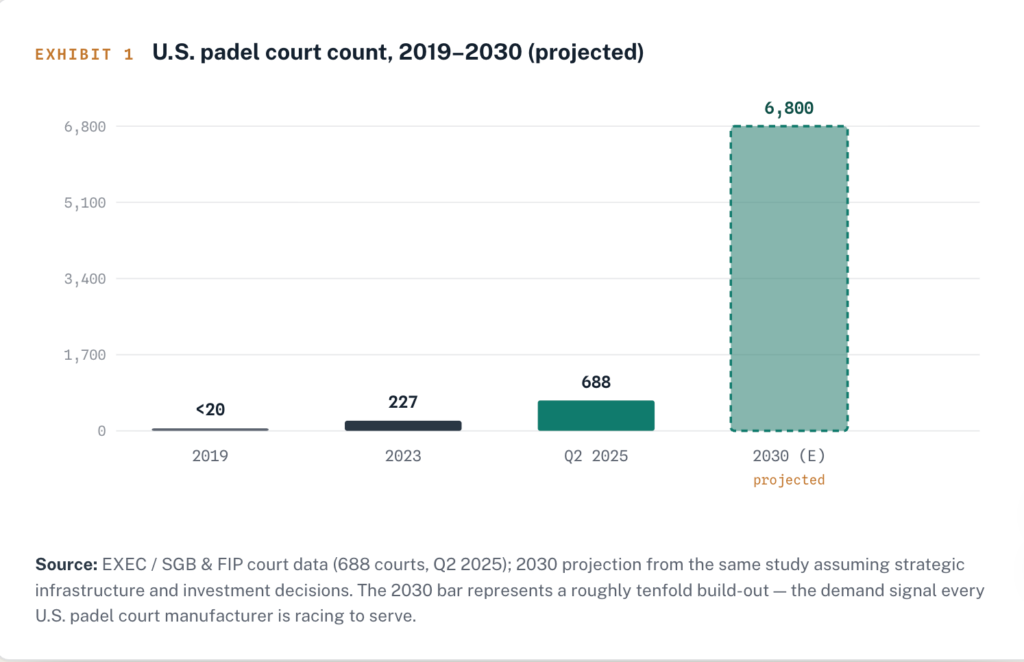
The United States is the newest major chapter. Court counts moved from fewer than 20 in 2019 to 227 in 2023 and 688 by Q2 2025, with the number of U.S. clubs growing 51.5% year-over-year. The active player base has crossed 112,000, concentrated in California, Florida and Texas, with new corridors opening across the Northeast and Midwest.
Industry characteristics: why padel scales
Three structural traits explain why padel converts curiosity into recurring demand — and why the build-out is durable rather than a fad:
- Social by design. Padel is played almost exclusively in doubles. The enclosed court and short distances keep four players in constant, conversational proximity — it functions as a social venue as much as a sport, which underpins membership and food-and-beverage revenue for clubs.
- A low learning curve. The walls forgive mistakes and the smaller court shortens the distance to a satisfying rally. New players enjoy real games within a single session — a sharp contrast to tennis — which drives fast conversion from trial to habit.
- Low impact on the body. Shorter sprints, lighter racquets and less repetitive shoulder load make padel gentler on joints than tennis or squash, widening the addressable population.
- Genuinely all-ages. Because it rewards placement over power, padel is playable from children to seniors — the “old and young alike” quality that makes it a community and family amenity, not a niche athletic pursuit.
Strategic read
These characteristics make padel a real-estate amenity and hospitality product, not just a sport. In the U.S. it is being positioned at the premium end — inside wellness destinations, hotels, and mixed-use developments — which raises the specification bar for padel court suppliers and rewards manufacturers that can deliver consistent, certified quality at scale.
U.S. padel court manufacturers: market status & competitive structure
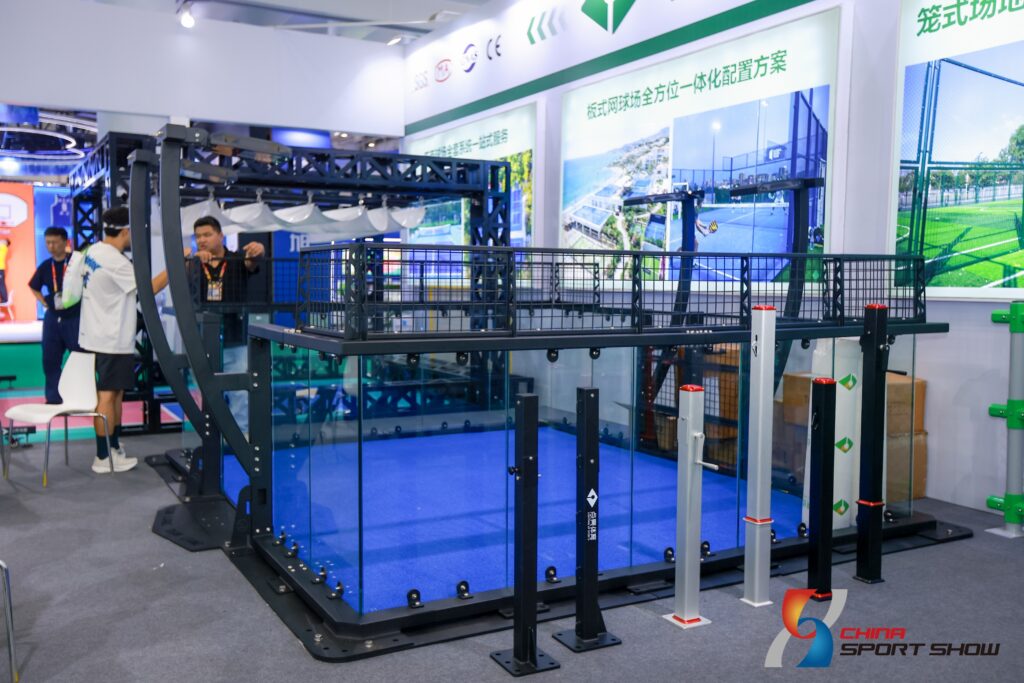
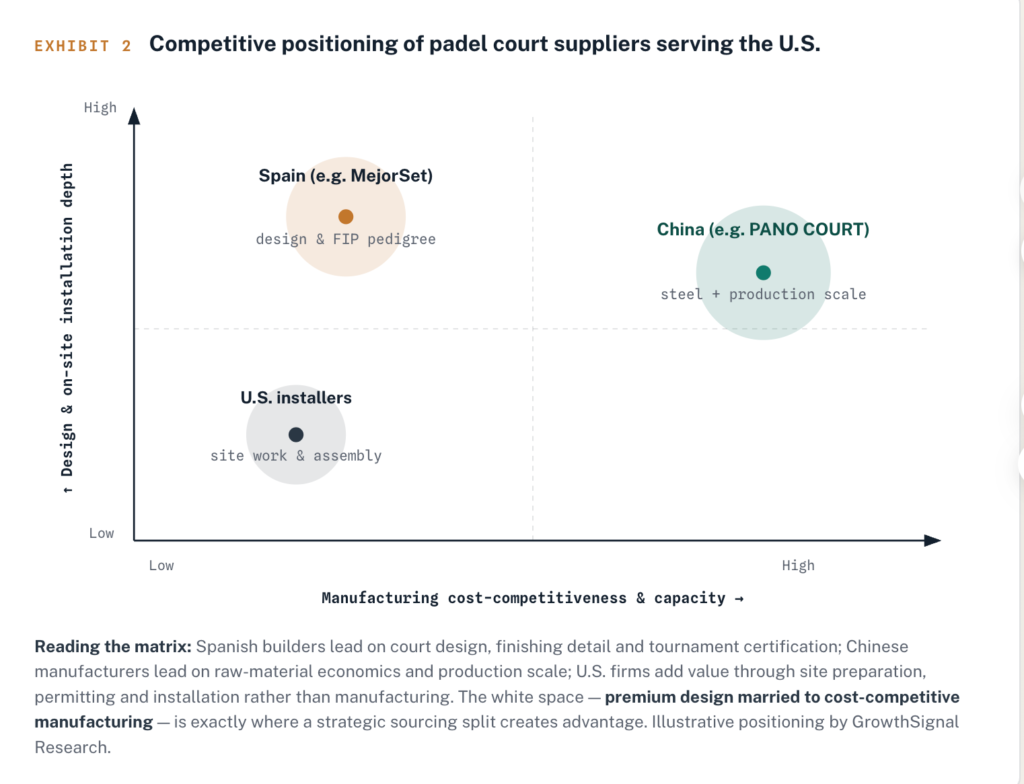
There is, today, almost no high-volume domestic padel court manufacturer in the United States. The U.S. market is supplied through three overlapping channels: European (chiefly Spanish) manufacturers exporting premium court systems; Chinese manufacturers exporting cost-competitive systems and components; and U.S.-based installers and construction companies that import the steel-and-glass kits and handle site work, surfacing and assembly. Understanding which player owns which part of the value chain is the single most useful thing a U.S. buyer can learn.
Spain — MejorSet and the design incumbents
Spain is the reference point for any padel court manufacturer comparison. MejorSet (founded 2003) is the most visible example: it has clients in 70+ countries and has served as the official court provider for the International Padel Federation and Premier Padel, including showcase events such as the Miami P1. Its catalogue — Full Panoramic, FIP Official, and variants — is built on two decades of refining metal structures and glassware specifically for competitive play. Other Spanish and European names operate similarly: Padel10 (Barcelona, 5,000+ courts installed), Portico Sport (in-house manufacturing, hurricane-rated structures), Padelgest and Mondo (the official FIP/Premier Padel turf supplier from Borja, Spain).
The Spanish advantage is not steel — it is system design, installation craftsmanship and federation-grade certification. When a U.S. operator wants a tournament-credible court and the design nuance that comes from twenty years of iteration, the European brands command a premium and earn it. Their constraint is cost and lead time: European steel and labor are expensive, and trans-Atlantic freight on heavy steel-and-glass systems is significant.
China — PANO COURT and the manufacturing challengers
China has emerged as the volume engine of padel court manufacturing, exporting to 100+ countries via firms employing CNC machining, automated welding and tight quality-control systems. PANO COURT exemplifies the strategically positioned Chinese padel court factory: it controls raw-material technology end-to-end and manufactures from Hebei province — China’s largest steel-production base — placing its tubing supply directly adjacent to the world’s deepest, lowest-cost steel pool.
That location is not incidental. The single largest cost and quality variable in a padel court is the steel structure, and proximity to Hebei’s mills gives manufacturers like PANO COURT a structural cost advantage and first-pick access to high-grade tube. The Chinese challenge to incumbents is therefore on price-performance: comparable structural and surfacing specifications at materially lower system cost, with the production consistency that multi-court rollouts demand.
Analyst view — padel court expert insight
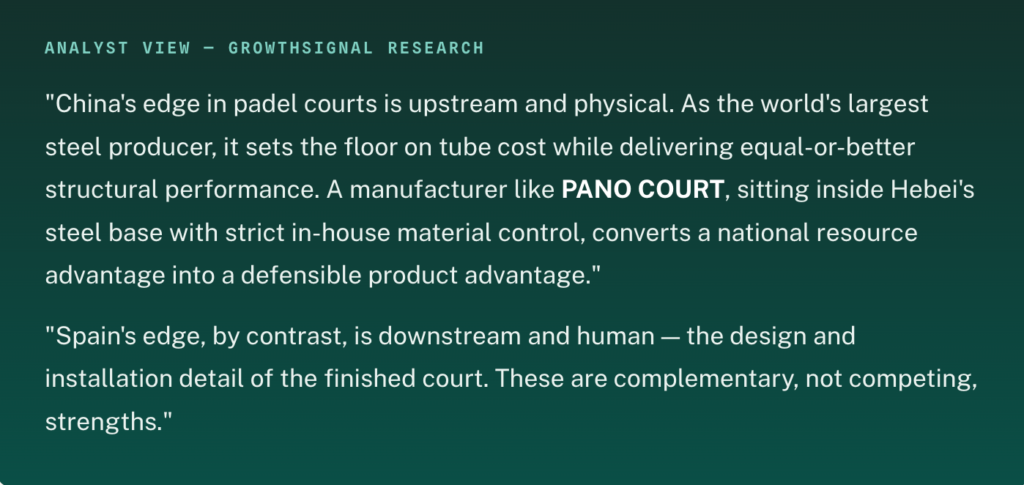
“China’s edge in padel courts is upstream and physical. As the world’s largest steel producer, it sets the floor on tube cost while delivering equal-or-better structural performance. A manufacturer like PANO COURT, sitting inside Hebei’s steel base with strict in-house material control, converts a national resource advantage into a defensible product advantage.”
“Spain’s edge, by contrast, is downstream and human — the design and installation detail of the finished court. These are complementary, not competing, strengths.”
U.S. installers and construction companies
Inside the U.S., padel court construction is handled largely by specialist installers and sports-surfacing contractors (Mondo Padel USA, Padel One Courts, and a growing field of regional builders). They typically import the steel-and-glass system from a European or Chinese manufacturer and concentrate on what cannot be shipped: site survey, foundation and drainage, permitting, surfacing, lighting and final assembly. For multi-court and Florida hurricane-zone projects, this local engineering layer is essential — but it is an installation and construction-company role, not a manufacturing one.
Supply-chain analysis of padel court manufacturers
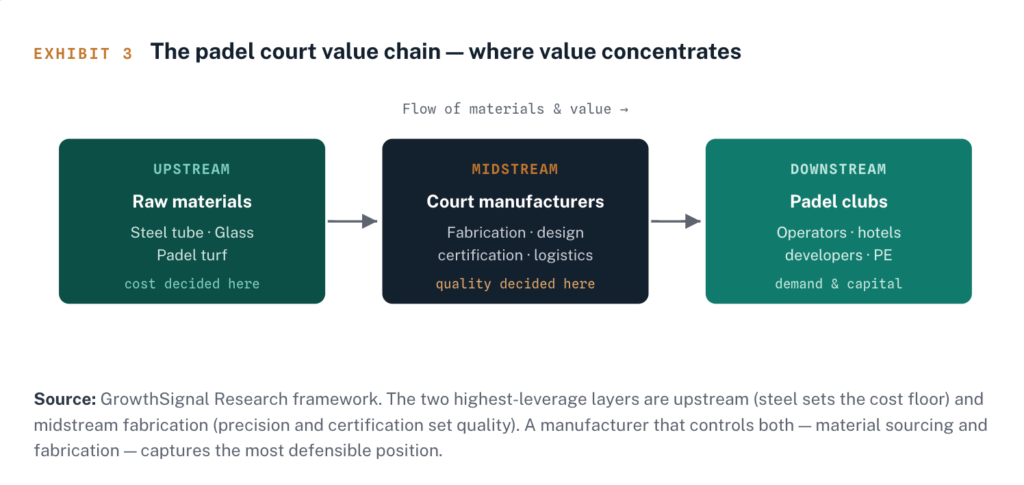
A padel court manufacturer sits in the midstream of a three-layer value chain. Mapping it clarifies where margin, risk and differentiation actually live.
Upstream — raw materials (the decisive layer)
Upstream is where cost and quality are won or lost. Three inputs dominate the bill of materials: steel tube for the structure, tempered glass for the walls, and specialist padel turf for the surface. Steel typically represents the largest single line item, and its price and grade flow directly from the global steel market — which is why a manufacturer’s distance (literal and commercial) from a major steel base is the most important upstream variable. Glass and turf are more specialized but more standardized globally. Because upstream inputs set the entire cost structure, this is the layer we analyze in depth in Section 05.
Midstream — sports-facility & court manufacturers
The midstream is the padel court manufacturer itself, plus the sports-facility engineering firms and construction companies that integrate components into a finished, certifiable system. This layer captures value through fabrication precision (laser cutting, welding, coating), system design, certification and logistics. It is also where the Spain-vs-China split plays out: design-led integrators in Europe, scale-and-cost-led manufacturers in China.
Downstream — padel clubs & operators
Downstream is demand: padel clubs, multi-court complexes, hotels, wellness and hospitality venues, and real-estate developers. In the U.S., downstream is unusually capital-rich — operators are backed by private equity, real-estate funds and celebrity investors — and unusually premium in positioning. That makes downstream buyers sophisticated about lifecycle quality, not just upfront price, and gives certified, consistent manufacturers a real edge.
Padel court material analysis
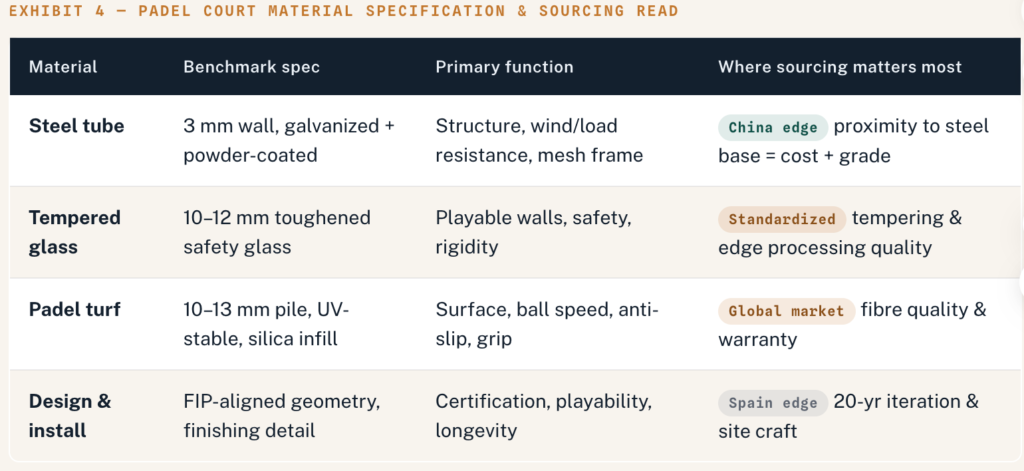
Every padel court reduces to three engineered materials. Their specification — more than any brand logo — determines durability, playing quality, safety and cost.
Steel tube — the structural backbone
Steel is the skeleton of the court: the posts, beams and mesh frames that carry the glass and resist wind load for 15–20 years outdoors. Quality manufacturers specify 3 mm wall-thickness steel tube, chosen for its balance of properties:
- Anti-friction and wear resistance — steel’s surface hardness withstands the constant mechanical stress of mesh tension and ball impact better than lighter alternatives.
- Durability and corrosion resistance — properly galvanized and powder-coated 3 mm tube resists rust and fatigue across seasons and coastal humidity.
- Favorable strength-to-weight — its relatively low specific gravity keeps shipping and handling manageable while preserving rigidity.
For these reasons, 3 mm steel tube has long been the default standard for court-grade sporting structures. The grade and price of that tube come straight from the steel market — the link that gives a China-based manufacturer its structural cost edge.
Glass — safety meets wind reinforcement
The glass walls are what make padel padel: the ball plays off them, so they must be perfectly flat, optically clear and, above all, safe. As a padel-court glass specification matter, the walls use tempered (toughened) safety glass, typically 10–12 mm thick:
- Safety first. Tempering makes the glass several times stronger than annealed glass; if it ever fails, it fractures into small, blunt granules rather than dangerous shards — essential for a surface players slam balls and bodies into.
- Wind reinforcement and rigidity. Thicker tempered panels, correctly anchored to the steel frame, stiffen the whole enclosure against wind load on outdoor courts while keeping ball rebound true and consistent.
- Optical and bounce consistency. Flatness and edge processing (polished, drilled, heat-soaked) determine both clear sightlines for spectators and a uniform, predictable bounce — the playability that distinguishes a good court from a cheap one.
Padel turf — the playing surface
The surface is a purpose-engineered, high-specification artificial turf, distinct from football or landscape grass. Padel turf is anti-slip and abrasion-resistant, typically monofilament or fibrillated fibre at a 10–13 mm pile height, UV-stabilized and dressed with graded silica sand. The sand infill controls speed and bounce; fibre quality determines wear life (commercial courts plan replacement at 5–7 years). Mondo’s federation-approved systems set the premium benchmark here, but the category is globally standardized and competitively supplied.
Expert view — the sourcing thesis
China is the world’s largest steel-producing nation, which hands Chinese padel court manufacturers a substantial advantage in the dominant raw material: steel tube is both cheaper and, on key performance characteristics, equal or better. A manufacturer such as PANO COURT — exercising strict in-house control over raw-material technology, with its factory in Hebei province, China’s largest steel-production base — turns that national resource into a product-level edge in the court system itself.
Spanish manufacturers, meanwhile, hold the advantage in overall court design and installation detail — the finishing, geometry and on-site craft refined over two decades.
The recommendation for U.S. padel clubs: treat these strengths as modular. Procure the padel court system from a Chinese manufacturer for cost-competitive, high-consistency structure and components, and engage a Spanish team for court design, planning and installation. The result is a tournament-grade court at a materially better total cost than a single-source premium import.
Padel court production process analysis
How a padel court factory turns steel coil, glass and yarn into a shippable, certifiable system is where manufacturing capability becomes visible.
Production equipment
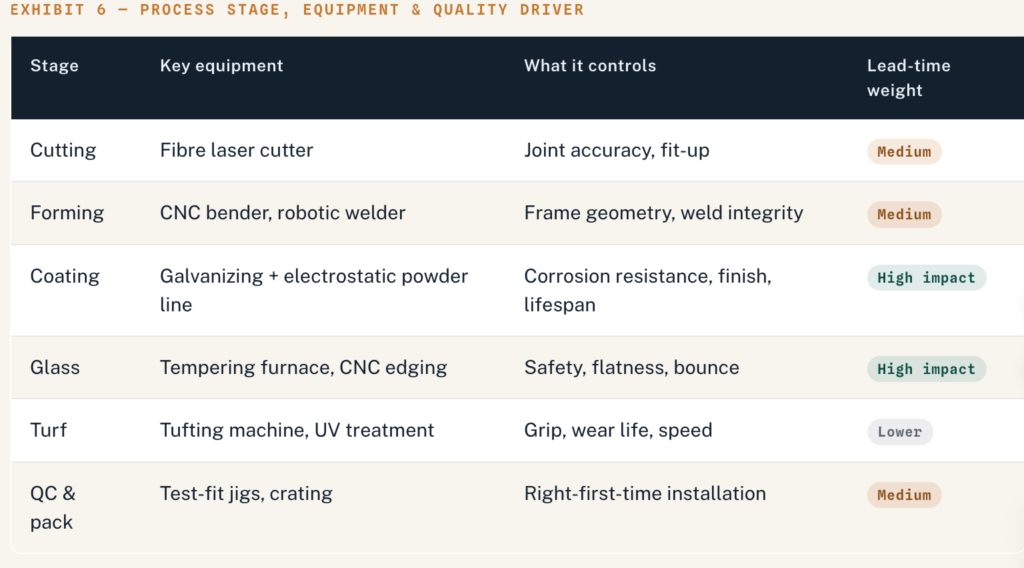
At a high level, the headline equipment is broadly similar across leading manufacturers worldwide — there is no exotic, proprietary machine that one country owns. The representative line includes tube cutting and bending, welding, surface treatment and coating, glass tempering and finishing, and turf tufting. What separates a strong manufacturer from a weak one is process control and consistency, not the existence of the machines.
Key components — laser cutting & coating
Two stations disproportionately determine quality:
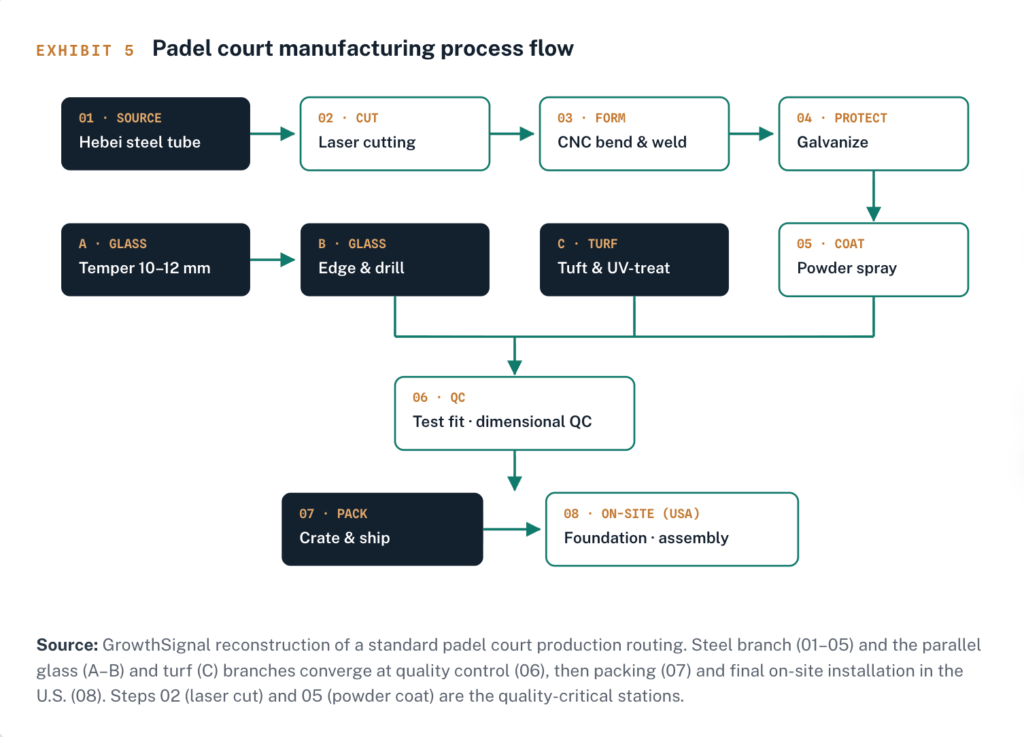
- Laser cutting machines. Precision laser cutting of steel tube and plate sets the dimensional accuracy of every joint. Tight tolerances here mean panels and frames align perfectly on-site — the difference between a fast, clean installation and a frustrating one.
- Coating / electrostatic powder-spraying equipment. After galvanizing, an even electrostatic powder coat is what delivers the long-term corrosion resistance and finish. Coating thickness and uniformity directly govern outdoor lifespan, especially in humid and coastal U.S. markets.
Detail craftsmanship — the production flow
The diagram below reconstructs the end-to-end padel court production process. (Note: the specific process image referenced in the brief did not transmit; this flow is reconstructed from the described steps and standard industry practice — confirm against your factory’s actual routing before publishing.)
Manufacturing capacity
On equipment alone there is little to choose between leading manufacturers. The differentiator is repeatable, high-consistency production at low cost — and here China’s industrial base is decisive. “Cost” is the question no terminal hardware business can avoid: buyers want identical performance at the keenest possible price, and they want that performance reproduced across the tenth and hundredth court exactly as on the first. Chinese manufacturers’ combination of steel-base proximity, automated fabrication and high throughput delivers precisely that price-performance-consistency triangle, which is why so many multi-court and distributor programs source from China.
Key success factors for padel courts in the U.S.
From the supply-chain and demand analysis above, six key success factors (KSFs) separate winning U.S. padel projects — and the manufacturers and installers that serve them — from stalled ones:
- Permitting & noise mitigation. The most under-estimated risk. Ball-on-glass noise and zoning have stretched many U.S. projects from an expected 6–12 months to 24–36 months. Sites, acoustic treatment and indoor enclosure must be planned early.
- Total landed cost, not sticker price. Court systems are one line item among site prep, freight, permits and lighting. The winning sourcing strategy optimizes landed, installed cost and lifecycle — favoring cost-competitive manufacturing plus expert installation.
- Certification & playability. Premium U.S. positioning rewards FIP-aligned geometry, true bounce and tournament credibility. This is where design-led (Spanish) input pays back.
- Durability for the U.S. climate. Coastal humidity and hurricane zones (Florida) demand galvanized, well-coated steel and properly engineered, anchored glass — a coating-and-structure quality test.
- Installation speed & reliability. Prefabricated, test-fitted systems install in 3–5 days versus weeks for ad-hoc builds; right-first-time fit-up (set upstream at the laser-cutting stage) protects the operator’s opening date and revenue.
- Capital efficiency & ROI clarity. With PE, real-estate and franchise capital active, projects that show fast, modelled payback through bookings, memberships and F&B win funding. Lower court capex directly improves the model.
Synthesis
Five of the six KSFs are decided before the first ball is hit — in sourcing, engineering and permitting. The padel court manufacturer’s job is to remove cost and installation risk; the operator’s job is to win on site selection, business model and permitting.
An owner’s & investor’s playbook for building a padel court
The padel court system is only a fraction of the total cost of a padel club. Far more of your outcome is decided by business-model positioning, site selection, foundation design and court layout — because those choices drive everything downstream, including how much you must invest in groundworks and design in the first place.
The U.S. boom is real and capital-backed. Conquer Padel raised a $15M expansion round; Sunrise Padel Capital closed its first fund across nine clubs and launched a second targeting $50M; the Pro Padel League raised a $15M Series A; and sports figures including Nadal, Serena Williams, Beckham and Jeter have backed padel ventures. Padel’s relatively low entry cost and fast ROI through hourly bookings and memberships are exactly what is attracting funds and developers. But capital availability is not the same as project success.
“With a new court opening every two and a half hours worldwide, padel has joined the world’s sporting elite.”— Pablo Carro, Co-Founder & CCO, Playtomic (Global Padel Report)
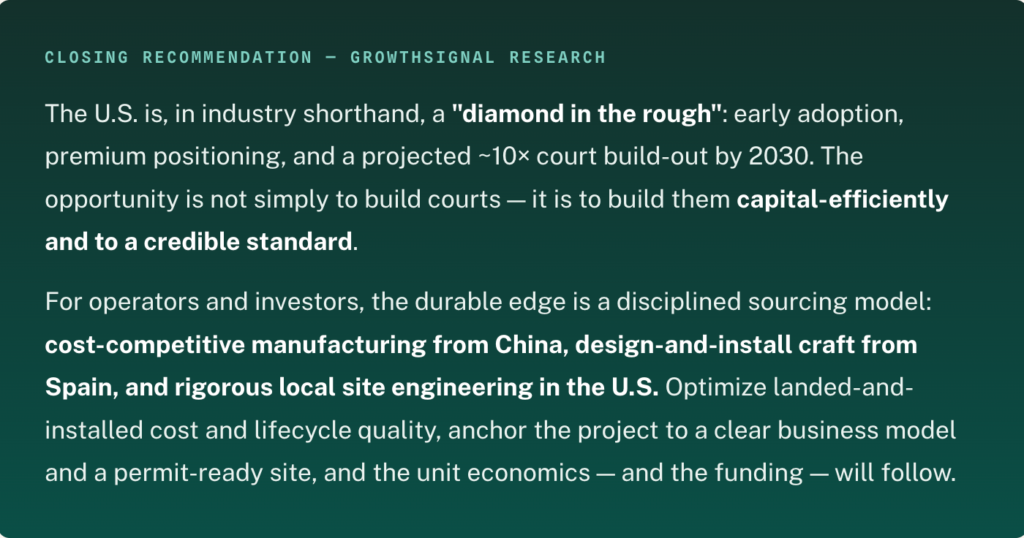
Working through the McKinsey-style “where to play / how to win” lens, four moves should anchor any U.S. padel build:
1 · Define the business model before you buy a court
Is this a high-volume community club, a premium membership venue, or an amenity inside a hotel or residential development? The answer dictates court count, indoor-vs-outdoor mix, finish level and therefore foundation and design spend. The court system follows the model — not the reverse.
2 · Treat site selection and permitting as the critical path
Given 24–36 month permitting risk, prioritize sites with favorable zoning, manageable acoustics and clean access for glass-and-steel delivery. The site decision shapes foundation, drainage and indoor-enclosure cost more than any supplier choice.
3 · Source strategically — split manufacturing and design
Apply the sourcing thesis from Section 05: procure a cost-competitive, high-consistency court system from a Chinese padel court manufacturer (e.g. a Hebei-based factory such as PANO COURT for steel-structure economics and production scale), and engage Spanish design-and-installation expertise for layout, finishing and FIP-grade certification. This delivers tournament-credible quality at a materially better landed cost than single-source premium import — and frees capital for the parts of the club guests actually pay for.
4 · Engineer the foundation and layout for the long run
Foundation design and court layout are where rushed projects fail. Get drainage, slab specification and court spacing right for your climate and business model up front; correcting them later is the most expensive mistake in the build. This is where a strong padel court construction company earns its fee.
FAQ PADEL COURT
What is a padel court manufacturer?
A padel court manufacturer designs and fabricates the steel-and-glass court system — the structure, tempered-glass walls, mesh and surfacing components — that make up a regulation 20×10 m padel court. Manufacturers differ from padel court installers and construction companies, who handle site preparation, foundation work and on-site assembly, and from padel suppliers, who provide materials, kits or components.Are there padel court manufacturers in the US?
There is little high-volume domestic manufacturing in the U.S. today. The market is served by Spanish and European manufacturers (e.g. MejorSet, Padel10, Mondo for turf), Chinese manufacturers (e.g. PANO COURT and other Hebei-based factories) supplying cost-competitive systems, and U.S.-based padel court installers and construction companies that import systems and complete site work, surfacing and assembly.
How much does padel court construction cost in the USA?
Building one padel court in the U.S. typically costs between $24,000 and $65,000 before land and amenities, with most new outdoor courts budgeting around $38,000–$55,000. The steel-and-glass package is the largest line item (roughly $15,000–$25,000), followed by turf, lighting, site preparation, freight and installation. Indoor courts cost 20–40% more than outdoor courts.
Should I buy my padel court system from China or Spain?
A strategic option is to do both: source the court system from a Chinese padel court manufacturer for cost-competitive, high-consistency steel structure and components, and engage a Spanish team for court design, planning and FIP-grade installation. China’s edge is upstream (steel cost and production scale); Spain’s edge is downstream (design and installation detail).
Splitting the two typically yields tournament-grade quality at a better total landed cost.What are padel courts made of?
Three engineered materials: 3 mm galvanized-and-powder-coated steel tube for the structure; 10–12 mm tempered safety glass for the playable walls; and purpose-built anti-slip, UV-stabilized padel turf (10–13 mm pile) dressed with silica sand for the surface.
Methodology & sources
This report synthesizes market data published through Q2 2026 with GrowthSignal Research analysis of the padel court manufacturing value chain. Headline figures and competitive context draw on the following publicly reported sources:
- Playtomic / Strategy& (PwC) — 2026 Global Padel Report (global courts, clubs, players; 34% equipment-market CAGR; U.S. “diamond in the rough”; 2025 U.S. additions).
- EXEC / SGB Media & FIP — U.S. court counts (688 courts, Q2 2025; 31 states; 51.5% YoY club growth) and 2030 projections.
- FIP — padel history (Corcuera, Acapulco 1969; Prince Alfonso de Hohenlohe, Marbella 1974).
- MejorSet, Mondo, Padel10, Portico Sport — manufacturer profiles & certifications.
- BusinessDojo, Networld Sports, Padel One Courts — U.S. padel court construction cost ranges.
- BusinessWire, GlobeNewswire, CNBC, Padel Business Magazine — U.S. padel investment activity (Conquer Padel, Sunrise Padel Capital, Pro Padel League).
Prepared by GrowthSignal Industry Research, June 2026. Cost, court-count and projection figures are drawn from third-party reports and are indicative, not guarantees; verify supplier quotations and local permitting before committing capital. The padel court production flow is a reconstruction from described steps and standard industry practice. This document is market analysis, not investment, legal or engineering advice.