
Panoramic Padel Court Manufacturer
Factory-direct panoramic padel court from China. Built to order in 15–20 days. 5-year structure warranty
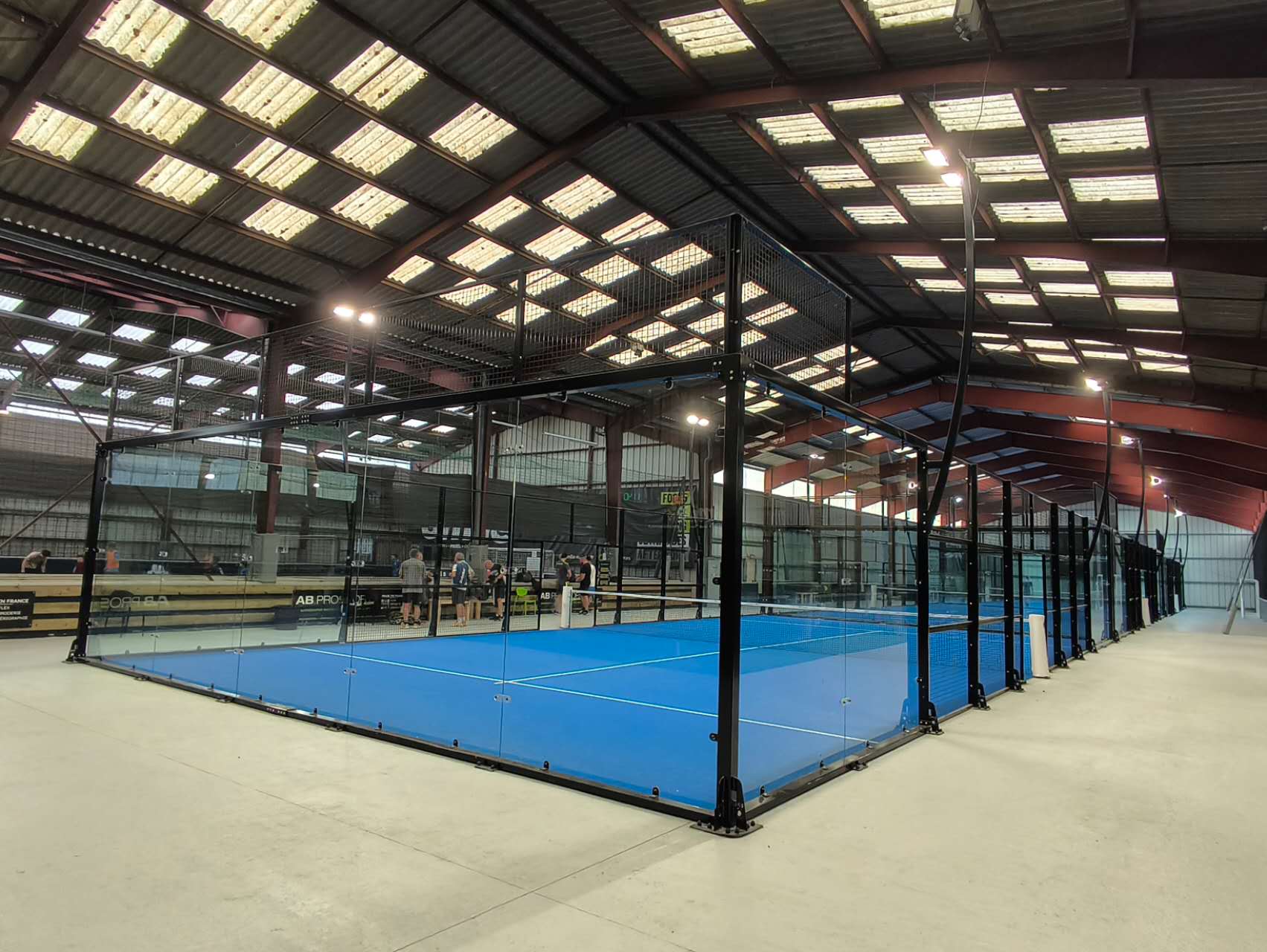
Panoramic padel court ourselves
Full in-house production from steel cutting to glass and turf. That’s how we control quality on every part and pass factory-direct pricing straight to you — no middlemen, no markup.
How Is the Panoramic Padel Court Steel Protected Against Corrosion?
PanoCourt offers 3 anti-corrosion routes for the panoramic padel court steel structure.
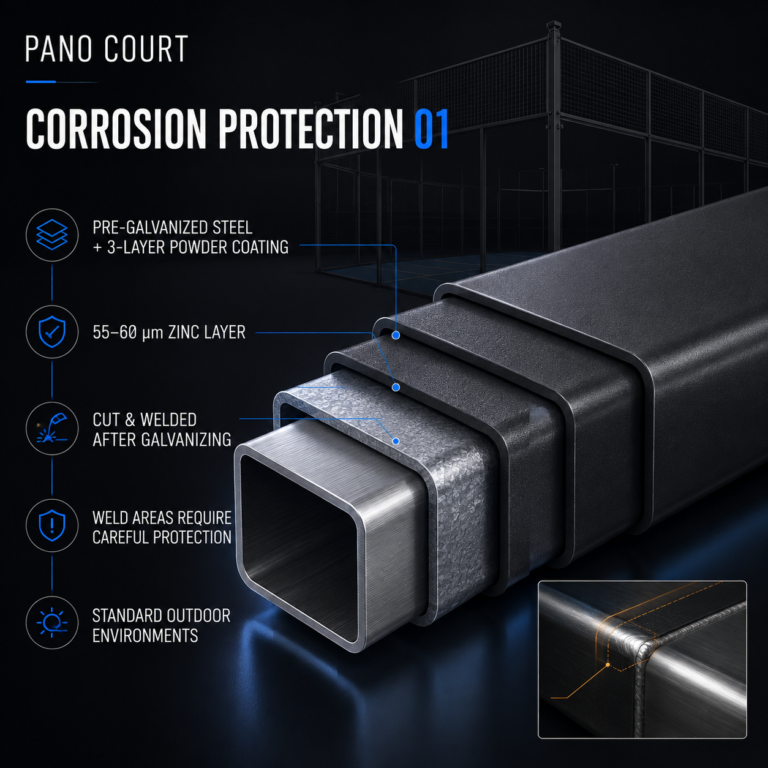
Route 1 – Pre-Galvanized Tube + 3-Layer Powder Coating
Pre-galvanized steel + 3-layer powder coating
55–60 µm zinc layer (mill certificate on request)
Cut and welded after galvanizing – weld areas protected by the powder system
Best fit: indoor halls, dry inland sites, budget-led outdoor projects
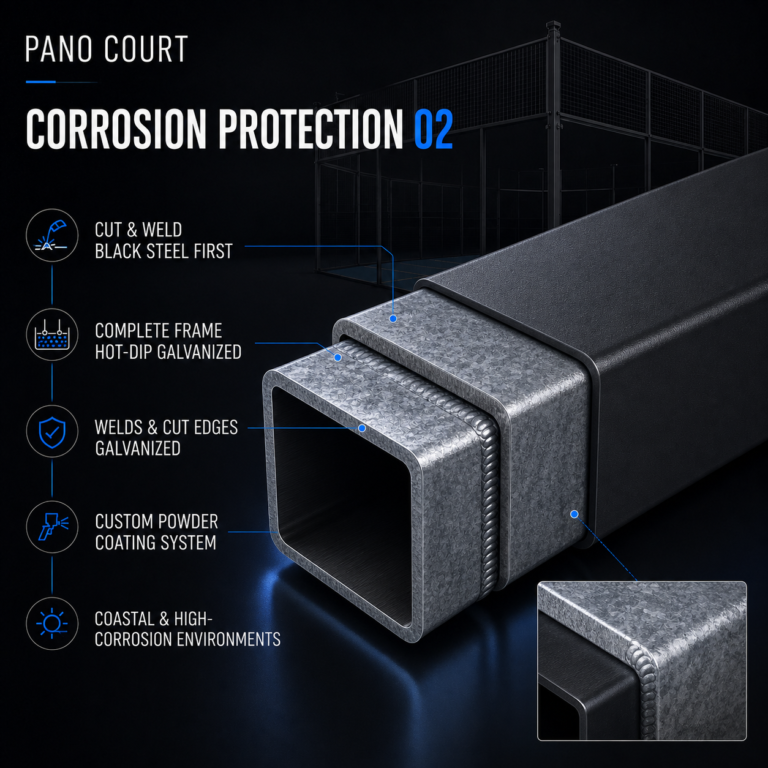
Route 2 – Weld First, Then Hot-Dip Galvanize the Whole Structure
Cut and weld black steel first, then complete frame hot-dip galvanized
Welds and cut edges galvanized – no unprotected seam
Custom powder-coating system on top, any RAL colour
Best fit: outdoor, coastal and high-corrosion environments
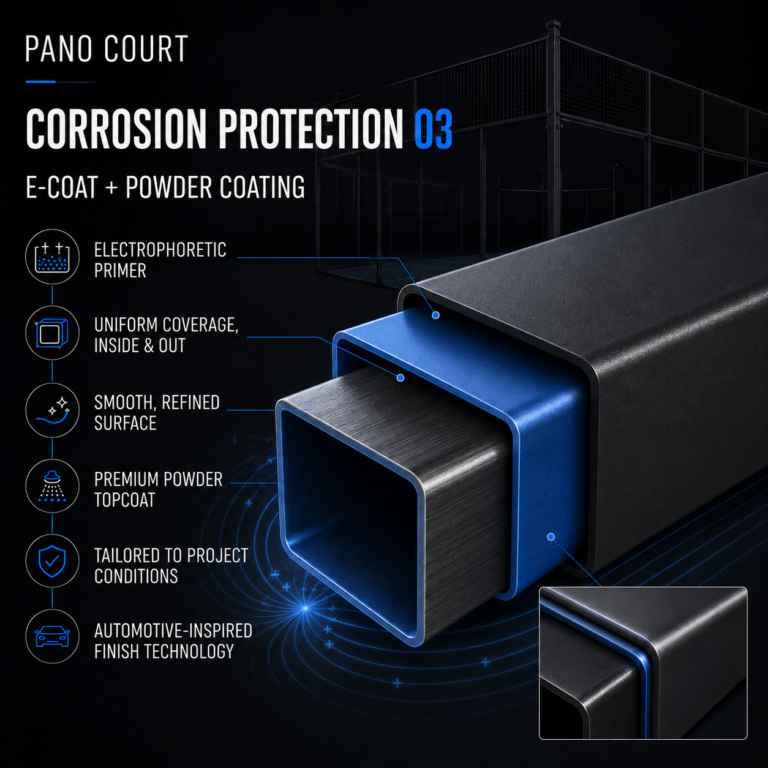
Route 3 – Electrophoretic (E-Coat) Primer + Powder Top Coat
Electrophoretic primer, uniform coverage inside and out
Smooth, refined surface – automotive-inspired finish technology
Premium powder top coat, tailored to project conditions
Best fit: hotels, showcase clubs, design-led venues
What Wind Load Can a Panoramic Padel Court Withstand?
The PanoCourt panoramic padel court is tested against a design wind pressure of 0.68 kN/m², calculated with the GB 50009-2012 0.68 kN/m² corresponds to roughly a 33 m/s (about 120 km/h)
Design wind pressure 0.68 kN/m² (Q/PANO 01S-2019, clause 5.4.3)
Glass ear plates tested at 6 × 680 N, held 60 seconds
Column test 1,500 N at 2 m; top beam 1,500 N at mid-span
Site-specific W0 accepted from the buyer's engineer; structure re-checked before production
Installed tolerance: straightness ≤ 50 mm, verticality ≤ 1/100
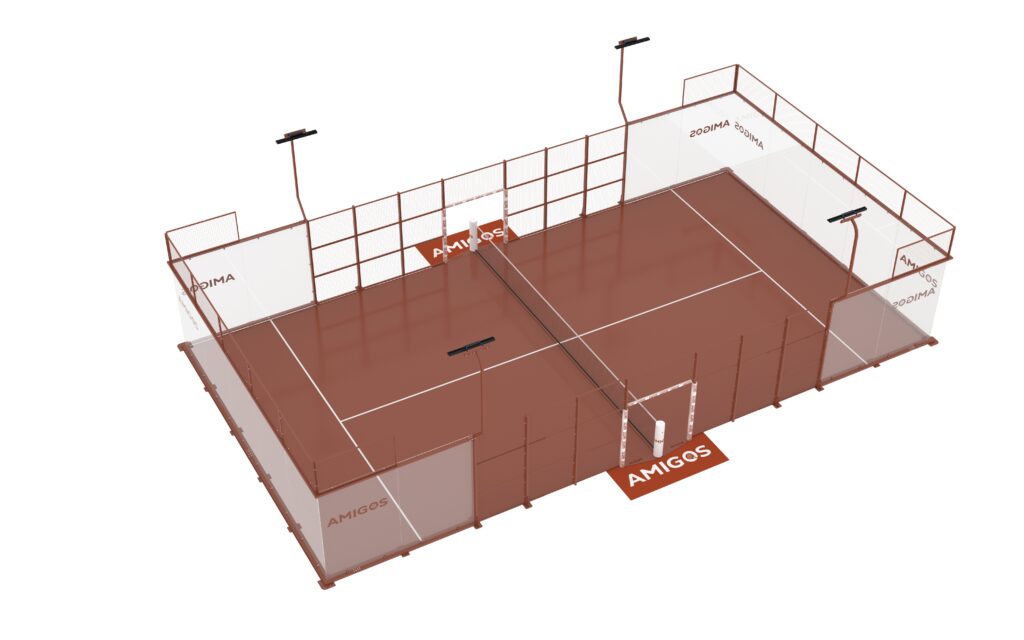
Outdoor panoramic padel court — structure explorer
Click any member to see its section and what it carries.
20 m × 10 m doubles court · glass 3 m · mesh to 4 m
Select a member
Tap a part of the frame, or a chip above.
Each member is listed with the section and quantity from a production specification for one 20 × 10 m panoramic court.
- Wind and impact load on the glass
- Into the upper and lower crossbeams
- Bending and shear down the posts
- Tension and shear at the base plate anchors
- Resisted by the concrete slab
Mechanical expansion anchor
Holds by friction and keying. Loads immediately, can be released, re-levelled and reused.
Bonded chemical anchor
Holds by adhesion along the whole rod. Higher tension, no expansion force — and effectively permanent.
| Consideration | Expansion anchor | Chemical anchor |
|---|---|---|
| Tension capacity | Good | Higher for the same size |
| Thin slab | Expansion force can spall | Tolerant |
| Close to a slab edge | Needs generous edge distance | Performs better |
| Ready to load | Immediately | After resin cure, slower when cold |
| Hole preparation | Forgiving | Critical — dust causes bond failure |
| Removable later | Yes | No |
| Use it for | Event, rental and relocatable courts | Permanent clubs, coastal and high-wind sites |
Anchor selection depends on the concrete, not the steel. The same court on two different slabs can need two different anchor solutions — confirm the schedule with your local qualified engineer.
Structure explorer · PanoCourt engineering
Customize your Panoramic Padel Court
What Are the Panoramic Padel Court Dimensions and Specifications?
| Item | Specification | Status | Reference |
|---|---|---|---|
| Playing area | 20 × 10 m, tolerance ±0.5 % (T/WQTB allows ±0.3 %) | Standard | Q/PANO 4.3.1.1; T/WQTB 4.2.4 |
| Lines | 50 mm wide, white, service line 6.95 m from net, centre line +0.20 m | Standard | Q/PANO 4.3.1.2–4.3.1.3 |
| Back walls | 4 m high, 12 mm tempered glass full height | Standard | Q/PANO 4.3.1.4 |
| Side walls | 3 m glass at both ends, 4 m mesh centre, 12 m symmetric to net | Standard | T/WQTB 4.5.3.2 |
| Steel | Q235B tube, wall 2.5 mm indoor / 3 mm outdoor / 4 mm coastal | Standard by model | Mill test report TST2024S00056 |
| Anti-corrosion | Route 1 / Route 2 / Route 3 | Optional | Per site corrosion class |
| Glass | 12 mm tempered, polished edges, 18 panels approx. 108 m²; 10 mm on request | Standard | GB 15763.2-2005 |
| Mesh | 50 × 50 mm, 4 mm wire, welded, hot-dip galvanized, mesh faces inward | Standard | Q/PANO 4.3.4.1; T/WQTB 4.5.5 |
| Net and posts | 10 m net, 0.88 m centre, 0.92 m ends, posts 1.05 m, white band 50–63 mm | Standard | Q/PANO 4.3.3 |
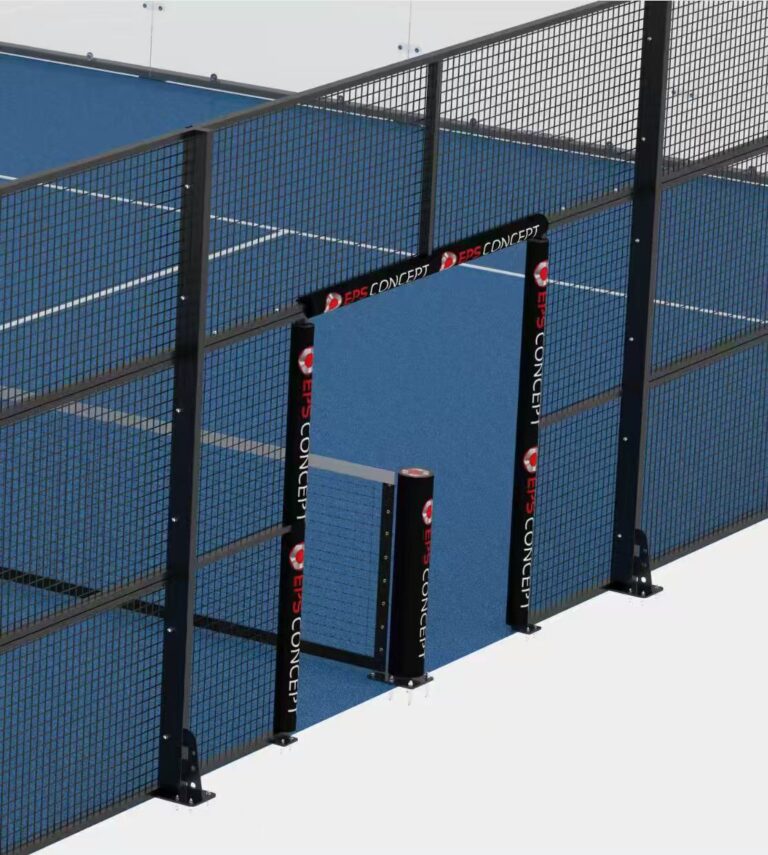
| Entrance | Two centre doors, 0.72–1.00 m wide × 2.00–2.20 m high | Standard | Q/PANO 4.3.5 |
| Turf | 12 mm monofilament + curled yarn, Dtex 9,500, 63,000 stitches/m², sand 8–10 kg/m², blue or green | Standard package | GB/T 20394 |
| Surface performance | Ball rebound ≥ 80 %, shock absorption ≥ 20 %, slip resistance 65–100 BPN | Project-confirmed | T/WQTB Table 1 |
| Lighting | 8 × 200 W or 4 × 400 W LED, anti-glare, ≥ 6 m above ground; halo option 55 fixtures | Optional | Q/PANO 4.3.6 |
| Clear height | ≥ 6 m; ≥ 8 m for competition venues | Project-confirmed | Q/PANO 4.3.2; T/WQTB 4.4.1 |
| Safety zone | ≥ 2 m each side; 20 ± 5 mm padding on door frames and net posts | Project-confirmed | T/WQTB 4.8 |
| Fasteners | 304/316 stainless steel | Standard | PanoCourt spec |
| Slope and flatness | ≤ 0.5 % outdoor, ≤ 0.3 % indoor; ≤ 3 mm under a 2 m straightedge | Project-confirmed | T/WQTB 4.3.3–4.3.4 |
| Warranty | 5 years structure and coating, 3 years turf | Standard | PanoCourt warranty terms |
Evidence: T/WQTB 1002-2021 “Technical requirements and test methods for the padel courts”, China Tennis Association, effective 6 June 2021; Q/PANO 01S-2019. Both PDFs on request. Dimensions match the FIP Rules of Padel.
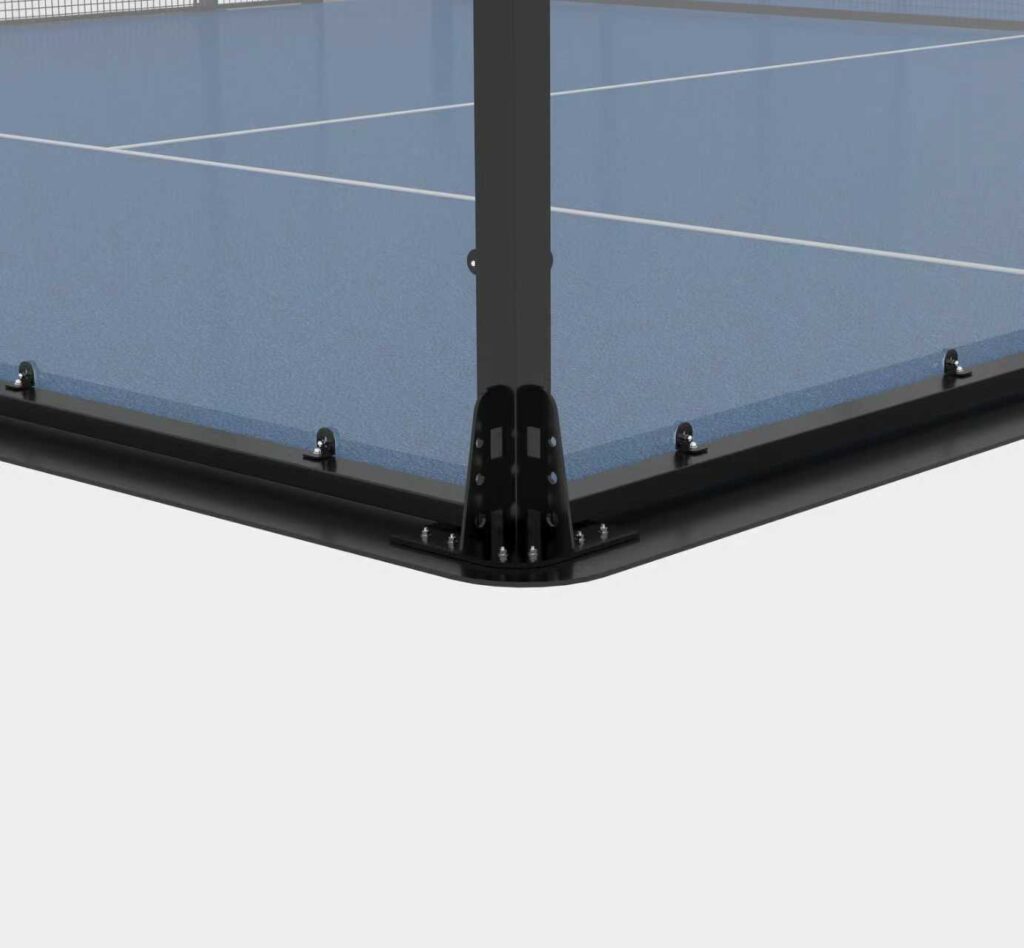
Key Benefits
Every steel tube on a Pano Court is hot-dip galvanized first, then sealed with a double-layer electrostatic powder coating.
3 layers Corrosion barrier
Hot-Dip Galvanizing process
2× Coat Powder coat finish
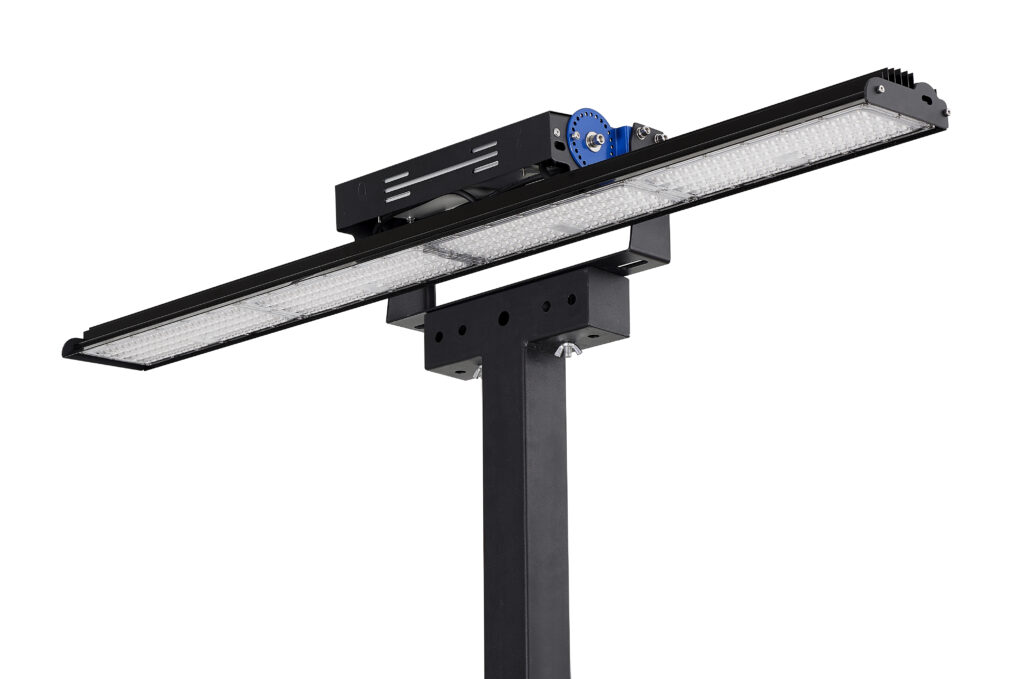
Key Benefits
Padel is a fast, vertical-look sport played in a 20 × 10m box. Generic stadium fixtures waste light outside the court and create the glare players hate.
4 × 400W 1,600W total output
Anti-Glare Low-UGR housing
Patented Optical lens design
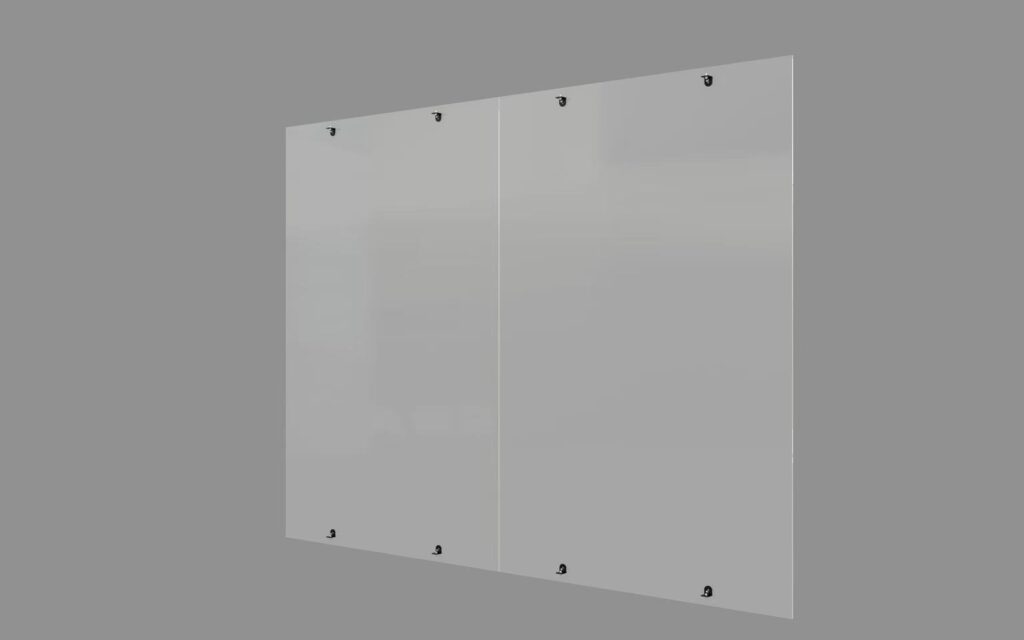
Key Benefits
Tempered glass is up to 5× stronger than ordinary annealed glass and, in the rare event of breakage, shatters into harmless granular pieces rather than sharp shards — protecting players, ball kids and spectators.
12 mm Max FIP thickness
5× Strong vs annealed glass
18 panels 108m² per court
Where Has the PanoCourt Panoramic Padel Court Been Installed?
RESORT · COASTAL
Belitung Island, Indonesia
Resort project · 3 custom terracotta panoramic courts
1 × 40GP, FOB Tianjin
Coastal coating route
Photo: add client-approved image
MOBILE · OUTDOOR
United Kingdom
Movable panoramic court on elevated floor system
Relocating operator
Route 2 coating
Photo: add client-approved image
CLUB · INLAND
Central Europe
4-court inland club
1 × 40HQ, DAP delivery
Route 2 coating, 3 mm model
Photo: add client-approved image
Panoramic Padel Court FAQ
How much does a panoramic padel court weigh and what is its packed volume?
One panoramic padel court set weighs about 6 tonnes packed, including steel, 18 glass panels, mesh, net and fasteners. Packed volume depends on the model and whether turf and lighting are in the same shipment; the packing list issued with your order states the exact CBM. As a planning figure, one set takes half of a 20GP or a quarter of a 40GP container.
How many panoramic padel courts fit in a 20GP and a 40GP container?
A 20GP container carries 2 complete panoramic padel court sets and a 40GP carries 4 sets. Ordering in multiples of 2 or 4 gives the lowest ocean freight per court. Turf rolls, sand and LED fixtures can share the container if space allows; canopies usually need their own container.
What wind load is normal for a panoramic padel court?
A design wind pressure between 0.5 and 0.7 kN/m² covers most inland and urban sites; PanoCourt’s test basis is 0.68 kN/m² (Q/PANO 01S-2019). Coastal, cyclone and typhoon regions can require 0.9–1.5 kN/m² or more. The local engineer sets the site value, and the frame, ear plates and anchors are re-checked against it before production.
How can the wind-load capacity of a panoramic padel court be increased?
Five measures, usually combined: increase the tube wall from 3 mm to 4 mm, move to a larger post profile, add reinforcing ribs at the glass load line, use more or larger anchor bolts with a ring-beam foundation, and reduce the free span of the glass with an additional intermediate post. A closed roof or windbreak also reduces the direct load on the glass. PanoCourt prepares the revised structure; the local engineer signs the calculation.
What is the difference between a panoramic and a full panoramic padel court?
A panoramic padel court keeps a corner column and slim intermediate posts on the 4 m glass back wall. A full panoramic padel court removes the corner column so the glass meets glass at the corner. The full version gives better visibility and costs more because the corner load moves into the glass fixings and the adjacent posts.
Is 12 mm glass required for a panoramic padel court?
12 mm heat-tempered safety glass is PanoCourt’s standard and is the thickness both Chinese padel standards reference. 10 mm is acceptable for some indoor projects with low wind load. Laminated glass is available on request. The final thickness is confirmed by the site wind pressure and local building code, not by a fixed rule.
Which anti-corrosion route should I choose?
Route 1 (pre-galvanized tube plus 3-layer powder) for indoor halls and dry inland sites. Route 2 (weld first, then hot-dip galvanize, then powder) for every outdoor and coastal site, with zinc thickness increased for C4–C5. Route 3 (e-coat plus powder) when surface finish is the priority, usually combined with Route 2 zinc for outdoor use.
What foundation does a panoramic padel court need?
A reinforced concrete slab or ring-beam foundation, flat within 3 mm under a 2 m straightedge, sloped no more than 0.5 % outdoors, with drainage outside the 2 m safety zone. PanoCourt supplies the anchor layout and loads; slab thickness, concrete grade and reinforcement are designed by the local engineer for the site soil and wind region.
How long does production and delivery take?
Production takes 25–30 days from the day our finance team confirms the deposit. Add ocean transit from Tianjin to your port, customs clearance and inland delivery. Installation of one court on a prepared slab takes a 4-person crew about 2–3 days.
Which certificates and test reports come with the panoramic padel court?
Steel mill test report with zinc coating mass and mechanical properties; per-batch coating thickness readings; the Q/PANO 01S-2019 enterprise safety standard with wind and stability test methods; UDEM attestation for the welded mesh to EN 10218-1 and EN 10223-4; and an ECM technical-file attestation reviewed against EN 1090-1 covering models PA-PC-001/002/003. The ECM document is a voluntary technical-documentation review, not a CE certificate, and it does not replace a local structural certificate.
Can the panoramic padel court be moved?
Yes. Combined with the PA-C01 steel base-plate system the court stands without anchors in concrete and can be installed or dismantled by a 4-person crew in 4–6 hours. See the mobile padel court page.
What is the minimum order and can colours be customised?
One court set. Powder-coat colour is any RAL shade; terracotta, black, anthracite and white are the most ordered. Turf is available in blue or green as standard, other colours on request.
Let's Discuss your Padel Court project!
Whether you’re an indoor pickleball court, outdoor, a homeowner or a pickleball installer, we can meet your custom pickleball needs

Build Your Next Padel Court With a 16-Year Source Factory
Services
Quick Links
Get In Touch
Maoyanbao Town, Feixiang District, Handan City, Hebei Province