
Here is the conclusion up front: when choosing padel turf for a commercial club, no single parameter is “the higher, the better.” The right padel turf decision balances your club’s usage intensity, your local climate, and your maintenance capacity against six technical variables — yarn technology, pile height, stitch density, Dtex, backing construction, and sand infill.
A turf that wins a spec-sheet comparison can still lose money on court if it flattens under 12 hours of daily play, overheats in your climate, or demands maintenance hours your staff cannot deliver. As a padel court manufacturer and supplier delivering complete courts and turf systems to clubs worldwide, we wrote this guide for one specific reader: the commercial club investor whose courts will run 10–14 hours a day, every day.
Everything below is based on the parameters that actually appear on turf specification labels, so you can use this article as a checklist when comparing quotations from any padel court supplier.
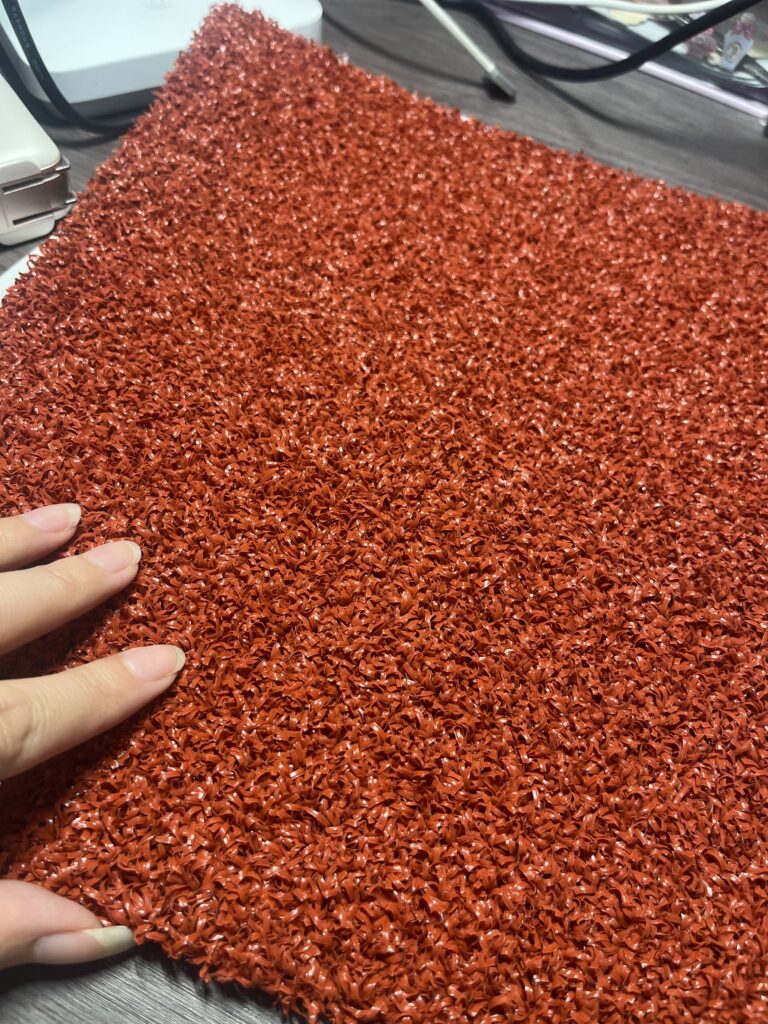
What Does This Padel Turf Guide Cover?
This padel turf buying guide answers the ten questions every commercial club investor should work through, in order:
- Yarn technology — and what Mondo turf teaches us
- The right pile height for commercial padel turf
- How stitch density drives lifespan
- What Dtex means — and why higher is not always better
- Sand infill: type, grain size and quantity
- Backing and coating requirements
- Maintaining padel turf at 10–14 hours of daily play
- Matching padel turf to your climate
- Purchase price vs lifetime padel turf cost
- The PanoCourt Commercial Grade Turf recommendation
What Yarn Technology Should Your Padel Turf Use — And What Can We Learn from Mondo Turf?
Padel turf yarn comes in three structures: fibrillated (split-film), monofilament, and hybrid (monofilament with a curled support yarn). Fibrillated turf — the technology behind Mondo’s professional surfaces — delivers the classic slow, sliding padel feel. Monofilament and hybrid constructions trade a little of that feel for significantly better wear resistance, which is why they dominate high-traffic commercial installations.
Key facts:
- Fibrillated yarn is an extruded polyethylene film mechanically split into a net-like structure; the split fibers trap sand extremely well and produce the slow ball speed used on the professional tour.
- Mondo turf is the reference point here: FIP-approved fibrillated surfaces engineered for tournament-grade consistency and broadcast appearance, as specified in the FIP Rules of Padel.
- Monofilament yarn is extruded as individual solid fibers; each fiber resists splitting, recovers upright faster, and wears 30–50% longer under equivalent foot traffic.
- Hybrid padel turf adds a curled root-zone yarn beneath straight monofilaments; the curl locks sand in place and reduces infill migration.
Deep insight — why Mondo-style fibrillated turf is not automatically the right commercial choice. The same split-film structure that makes fibrillated turf play beautifully is also its weakness in a commercial setting. Under intensive use, the pre-split network continues to fibrillate: fibers fray, the surface “wools up,” and playing characteristics drift.
This is acceptable — even intended — in professional venues, where surfaces are professionally groomed and replaced on short cycles regardless of condition. It is a different calculation for a club amortizing turf over 5–7 years. Fibrillated turf also carries a meaningful price premium when purchased from European brands, and it demands the most frequent brushing schedule of any yarn type to keep the sand distributed through the split fibers.
Real-world insight: the pattern we see across commercial projects is consistent. Clubs positioned as tournament venues chose fibrillated turf and budgeted for its grooming and replacement cycle. Clubs selling court hours to members chose monofilament or hybrid padel turf and prioritized consistency of playing feel across years two through six — because a member who books at 7am and again at 9pm judges your club on whether the court plays the same way it did last season, not on whether it matches the tour surface.
What Pile Height Is Right for Commercial Padel Turf?
For a commercial club, 12mm pile height is the sweet spot; the practical range for padel turf is 10–14mm. Below 10mm, ball speed rises sharply and the surface offers little cushioning for joints during long sessions. Above 14mm, the game slows to the point where recreational members complain, and infill requirements rise.
Key facts:
- 10mm: fast game, minimal infill, harder underfoot — suited to entry-level or multi-use courts.
- 12mm: the commercial padel turf standard, and the minimum height generally required for federation-approved surfaces; balanced ball speed, comfortable footing, stable sand retention.
- 14mm: slower, softer play; used where comfort is prioritized over pace, at the cost of more sand and more brushing.
Deep insight: pile height interacts directly with infill depth. The sand should fill roughly two-thirds of the pile, leaving 3–4mm of free fiber above the sand line. On a 12mm padel turf that means an 8mm sand bed — enough mass to anchor the carpet and control ball behavior, while the exposed fiber tips protect the ball and give players their slide.
Choose 10mm and you are working with only ~6mm of sand, which migrates faster under pivoting feet near the glass walls; choose 14mm and you carry 20–30% more sand that must be redistributed every week.
Real-world insight: if your club will host coaching programs and seniors’ sessions alongside competitive play, 12mm serves every group. We only recommend deviating when the court has a defined single purpose.
How Does Stitch Density Affect Padel Turf Performance and Lifespan?
Stitch density — the number of yarn tufts per square meter — is the single best predictor of how a padel turf will look and play in year four. For commercial clubs running 10–14 hours daily, specify at least 40,000 stitches/m²; premium commercial padel turf reaches 60,000+ stitches/m².
Key facts:
- Density is calculated from stitch rate × gauge: for example, 220 stitches per meter on a 3/16-inch gauge yields roughly 46,200 stitches/m².
- Below 35,000 stitches/m², high-wear zones (service boxes, the net line, the back-glass corners) develop visible “sand patches” within 18–24 months of commercial use.
- Higher density distributes player load across more fibers, so each fiber bends less and recovers better — this is why density, not fiber toughness alone, determines flattening resistance.
- Denser padel turf holds its infill more evenly, which keeps ball bounce consistent across the whole 200 m² playing surface.
Deep insight: density is also the most common place where low-cost quotations save money invisibly. Two turfs can share the same pile height, color and yarn type while differing by 20,000 stitches/m² — a difference you cannot see in photographs but will absolutely see in year three.
Always ask for stitch rate and gauge separately, calculate the density yourself, and write the figure into your purchase contract. Density and fiber weight are the two parameters that are hardest to fake at goods inspection.
Real-world insight: when we audit worn-out courts for replacement projects, premature failure traces back to insufficient density more often than to any other single specification.
What Does Dtex Mean in Padel Turf — And Is Higher Always Better?
Dtex measures yarn thickness: the weight in grams of 10,000 meters of fiber. For commercial padel turf, look for 6,600–9,500 Dtex. Thicker yarn resists splitting, abrasion and UV degradation better — but Dtex is exactly the parameter where “higher is better” thinking misleads buyers, because Dtex only creates durability when paired with adequate density.
Key facts:
- Under 6,000 Dtex: a warning sign on any commercial quotation; thin yarn flattens and wears quickly under daily multi-hour use.
- 6,600–8,800 Dtex: the mainstream commercial range, balancing durability with a natural playing feel.
- 9,000+ Dtex: heavy-duty yarn for the highest-traffic installations — the range we specify for clubs running 12+ hour days.
- A high-Dtex yarn tufted at low density produces a coarse, sparse surface that plays poorly and still exposes the backing to wear; the two parameters must rise together.
Deep insight: Dtex also carries a hidden verification role. Yarn weight per square meter should equal roughly (Dtex × stitches/m² × number of plies) ÷ 10,000,000. If a supplier claims 9,500 Dtex and 60,000+ stitches/m² but quotes a pile weight below 1,000 g/m², the numbers do not reconcile and one of the claims is inflated.
Running this arithmetic on every quotation takes thirty seconds and filters out a surprising share of spec-sheet exaggeration — the same verification mindset we recommend in our padel court supplier buyer’s guide.
Real-world insight: ask for a physical A4 sample and weigh it. Sample weight, measured against the labeled specification, is the fastest pre-contract quality check available to a buyer comparing padel turf offers remotely.
How Much Sand Infill Does Your Padel Turf Need?
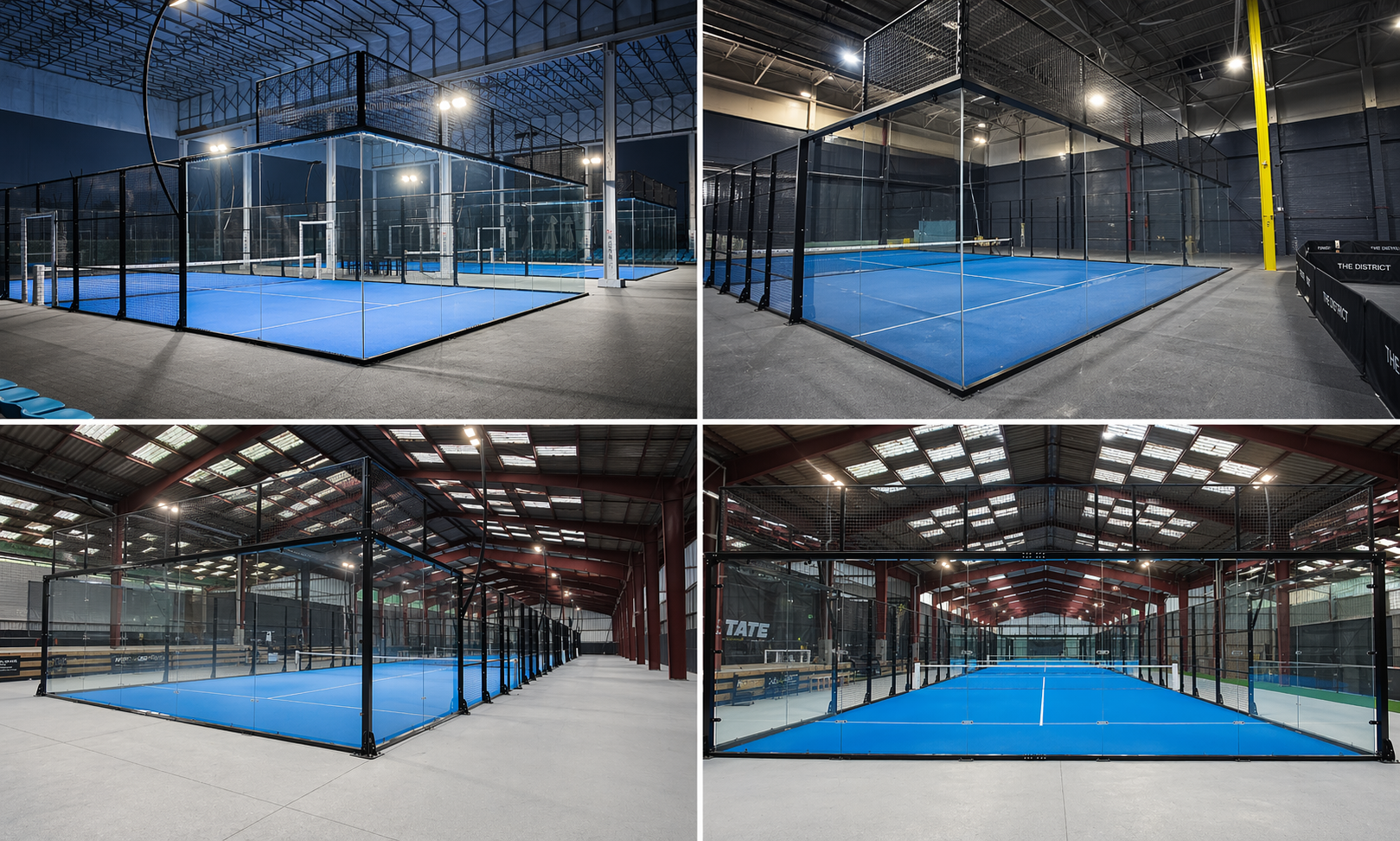
Commercial padel turf needs 8–12 kg/m² of rounded, washed, dried silica sand with a grain size of 0.3–0.8mm — with the exact quantity determined by pile height and density, not by a universal number. Denser, shorter turf needs less sand; taller, more open turf needs more.
Key facts:
- Rounded (spherical) grains are mandatory: angular sand acts like an abrasive inside the pile and measurably accelerates fiber wear.
- The sand must be washed and kiln-dried; damp or dusty sand compacts, drains poorly, and hardens the surface.
- On a 12mm, 60,000+ stitches/m² padel turf, 8–10 kg/m² fills the pile to the correct two-thirds level; a 200 m² court therefore takes roughly 1.6–2.0 tonnes of sand.
- Sand does three jobs at once: it ballasts the carpet, it regulates ball speed and bounce, and it supports the fibers upright.
Deep insight: infill is a running cost, not a one-time cost. Foot traffic pushes sand from the center of the court toward the perimeter, and every kilogram that migrates changes ball behavior in the depleted zone.
High-density hybrid padel turf with a curled root yarn holds sand dramatically better — this is the quiet economic argument for paying more per square meter up front, because it converts a weekly redistribution task into a fortnightly one across a multi-court facility.
Real-world insight: budget for a 5–10% sand top-up annually on outdoor courts (wind and drainage carry fines away) and specify the sand source in your installation contract. Local sand that “looks the same” but fails the roundness spec is one of the most common installation shortcuts, and it silently halves turf life.
What Backing and Coating Should Commercial Padel Turf Have?
Specify a double-layer polypropylene (PP) woven backing with a polyurethane (PU) secondary coating and factory-punched drainage holes. The backing is invisible after installation, yet it determines whether your padel turf survives climate stress — because turf almost never fails from the fiber side first; it fails when the tuft bind lets go.
Key facts:
- Double PP backing provides the dimensional stability that keeps seams tight and court lines straight across temperature swings.
- PU coating outperforms SBR latex in hydrolysis resistance — critical in hot, humid, or coastal markets — and maintains tuft-lock strength for longer.
- Look for tuft-lock (tuft withdrawal force) of 40+ Newtons on test reports; this is the number that predicts fiber loss under pivoting feet.
- Drainage perforation should support at least 60 L/min/m² so outdoor courts return to play quickly after rain.
Deep insight: latex backing carries a lower factory cost, which is why it appears on budget quotations. In dry, temperate climates it can perform acceptably. In Southeast Asia, the Gulf, coastal Latin America or the southern United States, latex hydrolysis is a known failure mode: the backing embrittles, tufts release, and the turf sheds fiber years before the yarn itself is worn.
Since the coating adds only a small percentage to total padel court cost, downgrading it to save money is a poor trade for any outdoor commercial project.
Real-world insight: when reviewing a quotation, request the backing composition in writing. “PU-coated” should appear on the specification and the contract — not just in the sales conversation.
How Do You Maintain Padel Turf Running 10–14 Hours of Daily Play?
A commercial padel turf under 10–14 hours of daily use needs drag-brushing to redistribute sand every 1–2 weeks, a monthly deep decompaction of high-wear zones, and quarterly professional grooming with sand top-up as required. Maintenance is not optional care — it is the variable that decides whether the same turf lasts four years or seven.
Key facts:
- Fibrillated turf requires roughly double the brushing frequency of monofilament/hybrid padel turf to prevent matting of the split fibers.
- Weekly tasks: drag-brush against the pile direction, clear leaves and debris, check sand level at the service boxes and net line.
- Monthly tasks: decompact the perimeter zones near the glass, inspect seams and line inlays, verify drainage outlets are clear.
- Neglected sand compaction is the leading cause of both surface hardening (player complaints, joint stress) and accelerated fiber wear.
Maintenance comparison — annual effort per court at commercial intensity:
| Yarn type | Brushing frequency | Est. annual maintenance hours | Typical commercial lifespan |
|---|---|---|---|
| Fibrillated (Mondo-style) | Weekly or more | 50–70 hours | 3–5 years |
| Monofilament | Every 1–2 weeks | 30–45 hours | 5–7 years |
| Hybrid (mono + curled) | Every 2 weeks | 25–40 hours | 5–8 years |
Real-world insight: across a six-court facility, the labor difference between fibrillated and hybrid turf is 150–250 staff hours per year. Priced at local wages, that difference alone can approach the cost of re-turfing one court over the surface’s lifetime — which is why maintenance load belongs in your purchase decision, not just your operations manual.
Which Padel Turf Works Best in Your Climate?
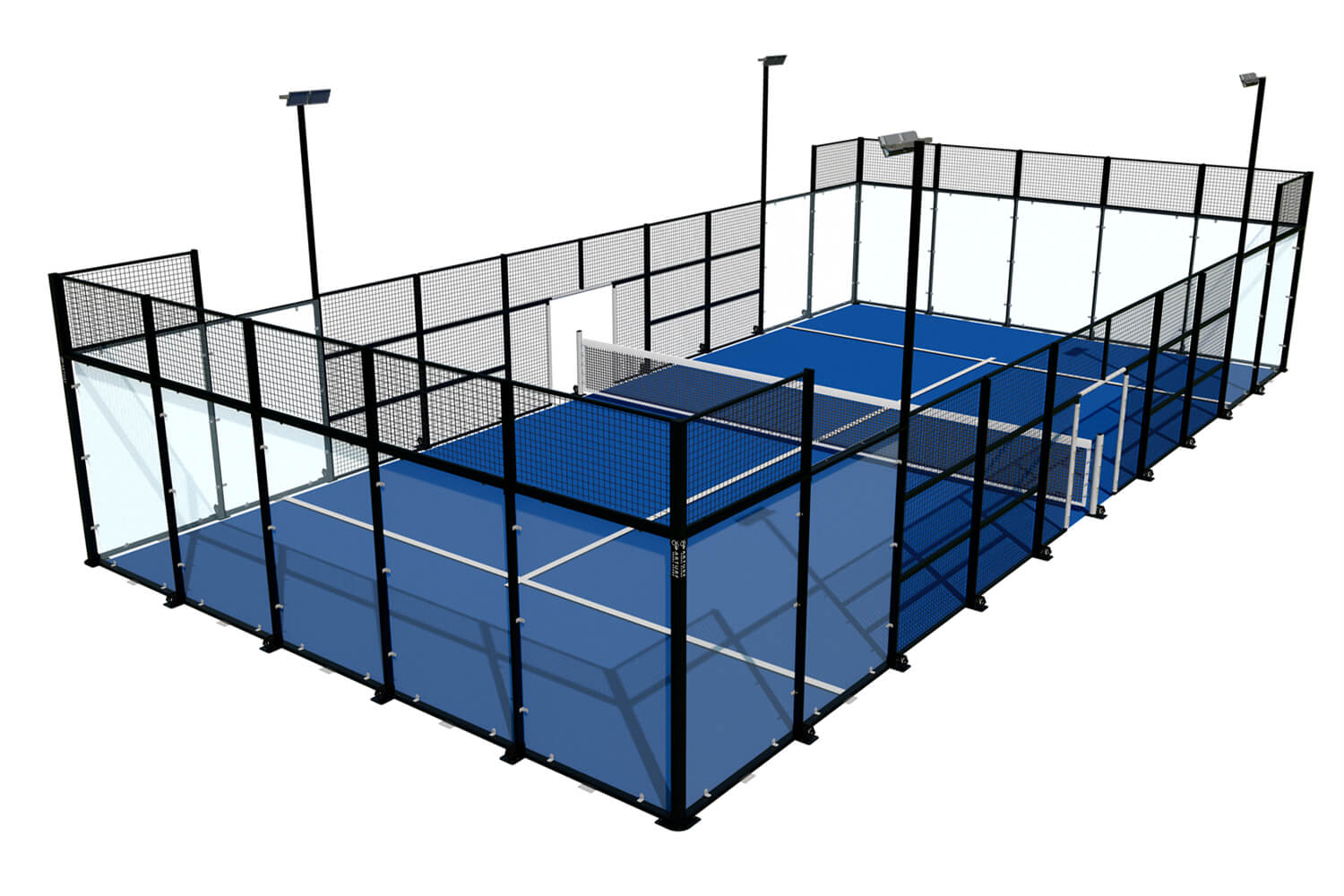
Climate should change your padel turf specification, not just your court structure. Hot and humid regions need PU backing and careful color selection; cold regions need yarn with proven low-temperature flexibility; indoor courts can relax UV requirements but should address flammability and static.
Key facts:
- Hot/humid (Southeast Asia, Gulf, Caribbean): PU backing mandatory; note that dark surfaces (black, deep blue) run measurably hotter under direct sun than lighter colors — relevant for uncovered courts.
- High-UV outdoor markets: require UV stabilization validated by 5,000+ hours of accelerated weathering, with color fastness of grade 7 or better (ISO 105-B02), backed by a written warranty.
- Cold climates (Northern Europe, Canada): confirm the yarn formulation retains flexibility below freezing so fibers do not turn brittle and snap under winter play.
- Indoor halls: UV load is minimal, so budget can shift from UV package to density; check local requirements on fire classification for interior surfaces.
Deep insight: color is the one climate decision investors usually treat as pure branding. Blue remains the commercial default for good reasons — ball contrast, photography, member expectation — and green suits traditional or landscape-sensitive settings. Red and terracotta create strong brand identity but show displaced sand more visibly and absorb more heat outdoors.
If your brand demands a dark court, plan for a padel court roof or canopy, or move the court indoors. Coastal projects carry their own corrosion and salt-air considerations, which we cover in our seaside padel court build guide.
Real-world insight: we specify padel turf differently for a covered court in Jakarta than for an open court in Northern Europe, even for the same client. Ask any padel court manufacturer you evaluate to explain what they would change in their standard turf for your city; the quality of that answer tells you how much project engineering sits behind their catalogue.
How Much Does Padel Turf Cost — Purchase Price vs Lifetime Cost?
Commercial padel turf typically represents only 10–15% of total padel court cost, yet it is the component you will replace most often — which makes lifetime cost per year, not price per square meter, the correct comparison metric. A cheaper turf that lasts three years is more expensive than a premium turf that lasts six.
Indicative lifetime cost comparison — one 200 m² court at 10–14 hours daily use (turf material + installation + annual maintenance, illustrative figures for comparison of structure, not a quotation):
| Option | Relative upfront cost | Expected lifespan | Replacements in 10 years | Relative 10-year cost |
|---|---|---|---|---|
| Budget low-density turf | 1.0× | 2.5–3.5 years | 2–3 | ~2.8–3.5× |
| European brand fibrillated (Mondo-class) | 2.0–2.5× | 3–5 years | 1–2 | ~3.0–4.0× |
| High-density hybrid commercial turf | 1.4–1.7× | 5–8 years | 1 | ~2.0–2.5× |
Deep insight: the table understates the real gap, because it excludes the revenue cost of replacement itself: each re-turf takes a court out of service for days, and at commercial booking rates that downtime is real money. It also excludes the maintenance-hour differences covered above.
When those are included, the high-density hybrid option widens its lead — which is exactly why the “not the highest parameter, but the right parameter” principle from the opening of this article translates directly into return on investment. For the full picture of how turf fits into total project budgeting, freight and duties included, see our landed cost breakdown for imported courts and our padel court construction requirements guide.
Real-world insight: when you request quotations, ask every supplier for the same three numbers — price per m² installed, warranted lifespan at your stated usage hours, and recommended annual maintenance budget. Comparing those three together is the fastest way to expose a quotation that only looks cheap.
What Padel Turf Does PanoCourt Recommend for Commercial Clubs?
For clubs running 10–14 hours of daily play, our engineering team specifies the PanoCourt Commercial Grade Turf — a padel turf specification built around the exact logic of this guide: maximum consistency and minimum maintenance across a 5+ year commercial lifecycle, rather than headline numbers in any single parameter.
- Structure: monofilament + curled support yarn hybrid — wear resistance on top, sand-locking root zone below
- Pile height: 12mm — the commercial standard for balanced ball speed and player comfort
- Dtex: 9,500 — heavy-duty yarn matched to the density below
- Density: 63,000 stitches/m² — premium-tier density for flattening resistance and even infill retention
- Backing: double PP woven backing + PU coating, factory-punched drainage
- Infill: rounded washed silica sand, 0.3–0.8mm, 8–10 kg/m²
- Colors: Blue / Green
- Warranty: 3 years, with third-party test documentation available
As a factory-direct padel court manufacturer, we supply this turf both as part of complete court packages and as a standalone specification for replacement projects, and we adjust the infill plan and color recommendation to each project’s climate. Turf is quoted per project alongside your court structure, so the specification above arrives as a written contract line — density, Dtex and pile weight included — not a brochure claim.
FAQ: Choosing Padel Turf for a Commercial Club
What is the best pile height for commercial padel turf?
12mm is the commercial standard. It balances ball speed, player comfort and sand retention, and it is the height generally required for federation-approved play. 10mm suits fast entry-level courts; 14mm plays slower and needs more infill and brushing.
Is Mondo turf worth it for a commercial padel club?
Mondo-class fibrillated turf is engineered for professional tournament play and delivers the tour’s playing feel. For a commercial club, weigh its price premium, higher brushing requirement and shorter high-traffic lifespan against a hybrid padel turf that plays consistently for 5–8 years with less maintenance.
What Dtex should padel turf have?
Specify 6,600–9,500 Dtex for commercial use, and treat anything under 6,000 as a red flag. Remember that Dtex only delivers durability when paired with adequate stitch density — verify both, and cross-check them against the quoted pile weight.
How many stitches per square meter does commercial padel turf need?
At least 40,000 stitches/m² for daily commercial use; premium commercial padel turf reaches 60,000+ stitches/m². Density determines how evenly the turf holds sand and how well fibers resist flattening in service boxes and other high-wear zones.
How much sand does a padel court need?
Plan 8–12 kg/m² of rounded, washed, dried silica sand (0.3–0.8mm), filling about two-thirds of the pile height. A standard 200 m² court takes roughly 1.6–2.4 tonnes. Denser padel turf sits at the lower end of the range.
How long does padel turf last with 10–14 hours of daily use?
Budget low-density turf: 2.5–3.5 years. Fibrillated tournament turf: 3–5 years. High-density hybrid commercial padel turf: 5–8 years — provided sand is redistributed regularly and high-wear zones are decompacted monthly.
PU backing or latex backing for padel turf?
Choose PU coating for any outdoor commercial court, and consider it mandatory in hot, humid or coastal climates where latex hydrolysis causes premature tuft loss. The cost difference is small relative to total padel court construction cost.
What color padel turf should a commercial club choose?
Blue is the commercial default for ball contrast and member expectation; green suits traditional settings. Red or terracotta builds brand identity but shows sand displacement more and runs hotter outdoors — pair dark colors with a canopy or indoor hall.
How much does padel turf cost to replace?
Turf typically represents 10–15% of total padel court cost, but it is the most frequently replaced component. Compare quotations on 10-year lifetime cost — material, installation, maintenance hours and court downtime — rather than price per square meter alone.
Can I buy padel turf separately from the court structure?
Yes. Established manufacturers supply padel turf as a standalone specification for replacement projects as well as within complete court packages. Insist that pile height, Dtex, stitch density, pile weight and backing type are written into the sales contract for inspection at delivery.
Conclusion: Match the Padel Turf to the Club, Not the Spec Sheet
The right padel turf for a commercial club is the one whose parameters are chosen together: a 12mm pile with density high enough to hold its sand, yarn thick enough to survive your booking calendar, a backing built for your climate, and a maintenance plan your team will actually execute. None of those parameters is maximized in isolation — they are balanced against 10–14 hours of daily play and a 5+ year investment horizon.
If you are comparing padel turf specifications for a new build or a replacement project, send us your location, expected daily usage hours and court count. As a factory-direct padel court manufacturer, PanoCourt will return a written turf specification with the contract-verifiable numbers this guide covers — so you can compare our offer, line by line, against any other quotation on your desk.