
Padel court suppliers in Europe fall into three groups: established European court brands, local turnkey builders who buy courts from a factory, and factory-direct manufacturers, often in China, who work with a local installer. For a new club, the right choice is the one that can show the documents your authority accepts, quote a delivered cost on the same basis as the others, and keep spare parts and claims moving after opening.
Written by Macy Zhou, Senior Product Manager at PANO (PanoCourt). I have worked in the sports-facility industry for ten years, and this autumn I have worked through European enquiries from the UK, France, Germany, Italy, Hungary and Romania. Last updated: 9 November 2026.
I am writing as one of the suppliers you might compare, so I will be clear about where a factory-direct route works well and where it adds work for you. Everything below comes from real European project conversations, anonymised, plus the published UK guidance from SAPCA and the LTA that many continental buyers also use as a reference.
In this guide:
- How to choose a supplier for a new club
- The three types of supplier
- Which documents to request
- CE marking and EN 1090
- How delivery terms change the price
- After-sales from a non-local supplier
- Realistic delivery timeline
- What goes wrong when comparing quotes
- Buyer questions
- What to send for a usable quote
How should a new club choose between padel court suppliers in Europe?
Shortlist two or three padel court suppliers in Europe or abroad, send each the same brief, and judge them on three things: documents that your engineer and authority accept, a delivered cost on the same Incoterm and scope, and a written after-sales route for parts and claims. Price only becomes meaningful once those three are equal.
- Documents: drawings, bill of materials, glass and steel evidence, installation manual and a register of what each document covers.
- Delivered cost: court equipment, freight, insurance, import duty and VAT, unloading, installation and local works, shown line by line.
- After-sales: warranty per component, a spare-parts list agreed before shipment and a named claim process.
The most common mistake I see is a club comparing a Spanish brand’s installed price with a factory’s FOB price. They are different products in commercial terms, even if the steel and glass look alike. Our guide to comparing a padel court quote line by line shows how to put them on one sheet.
What types of padel court suppliers in Europe can a new club buy from?
A new club can buy from a European court brand, from a local builder who supplies and installs a court made elsewhere, or directly from a manufacturer with a local installation team. Each route moves cost and responsibility to a different place, so the choice is really about how much coordination your team can take on.
| Route | What you gain | What you take on |
|---|---|---|
| European court brand | Brand recognition, regional installers, local stock in some markets | Higher equipment price and brand margin |
| Local turnkey builder | One contract for court, groundworks and installation | Less visibility of who made the court and to what drawing |
| Factory-direct plus local installer | Lower equipment cost, direct access to drawings and production | Import, unloading and coordination between factory and installer |
There is no universally best route. A first-time investor with no construction team often values one turnkey contract. A contractor or multi-site operator usually values direct access to the factory and the drawings. Our comparison of padel court manufacturers covers the main European and Chinese factories, including where we are not the right fit.
Which documents should padel court suppliers in Europe provide?
Ask every supplier for a document register for the exact model: approved drawings, a model-specific bill of materials, glass test evidence for the actual glass source, steel and coating records, the lighting data, the installation manual and the inspection records agreed for your order. Each entry should name the issuer, the product covered, the standard and the date.
- Glass: EN 12150-1 covers thermally toughened safety glass; heat-soaked glass falls under EN 14179-1.
- Galvanizing after fabrication is usually specified to EN ISO 1461.
- Sports lighting is commonly designed against EN 12193, which needs a project calculation, not just a luminaire count.
- The SAPCA Code of Practice and the LTA construction guidance note are UK documents, but many European buyers use them as a checklist.
Send the register to your engineer before you order, not the folder after delivery. When an Italian contractor sent us a tender pack this autumn, the written specification and the attached drawings disagreed on the number of luminaires, the glass and the steel. We answered with a line-by-line difference table and asked for written confirmation of each item before quoting. Any supplier that quotes straight through a conflict like that is guessing.
Do padel courts need CE marking or EN 1090 in Europe?
It depends on how your country and your authority treat the court, and padel court suppliers in Europe do not all answer this the same way. Ask your engineer or approval body which documents they accept for the steel structure, then ask each supplier to show exactly what it holds and what that document does and does not cover.
I will use our own documents as an example of how to read the fine print. We hold an ECM attestation (No. 0P260724.TPSTN84) in which the technical construction file for twelve of our models was reviewed against EN 1090-1. The attestation itself states that it is voluntary, covers the technical documentation only, and does not replace an EC Declaration of Conformity. So it is useful evidence for your engineer, but it is not CE marking of the court, and I would not let anyone present it as such.
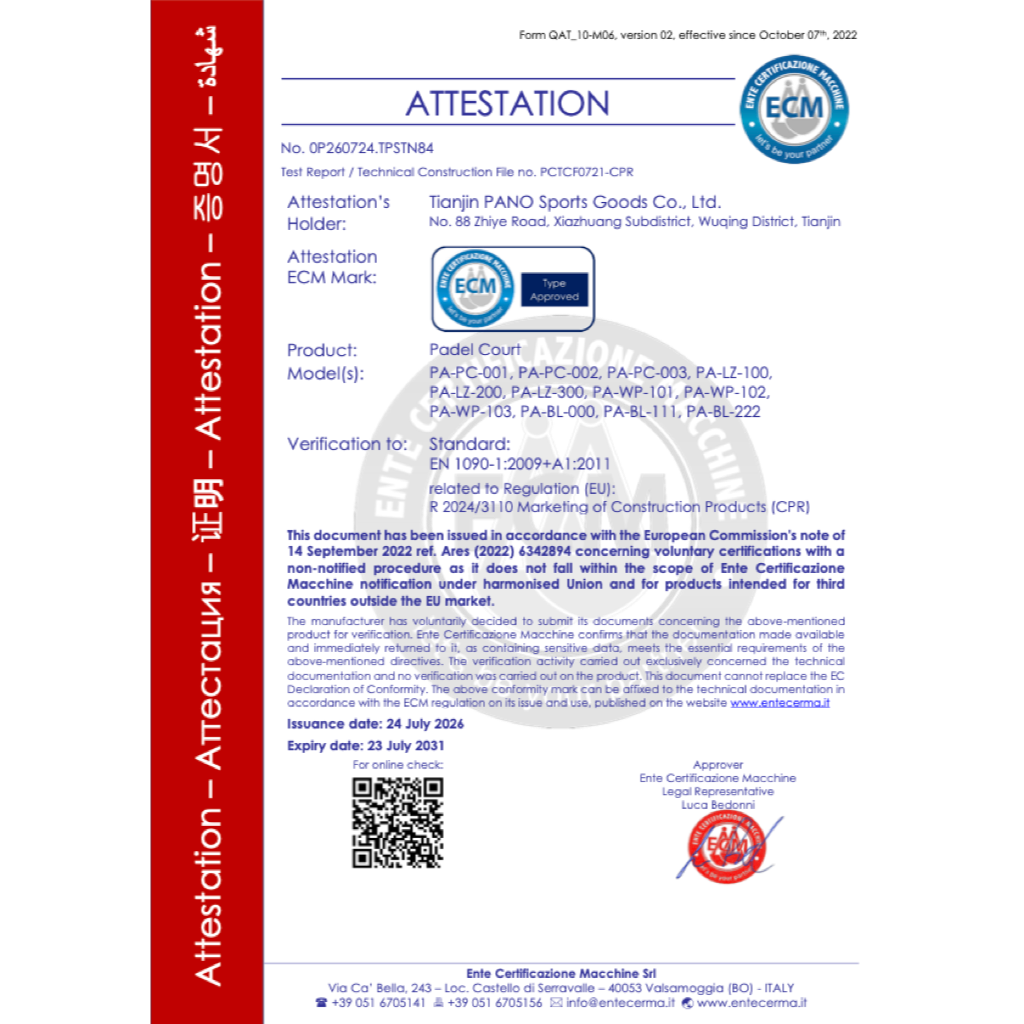
Whatever a supplier holds, the site-specific items stay local: wind and snow design, the slab and anchors, electrical approval and final acceptance. On a German project near Munich this autumn, the client paused because the applicability of the technical documents to the local approval route was still open, and a local concrete base turned out to cost about the same as our modular base. That was the right decision to pause on, and it is a good example of why documents need checking early.
How do delivery terms change the price from padel court suppliers in Europe?
The Incoterm decides who pays for freight, insurance, import clearance, duty, VAT and final delivery, so two quotes are only comparable on the same term and the same named place. FOB stops at the loading port, CIF adds sea freight and insurance to a destination port, DAP adds delivery to an address, and DDP adds import clearance and taxes.
| Term | Supplier arranges | Club still arranges |
|---|---|---|
| FOB Tianjin | Goods loaded on the vessel | Freight, insurance, clearance, duty, VAT, delivery, unloading |
| CIF destination port | Sea freight and cargo insurance | Port charges, clearance, duty, VAT, delivery, unloading |
| DAP named address | Carriage to the named place | Import formalities, duty, VAT, unloading |
| DDP named address | Carriage, clearance, duty and taxes | Unloading, unless agreed otherwise |
Two French clients this autumn asked for DDP prices on two courts, with taxes and installation split out. My honest answer was a planning budget first, and a firm DDP offer only once the importer of record, delivery address and a current forwarder quote were confirmed. A budget is not a promise of savings, and a DDP figure built on guesses can cost you more than it saves. The official ICC Incoterms 2020 rules and our guide to padel court costs under FOB, CIF, DAP and DDP explain the split; duty and VAT treatment should always be confirmed by your own customs broker.
What does after-sales support look like when your supplier is not local?
It works when three things are written down before shipment: warranty terms per component, a project-specific spare-parts list that travels with the courts, and a claim route with the evidence the supplier needs. Your local installer handles day-to-day service; the manufacturer supplies parts, drawings and technical guidance against component codes.
- Warranty: the contract should state the start date, covered defects, exclusions, claim evidence, and who pays labour and freight for replacements.
- Spares: glass panels, fixings, net parts and turf offcuts are the items clubs most often need first.
- Claims: we ask for the order number, component code, photos, installation date and a short description.
- Local service: your installer inspects fixings, anchors and turf on a set schedule and keeps a log.
I will be direct about one limitation: we do not run a spare-parts depot in Europe. That is why I push European clubs to agree spare panels and fittings in the first order rather than after a breakage. Replacement glass must match the original thickness and drilling, so keep the drawing revision on file. Our padel court warranty guide explains what each component term should cover.
How long does delivery take to a new European club?
Plan the stages separately: technical confirmation and drawing approval, deposit, production, inspection and packing, sailing, clearance, inland delivery and installation. In our recent quotations, production has been 20 to 25 working days from the confirmed deposit; sea transit to northern European ports usually adds around five to six weeks, depending on the carrier.
- Technical confirmation and written drawing approval.
- Deposit received and confirmed.
- Production, with progress updates at an agreed frequency.
- Inspection, packing and container loading with photos.
- Sailing and transit to the destination port.
- Import clearance and inland delivery.
- Unloading, installation and handover by the local team.
Local permits and groundworks run on their own schedule and are usually the real critical path. For one UK club we offered a photo update every seven days during production, which made the installer’s planning much easier. Work backwards from your opening date and give the slab and permits the longest lead.
What goes wrong when a new club compares padel court suppliers in Europe?
Most problems come from comparing quotes that are not like for like, or from site questions that surface after the order. In my experience the four repeat offenders are mismatched scope, unresolved tender conflicts, indoor clear height and existing bases that were assumed to be reusable.
- Mismatched scope: one quote includes turf, lighting and installation, another excludes turf. Check the inclusion list before the price.
- Tender conflicts: if the specification and drawings disagree, get each item confirmed in writing before anyone quotes.
- Indoor clear height: on a Welsh indoor project, price discussions ran alongside a roof-height and layout clash. Measure clear height at the net, the back walls and the light positions before choosing a model.
- Existing bases: a tennis court slab may be reusable, but only after a survey of levels, thickness, cracks, drainage and anchor edge distances. See our padel court foundation requirements.
None of these is solved by choosing a different supplier. They are solved by a better brief and written confirmations, which any good supplier should welcome. If one of the padel court suppliers in Europe you are talking to resists line-by-line clarification, that tells you how claims will be handled later.
What else do European club owners ask padel court suppliers?
Are padel courts from China accepted in Europe?
Yes, many European clubs and distributors install courts made in China. Acceptance depends on the documents your engineer and authority require, not on the country of origin. Ask for a document register, check what each document covers, and confirm which items need local design or approval before you order.
Is it cheaper to buy padel courts from a factory than from a European brand?
The equipment price is usually lower factory-direct, but you take on freight, import, unloading and coordination with a local installer. Compare delivered and installed cost on the same scope and Incoterm. The gap varies by country, quantity and how much local work your project needs.
Who pays import duty and VAT on padel courts shipped to Europe?
It depends on the Incoterm. Under FOB, CIF and DAP the buyer normally handles import clearance, duty and VAT. Under DDP the seller does, but DDP should only be offered once the importer, tax and customs responsibilities are confirmed. Your customs broker should confirm classification and rates.
Do I need a local installer if I buy from a manufacturer abroad?
Yes. An equipment-only quotation does not include local civil works, lifting, permits, electrical work or final acceptance. The manufacturer supplies drawings, labelled parts, a manual and remote guidance, while a local team you contract directly installs the courts and handles service.
What warranty should a padel court supplier offer a European club?
Ask for written terms per component: steel structure and coating, glass, turf and lighting, each with a start date, exclusions and claim evidence. Periods differ between suppliers and quotations, so rely on the signed warranty schedule rather than a headline number on a website.
Can an existing tennis court in Europe be converted to padel?
Often, but only after a site survey and engineering review of levels, slab thickness, reinforcement, cracks, drainage and anchor edge distances. If direct anchoring is not suitable, a modular or raised base can be reviewed. The local engineer signs off the final interface.
What should a new club send padel court suppliers in Europe to get a usable quote?
Send the same short brief to every supplier: country and city, delivery address or port, number of courts, indoor or outdoor use, a site drawing with clear height, the preferred model, your target opening date and who will handle foundations, electrics, unloading and installation. With that, a supplier can quote a model-specific scope on a named Incoterm.
- Site: address, layout or photos, existing base, clear height for indoor courts.
- Project: court quantity, model preference, target opening date.
- Responsibilities: who does the slab, electrics, unloading, installation and permits.
- Commercial: preferred Incoterm and the importer of record if you want DAP or DDP.
- Documents: the standards or clauses your engineer or authority will check.
If you would like PANO to be one of the padel court suppliers in Europe and beyond that you compare, send that brief through our contact page. I will reply with a model-specific scope, a document register and the open questions for your engineer, so you can compare us fairly with the others. For background reading, see our padel court supplier buyer’s guide and padel court manufacturer page.