
Mobile padel court cost is driven by eight choices: the court model, glass, steel and coating, turf, lighting, the steel base that replaces a concrete foundation, the shipping term, and the number of courts. Over the court’s life you must also add the cost of every move. Two mobile courts that look identical in a photo can be priced very differently because of the base and the moves.
Written by Macy Zhou, Senior Product Manager at PANO (PanoCourt). I have worked in the sports-facility industry for ten years and have led the development of more than ten padel court products, including our steel-plate mobile base. Last updated: 9 November 2026.
We build mobile courts in the same Handan factory as our fixed courts, and I deliberately do not publish prices on this page. Base thickness, coating, lighting and the delivery term change the figure too much for a single number to be honest. Instead, I will show you which choices move your mobile padel court cost, so the quote you request is the one you actually need.
In this guide:
- What drives mobile padel court cost
- How a mobile court stands without concrete
- Court choices that change the price
- What the steel base adds
- Shipping terms and weight
- The cost of every move
- Reading prices you find online
- Buy or rent
- Buyer questions
- How to get an accurate quote
What drives mobile padel court cost?
Mobile padel court cost is the sum of the court itself, the steel base system, freight on a heavier shipment, and the local cost of each installation and move. The court specification sets the starting point; the base and the number of moves decide whether a mobile court is cheaper or dearer than a fixed court over its life.
| Cost driver | Main options | How it moves the quote |
|---|---|---|
| Court model | Panoramic or classic | More steel and glass area raises price and weight |
| Glass | 12 mm tempered as standard | Special sizes, drilling or treatment raise it |
| Steel and coating | Indoor, outdoor or coastal protection system | Heavier protection raises it |
| Turf | Commercial turf specified per project | Yarn, density and backing change it |
| Lighting | LED package or none | Leaving lights out lowers it |
| Base system | Steel-plate base or raised modular floor | The line a fixed court does not have |
| Shipping term | FOB, CIF, DAP or DDP | Changes who pays freight, duty and delivery |
| Quantity | One court or several | Shared freight and packing per court |
What is a mobile padel court, and how does it stand without concrete?
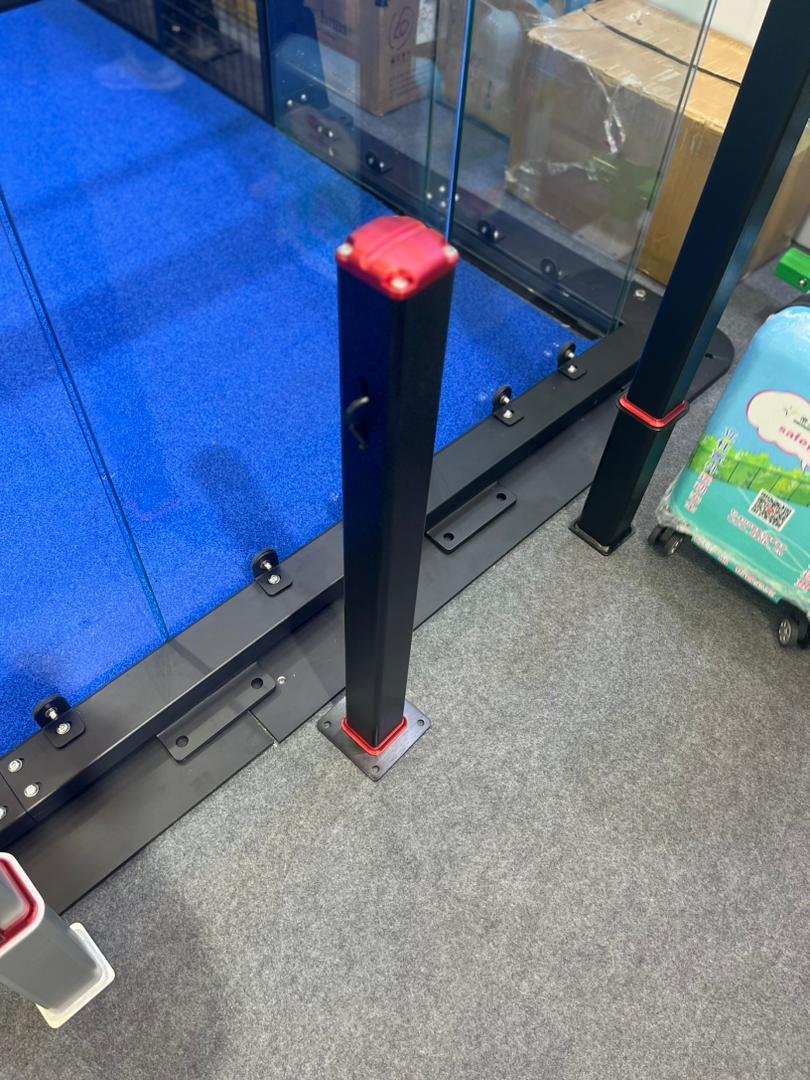
A mobile padel court stands on a steel base instead of a reinforced concrete foundation. In our PA-C01 system, the court’s posts bolt to a perimeter of 26 steel plates laid on flat, hard ground such as asphalt, so nothing is drilled into the surface and no concrete is poured.
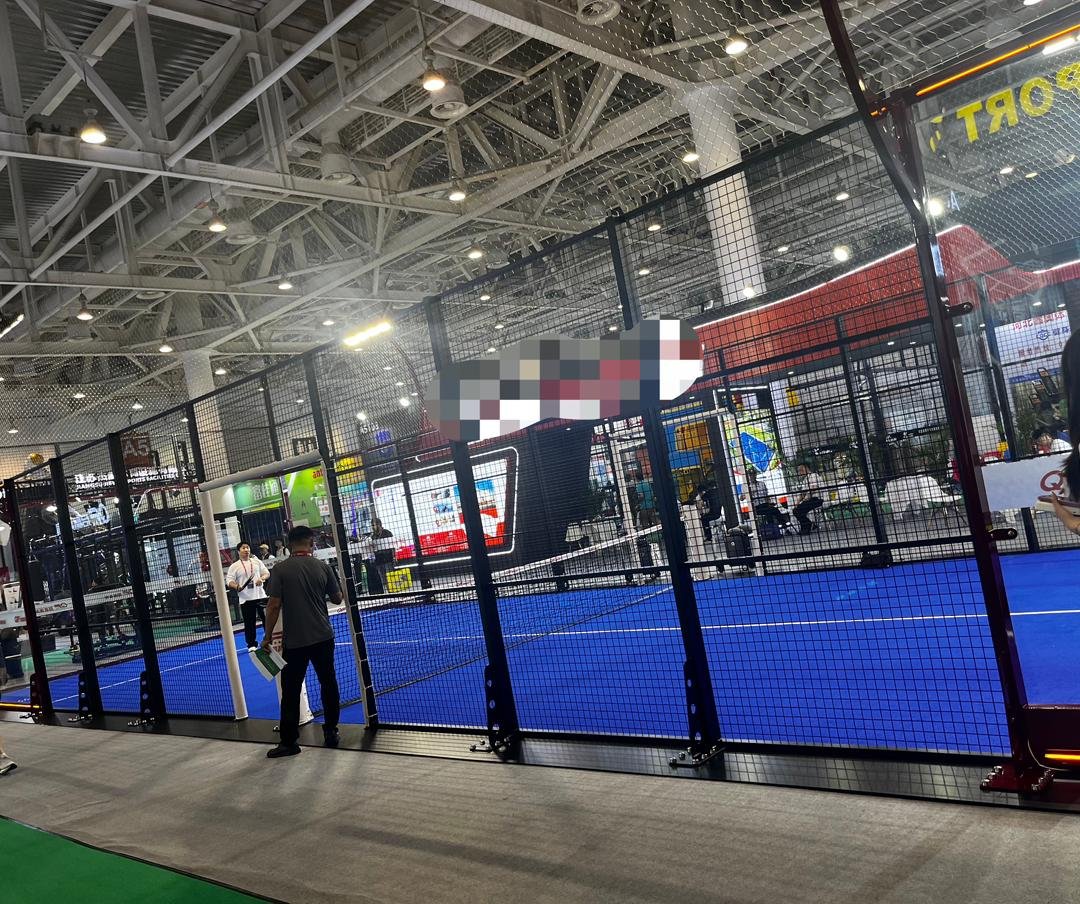
That makes it a good fit for hotels, shopping centres, events and sites where digging is not allowed. It still needs a site check at every location: wind exposure, sliding, ground bearing, drainage and permits should be confirmed by qualified local professionals. Our mobile padel court product page carries the same note.
My honest view: a mobile court is the right tool when the court will move, or when the ground cannot be dug. It is not a cheaper way to build a permanent outdoor club. The LTA padel court construction guidance note says a steel-plated or above-ground foundation must not be used for a permanent outdoor court in the UK. If your court will stay outdoors in one place, price a fixed court as well.
Which court choices change mobile padel court cost?
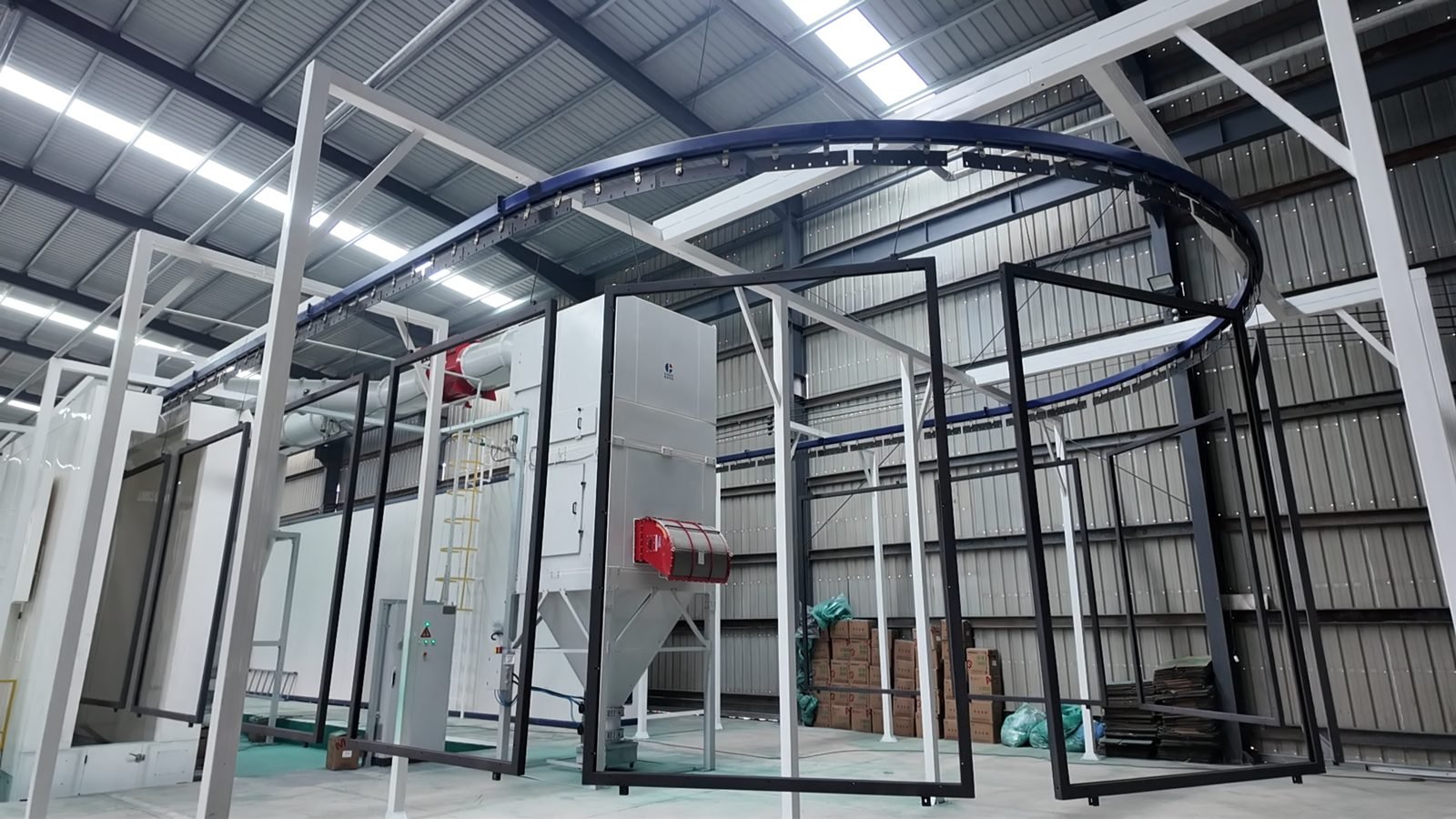
The court on top of the base is priced much like a fixed court. Model, glass, steel protection, turf and lighting each add a line, and each also changes weight and freight. The biggest swing usually comes from the model and the corrosion-protection system, because they change how much steel ships and how it is finished.
- Model: panoramic and classic courts use different column profiles and glass areas, so they differ in steel, glass and shipped weight.
- Glass: our standard is 12 mm tempered safety glass; glass is a large share of weight and freight volume.
- Steel protection: indoor, outdoor and coastal sites need different systems; tell us where the court will stand and we specify to match.
- Turf: confirmed as a named product with its own sheet and sample, not as a headline number.
- Lighting: optional on a mobile court; if you want it, masts must suit a base with no foundation and are specified with the structure.
For daytime events, leaving lighting out is the simplest saving. For coastal or repeatedly moved courts, I would not save on protection: every assembly and dismantling is a chance to chip the finish, so ask how touch-up and repainting are handled. Our coastal padel court guide explains the protection routes.
How much does the steel base add to mobile padel court cost?
The base is the cost line a fixed court does not have, and it is heavy. Our PA-C01 base uses 26 plates of 2,000 × 500 mm, 14 mm thick as standard with 10 or 12 mm options, and weighs about 3.7 tonnes per court. You pay for that steel, its coating and its freight instead of paying a local contractor for concrete.
- Thicker plates add stability and weight; they suit courts that stay longer or sit in more exposed spots.
- Thinner plates cut transport weight; they suit courts that move more often, subject to the site assessment.
- A complete mobile system is roughly 9.7 tonnes and about 10.5 cubic metres: about 6 tonnes of court plus the base.
- We also offer a different concept, PA-C02, a raised modular floor with adjustable pedestals, for converting existing surfaces.
Here is a real example of the trade-off. A German club near Munich asked us about a modular base for an existing tennis site. When the numbers came in, the total landed cost of the base was close to a local concrete solution, and the applicability of our technical documents to their local approval route was still open, so they paused. That is exactly the comparison I want every buyer to make: base steel plus freight against local concrete, on the same site.
How do shipping terms and weight affect mobile padel court cost?
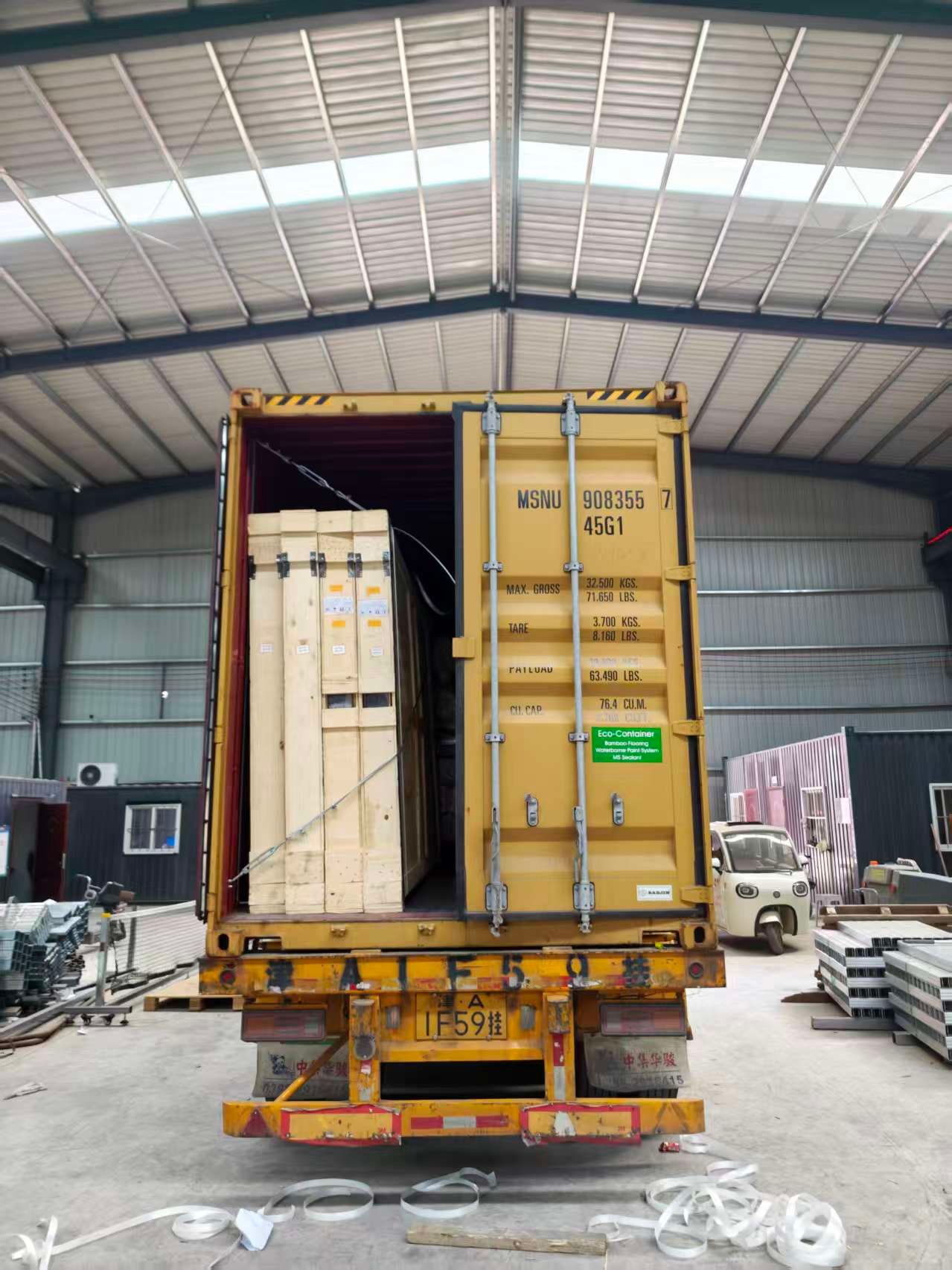
Weight drives freight, and the Incoterm decides who pays it. Because about 3.7 of the roughly 9.7 tonnes is the base, a mobile court costs more to ship than a fixed court. Under FOB you pay freight from the port of export; under CIF, DAP and DDP more of that cost moves into the supplier’s quote.
- FOB: we deliver on board at the port of export; you pay sea freight, insurance, import duty and taxes, and delivery to site.
- CIF: we also pay sea freight and cargo insurance to your destination port; you handle clearance, duty, taxes and delivery.
- DAP and DDP: delivery moves to your address, and under DDP import duty and taxes too; ask who acts as importer of record.
- Container loading is confirmed from the final packing list, not from a generic per-container figure.
Plan for a forklift or equivalent at delivery: glass packages and base bundles need mechanical handling. The ICC Incoterms 2020 rules define each term, the UK Trade Tariff and the EU Access2Markets tool help you check duty, and our guide to padel court costs under FOB, CIF, DAP and DDP covers the rest.
What does each move add to the lifetime mobile padel court cost?
Total mobile padel court cost is the purchase plus the cost of every move. A court bought for a summer events circuit and a court that stands in one shopping centre for years can share the same purchase quote and end with very different totals, because each move needs a crew, trucks, lifting, a site check and sometimes permits.
- A local crew to dismantle and reassemble the court.
- Trucks, plus a forklift or equivalent at both ends.
- A site check at the new location for wind, sliding, ground bearing and drainage.
- Permits where local rules require them.
- Touch-up of coating and replacement of worn or damaged parts.
| Aspect | Mobile, steel-plate base | Fixed, concrete foundation |
|---|---|---|
| Ground preparation | Flat, hard ground; no drilling | Reinforced slab built to drawings |
| Relocation | Intended to be dismantled and reinstalled | Stays where it is built |
| Site assessment | At each location | Once, for the foundation design |
| Shipping weight | Court plus base, about 9.7 t | Court only |
| Recurring cost | Cost per move | None for relocation |
| Typical use | Hotels, malls, events, temporary sites | Permanent clubs |
Ask a local provider to price one move, then multiply by the moves in your plan. I also distinguish two very different uses: a seasonal court that moves once or twice a year, and an event court that moves every few weeks. For the second, I recommend validating the assembly, handling and storage routine through a pilot before you commit, because crew time and wear are what decide the real lifetime cost. We have filmed trial assemblies at the factory to check measuring and adjustment steps, but a trial is not proof that every site and schedule will run the same way.
How should I read a mobile padel court cost figure found online?
Treat any published mobile padel court cost as a starting point and ask what it covers. Online figures differ mostly because they are quoted on different bases: with or without the base, with or without lighting and turf, and on a different delivery term.
- Which delivery term: ex-works, FOB, CIF, DAP or DDP?
- Court only, or court plus base system?
- Which glass, turf and lighting are included?
- What is excluded: crew, permits, site survey, unloading equipment, spares?
Only once those four answers match should you compare figures. A complete quote lists structure, glass, mesh, base plates, turf, lighting, hardware, packing, the shipping term with a named port or address, installation drawings and remote guidance, and spare parts. Our quotes do not include an on-site crew, local permits or a site survey, because those come from local providers. If you are also looking at a portable padel court or a fixed court, ask every supplier to quote on the same basis.
Should you buy or rent to control mobile padel court cost?
Renting suits a short, one-off use; buying suits a court you will use or move over several seasons. We sell mobile court systems and do not run a rental service. To compare, set the total hire cost for your planned period against the purchase price plus the cost per move.
Hire operators exist in several markets and some set a minimum hire period. Check who carries the site assessment and insurance in each option. Some hire and event operators buy their courts from manufacturers and run their own business; they can buy from us on the same basis as any other customer.
What else do buyers ask about mobile padel court cost?
How much does a mobile padel court cost?
It depends on eight factors: model, glass, steel protection, turf, lighting, the steel base, the shipping term and quantity, plus the cost of each move over the court life. Because the base and moves vary so much, we quote each project itemised rather than publishing one figure.
Why does a mobile padel court cost more to ship than a fixed court?
The steel base replaces the concrete foundation and ships with the court. In our PA-C01 system the base is about 3.7 tonnes of a roughly 9.7-tonne system, so freight is paid on steel that a fixed court would replace with locally poured concrete.
Does a mobile padel court need a concrete foundation?
No reinforced concrete is needed, only flat, hard ground such as asphalt. A qualified local professional should still confirm wind exposure, sliding, ground bearing and drainage at each location before the court is installed.
Can a mobile padel court be used outdoors?
Yes, subject to a site-specific assessment of wind, sliding and overturning by a qualified local professional. For a permanent outdoor court in the UK, LTA guidance calls for a proper below-ground foundation instead of a steel-plated base.
Is it cheaper to rent or buy a mobile padel court?
Renting usually suits a short, one-off use, while buying suits several seasons or repeated moves. Compare the total hire cost for your period with the purchase price plus the cost per move. PANO sells mobile systems and does not rent them out.
How often can a mobile padel court be moved?
The system is intended to be relocatable, but how often it can move economically depends on crew, handling equipment, storage and wear. For frequent event moves, validate the routine with a pilot first, and agree touch-up and spare parts before the season starts.
Do mobile padel courts need planning permission?
It depends on local rules and how long the court stays on site. Check with your local authority before you book a location, and include permit time and cost in the cost per move.
How do I get an accurate mobile padel court cost quote?
Send the details that decide the eight cost drivers, plus how often you plan to move the court. With those, we can return an itemised quote in which the court, the base, freight and exclusions are separate lines, so you can compare it with a fixed court or another supplier on the same basis.
- Court model, quantity, and indoor or outdoor use.
- Ground surface and site exposure: sheltered, open or coastal.
- How often you plan to move the court, and where it will be stored.
- Lighting yes or no, and any turf preference.
- Destination port or delivery address, and your preferred Incoterm.
Request your itemised mobile padel court cost breakdown through our contact page. If a fixed court turns out to be the better answer for your site, I will tell you so, and our padel court foundation requirements guide is a good place to start that comparison.