Indonesia is one of Southeast Asia’s fastest-growing padel markets, and one of the least understood by شركة مصنعة لملاعب البادل positioning for international growth. With a population of 275 million, rising urban middle-class sports consumption, and a geographical proximity to Chinese manufacturing that reduces freight costs and timelines, Indonesia presents a compelling opportunity for club developers—and a genuinely accessible supply chain for the courts they need.
This guide covers everything Indonesian developers, club operators, and sports facility investors need to source the right مُصنِّع ملاعب البادل for 2026—including import regulations, court cost benchmarks, manufacturer evaluation, and the specific climate considerations that affect long-term court performance in Indonesia’s tropical environment.
Indonesia Padel Market: The Growth Opportunity
Padel arrived in Indonesia relatively recently compared to its European heartland, but adoption has been rapid. Key market indicators:
- الـ Indonesia Padel Federation (INAPAF) was officially established in 2022, signaling institutional recognition of the sport’s scale
- Jakarta, Surabaya, Bali, and Bandung are the primary urban padel markets, with emerging growth in Medan and Makassar
- Premium sports club developers—Fitnation, Sports Hub, and premium hotel brands—are actively adding padel courts to differentiate facilities
- Court rental rates in Jakarta premium clubs: IDR 200,000–350,000/hour ($12–$22), with premium outdoor panoramic courts at the upper end
- Strong demand from the expatriate business community (established padel player base) and young urban Indonesian professionals
الـ Global Padel Report 2025 (Playtomic/PwC) identifies Southeast Asia as one of the three highest-growth padel corridors for 2025–2028, alongside South America and the Middle East. Indonesia, with its size and urban concentration, is the region’s anchor market.
Importing Padel Courts to Indonesia: Customs and Regulatory Framework
HS Classification and Import Duty
Padel court components import into Indonesia primarily under:
- HS 9506.99: Sports articles and equipment (covers complete court systems)
- HS 7308.90: Structures and parts of structures, iron or steel (applicable to steel frame components)
- HS 7007.19: Tempered safety glass (glass panel components)
Current Indonesia MFN import duty rates: HS 9506.99 at 10–15%; HS 7308.90 at 7.5–15%; HS 7007.19 at 0–5%. VAT (PPN) at 11% applies to all imported goods. Indonesia and China have preferential trade arrangements under ASEAN-China Free Trade Agreement (ACFTA), which may reduce applicable tariff rates for qualifying Chinese-manufactured padel court components—confirmation with a licensed Indonesian customs broker is recommended for each shipment classification.
API and NIK Import Licensing
Importing padel courts into Indonesia requires the buyer to hold or work with an entity that holds:
- API-U (General Importer Identity Number): For entities importing goods for distribution or resale
- API-P (Producer Importer Identity Number): For entities importing goods for own use in their business operations (appropriate for club developers importing courts for their own facility)
- NIK (Customs Identification Number): Required for all customs declarations
Foreign-owned companies importing directly require additional compliance steps through BKPM (Indonesia Investment Coordinating Board) for API licensing. Most buyers work with Indonesian PT (Perseroan Terbatas) entities as importers of record.
SNI Compliance
Indonesia’s Standar Nasional Indonesia (SNI) mandatory product standards may apply to certain padel court components. As of 2026, padel courts as a category do not have a specific SNI standard, but electrical components (LED fixtures) must comply with relevant SNI electrical standards. Verify current SNI applicability with your customs broker at time of procurement.
Climate Considerations for Padel Courts in Indonesia
Indonesia’s tropical climate creates specific performance requirements that buyers must address in specification. Failing to do so is the most common quality failure in Indonesian padel court projects.
Humidity and Corrosion
Indonesia’s average relative humidity of 70–80% year-round, rising to 85–95% in coastal areas and during monsoon periods, creates a C3–C4 corrosion environment for steel structures. Standard specifications for Indonesian installations:
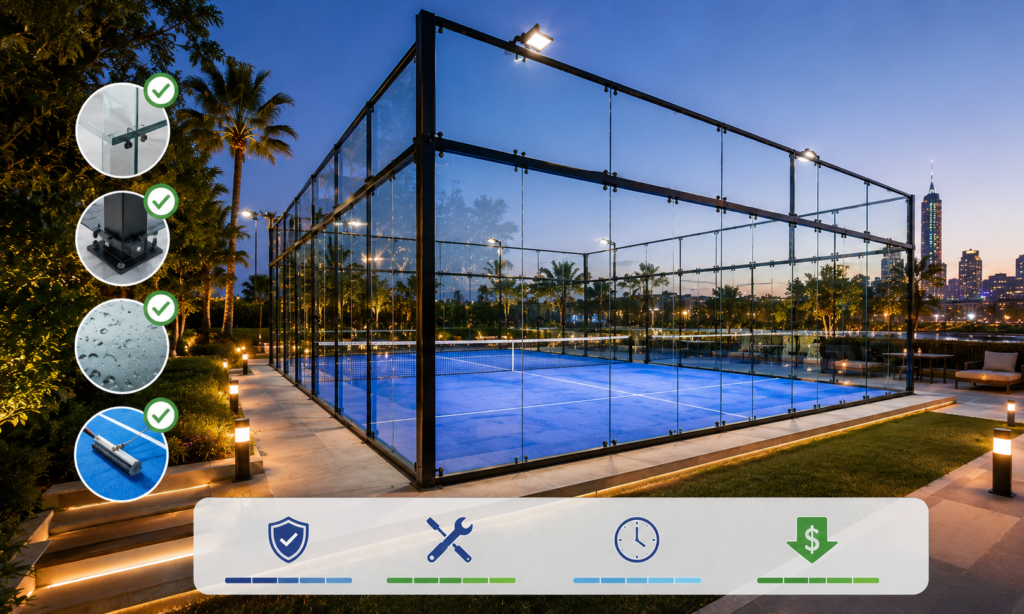
- Hot-dip galvanized steel: 100µm minimum zinc coating (vs. standard 85µm for temperate climates)
- Powder coating over galvanizing: QUALICOAT Class 2 or equivalent, minimum 60µm thickness
- All fasteners: Stainless steel 316L grade (essential for coastal/high-humidity environments)
- Drainage design: Generous drainage provision in foundation and court perimeter to prevent water pooling
UV Intensity
Indonesia’s equatorial position delivers UV Index levels of 10–13 consistently, with higher values at altitude (Bandung at 768m, Malang at 445m). Artificial turf UV stability is critical—specify minimum 3,000 hours accelerated UV weathering resistance per ISO 4892-3, and request factory test certificates confirming compliance. Substandard turf in Indonesian conditions fades and degrades within 2–3 years.
Wind and Rain Load
Indonesia’s monsoon season (November–April across most of the archipelago) brings sustained wind and heavy rainfall. Padel court structures must be specified for tropical wind loads:
- Design wind speed: 100–140 km/h in most Indonesian locations (higher in exposed coastal and elevated sites)
- Frame column base plate and anchor bolt specification should be verified for Indonesian wind zone
- Glass panel framing should include redundant mechanical retention against wind suction loads
PanoCourt provides Indonesia-specific structural engineering calculations adapted for tropical wind loads and high-humidity corrosion environments. See our technical approach: How to Choose a Padel Court: 2026 Guide for Investors and Club Owners.
Padel Court Cost in Indonesia: 2026 Market Benchmarks
Total per-court cost for Indonesian installations from Chinese مصنعو ملاعب البادل:
| Court Type | FOB China | CIF Tanjung Priok (Jakarta) | Duties + VAT (~25%) | التركيب | Total Landed + Installed |
|---|---|---|---|---|---|
| ملعب البادل الكلاسيكي | $13,500–$18,500 | $15,500–$21,000 | $3,900–$5,300 | $2,500–$4,000 | $21,900–$30,300 |
| ملعب الباديل البانورامي | $19,500–$26,000 | $22,000–$29,500 | $5,500–$7,400 | $3,000–$5,000 | $30,500–$41,900 |
| Super-panoramic | $24,000–$32,000 | $27,000–$36,000 | $6,800–$9,000 | $4,000–$6,500 | $37,800–$51,500 |
Note: Duty calculations approximate; exact rates depend on HS code classification and ACFTA preferential rate eligibility. Foundation cost ($2,500–$7,000 per court depending on site conditions) excluded from above.
Indonesia’s proximity to Chinese manufacturing (approximately 7–10 day transit time to Tanjung Priok) gives Indonesian buyers a logistics efficiency advantage over European market buyers—this proximity directly reduces landed cost and project timeline risk.
Indoor vs Outdoor Padel Courts in Indonesia
Indonesia’s climate makes the indoor/outdoor decision more complex than in European markets. Key considerations:
Outdoor Courts: Tropical Adaptation Required
Outdoor padel courts are commercially viable year-round in Indonesia’s dry season (May–October in Java and Bali; variation by island). However, the wet season reduces outdoor court utilization by 30–50% in the most affected markets. For pure outdoor facilities, this seasonal revenue loss must be modeled into investment cases.
Covered Outdoor Courts: The Indonesian Sweet Spot
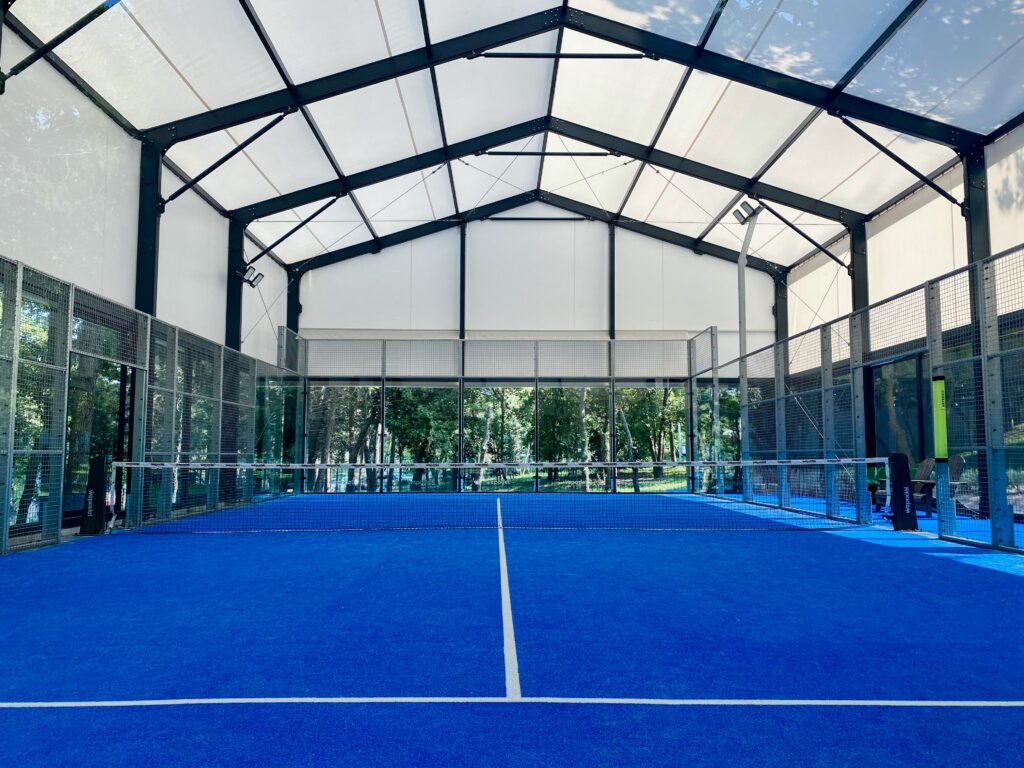
The most commercially resilient Indonesian padel facility model is covered outdoor—padel courts with an open-sided shed structure (steel columns + corrugated metal or polycarbonate roof) that provides rain protection without requiring full air conditioning. This configuration adds $15,000–$40,000 per court in roofing structure cost but extends year-round utilization to near-European levels while keeping operating costs below fully indoor facilities.
Fully Indoor Courts: High CAPEX, Premium Positioning
Fully air-conditioned indoor padel courts position at the premium end of the Indonesian market. Operating cost of air conditioning ($3,000–$6,000/month for a 4-court facility) must be recovered through higher rental rates and membership fees. Viable in Jakarta’s Sudirman/SCBD premium business district and Bali’s Seminyak/Canggu premium zones; challenging in secondary cities without established premium sports consumption.
Top Padel Court Manufacturer for Indonesia: Evaluation
Why Chinese Padel Court Manufacturer Dominate Indonesian Sourcing
Indonesian buyers sourcing padel courts overwhelmingly favor Chinese مصنعو ملاعب البادل for structurally sound reasons:
- 7–10 day transit time from Chinese ports to Tanjung Priok—dramatically reducing logistics complexity vs. European suppliers
- ACFTA preferential tariff eligibility for qualifying Chinese goods
- Chinese factories accustomed to tropical climate specification requests (significant Southeast Asian export experience)
- Time zone alignment enabling real-time communication during Indonesian business hours
- FOB pricing 35–45% below European equivalents for comparable FIP specification
PanoCourt: Dedicated Southeast Asia Supply Chain
PanoCourt serves Indonesian buyers with:
- Tropical climate specification package: 100µm galvanizing, UV-3000 turf, stainless 316L hardware standard for Indonesian orders
- ACFTA Certificate of Origin (Form E) documentation for preferential duty eligibility
- CIF Tanjung Priok (Jakarta), Tanjung Perak (Surabaya), Ngurah Rai (Bali) pricing options
- Indonesian customs documentation package (commercial invoice, packing list, B/L per Bea Cukai requirements)
- English and Bahasa Indonesia technical support
For a broader view of PanoCourt’s manufacturing capabilities and global track record: أفضل 3 مصانع لملاعب البادل في الصين: دليل المشتري لعام 2026.
Panoramic vs Classic Courts: The Indonesian Market Preference
Indonesia’s premium club segment has adopted the ملعب الباديل البانورامي as the standard expectation for new commercial facilities. Key drivers of panoramic preference in the Indonesian context:
- Social media culture: Indonesia is among the world’s most active social media markets; panoramic courts generate significantly more shareable visual content
- Expatriate expectations: Jakarta and Bali’s substantial expatriate communities bring European/Latin American padel expectations, where panoramic is standard
- Premium positioning: In Indonesia’s aspirational sports market, panoramic glass communicates quality and modernity in a way solid-wall courts cannot match
Classic padel courts remain appropriate for secondary cities, community facilities, and budget-constrained projects where capital minimization is the primary objective. The ملعب بادل كلاسيكي delivers identical playability at $5,000–$10,000 lower total cost per court for Indonesian buyers. For a complete comparison: ملعب البادل البانورامي: تحليل نقدي لما يحتاجه أصحاب النوادي فعليًّا في عام 2026.
Sourcing Padel Courts for Your Indonesia Project
PanoCourt supplies FIP-certified ملاعب باديل بانورامية and ملاعب الباديل الكلاسيكية to Indonesian buyers with tropical climate specification, ACFTA documentation, and CIF pricing for major Indonesian ports. Contact us to receive a full project quotation within 48 hours.
→ Request Your Indonesia Padel Court Quote
FAQ: Padel Court Manufacturer Indonesia
What import duties apply to padel courts imported into Indonesia?
Padel court systems imported into Indonesia under HS 9506.99 currently attract MFN import duty of 10–15% on CIF value, plus 11% PPN (VAT). Chinese-manufactured goods qualifying under ACFTA Form E Certificate of Origin may attract reduced preferential tariff rates—the specific rate depends on HS sub-classification. Indonesian customs broker consultation is recommended before finalizing cost models. Total duty + VAT burden is typically 20–28% of CIF value.
How much does a padel court cost in Indonesia?
For Indonesian installations sourced from Chinese مصنعو ملاعب البادل: classic courts $21,900–$30,300 landed and installed; panoramic courts $30,500–$41,900 landed and installed; super-panoramic $37,800–$51,500. These figures include CIF Tanjung Priok, duties and VAT, and installation labor. Foundation ($2,500–$7,000) and covered structure (if applicable, $15,000–$40,000) are additional. For regional comparison: تكلفة بناء ملعب باديل كورت الإكوادور 2026.
How long does shipping take from China to Indonesia?
China-to-Indonesia shipping transit time is among the shortest globally for padel court sourcing: 7–10 days from Shanghai, Ningbo, or Guangzhou to Tanjung Priok (Jakarta); 8–11 days to Tanjung Perak (Surabaya); 9–12 days to Benoa (Bali). Combined with 6–8 week factory production, total lead time from purchase order to goods-at-port is 10–12 weeks—significantly faster than European-supplied courts (18–22 weeks to Indonesia).
What specifications are needed for padel courts in Indonesia’s tropical climate?
Essential tropical climate specifications for Indonesian padel courts: minimum 100µm hot-dip galvanized zinc coating (vs. 85µm standard); 316L stainless steel for all fasteners and hardware; QUALICOAT Class 2 powder coating; UV-stabilized turf rated minimum 3,000 hours ISO 4892-3; tropical wind load structural calculation (100–140 km/h design wind speed); drainage provision for 150mm/hour rainfall intensity. Any شركة مصنعة لملاعب البادل without documented experience in Southeast Asian or tropical market supply should not be trusted to specify these requirements correctly.
Is padel growing in Indonesia?
Yes, significantly. Padel in Indonesia has grown from a niche expatriate sport in 2019 to a mainstream urban premium sport in 2026. The Indonesia Padel Federation (INAPAF) was established in 2022 and has driven regulatory legitimization. Jakarta’s premium sports club market is the primary demand driver, with Bali (sport tourism and expatriate community), Surabaya, and Bandung as secondary growth markets. The padel court supply shortage in Indonesian urban markets creates attractive investment timing for developers who can move quickly with reliable موردو ملاعب البادل.
Are European padel court brands available in Indonesia?
European مصنعو ملاعب البادل (MejorSet, Portico Sport, AFP) can supply to Indonesia but face significant disadvantages: 28–35 day shipping transit vs. 7–10 days from China; 35–45% higher FOB pricing; no ACFTA duty preference; limited Indonesian market installation reference experience; and European time zone customer service. For most Indonesian buyers, the Chinese manufacturer advantage is decisive. European brands are primarily chosen for their tournament prestige—relevant for Indonesia’s handful of premium international-standard venues but not for the majority of commercial club development.