By Chen, · Last updated: May 2026 · ~12 min read
Padel is the fastest-growing racquet sport on the planet right now, and most of the courts going into the ground are built in China. If you’re sourcing padel courts and trying to figure out who the real manufacturers are — not just the trading companies — this guide walks you through where the padel court factory base actually sits, why steel makes China so hard to beat on price, and the three names worth putting on your shortlist.
Here’s something most buyers don’t realize until they’ve done a few sourcing trips: the head of China’s padel court manufacturing isn’t in the south where you’d expect the export factories to be. It’s up north. The serious players are clustered in two provinces — Hebei and Shandong — and there’s a very practical reason for that, which we’ll get to in a minute.
The two biggest brands in china. Pano Court runs its factory in Hebei. Faither is based in Shandong. Between them and a handful of others, the northern cluster turns out the bulk of the padel courts that get shipped abroad every year — and the lion’s share of those are physically built in Hebei before they ever see a container.
And the volume keeps climbing. According to Playtomic’s Global Padel Report 2025, the world went from around 50,400 padel courts at the end of 2024 to a projected 70,000-plus by 2026 — with 81,000 expected by 2027. That’s a new court being built roughly every two and a half hours, with about 30 million players now across 130 countries. A huge slice of that demand is being met by a Chinese padel court factory — and Hebei’s export share grows right alongside it.
Why Buy From a Padel Court Factory in China?
cost, quality, and a supply chain that’s genuinely built for export. But to understand why China wins here, you have to understand what a padel court actually is — because most of the cost lives in one material.
What Goes Into a Padel Court System?
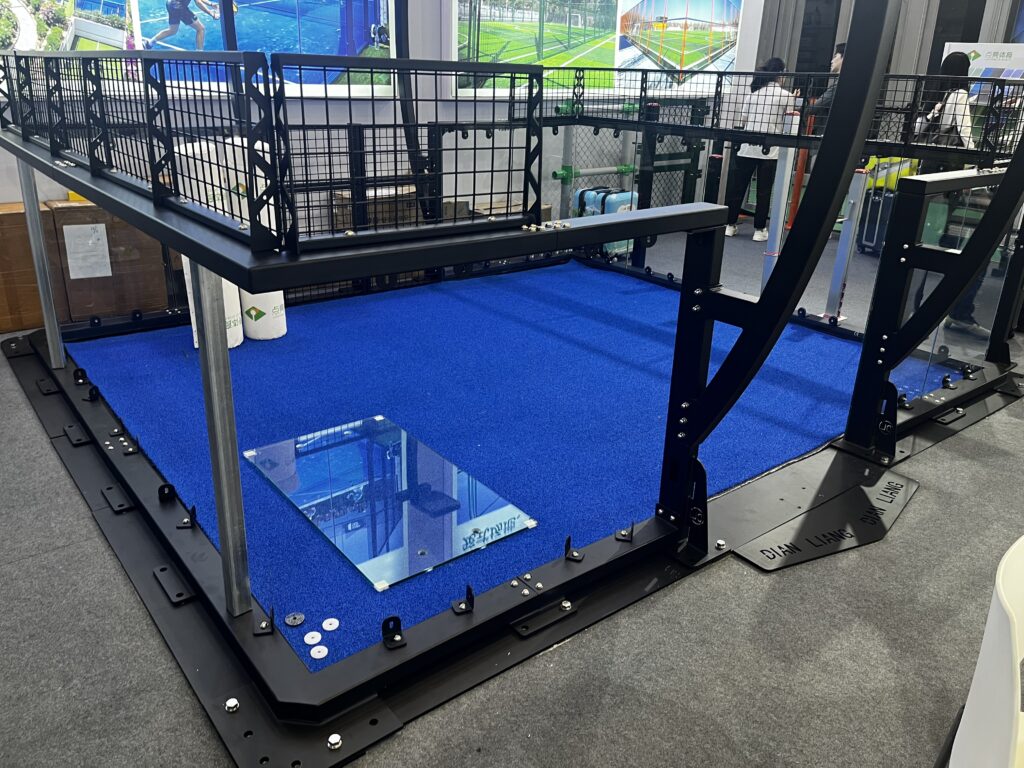
A padel court isn’t one product — it’s a system. When you buy a court, you’re really buying five things bolted together:
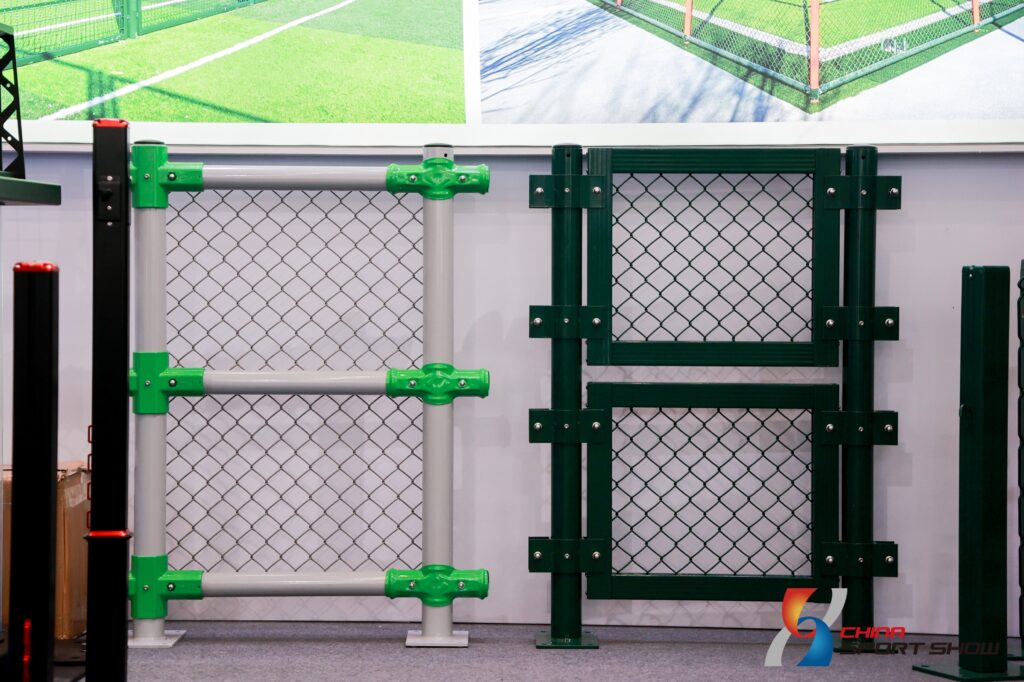
- Steel structure — the hot-dip galvanized posts, the perimeter frame, and the mesh fencing that holds everything up
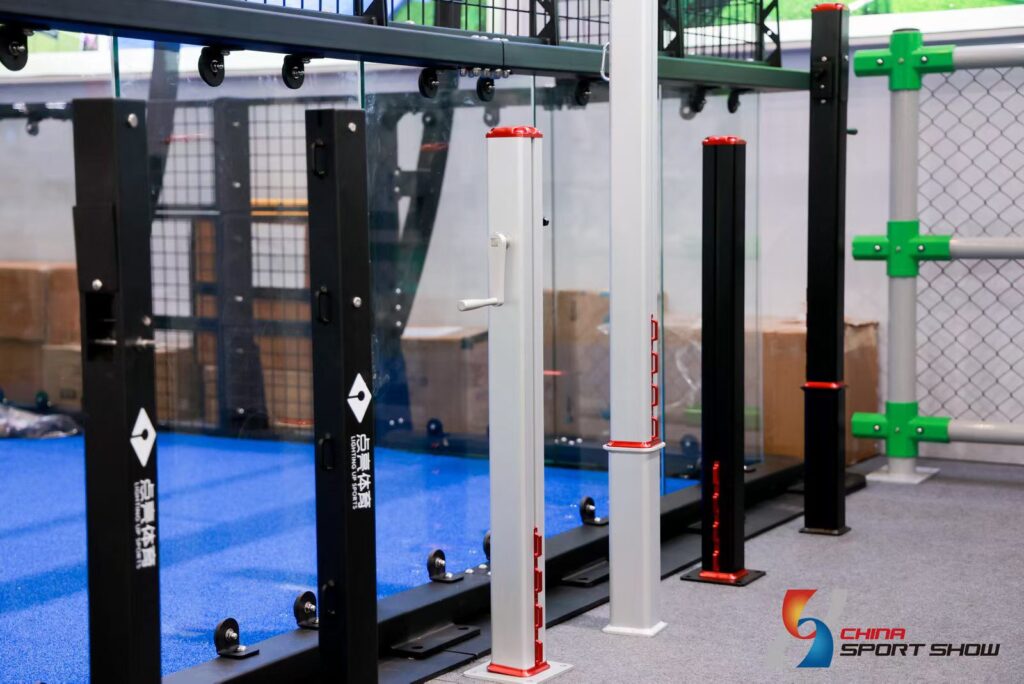
- Tempered glass — the 10–12mm safety glass walls players bounce the ball off
- Artificial turf — the monofilament or fibrillated court surface, plus silica sand infill
- Accessories — the net and net posts, gates, fixings, and brackets
- Lighting (optional) — LED floodlights and poles for indoor or evening play
Now here’s the part that matters for sourcing. The single most expensive piece of that list is the steel. The posts and frame and fencing typically eat up the biggest chunk of the bill of materials — and steel just happens to be the one thing China makes better and cheaper than anyone else on Earth.
That’s not marketing talk. According to the World Steel Association, China produced over half of the world’s crude steel in 2025 — more than the next 12 steel-producing countries combined. When the most expensive component of your court comes from the country that owns the global steel supply, the math on price gets very hard to argue with.
Padel court system: components and where the money goes?
| Component | What it includes | Typical share of court cost |
|---|---|---|
| Steel structure | Hot-dip galvanized posts, perimeter frame, mesh fencing | ~40–50% |
| Tempered glass | 10–12mm tempered safety glass panels | ~20–25% |
| Artificial turf | Monofilament court turf + silica sand infill | ~12–18% |
| Accessories | Net, net posts, gates, fixings, brackets | ~8–12% |
| Lighting (optional) | LED floodlights + mounting poles | ~5–10% |
Representative cost shares for a standard panoramic court; exact split varies by spec, glass thickness, and whether lighting is included. Steel is consistently the #1 cost driver.
The Real Advantages of a Chinese Padel Court Factory
Four things stack up in China’s favor, and they compound on each other:
- A deep, skilled manufacturing workforce. China is still the world’s largest manufacturing economy by output, and the northern industrial belt has decades of metalwork and welding labor to draw on. That keeps fabrication costs down without cutting corners on the welds and galvanizing that actually keep a court standing for 15+ years.
- Raw materials on the doorstep. Steel and tempered glass — your two biggest cost lines — are both produced at massive scale right inside China. No long import legs, no middleman markup.
- A mature manufacturing ecosystem. Padel courts share a lot of DNA with sports fencing, stadium structures, and steel fabrication — industries China has been refining for 30+ years. The tooling, the QC processes, the experienced engineers are already there.
- An export chain that actually works. This is the underrated one. Chinese factories don’t just build the court — they handle the logistics, customs paperwork, and freight booking, and many now offer genuine door-to-door delivery to buyers worldwide. You get the court dropped at your site, not stranded at a port.
If you want to see how that last point plays out in practice, Pano Court’s padel court export process page lays out how a single court goes from their Hebei line to a container to your door.
China vs. the Top Spanish Padel Court Manufacturers
Spain is the spiritual home of padel, and the top Spanish manufacturers have real brand heritage — that’s worth respecting, and for some premium club projects it genuinely matters. But for most buyers weighing cost against quality, here’s how the two stack up honestly:
| Factor | Chinese padel court factory | Top Spanish manufacturers |
|---|---|---|
| Unit price (single court, FOB) | Lower — local steel & glass | Higher — EU material & labor costs |
| Steel cost base | Lowest globally (China is #1 producer) | Higher (EU steel prices) |
| Brand & heritage | Newer to global recognition | Strong — the ‘origin’ prestige |
| OEM / customization | Highly flexible OEM & ODM | Often more standardized |
| MOQ flexibility | Single court to bulk orders | Often higher export minimums |
| Shipping to global buyers | Mature container export chain | Strong in EU, costlier overseas |
A fair comparison — Spain wins on heritage and brand cachet; China wins on cost, flexibility, and export readiness. Both can build a competition-grade court.
Why Hebei? The Province That Quietly Owns Padel Court Manufacturing
Why Padel Court Factories Cluster in Hebei
Remember that question from the start — why the north, why not the export-heavy south? Here it is: Hebei is China’s single largest steel-producing province. It accounts for roughly a fifth to nearly a quarter of the entire country’s crude steel output. To put that in perspective, the steel city of Tangshan in Hebei alone produces more steel than India and Japan put together.
When you build the most steel-heavy product in the sports industry inside the most steel-rich province in the world’s biggest steel nation, the savings are real and measurable. Factories sourcing steel right at the mill gate in Hebei typically save on the order of US$100–200 per ton versus buying the same steel down south — once you add up the material price difference and the inland freight you don’t have to pay. On a full court, that difference flows straight into a lower price for you.
Sourcing steel in Hebei vs. South China (Guangzhou)
| Factor | Hebei (Tangshan / Handan) | Guangzhou / South China |
|---|---|---|
| Distance to steel mills | At the source — China’s #1 steel province | Steel shipped in from the north |
| Est. steel cost per ton | Baseline (lowest) | +US$100–200 / ton* |
| Inland logistics | Minimal — mills are next door | Added trucking & rail freight |
| Net effect per court | Lower material cost | Higher landed material cost |
*Includes both the raw steel price gap and inland freight. Figures are typical industry estimates and move with the steel market.
The Raw-Material Supply Chain Lives Here Too
It’s not just the steel mills. Hebei has spent years building out the whole feeder chain around metal fabrication — galvanizing plants, glass processors, fencing and mesh suppliers, hardware makers. A Hebei padel court factory can source nearly every part of the court system within a short drive, which means faster lead times, tighter quality control, and fewer things that can go wrong between order and shipment. That mature local ecosystem is exactly why the region punches so far above its weight in this category.
Who Are the Top Padel Court Factories in China?
Here are the three names worth knowing — starting with the most established. If you only research one padel court factory china supplier in depth, make it the first.
1. Pano Court (Hebei)
Pano Court is the one with the deepest track record, and it shows in the details. This is a company that has spent 16 years in the sports-facility business — they didn’t parachute into padel when the trend got hot.
Their story actually starts with steel. They began by manufacturing steel pipe, then moved into football-pitch fencing and sports enclosures — which is about the best possible foundation for building padel courts, since a court is essentially a precision steel-and-glass enclosure. Then in 2018 they made the move that separates real manufacturers from assemblers: they built a full in-house team covering R&D, design, production, and installation under one roof.
The numbers that back them up:
- Factory location: Handan, Hebei — widely regarded as the home of padel court production in China
- Factory size: over 10,000 square meters
- Team: 60+ employees, including 13 dedicated technical staff
- Experience: 16 years in sports facilities; in-house R&D–design–production–installation since 2018
- Footprint: branch offices in Hebei, Tianjin, and Henan
- Export reach: ships to 30+ countries
- Output: 1,000+ sets of padel courts exported every year
That combination — a steel-fabrication heritage, an in-house engineering team, a Handan location, and a thousand-plus courts going out the door annually — is why Pano Court tends to be the safe first call for serious buyers. You can browse their full panoramic padel court range or send an inquiry directly if you want a quote on a specific spec.
2. Faither (Shandong)
Feize is the leading name out of the Shandong cluster — the other half of China’s northern padel manufacturing base. They’re an established sports-facility manufacturer that supplies padel courts alongside other steel-structure sports products. If you’re comparing across provinces, Feize is the natural Shandong counterpart to put up against the Hebei factories, and worth getting a quote from to benchmark pricing and lead times.
3. Qifan (Hebei)
Qifan is another Hebei-based manufacturer in the padel court space, benefiting from the same steel-cost and supply-chain advantages as the rest of the province. They round out a sensible three-way shortlist: two Hebei factories (Pano Court and Qifan) plus one Shandong factory (Feize) gives you a clean apples-to-apples comparison across the two regions that actually matter in this industry.
Padel Court Factory FAQ
How do I import a padel court from China, step by step?
It’s more straightforward than most first-time buyers expect. The typical flow looks like this:
- Send your requirements — court type (single or double), glass thickness, turf color, lighting — to the factory and get a quote
- Confirm the spec and sign the proforma invoice; pay a deposit (commonly 30–50%)
- Production runs — usually a few weeks depending on order size and the factory’s queue
- Balance payment, then shipping — a good factory books the freight, handles export customs, and can arrange door-to-door delivery
- Installation — either your local crew, or the factory’s installation guidance/team
A factory with a real in-house export team — Pano Court being the obvious example, exporting 1,000+ sets a year to 30+ countries — will manage most of steps 3 through 5 for you, which is exactly why an experienced padel court factory is worth more than a cheap trading company.
Can a factory supply just one court, or do I have to order in bulk?
Yes — you can absolutely order a single court. A lot of buyers searching for 1v1 padel court factories assume there’s a high minimum, but China’s flexible MOQ is one of its real edges over European suppliers. Whether you need one single 1v1 padel court unit for a private setup or fifty for a new club chain, a direct manufacturer can quote it. Working with a 1v1 padel court factory directly (rather than a reseller) also means you’re getting the actual builder’s price on that single unit — Pano Court, for instance, handles both one-off and bulk orders on the same line.
Which padel court factory should I actually choose?
Shortlist by track record, not just price. Look for a manufacturer with a genuine in-house team (R&D, production, and installation), verifiable export volume, and a steel-fabrication background — because the steel structure is where court quality is won or lost. Of the three covered here, Pano Court checks the most boxes: 16 years in the industry, 13 technical staff, a Handan factory, and 1,000+ courts exported annually. Get quotes from all three, compare on total landed cost and lead time, and weight experience heavily.
Is a Chinese-made padel court good enough for competition play?
It can be, provided you spec it right. The quality lives in the details: hot-dip galvanized steel (not just painted), genuine 10–12mm tempered safety glass, and a quality monofilament turf. A reputable padel court factory china builds to these standards as a matter of course — just confirm the galvanizing and glass certifications in writing before you pay your deposit.
What does a padel court from China cost?
Prices move with the steel market and your exact spec, so any factory quoting a fixed number sight-unseen is guessing. What you can count on is that a court built in Hebei carries a structural cost advantage — that US$100–200-per-ton steel saving flows into a lower court price than you’ll find from a southern Chinese or European supplier. Get a spec-based quote rather than a ballpark; it’s the only number that means anything.
About the Author
Macy Chen is the founder of Pano Court, a B2B overseas marketing consultancy that helps Chinese manufacturers reach overseas buyers through the sports industry. She has worked hands-on with sports-facility and artificial-turf manufacturers — including padel court factories preparing for the Canton Fair — building their international sites, sourcing content, and buyer-inquiry systems. Her work sits at the intersection of cross-border trade and search strategy, which means the sourcing advice here comes from someone who has actually sat inside these factories and managed their export funnels, not just read about them.
Have a sourcing question or want this guide tailored to your project? Get in touch with Pano Court’s export team.
Sources & Further Reading