I’ve spent the last few years sourcing and comparing padel court systems for clubs and developers, and I can tell you the American market has flipped from a curiosity into a genuine land grab. According to the 2026 Playtomic Global Padel Report, produced with Strategy& and PwC, the world now has roughly 58,300 courts, nearly 20,900 clubs, and 19.4 million players, with the equipment market growing at about a 34% compound rate since 2019. The same report tags the United States as a “Diamond in the Rough” — early in its curve but loaded with upside. Industry tracking shows the US crossed 1,000+ courts across 31 states by early 2026, with Florida holding roughly 41% of them, Texas around 18%, California near 10%, and New York close to 5%. The US Padel Association projects 30,000 courts and 10 million players by 2030. In other words, this is not a fad you missed — you’re still early.
Behind every one of those courts sits a supply chain, and that’s where the real money decisions happen. If you’re planning to invest in or build padel court, the first question is always the same: what is the actual تكلفة ملعب البادل, and how much do I need to put down to open a profitable البادل club? For context, well-run clubs typically see payback in 18–36 months and hit break-even at roughly 35–45% court occupancy, so the math works — but only if you control your build cost. And the single biggest lever on that build cost is which مُصنِّع ملاعب البادل you buy from. You want a supplier that meets the International Padel Federation (FIP) standard and protects your budget. Today the serious options for the US market come mostly from two origins: premium Spanish brands and increasingly capable Chinese Padel Court Manufacturer suppliers (like PANO COURT). Before you pick one, you need to understand what you’re actually paying for. Choosing the right padel court manufacturer is a key factor for success
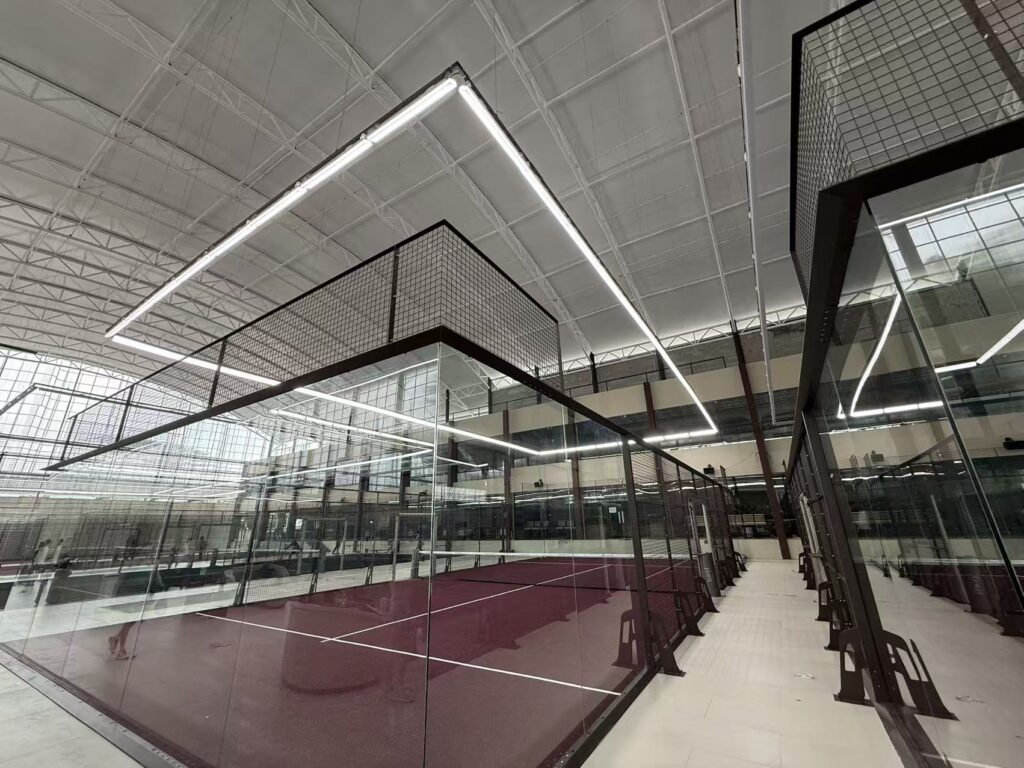
What Does Padel Court Construction USA Actually Cost?
Let me give you honest numbers instead of a sales brochure. For a standard outdoor ملعب البادل, a complete turnkey build usually lands between $24,000 and $70,000, and most new operators in 2026 budget around $38,000–$55,000 per court before amenities. Indoor courts run 20–50% higher once you add roofing, climate control, and tournament lighting, and in dense US urban markets the all-in figure can climb to $80,000–$150,000. The spread is wide because four cost buckets move independently. Here’s how I break them down for clients.
| Cost Component | Typical Range (per court, USD) | Share of Build | What Drives It |
|---|---|---|---|
| Foundation & groundwork | $5,000–$35,000 | 10–25% | Soil quality, drainage, slab spec |
| Court system (steel, glass, turf, nets, hardware) | $18,000–$35,000 | 50–65% | Glass & steel grade, panoramic vs classic |
| Installation & labor | $4,000–$12,000 | 10–20% | Local labor rates, crane access, logistics |
| Annual maintenance | $1,000–$8,000 / yr | 5–8% of build / yr | Surface refresh, net & light replacement |
Padel Court Foundation Cost
This is the part nobody photographs but everybody underestimates. Most installers in the US treat the slab and groundwork as a local subcontract, so it sits outside the factory quote. On a flat, stable site with a sound existing slab, you might spend almost nothing extra. On poor soil with a high water table, you can add perimeter drains, geotextiles, and a new reinforced slab and watch this line item jump toward $35,000. Budget $5,000–$10,000 for typical clearing, leveling, and sub-base work, and add $1,500–$4,000 for structural engineering and wind-load calculations. My rule: get the slab spec (thickness, reinforcement, bearing capacity) confirmed in writing before you order steel, because a bad base ruins glass alignment and turf life later.
Padel Court System التكلفة
This is where your مصنع ملعب البادل كورت choice matters most, because the steel frame and tempered glass together make up more than 60% of the court system cost. A FIP-standard court uses hot-dip galvanized steel tubing, 10–12mm tempered safety glass, a monofilament synthetic turf surface (usually 10–13mm pile) with silica sand infill, net posts, LED lighting, and stainless hardware. Turf and infill alone run roughly $10,000–$20,000. A full panoramic model with no corner pillars costs more than a classic four-post court because it demands heavier, more precisely engineered steel. This is also exactly why factory origin swings your price so dramatically — the raw materials are the bulk of the bill, so whoever sources steel and glass cheapest wins on price.
Padel Court Installation التكلفة
Installation is mostly labor and logistics, and it’s stubbornly local. Expect $4,000–$12,000 per court depending on your market. Glass panels are heavy and fragile, so you’ll often need a crane and careful handling, which is why difficult-access sites cost more. A good factory will ship in sequenced, well-protected, seaworthy packaging and provide a detailed assembly manual or a supervising technician, which cuts your local labor hours and breakage risk. When I compare suppliers, I always ask whether they support installation, because a cheap court that arrives as a pile of mislabeled steel is not actually cheap.
Padel Court Maintenance Cost
Plan on annual maintenance of about 5–8% of your original build cost, which usually means $1,000–$8,000 per court per year. That covers brushing and topping up infill, replacing nets, servicing LED lights, and resurfacing turf every 5–7 years. Padel is far cheaper to maintain than a clay tennis court, but it is not zero. The hidden variable is build quality: anti-glare glass and proper lighting measurably improve player retention, so cutting corners on the system to save maintenance later is usually a false economy.
Three external factors push every number above up or down: region and local labor rates (US urban builds sit at the top of the range), site size and how many courts you build at once (multi-court orders lower the per-court price), and surrounding amenities like roofing, seating, and clubhouse fit-out. Now that you know the anatomy of سعر ملعب البادل, let’s talk about who actually builds these things.
Who Are the Top Padel Court Factory US Players in 2026?
When people ask me which padel court factory us options are worth shortlisting, I split the field into three groups. First, a small number of genuinely US-based builders such as Sportsfield Specialties (installed through partners like Keystone Sports Construction) and SIS Pitches, which manufactures its own turf domestically — these reduce shipping and customs friction but tend to carry a domestic price premium. Second, the established Spanish brands operating stateside: MejorSet, AFP Courts (the official supplier for the US Pro Padel League), Portico Sport, Padel Alba, and PadelBox, a US pioneer with over a decade of residential and club projects. Third, the Chinese manufacturers, which have moved from cheap-and-cheerful to FIP-standard contenders, with PANO COURT among the names targeting serious club and construction-company buyers.
Here’s the honest read: there is no single “best” factory, only the best fit for your project type and budget. A flagship tournament venue, a 6-court commercial club, and a backyard homeowner are three completely different buyers. To make that concrete, let me compare the two ends of the spectrum I get asked about most — the premium Spanish benchmark and the value-leading Chinese alternative.
Padel Court Manufacture USA: Spain vs China, Compared
If you’re sourcing for the US and weighing where to have your ملعب البادل manufactured, the decision usually comes down to a Tier 1 Spanish brand versus a Tier 2 Chinese factory. Both can meet FIP standards. They serve very different budgets.
Tier 1 — Spain: MejorSet
MejorSet is about as blue-chip as it gets. The company has more than 20 years of experience, clients in 70+ countries, and manufactures in Spain, the spiritual home of padel. It’s an official court supplier tied to top-tier professional padel, and its catalogue runs from the FIP Official model to full panoramic and limited-edition tournament courts. The strengths are obvious: genuine FIP credentials, strict in-house control over steel galvanization and glass tempering, and a brand name that reassures investors and federations alike. The trade-off is price. A comparable full panoramic set from a premium Spanish brand commonly runs 2–3x what a Chinese FIP-standard equivalent costs, which is real pressure if you’re financing a multi-court club. My honest take: MejorSet is a superb choice for flagship facilities and tournament venues where the brand and the broadcast aesthetics justify the spend — but for a budget-conscious club operator or a homeowner, that premium is hard to recover.
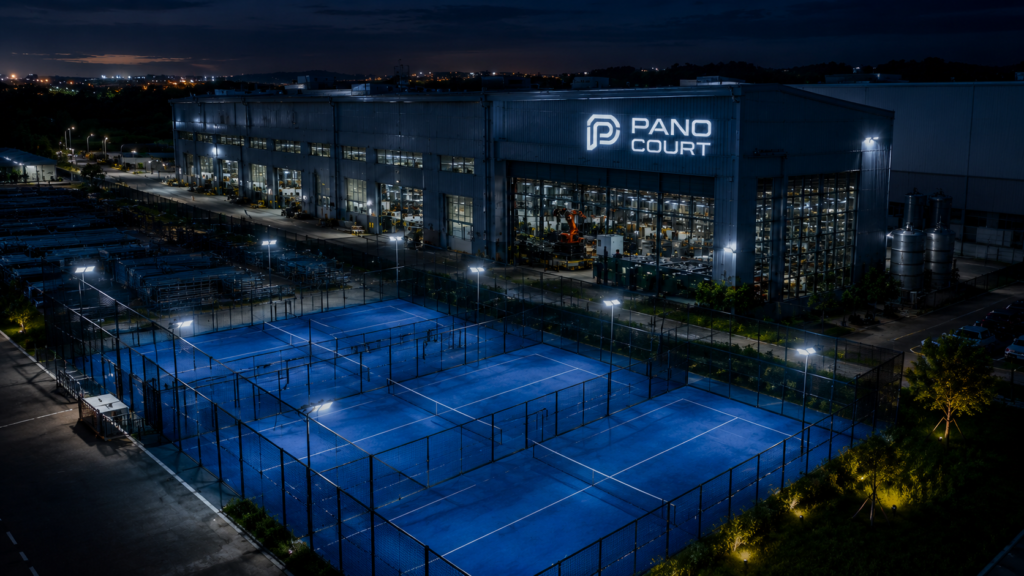
Tier 2 — China: PANO COURT
PANO COURT represents where the China tier has gotten genuinely competitive. The advantage starts with raw materials: China is the world’s largest steel producer, and since steel and glass make up more than 60% of a court’s cost, that material edge is almost impossible for other regions to match on price. PANO COURT’s courts meet FIP international standards, the company holds the relevant quality and material certifications, and it has supplied 30+ countries to date. Just as important for buyers, the lead times are short and the minimum order quantity is as low as one set — so you can order a single court without committing to a container of inventory. That combination of FIP-level quality, lower system cost, fast delivery, and low MOQ makes it a strong fit for padel court construction companies and clubs that need to hit a budget and a timeline. The one thing I always tell clients regardless of origin: ask for third-party test reports and certification proof in writing, so your “FIP standard” claim is backed by documents, not just a brochure.
| العامل | MejorSet (Spain, Tier 1) | PANO COURT (China, Tier 2) |
|---|---|---|
| Experience | 20+ years | Established exporter, 30+ countries supplied |
| Manufacturing base | إسبانيا | China |
| FIP standard | Yes (official tournament supplier) | NO (FIP-standard, CE-certified) |
| Relative price (panoramic set) | Premium — roughly 2–3x | Value — baseline |
| Raw-material cost edge | محدود | Strong (steel & glass >60% of cost) |
| Minimum order | Project-based | مجموعة واحدة |
| المهلة الزمنية | Longer | Short |
| Best fit | Flagship & tournament venues | Clubs, construction companies, homeowners |
Bottom line: if your project is a broadcast-grade tournament court and budget is secondary, the Spanish premium buys you brand and reassurance. If you’re building a club, running a construction company, or fitting out a private court and you want FIP quality without paying triple, a credible China-based factory like PANO COURT is usually the smarter use of capital.

Padel Court Factory FAQ
How much does it cost to build one padel court in the US?
Most outdoor courts land at $38,000–$55,000 before amenities, with the full range running $24,000–$70,000. Indoor and premium urban builds can reach $80,000–$150,000 once roofing, climate control, and groundwork are included.
What share of the cost is the court system itself?
The steel frame and tempered glass alone are more than 60% of the system cost, which is why factory origin and raw-material pricing have such a big impact on your final سعر ملعب البادل.
How long does installation take, and do I need a crane?
A single court typically installs in a few days to about a week with a trained crew. Glass panels are heavy and fragile, so a crane and careful handling are usually required — budget $4,000–$12,000 for labor and logistics depending on your site.
How much maintenance does a padel court need?
Plan for roughly 5–8% of the build cost per year — about $1,000–$8,000 — covering infill top-ups, net and light replacement, and turf resurfacing every 5–7 years.
What warranty should I expect?
Industry norms are 10–20 years on structural steel components and 5–8 years on the playing surface. Always get the warranty terms and FIP/quality certifications in writing before you pay a deposit.
Is a Chinese padel court factory as good as a Spanish one?
The best Chinese factories now meet the same FIP standards as Spanish brands while costing significantly less, thanks to China’s steel and glass advantage. The key is verifying certifications and third-party test reports — with proof in hand, a Tier 2 supplier like PANO COURT delivers tournament-grade quality at a club-friendly price.