
Australia crossed 100 padel courts during 2025 and is now tracking toward roughly 200 by the end of 2026. Padel Australia, the national governing body, reported ten new clubs opening in twelve months, a 40% year-on-year increase in available courts, and official recognition of padel by the Australian Sports Commission. Independent trackers listed 154 courts across 33 operational clubs as at 28 May 2026.
Three facts matter more to a padel court Australia investor than the headline growth number:
- Supply, not demand, is the bottleneck. Most Australian venues run at or near capacity during evenings and weekends. Sydney sits at roughly 0.3 courts per 100,000 residents — a fraction of mature European markets.
- Court density is still low in every state. NSW and VIC lead; QLD, WA, SA and the ACT are earlier. First-mover position in a suburban catchment is still available across most of the country.
- Recognition unlocks the pipeline. Australian Sports Commission recognition changes how councils, schools and multi-sport clubs treat padel in facility planning — which is where the next wave of four- and six-court projects will come from.
a padel court Australia investment — a four-court outdoor club, comparing a Spanish supplier against a China padel court factory, and trying to work out what a court actually costs once it is standing on the slab in Melbourne, Brisbane or Perth, not what it costs FOB.
Everything below is what we hand to a buyer before we quote a padel court Australia project. Where a number is a planning assumption rather than a firm price, it is labelled as one.
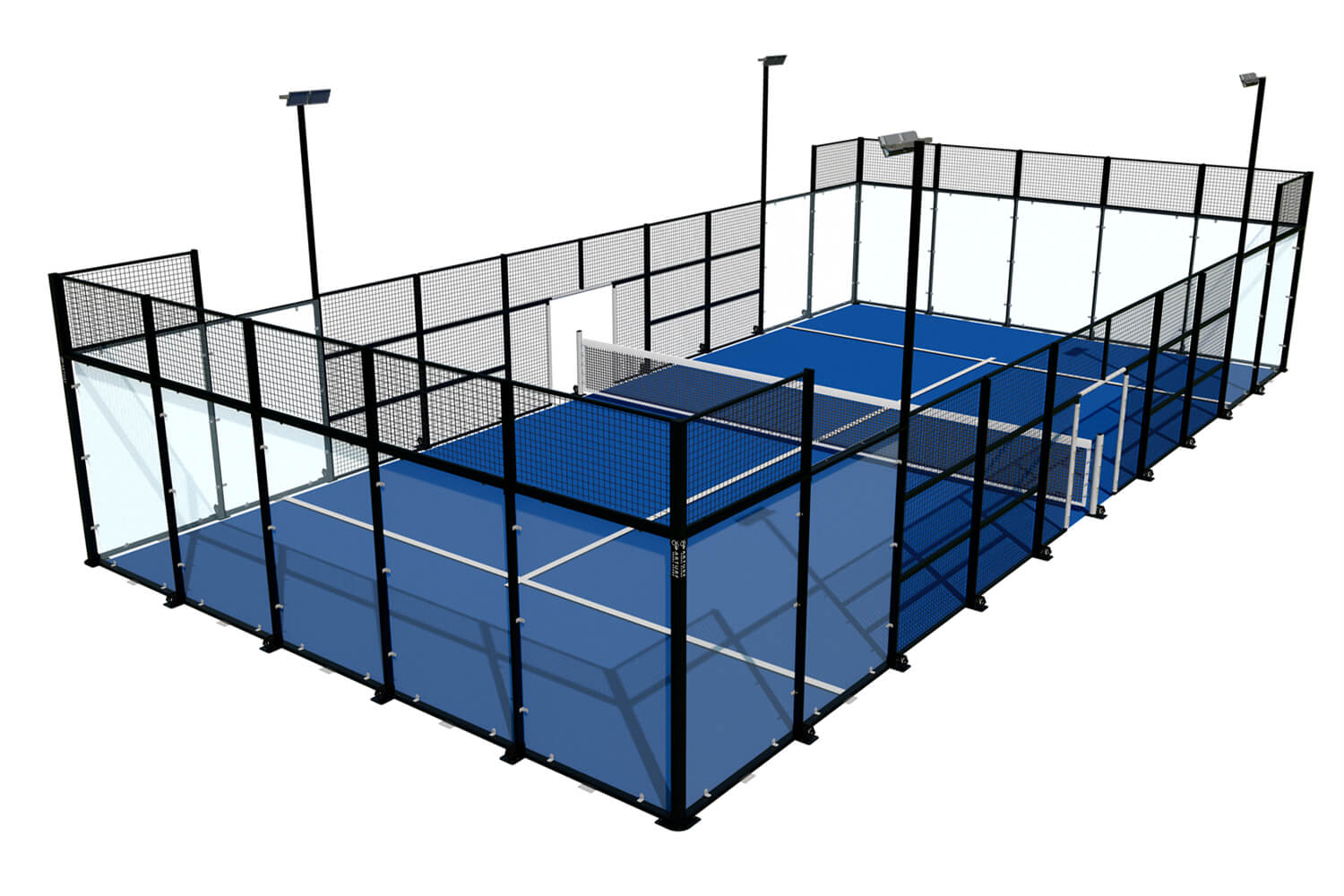
What Does This Padel Court Australia Guide Cover?
- Which specification suits your padel court Australia site
- A worked landed-cost breakdown for four courts, Tianjin to Melbourne
- Where China’s padel court factories are, and what documentation to demand
- Australian standards and approvals that apply to a padel court Australia build
- Local installer vs factory installation team — real cost comparison
- How Australian builders and installers work with a factory directly
Where Are Padel Courts Australia Manufactured?
Global padel court manufacturing sits in 3 clusters: إسبانيا (the historic centre, home to most premium brands), China (Hebei, Shandong and Guangdong — the volume steel-structure base), and Turkey (a mid-cost European-adjacent option). Almost every padel court Australia project is supplied by import. Even Australia’s most established suppliers state openly that their courts are built in Spain, Italy or China (like PANO court); what is manufactured locally is generally the synthetic turf layer, not the steel enclosure or the glass.
For a padel court Australia project, China has four structural advantages over Europe:
- Distance. Tianjin to Australian east-coast ports is a far shorter sea leg than Valencia or Barcelona, with fewer transhipments.
- Tariff treatment. Under the China–Australia Free Trade Agreement, Australian import tariffs on Chinese-origin goods were fully eliminated from 1 January 2019, subject to origin and classification rules. European-origin goods have no equivalent agreement in force.
- Lead time. Our production runs 15–20 days from confirmed deposit, against the longer queues typical of premium Spanish order books in peak season.
- Container economics. A complete court set weighs about 6 tonnes. Four courts fit one 40HQ, so a four-court padel court Australia project pays one ocean freight bill, not four.
Which Padel Court Australia Specification Suits Your Site?
a padel court Australia project is overwhelmingly an outdoor project, in a country with four distinct wind regions and a coastline that drives every corrosion decision. The court model matters far less than the structural grade and the corrosion system behind it. A specification that performs in Adelaide will fail early in Cairns.
Outdoor Courts — Wind Region Selection
Structural design actions are set by AS/NZS 1170.2:2021, which divides the country into wind regions A, B, C and D. This is the single most commonly ignored factor when Australian buyers compare padel court Australia quotations, because most international spec sheets are written to European wind assumptions.
| Wind region | Typical locations | Structural planning envelope | Anchor / base plate | Local engineer sign-off |
|---|---|---|---|---|
| Region A | Melbourne, Sydney, Adelaide, Canberra, Hobart, Perth metro, most inland areas | 100×100×2.5–3 mm corner posts, standard bay spacing | Standard chemical anchor set to approved P001 base-plate drawing | Required for DA; standard scope |
| Region B | Brisbane, Gold Coast, Sunshine Coast, northern NSW coast, parts of SA/WA coast | 100×100×3 mm corners, additional bracing, reviewed post spacing | Increased embedment and edge distance; thickened anchor zones in slab | Required; expect a specific wind-load check |
| Region C (cyclonic) | Cairns, Townsville, Mackay, Darwin, Broome | Project-specific engineered structure; heavier sections and base plates | Engineered anchor design mandatory; glass fixing detail reviewed | Mandatory, project-specific; certifier involvement |
| Region D (severe cyclonic) | Port Hedland, Karratha, Onslow, Exmouth | Treat as bespoke engineering, not a catalogue court | Fully engineered; may require an alternative enclosure strategy | Mandatory; budget engineering time before quoting |
Planning envelope only. Final sections, anchor sizes, embedment and torque must be designed by a locally licensed structural engineer against the approved P001 general-arrangement and base-plate drawings, the site survey, soil conditions and the local wind design basis. Anchor details are model-specific — never copy them from another supplier’s court.
Coastal and Corrosion Selection
AS 4312:2019 classifies Australian atmospheric corrosivity zones using the ISO 9223 categories, with an additional tropical classification. This is what should drive the zinc thickness and stainless grade on a padel court Australia build — not a supplier’s marketing claim.

| AS 4312 zone | Typical exposure | Steel protection | Fixings | الصيانة |
|---|---|---|---|---|
| C2 / C3 | Inland, urban, more than ~1 km from breaking surf | Hot-dip galvanized ≥60 µm zinc plus 3-layer powder system, 85–100 µm total | 304 stainless | Annual inspection; rinse as required |
| C4 | Coastal 200 m – 1 km from surf; light industrial | Duplex system: heavier zinc plus full powder coat; sealed and concealed joints | 316 stainless on exposed fixings | Quarterly fresh-water wash-down |
| C5-M | Within ~200 m of breaking surf | Maximum practical zinc, duplex coating, review of every dissimilar-metal interface | 316 throughout, including glass fittings and net posts | Monthly wash-down; documented regime affects warranty |
| Tropical (T) | Darwin, far north QLD | UV, not salt, is the coating driver — powder chemistry and film build matter more than zinc alone | 316 recommended | Coating inspection at shorter intervals |
Covered Court, Canopy, or Full Indoor?
Most projects land on one of three answers, and the decision changes a padel court Australia capital plan far more than the court model does:
- Open outdoor. Lowest capital cost, highest revenue exposure to rain and summer heat. Works well in Perth and Adelaide; harder through a Brisbane wet season.
- Canopy over outdoor courts. An aluminium or steel padel court canopy converts weather-lost hours into billable hours. In Australia the canopy is designed for wind uplift and UV, not snow load — a European canopy specification is the wrong starting point. See our padel court roof and canopy guide for clear-height and drainage detail.
- Indoor or warehouse conversion. The premium format in Melbourne and Sydney. Minimum 8 m clear height above the playing surface is the practical planning figure for club play; 9–10 m for competition. Warehouse conversions also need slab flatness verified before the court arrives, plus a lighting redesign, because existing warehouse lighting is almost never suitable.
PanoCourt Expert Recommendation: Match Turf and Lighting to the Climate
No single turf parameter is “higher is better”. Pile height affects ball response. Dtex is the linear mass of the yarn bundle. Tuft density is stitches per square metre. Face weight is the actual yarn used per square metre. A heavier total product weight can simply mean more backing and coating, not more yarn. Judge the whole system.
What we recommend for padel court Australia conditions:
- High-UV and hot regions (QLD, NT, northern WA): monofilament plus curled support-yarn hybrid, 12 mm pile, 9,500 Dtex, 63,000 stitches/m², double PP backing with PU coating and drainage holes, rounded silica infill 0.3–0.8 mm at 8–10 kg/m². Lighter colour selections reduce surface temperature.
- Coastal humid sites: prioritise backing drainage and a documented brushing schedule; standing water under the turf is the failure mode, not the fibre.
- Temperate southern sites: the standard commercial-grade system performs without modification.
- Lighting: 300–500 lux for club and recreational play; 500–750 lux where you intend to host ranked tournaments or filmed matches. Specify flicker-free, anti-glare, IP66 fixtures — and check obtrusive-light limits early, because that is what stalls outdoor lighting at council.
- الفولاذ: set wall thickness from the wind region and zinc thickness from the corrosion zone. These are two separate decisions and buyers routinely conflate them.
What Does a Padel Court Australia Project Cost to Land?
for a four-court outdoor padel court Australia project shipping Tianjin to Melbourne, our planning model puts the cash landed cost at roughly AUD 20,900 per court, or about AUD 19,200 per court net of recoverable GST — before any site civil works, foundations, electrical work or installation. The AUD 65,000–85,000 figures published around the Australian market are turnkey completed-project numbers. They are not comparable to a court supply price, and conflating them is the most common budgeting error we see.
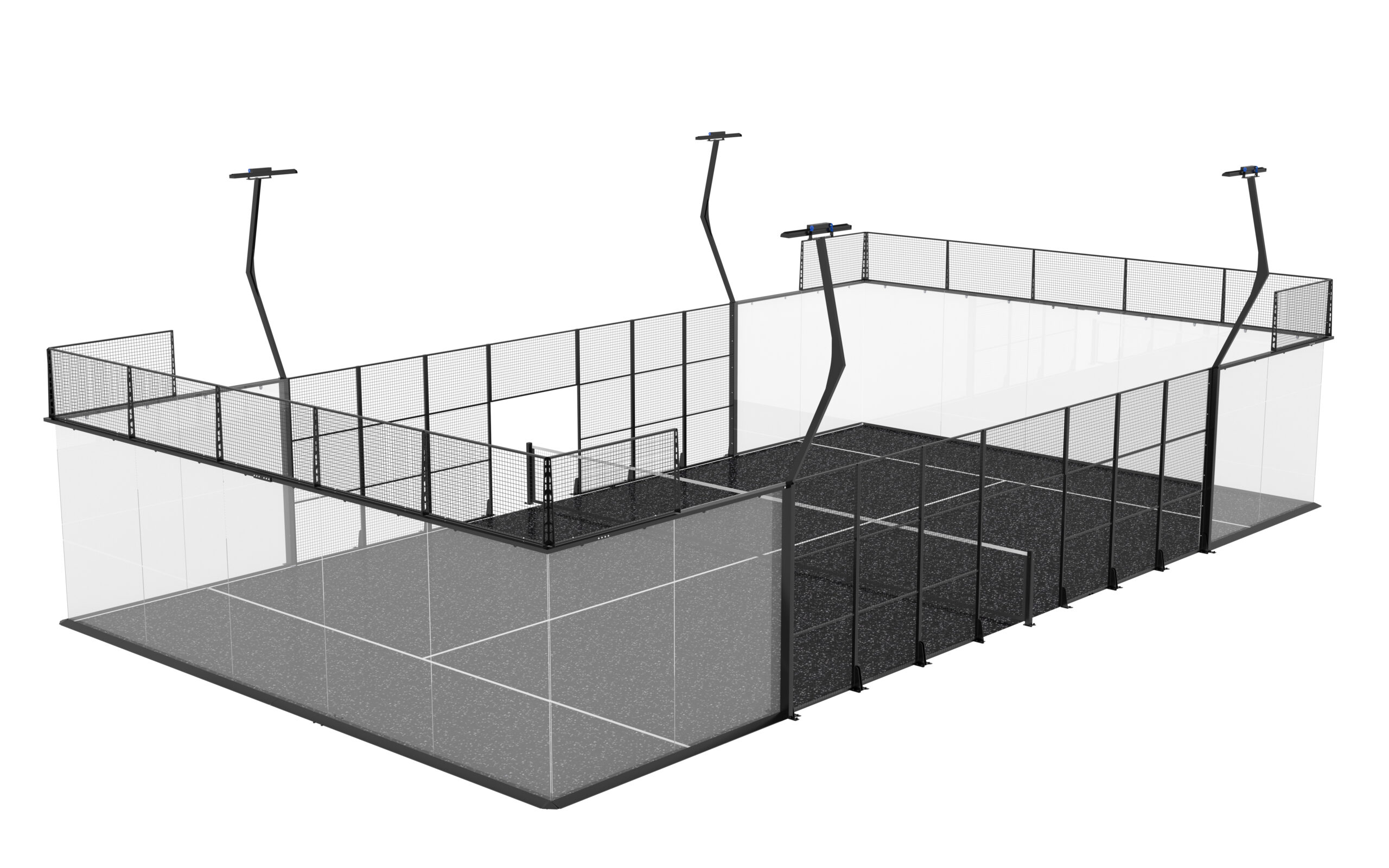
Here is the padel court Australia landed-cost build-up. Assumptions: 4 courts in 1×40HQ, FOB Tianjin USD 10,500 per set, USD 1.00 = AUD 1.50.
| طبقة التكلفة | AUD (4 courts) | الأساس |
|---|---|---|
| FOB equipment value | 63,000 | USD 42,000 × 1.50 |
| Ocean freight, 1×40HQ | 4,800 | Planning placeholder — replace with a written forwarder quote |
| التأمين البحري | 203 | 0.3% of FOB + freight |
| Customs duty (ChAFTA preferential) | 0 | MFN scenario would add 3,150 — see below |
| Import GST (10% of VoTI) | 6,800 | VoTI = customs value + transport & insurance + duty |
| Terminal / destination handling | 1,500 | Confirm with forwarder |
| Customs broker & import declaration | 450 | Confirm with broker |
| DAFF / biosecurity contingency | 500 | Contingency only; inspection outcomes vary |
| Metro inland delivery | 1,500 | Site access changes this materially |
| Unloading / crane / forklift | 900 | Site-specific |
| Contingency @ 5% | 3,983 | Planning allowance |
| Total landed, 4 courts | 83,636 | Excludes installation and all site works |
| Per court, cash | 20,909 | |
| Per court, net of recoverable GST | 19,209 | For a GST-registered importer |
Excluded and budgeted separately: site civil works and foundations, drainage, electrical supply and lighting installation, permits, local engineering and certifier fees, storage, demurrage and detention, and project financing. Our outdoor padel court foundation guide sets out the slab, reinforcement, anchor and tolerance scope that sits underneath these numbers.
Which Australian Port Should You Ship To?
| Discharge port | Serves | Planning note |
|---|---|---|
| Port Botany (Sydney) | NSW, ACT | Highest volume; inland trucking to regional NSW is the variable |
| Port of Melbourne | VIC, TAS, southern NSW | Most competitive destination charges in our experience |
| Port of Brisbane | QLD, northern NSW | Shortest sea leg from North China of the eastern ports |
| Fremantle | WA | Shortest overall transit; confirm inland access for a 40HQ at site |
Ship to the port nearest the padel court Australia site, not the port nearest your accountant. Container drayage across state lines erases the freight saving quickly. Confirm actual sailing schedules and transit windows with your forwarder — we do not publish transit days as a commitment.
ChAFTA, GST and the HS Code — What Your Broker Needs
Padel court Australia imports are generally classified under HS 9506 (sports goods). Under the China–Australia Free Trade Agreement, Chinese-origin goods meeting the rules of origin have had Australian tariffs fully eliminated since 1 January 2019. To claim it you need a valid Certificate of Origin or Declaration of Origin, which we issue with the shipping documents.
Do not treat that as settled by us. Ask your customs broker to confirm the correct HS classification for your configuration and your ChAFTA eligibility before you finalise a budget. Our model defaults to the MFN 5% scenario precisely so that a buyer who cannot support the preference is not surprised — the difference across four courts is about AUD 3,600.
استيراد GST is 10% of the Value of the Taxable Importation, which includes customs value, duty, and international transport and insurance. It is a cash-flow item rather than a true cost for a GST-registered business, and the Deferred GST Scheme is worth raising with your accountant if you are importing multiple containers.
ISPM 15 and Biosecurity — The Step Most Buyers Miss
Australia runs one of the strictest biosecurity regimes in the world, and timber packaging is a primary inspection target. All solid wood packaging must be treated and marked to ISPM 15; packaging showing signs of infestation is ordered for treatment, export or destruction at the importer’s cost.
What we supply with every padel court Australia shipment:
- Heat-treated timber crating with a visible IPPC mark carrying the CN country code and treatment provider code
- Heat treatment certification in the document set
- A packing declaration referencing ISPM 15 compliance on the commercial documentation
- Container cleanliness checked and photographed at loading, with the container number recorded against the packing list
This is routine for us and should not be a project risk. It becomes one when a supplier cannot produce the certificate on demand after the container has already arrived.
Where Are China’s Padel Court Factories, and What Should You Verify?
China’s manufacturing is concentrated in three areas. Hebei and Tianjin hold the steel-structure base — Hebei is China’s largest steel-pipe production region, which is why enclosure fabrication clusters there. شاندونغ supplies much of the synthetic turf. Guangdong has a smaller cluster oriented to trading companies and export agents.
That distinction matters. A large share of companies presenting as a “padel court factory” online are trading companies with no fabrication line. Four checks separate them on any padel court Australia enquiry:
- Ask for the production line, not the showroom. Laser cutting, welding, shot blasting and powder coating should be in-house and on one site. Ask for a live, unedited video walk-through.
- Ask for coating-thickness records. A real line samples zinc and powder thickness and logs it. Ours runs a fully automatic three-layer powder system to 85–100 µm total over hot-dip galvanized Q235 tube with ≥60 µm zinc.
- Ask for conformity documentation and read the scope. Ours includes an ECM attestation for padel court models verified to EN 1090-1:2009+A1:2011 and a UDEM technical inspection attestation against EN 10218-1:2012 and EN 10223-4:2012 for the wire mesh. These are product conformity attestations — they are not, and no supplier’s certificate is, an approval for your Australian site.
- Ask what happens after delivery. Spare glass panels, spare mesh, replacement fixings and drawing revisions are where importing goes wrong three years in, not at the port.
The Approval Point Every Buyer Should Understand
This is worth reading twice. No Chinese, Spanish or Turkish certificate approves a padel court Australia installation. European conformity documentation demonstrates the product was manufactured and verified to a recognised standard. Australian approval is a separate, site-specific process: a locally licensed structural engineer reviews the manufacturer’s drawings, post reactions and anchor schedule against AS/NZS 1170.2 wind actions, AS 4100 steel design and AS 3600 concrete design for your site, then certifies into your Development Application.
What we provide: the final P001 general arrangement, base-plate layout, post locations and anchor coordinate schedule, structural member schedules, material and coating certification, and wind and static load information on request. What your engineer provides: site-specific verification and the signature. Any supplier who claims their certificate removes the need for local engineering is telling you something that will not survive a council review.
What Australian Standards Apply to a Padel Court Australia Build?
Direct answer: in almost every council, a commercial padel court Australia project requires Development Approval covering structure, lighting, acoustics and often car parking. Budget 8–16 weeks for approval and start the conversation before you place a court order, not after.
The standards your engineer and certifier will apply to a padel court Australia build:
| المساحة | قياسي | What it governs on a padel court |
|---|---|---|
| Structural actions | AS/NZS 1170.0, 1170.1, 1170.2:2021 | Permanent, imposed and wind actions on the enclosure |
| Steel design | AS 4100 | Member capacity, connections, base plates |
| Concrete | AS 3600 | Slab and ring-beam design, reinforcement, anchor zones |
| Galvanizing | AS/NZS 4680, durability per AS/NZS 2312.2 | Zinc coating specification and life to first maintenance |
| Corrosivity zone | AS 4312:2019 | Which coating system your site actually needs |
| الزجاج | AS 1288 | Glass selection and installation in a structure |
| Sports lighting | AS 2560 series | Illuminance and uniformity for the level of play |
| Obtrusive light | AS 4282 | Spill light to neighbours — the most common outdoor DA objection |
| Building code | National Construction Code | Compliance pathway; classification of any roofed structure |
On foundations, our standing preliminary recommendation for a permanent outdoor court is a reinforced-concrete perimeter ring beam or strip foundation for all enclosure, glass-support and net-post base plates, with a free-draining internal court base — or a full reinforced slab with thickened structural perimeter zones where the local engineer confirms soil bearing capacity and anchor resistance. Planning envelope: minimum 30 MPa concrete at 28 days in structural and anchor zones, roughly 180–200 mm slab if a full slab is used, ring beam roughly 400–500 mm wide by 500–800 mm deep, flatness within about ±3 mm under a 3 m straightedge, and a controlled fall of about 0.5–1.0% toward the drainage route on a non-porous slab. Set out from the P001 drawing, never from a generic 20 × 10 m playing area.
Local Installer or Factory Team for a Padel Court Australia Project?
Direct answer: for a four-court job, a PanoCourt factory installation team costs roughly AUD 4,400 per court all-in, against roughly AUD 5,400 per court for a local four-person crew at an illustrative AUD 900 per person-day. The gap is smaller than most buyers assume, and it is not the number that should decide it.
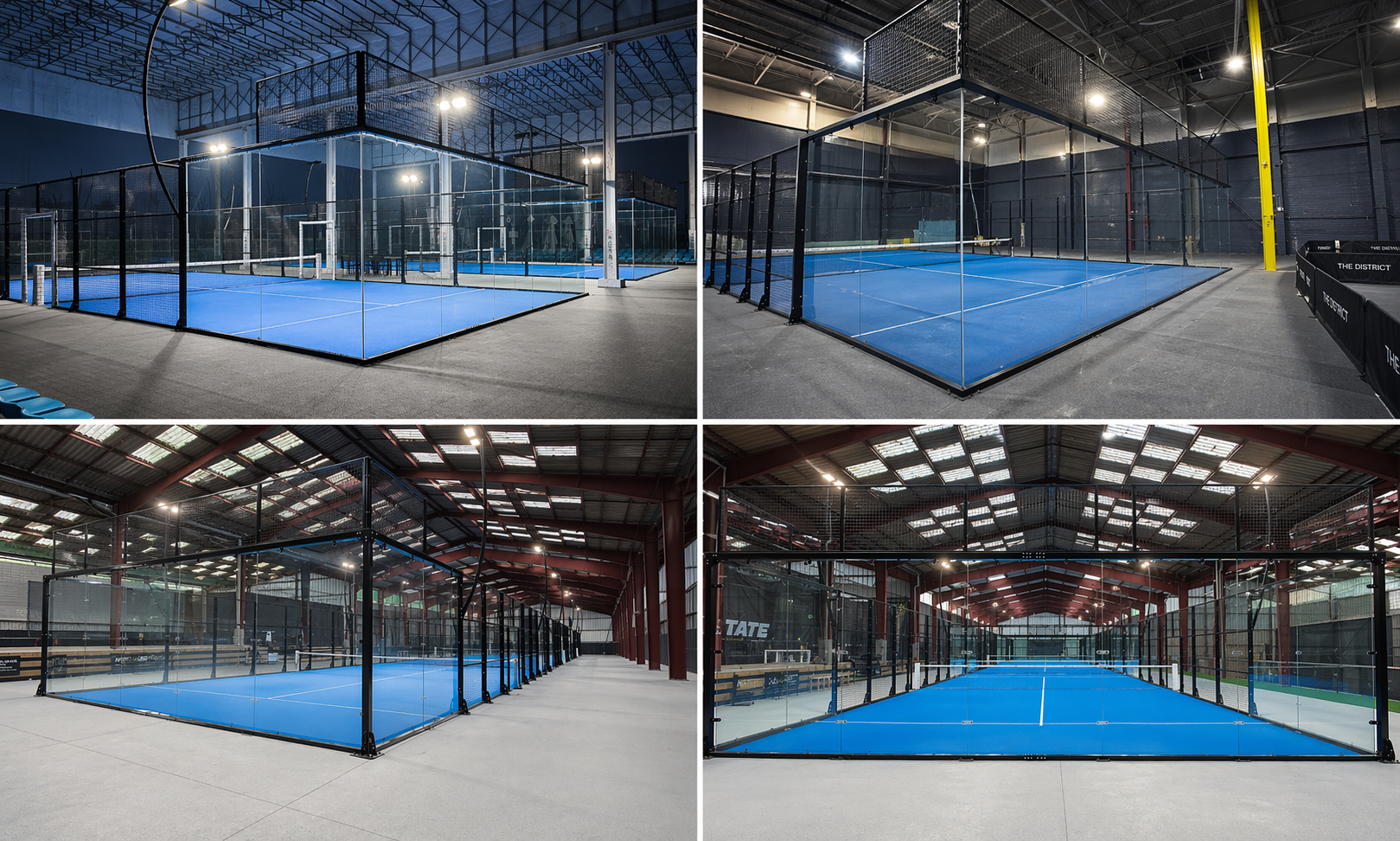
Option 1 — PanoCourt Factory Installation Team
Scope: 4 courts, 4 technicians, 5 working days on site. The buyer carries travel and living costs; technician wages are USD 100 per person per day.
| العنصر | USD | AUD @1.50 |
|---|---|---|
| Technician wages — 4 × 5 days × USD 100 | 2,000 | 3,000 |
| Return airfare — 4 × USD 1,000 | 4,000 | 6,000 |
| Accommodation & meals — 4 × 8 nights × USD 120 | 3,840 | 5,760 |
| Vehicle hire & fuel — 8 days | 800 | 1,200 |
| Visa & travel insurance — 4 × USD 250 | 1,000 | 1,500 |
| Total, 4 courts | 11,640 | 17,460 |
| Per court | 2,910 | 4,365 |
The constraint nobody mentions: Chinese technicians performing installation work in Australia need an appropriate visa — commonly a short-stay specialist work visa — arranged well in advance. Confirm the correct subclass and lead time with a registered Australian migration agent before building it into a program. A crew that cannot board is a schedule failure, not a cost line.
Option 2 — Local Australian Installer
Illustrative build-up: 4 people × 6 days × AUD 900 per person-day = AUD 21,600, or AUD 5,400 per court. Replace the day rate with two written quotes — it varies sharply by state and crew availability, and a first-time padel crew will take longer than six days.
What you buy for the premium: no visa or airfare exposure, faster mobilisation and re-mobilisation for snags, workmanship warranty enforceable in Australia, familiarity with local site rules and induction requirements, and someone who can return next month when a glass panel needs replacing.
Option 3 — The Hybrid, and What We Actually Recommend
One PanoCourt supervisor (approximately AUD 4,100 all-in) directing a local three-person crew for six days (approximately AUD 16,200) lands around AUD 20,300, or AUD 5,075 per court. You pay a small premium over a full factory crew and you get the factory’s assembly sequence knowledge plus a locally accountable workforce — and a trained local crew for your next expansion.
For a first padel court Australia project this is almost always the right call. Our supply includes CAD drawings with pre-labelled parts and free remote supervision by video call at no charge, which materially reduces site labour hours regardless of which crew you use. Full detail is in our padel court construction and installation guide.
How Do Australian Builders Work with a Padel Court Australia Factory Direct?
Most content about a padel court Australia project is written for club owners. This section is not. A large and growing share of our Australian enquiries come from sports-surface contractors, fencing and glazing installers, landscape and civil builders, and design practices who need a court supply layer behind their own client relationship.
What working with us directly looks like:
- Supply-only or supply-and-supervise. You keep the client, the civil works and the installation margin. We supply the court system, the drawings and the technical backing.
- OEM and white-label. We have manufactured to European premium standards for international brands and distributors for years. Your frame colour, your glass logo, your branding on the fencing.
- Drawing support before you quote. Send a site plan and we return a court layout, base-plate coordinates and load information your engineer can price against — before you commit to a tender.
- Trade pricing that scales. A 40HQ carries four courts. Consolidating two clients into one container is the single largest saving available to an Australian installer.
- Spares held for you. Glass panels, mesh sections and fixings are the difference between a two-day repair and a two-month one.
- Installation training. One supervised build and your crew owns the sequence. Padel installation is a genuine capability for a fencing or glazing business, not a one-off job.
الأسئلة الشائعة
How much does a padel court Australia project cost in 2026?
Landed court supply from a China padel court factory runs roughly AUD 19,000–21,000 per court for a four-court order shipped to a capital-city port, excluding site works. Completed turnkey projects including civil works, drainage, lighting and installation are commonly quoted in the AUD 65,000–100,000 per court range depending on ground conditions and whether the court is covered.
Do I pay import duty on a padel court in Australia?
Chinese-origin goods meeting ChAFTA rules of origin have had Australian tariffs eliminated since 1 January 2019, so the preferential rate is generally nil with a valid Certificate of Origin. The MFN scenario is 5%. Confirm both the HS classification and your preference eligibility with your customs broker before finalising a budget.
What are the padel court dimensions in Australia?
The playing area is 20 × 10 m for doubles and 20 × 6 m for singles, the same worldwide. For site planning allow at least 21 × 11 m per court to accommodate structure, run-out and walkways. A four-court commercial club needs roughly 1,000–1,200 m² once amenities and player circulation are included.
How long does delivery take from China to Australia?
Production runs 25–30 days from confirmed deposit receipt. Sea freight and port handling follow. Confirm the transit window against your forwarder’s actual sailing schedule rather than a supplier’s marketing figure, and add contingency for biosecurity inspection.
Do I need council approval for a padel court Australia project?
In almost all cases, yes. Development Approval typically covers the structure, lighting, acoustics and parking. Outdoor floodlighting is the most frequent objection point, so address obtrusive light limits under AS 4282 in the application rather than after a complaint.
What ceiling height does an indoor padel court need?
Plan for a minimum of 8 m clear above the playing surface for club play, and 9–10 m for competition. Measure the lowest obstruction, not the ridge — sprinklers, ducting and beams are what actually constrain a warehouse conversion.
Can a padel court handle cyclonic conditions in northern Australia?
Only as a project-specific engineered structure. AS/NZS 1170.2 Regions C and D require a design developed for the site, with heavier sections, engineered anchors and a reviewed glass fixing strategy. Treat a Region C or D court as a bespoke build with engineering time budgeted in.
What warranty applies to a padel court supplier in Australia?
Ask three questions: what is covered, who executes it in Australia, and what maintenance conditions void it. A structural warranty is worth little without a local party who can act on it, which is one reason the hybrid installation model matters more than the headline warranty period.
Is it cheaper to buy through an Australian distributor or direct from the factory?
Factory-direct removes a margin layer but transfers importer responsibility, customs classification and installation coordination to you. It suits investors building four or more courts, and builders who already run projects. A single-court private buyer is usually better served by a local distributor.
What documentation should I request before paying a deposit?
Structural member schedules, coating specification with thickness values, glass and mesh certification, the P001 general arrangement and base-plate drawing, conformity attestations with their scope stated, packing list with container loading plan, and an ISPM 15 treatment declaration.
Building a Padel Court Australia Project: Where to Start
The padel court Australia market is at the point European markets reached around 2018 — enough proven demand to justify a four-court club, not enough supply to make the catchment competitive. The projects that succeed get three things right early: a specification matched to the actual wind region and corrosion zone, a landed-cost model that separates court supply from site works, and an installation plan decided before the container sails.
PanoCourt manufactures in Hebei, China’s steel-structure base, with laser cutting, welding, shot blasting and a fully automatic three-layer powder coating line in-house. Ten years in sports court steel structures, OEM production for European brands, and 600 court sets produced in 2025. Every court is custom designed and produced against an approved drawing.
Request a padel court Australia landed-cost quotation — FOB Tianjin plus freight to your port. Send your site location, court quantity, preferred model and target schedule, and we will return a configured specification, the P001 drawing package your engineer needs, and a landed-cost worksheet built on your own port and exchange rate rather than ours.
Related reading: landed cost from a China padel court factory · the complete 2026 import guide · outdoor padel court foundation specifications
Commercial boundary: PanoCourt supplies the factory scope. Final import classification, Australian duty and tax treatment, local approvals, foundations, electrical works, unloading and installation must be confirmed by the importer, a licensed customs broker, and qualified local engineering and construction professionals. Cost figures in this article are planning estimates, not quotations.