
Reino Unido fabricantes de canchas de pádel se dividen en dos grupos principales de proveedores: las fábricas españolas y la fábrica china de pádel. España desarrolló el lenguaje de diseño de este deporte y su infraestructura de torneos profesionales. China ha ganado una cuota cada vez mayor en las nuevas instalaciones del Reino Unido gracias a las ventajas en el costo de las materias primas y a su capacidad de producción a gran escala.
Según el Asociación de Tenis sobre Césped, Gran Bretaña cerró el año 2025 con 1.553 canchas de pádel repartidas en 559 instalaciones, lo que supone un aumento respecto a las 870 canchas en 293 instalaciones del año anterior, y frente a las apenas 69 canchas que había en 2020. El Reino Unido no publica datos aduaneros que separen las estructuras de canchas de pádel como una categoría propia, por lo que no se lleva un registro oficial de las cifras exactas de la participación en las importaciones entre España y China. Lo que las plataformas de abastecimiento y los registros de exportación de las fábricas muestran de manera consistente es un cambio estructural: los operadores británicos establecidos con ambiciones de formar parte de la FIP o de Premier Padel siguen inclinándose por los proveedores españoles, mientras que los clubes comunitarios, los centros de ocio y los recintos comerciales con múltiples canchas están optando cada vez más por estructuras panorámicas y modulares de fabricación china para controlar el costo de capital por cancha.
España sigue siendo el referente técnico de este deporte. Sus fabricantes crearon el formato original de canchas de vidrio y malla, suministran las canchas oficiales para los eventos de Premier Padel y la FIP, y cuentan con el equipo más amplio de instaladores certificados y socios especializados en superficies. Ese legado conlleva un sobreprecio, que se justifica en el caso de las canchas insignia y de competencia, pero que es más difícil de justificar en el caso de una cancha comunitaria utilizada principalmente para reservas recreativas.
Fabricante chino de canchas de pádel((como Pano Court) La producción se concentra en Hebei y Shandong. Estos clústeres combinan el procesamiento de acero, la producción de vidrio templado y la fabricación de césped sintético en cadenas de suministro cortas, lo que reduce los tiempos de entrega y el costo de entrega. La brecha de calidad con respecto a las fábricas europeas se ha reducido significativamente en los últimos tres años, especialmente en los formatos estándar de canchas panorámicas y clásicas construidas según las dimensiones establecidas por la FIP.
Si estás pensando en invertir en un club de pádel o en un centro deportivo, ya sea como inversionista o como la empresa constructora de canchas de pádel encargada de ejecutar el proyecto, la planificación del diseño y la selección del fabricante deben coordinarse, no manejarse por separado. Se trata de un proyecto único sin etapas prescindibles. Una cancha comunitaria, Por ejemplo, el perfil de uso debería determinar qué fabricante de canchas de pádel y qué categoría de materiales elijas. Especificar vidrio, perfiles y revestimiento de nivel de competencia para una cancha que, en su mayoría, se utilizará para reservas ocasionales de fin de semana es, simplemente, un gasto excesivo que no se justifica en el presupuesto.
¿Qué es un fabricante de canchas de pádel?
Un fabricante de canchas de pádel diseña y produce el sistema estructural de una cancha de pádel: el armazón de acero galvanizado, los paneles de vidrio templado, las mallas de protección, la integración del sistema de iluminación y el césped artificial. Algunos fabricantes operan únicamente como proveedores de canchas de pádel, enviando componentes para que sean instalados por terceros. Otros operan como constructores integrales de canchas de pádel, encargándose del apoyo en el diseño, el transporte, el montaje en el lugar y el mantenimiento posventa.
Esta distinción es importante a la hora de comparar cotizaciones. Un precio unitario bajo de un proveedor que no instala ni garantiza la estructura no es directamente comparable con un precio “llave en mano” de un fabricante que controla toda la cadena de suministro. Siempre confirma qué alcance de trabajo está incluido antes de comparar dos cifras.
¿Cómo se fabrican las canchas de pádel? Materiales utilizados en su construcción
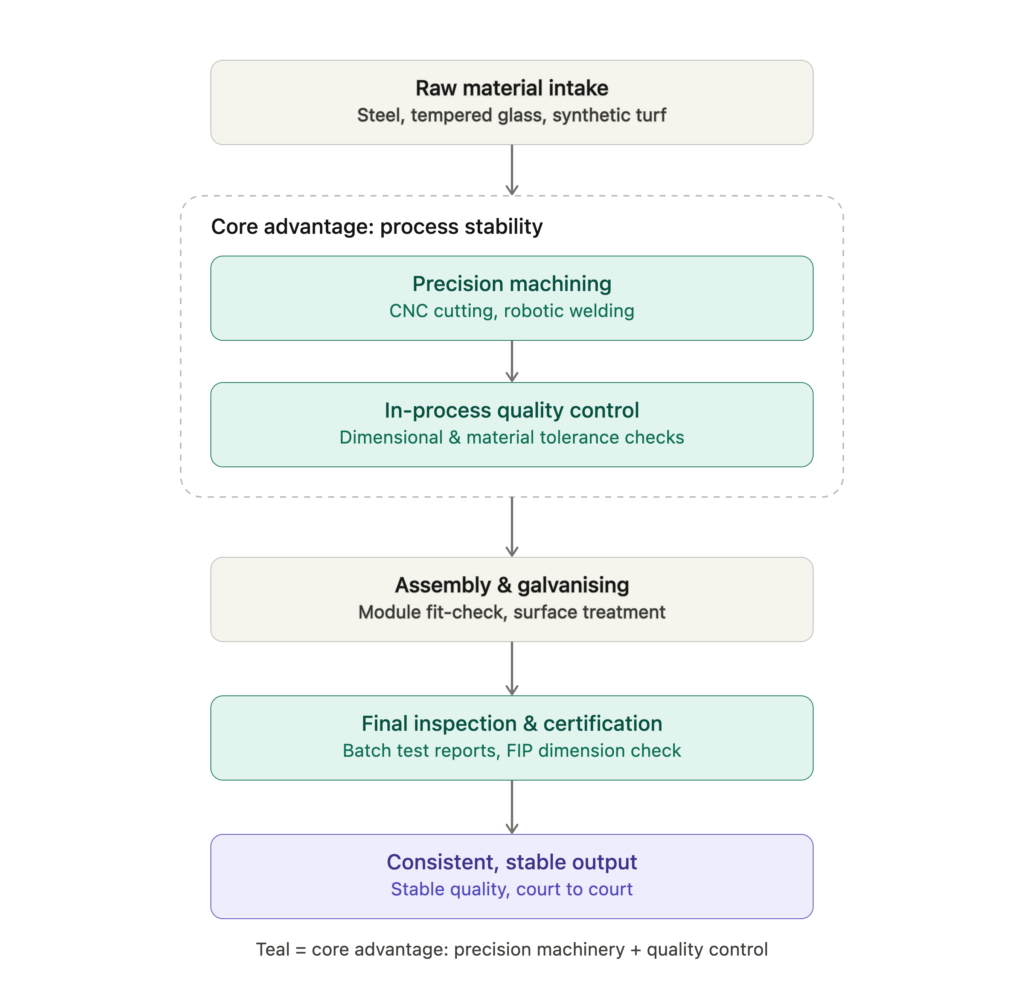
Una cancha de pádel es una instalación diseñada, no una superficie pintada. Hay tres tipos de materiales que determinan el costo, la durabilidad y la calidad de juego.
Estructura de acero. El marco es de acero galvanizado por inmersión en caliente, con un espesor de pared de entre 2,5 y 3 mm en los postes principales, y está diseñado para resistir la carga del viento y la corrosión. Las ubicaciones costeras y las zonas del interior expuestas del Reino Unido requieren una especificación de galvanizado más resistente que la configuración estándar de exportación del fabricante.
Vidrio. Las paredes utilizan vidrio de seguridad templado de 10 mm o 12 mm, ya sea atornillado en paneles enmarcados o, en el caso de las canchas de pádel panorámicas, fijado con una visibilidad mínima del marco para ofrecer una vista sin obstáculos. Las configuraciones panorámicas tienen un costo más elevado por metro cuadrado debido a que las tolerancias del vidrio y de los herrajes de fijación son más estrictas.
Césped. El césped sintético para padel utiliza una fibra monofilamento con relleno de arena de sílice, diseñada para proporcionar un rebote constante de la pelota y un buen agarre para los jugadores. La altura del pelo, la densidad y la proporción de relleno influyen tanto en la calidad del juego como en la resistencia a la abrasión a lo largo de un ciclo de uso de varios años.
¿Cuál es el proceso y el plazo para construir una cancha de pádel en el Reino Unido?
La construcción de canchas de pádel en el Reino Unido se lleva a cabo en tres etapas secuenciales. Acortar esta secuencia es la causa más común de retrasos en los proyectos.
| Paso | Actividad | Duración habitual | Quiénes participan |
|---|---|---|---|
| 1 | Diseño y planificación: estudio del sitio, distribución del espacio, visualización en 3D, documentación para la solicitud de permiso de construcción | 3 a 6 semanas | Consultoría de arquitectura o de diseño específico para pádel |
| 2 | Aprobación del proyecto: revisión por parte de la autoridad local, posible evaluación del ruido y la iluminación | De 8 a 13 semanas (plazo estándar); más tiempo si se solicita una revisión por parte del comité | Autoridad local de planificación, consultor de planificación |
| 3a | Modalidad de contratista «llave en mano»: entrega del diseño, selección de fabricantes, despacho aduanal, transporte, obras de cimentación, instalación y puesta en marcha | De 10 a 16 semanas a partir de la firma del contrato | Contratista general, fabricante de canchas de pádel, agente de carga |
| 3b | Ruta directa a fábrica: el cliente se encarga por separado del diseño de la interfaz, los trámites aduaneros y los trabajos de preparación locales; el fabricante realiza el envío y supervisa la instalación | De 8 a 14 semanas a partir de la confirmación del pedido | Cliente o gerente de proyecto designado, fábrica de canchas de pádel, contratista local de obras de cimentación |
La ruta 3a, el modelo de contratista general, delega cada paso a una sola empresa que subcontrata el diseño y la fabricación. Esto reduce el trabajo de coordinación para el cliente, pero añade una capa de margen, ya que el contratista aún debe pagar a la firma de diseño y a la fábrica. La opción 3b elimina ese margen, pero requiere que el cliente, o PanoCourt como socio del cliente por parte del fabricante, se coordine directamente con el contratista local de obras de cimentación.
¿Cuáles son las mejores empresas de diseño de canchas de pádel en el Reino Unido?
El diseño de canchas de pádel en el Reino Unido cuenta ahora con especialistas dedicados a esta disciplina, en lugar de solo arquitectos deportivos generales. The Padel Architects es un estudio acreditado por el RIBA que se enfoca exclusivamente en el diseño de clubes de pádel, abarcando desde la viabilidad hasta la coordinación de la construcción. Padel Court Design funciona como una consultoría centrada en la planificación, que elabora paquetes de visualización CGI utilizados tanto para solicitudes de permisos de construcción como para presentaciones a inversionistas.
Varios estudios de arquitectura deportiva consolidados también se han sumado al pádel a medida que crecía la demanda: Zebra Architects ha diseñado recintos con múltiples canchas que combinan canchas interiores y al aire libre con espacios sociales; gcp Chartered Architects cuenta con un equipo deportivo especializado que se encarga de la reconversión de canchas de tenis existentes y edificios subutilizados en canchas de pádel; y CPMG Architects ha construido varios complejos de pádel en la región de Midlands, incluyendo proyectos de múltiples canchas que ya cuentan con la aprobación de las autoridades de planificación.
El valor de una empresa de diseño se concentra en dos resultados: una solicitud de permiso de construcción que se apruebe sin una segunda ronda de objeciones, y un diseño que haga coincidir el número de locales con la frecuencia de uso realista del sitio. Invertir en visualizaciones elaboradas sin un historial sólido en materia de permisos de construcción es un desperdicio común del presupuesto en las primeras etapas.
¿Cuáles son las mejores empresas de construcción de canchas de pádel en el Reino Unido?
En lo que respecta a la construcción e instalación, iPadel Ltd opera como una consultora independiente que solicita cotizaciones a diversos proveedores de canchas y supervisa la instalación, en lugar de fabricar las canchas por sí misma. Quickpadel se encarga del apoyo en la planificación y la instalación como constructora de canchas de padel con sede en el Reino Unido, y trabaja directamente en las evaluaciones del sitio, incluyendo estudios de ruido y topográficos.
Las empresas de construcción en este sector suelen dividirse en dos modelos: consultoras independientes que comparan a varios fabricantes en nombre del cliente, e instaladores vinculados a un fabricante que solo utilizan productos de una sola marca. Las consultoras independientes ofrecen mayor transparencia en los precios; los instaladores vinculados a un fabricante suelen ofrecer plazos de entrega más rápidos y un único punto de responsabilidad para la estructura.
Portico Sport Reino Unido : Orígenes en la industria manufacturera española; nueva fábrica de 10 000 m² construida en 2023; diseño y fabricación propios de 100%; soluciones integrales de canchas y marquesinas; alianza estratégica con la marca HEAD PorticosportAbarca las principales ciudades del Reino Unido, entre ellas Londres, Manchester y Birmingham; servicio integral desde la planificación y el diseño hasta la instalación
- Hexa PadelUno de los constructores de canchas de pádel más grandes del Reino Unido. Cuenta con una sólida experiencia técnica y una amplia red de socios; los testimonios de los clientes destacan la flexibilidad en la ejecución y el sólido servicio posventa. HexapadelDe principio a fin, desde la planificación y la logística hasta la instalación y el servicio posventa; los testimonios mencionan una estrecha colaboración con los directores de deportes de raqueta de los clubes desde la etapa de diseño en adelante
- Canchas de pádel PROFundada en 2019, su fundador cuenta con más de 25 años de experiencia en la industria del tenis en el Reino Unido. Colabora con fabricantes de primer nivel en España e Italia, y se dirige a clientes privados, clubes e instituciones de alto nivel; es el único proveedor de canchas de pádel reconocido en la lista «100 Ones to Watch 2025» de The Times. Pro PadelAsesoría en las etapas iniciales, planificación y viabilidad de financiamiento a través de la gestión integral del ciclo de vida del proyecto
- iPadel LtdDistribuidor exclusivo en el Reino Unido de productos Adidas para canchas de pádel. Homologado técnicamente por British Padel como uno de los principales proveedores de canchas de pádel del Reino Unido. iPadel LtdExperiencia en proyectos a nivel mundial, con especial énfasis en la experiencia en instalaciones y en los estándares de la industriaSG PadelDistribuidor oficial en el Reino Unido de las canchas MejorSet. Se promociona como proveedor de sistemas de canchas de “la mejor calidad del mundo”, con un alto grado de personalización que incluye soluciones de techado al estilo de los graneros holandeses. SG PadelCiclo completo, desde el estudio de viabilidad, los trabajos de cimentación, drenaje y preparación del terreno, pasando por el suministro y la instalación, hasta el mantenimiento a largo plazo SG Padel
¿Cuáles son los principales fabricantes mundiales de canchas de pádel?
Dos regiones productoras suministran la mayor parte de las canchas de pádel del mundo: España, donde se originaron el estilo de diseño y la infraestructura de torneos de este deporte, y China, que en la última década se ha convertido en la principal fuente de exportación de estructuras de canchas panorámicas, clásicas y modulares.
España: El punto de referencia de nivel de torneo
- Padel Galis (Valencia) — Más de 20 años en el mercado, más de 10,000 canchas instaladas en 85 países, proveedor oficial de más de 50 torneos profesionales, entre ellos el World Padel Tour y el Premier Padel.
- Portico Sport (Barcelona) — en funcionamiento desde 2009, más de 4,000 instalaciones en más de 35 países, diseño y fabricación totalmente internos con una nueva fábrica de 10,000 m² inaugurada en 2023.
- JUBOpadel — 28 años de experiencia en diseño, fabricación e instalación, con más de 6,000 canchas entregadas en todo el mundo, conformes a la norma UNE 147201:2024 y a las normas estructurales del Eurocódigo.
- Padel10 (Barcelona) — proveedor oficial de canchas del World Padel Tour durante cuatro años consecutivos, con más de 4.500 canchas fabricadas y exportadas, y un plazo de producción estándar de 15 días.
- MejorSet (Alicante) — Más de 20 años de experiencia, canchas oficiales para eventos de Premier Padel y de la FIP, con un ciclo promedio de construcción e instalación de aproximadamente 33 días.
China: líder en costos y capacidad
La producción manufacturera china se concentra en clústeres industriales repartidos por Hebei y Shandong, donde la transformación del acero, el templado del vidrio y la producción de césped forman parte de la misma cadena de suministro regional. En este contexto, PanoCourt Se ha consolidado como uno de los principales fabricantes de canchas de pádel de China, con sede en la provincia de Hebei —sede de una de las bases industriales de tubos de acero y malla metálica más grandes del país, que suministra estructuras de acero galvanizado y materiales para cercas a fabricantes de todo el país—.
La posición de PanoCourt se basa en dos ventajas estructurales, más allá de su mera escala. En primer lugar, su ubicación en Hebei la sitúa directamente en el seno de la cadena de suministro de materias primas que ha sustentado durante décadas la industria de exportación de malla de alambre y tubos de acero de la región, lo que le brinda un acceso a los materiales y un control de costos que las fábricas fuera de estos clústeres no pueden igualar fácilmente.
En segundo lugar, la fábrica tiene su origen en el rubro de las vallas deportivas y las estructuras de cerramiento, con más de diez años de experiencia en la producción de vallas para canchas antes de dar el salto a la fabricación específica para el pádel, lo que significa que sus procesos de soldadura, galvanización e ingeniería estructural ya estaban consolidados y no se desarrollaron desde cero para el mercado del pádel.
Esta combinación de proximidad a las materias primas y experiencia heredada en ingeniería de cercas sustenta el enfoque de PanoCourt en sistemas de canchas de pádel hechos a la medida, en lugar de una única línea de productos fija. En 2025, la fábrica entregó más de 1,000 conjuntos de canchas y exportó a más de 30 países, lo que la posicionó entre los principales fabricantes chinos de canchas de pádel, tanto en escala de producción como en capacidad de personalización.
España vs. China: Comparación de fabricantes
| Dimensión | España | China |
|---|---|---|
| Materias primas | Acero certificado por la UE y vidrio templado con certificación CE que cumplen rigurosamente con las normas de conformidad, aunque los materiales suelen obtenerse fuera de la región donde se encuentra la fábrica, lo que añade pasos a la cadena de suministro. | Los materiales se obtienen dentro del mismo complejo industrial donde se lleva a cabo la producción —por ejemplo, la planta de PanoCourt en Hebei se encuentra dentro de un centro de larga tradición dedicado a la fabricación de tubos de acero y malla metálica—, lo que permite un mayor control de los costos y garantiza la continuidad del suministro. |
| Tiempo de producción | Aproximadamente entre 15 y 33 días desde la fábrica en el caso de los principales fabricantes, con tiempos de espera más largos durante la temporada alta de primavera/verano en Europa. | Aproximadamente entre 20 y 30 días desde la fábrica, con múltiples líneas de producción en paralelo que brindan mayor flexibilidad para atender pedidos grandes o que abarcan varias regiones durante los períodos de mayor demanda. |
| Precio | Posicionamiento de lujo: la tradición de la marca y las credenciales en torneos conllevan un precio más elevado que se justifica en el caso de los recintos insignia y de competencia. | Por lo general, su precio de fábrica es entre 20 y 35% más bajo que el de productos con especificaciones comparables, lo que lo convierte en la opción más rentable para espacios comunitarios, centros de ocio y locales comerciales. |
| Garantía | Condiciones de garantía vinculadas a la certificación de nivel federal y a las normas de la UE, con un alto nivel de confianza en la marca. | Las principales fábricas chinas cumplen ahora con las normas internacionales de garantía, que suelen consistir en garantías de 5 años para la estructura y el césped, respaldadas por informes documentados de pruebas de materiales. |
| Servicio y personalización | Redes de servicio locales bien establecidas en Europa, apoyo financiero y herramientas de diseño CGI/3D en el punto de venta. | Gran flexibilidad en cuanto a dimensiones personalizadas, colores, espesor del vidrio y configuración de la marquesina, con la documentación de exportación EXW/FOB/CIF gestionada directamente por la fábrica. |
Para los compradores del Reino Unido, la conclusión práctica es que la mayoría de las fábricas de ambos lados ahora fabrican según el mismo estándar dimensional FIP, por lo que la decisión se reduce a dónde se ubica un proyecto en la curva de gasto frente a credenciales. España sigue siendo el punto de referencia para instalaciones emblemáticas y de nivel competitivo. China —y PanoCourt en particular, gracias a su posición en la cadena de suministro de Hebei y a su década de experiencia en la fabricación de vallas— se ha convertido en la opción predeterminada para los operadores que necesitan una cancha personalizada y bien documentada a un costo final más bajo y con una capacidad confiable de entrega por lotes.
¿Cuánto cuesta construir una cancha de pádel en el Reino Unido?
El costo de construcción de una cancha de pádel en el Reino Unido se divide en cuatro componentes, y las cotizaciones que los agrupan sin un desglose por partida son más difíciles de comparar de manera justa.
| Componente de costo | Qué cubre | Porcentaje típico del gasto total |
|---|---|---|
| Estructura de la cancha (saliendo de fábrica) | Estructura de acero, vidrio, malla, césped artificial, luminarias | 40–55% |
| Transporte y aduanas | Transporte marítimo o terrestre, aranceles de importación, manejo en puertos del Reino Unido | 8–15% |
| Trabajos de cimentación y cimientos | Losa, drenaje, nivelación, conexión de servicios públicos | 15–25% |
| Instalación y puesta en marcha | Montaje, pruebas y entrega en el lugar | 10–20% |
Las canchas interiores y cubiertas añaden el costo de una cubierta estructural o del armazón del edificio a esta base de referencia, lo cual suele ser la variable más importante que diferencia dos cotizaciones que, por lo demás, son comparables. Los factores específicos del sitio, como las condiciones del terreno, el acceso para los vehículos de entrega y la proximidad a propiedades residenciales para la mitigación acústica, pueden alterar considerablemente el costo de los trabajos de cimentación y deben confirmarse antes de comparar las cotizaciones de los proveedores.
¿Cuáles son los errores más comunes al elegir un proveedor de canchas de pádel?
El error más común es comparar el precio unitario de fábrica sin verificar qué conceptos quedan excluidos. El flete, los aranceles aduaneros, los trabajos de cimentación y la supervisión en el lugar de la obra a veces se cotizan por separado y otras veces se incluyen en el precio total, por lo que un precio nominal más bajo puede, aun así, resultar en un costo total más elevado.
Un segundo error común es especificar materiales de nivel de competencia para un recinto con uso recreativo. Adaptar las especificaciones de la cancha a la frecuencia de uso prevista, y no a lo que se ve más impresionante en una presentación de ventas, protege la rentabilidad de un proyecto comunitario o de un centro de ocio.
Un tercer error es saltarse la verificación de la fábrica. Se deben verificar la capacidad de producción, el número de empleados, la superficie de la fábrica y los informes de pruebas de terceros para el vidrio y el césped antes de realizar un depósito, especialmente en el caso de compradores del Reino Unido que trabajan por primera vez con un fabricante extranjero de canchas de pádel.
¿Por qué resulta rentable abastecerse de una fábrica china para proyectos en el Reino Unido?
La ventaja de China en cuanto a los precios de los fabricantes de canchas de pádel se debe a dos factores estructurales, y no a estándares de calidad más bajos. El abastecimiento de materias primas, en particular el vidrio templado y el acero galvanizado, se lleva a cabo dentro de los mismos clústeres industriales que las fábricas de ensamblaje, lo que elimina varias capas de logística y márgenes que sí tienen los proveedores europeos. La escala de producción en Hebei, Shandong y Guangdong también significa que las fábricas operan con una producción en lotes constante en lugar de fabricaciones únicas, lo que reduce los costos unitarios de utillaje y mano de obra.
Para los compradores del Reino Unido, esto suele traducirse en un precio de fábrica entre 20 y 35% más bajo para especificaciones comparables de canchas panorámicas o clásicas, sin incluir el flete ni los aranceles. La diferencia se reduce una vez que se suman el flete, los aranceles aduaneros y los trabajos de instalación en el Reino Unido; por eso, el costo total de entrega, y no solo el precio de fábrica, debe ser la base de comparación al evaluar a un fabricante de canchas de pádel de China frente a uno europeo.
Conclusión
El panorama de los fabricantes de canchas de pádel en el Reino Unido en 2026 no se reduce a elegir entre un buen o mal abastecimiento, sino que se trata de elegir entre dos modelos de costo y posicionamiento. España es la heredera del legado de diseño de este deporte y goza de credibilidad en el ámbito competitivo. China ofrece ventajas de costo y capacidad que tienen sentido para las instalaciones comunitarias y comerciales que impulsan la mayor parte del crecimiento actual de las canchas en Gran Bretaña. La decisión correcta depende de ajustar el nivel del fabricante al perfil de uso real de la instalación, no solo al prestigio de la marca.
PanoCourt opera en todo este proceso de producción en el Reino Unido como fabricante de canchas panorámicas y clásicas, brindando apoyo tanto a proyectos de contratistas llave en mano como a pedidos directos de fábrica a obra para operadores que desean gestionar sus propios trabajos de cimentación en el Reino Unido y elegir a su propio socio de instalación.
Preguntas frecuentes
¿Cuál es la diferencia entre un fabricante de canchas de pádel y un proveedor de canchas de pádel?
Un fabricante produce los componentes estructurales en sus propias instalaciones. Un proveedor puede revender o distribuir el producto de otra fábrica sin ser el responsable de su producción. Verifica a quién le estás dando la cotización antes de comparar precios.
¿Cuánto tiempo se tarda en construir una cancha de pádel en el Reino Unido?
Desde el inicio del diseño hasta la puesta en marcha, un proyecto de una sola cancha suele tardar entre 21 y 35 semanas, incluida la aprobación del plan. Las instalaciones con varias canchas que cuentan con una estructura de techo a medida suelen tardar más tiempo.
¿Necesito un permiso de construcción para construir una cancha de pádel en el Reino Unido?
En casi todos los casos, sí, especialmente en el caso de canchas cubiertas o en interiores, con iluminación de reflectores y ubicadas cerca de propiedades residenciales. Las canchas individuales al aire libre, sin cubierta, ubicadas sobre una superficie pavimentada ya existente, podrían ser elegibles para un proceso más sencillo, pero esto debe confirmarse con la autoridad de planificación local antes de comprometer el presupuesto.
¿Una cancha de pádel fabricada en China tiene la misma calidad que una española?
La mayoría de las fábricas de ambos lados producen ahora según el mismo estándar dimensional alineado con el FIP. Las verdaderas variables son el grado del material, la consistencia en el control de calidad y el servicio posventa, aspectos que deben verificarse fábrica por fábrica, en lugar de darse por sentado en función del país de origen.
¿Qué es una cancha de pádel panorámica?
Una cancha de pádel panorámica utiliza paneles de vidrio con marcos mínimos para ofrecer una vista sin obstáculos alrededor de todo el recinto, a diferencia de las secciones de vidrio con marcos de una cancha clásica. Su costo por metro cuadrado es mayor debido a las tolerancias más estrictas del vidrio y los herrajes.
¿Cuánto cuesta construir una cancha de pádel en el Reino Unido?
El costo total depende de la estructura de la cancha, el transporte y los aranceles aduaneros, los trabajos de cimentación e instalación; en el caso de las canchas interiores o cubiertas, hay que sumar el costo de la cubierta o la estructura del edificio. Solicita una cotización detallada, por partida, en lugar de una sola cifra global, para poder comparar a los proveedores con precisión.
¿Puedo importar una cancha de pádel directamente de una fábrica en China sin un contratista del Reino Unido?
Sí, esta es la ruta directa de fábrica. Requiere que el comprador o un gerente de proyecto designado coordine el despacho aduanal y los preparativos locales por separado del fabricante, lo que reduce los costos pero aumenta la responsabilidad de coordinación.
¿Qué materiales se utilizan en la construcción de canchas de pádel?
Acero galvanizado para el armazón, vidrio de seguridad templado para las paredes y césped sintético de monofilamento con relleno de arena de sílice para la superficie de juego.
¿Cuántas canchas de pádel hay en el Reino Unido?
La LTA registró 1.553 canchas de pádel repartidas en 559 instalaciones en Gran Bretaña a finales de 2025, lo que supone un aumento respecto a las 870 canchas del año anterior.
¿Cuál es el mejor fabricante de canchas de pádel para un club comunitario?
En el caso de los centros comunitarios y de ocio con un uso recreativo, una cancha panorámica o clásica de gama media, fabricada por una empresa china reconocida, suele ofrecer la mejor relación costo-durabilidad, reservando las especificaciones españolas de nivel de competencia para las instalaciones insignia o aquellas que albergan torneos.
Artículos relacionados

Cancha de pádel panorámica: un análisis crítico de lo que realmente necesitan los propietarios de clubes en 2026
Las 3 principales fábricas de pistas de pádel en China: Guía del comprador 2026