
A standard PanoCourt panoramic court is engineered and factory-verified to a padel court wind load of 0.68 kN/m² — a design gust pressure roughly equivalent to a 33 m/s gust, or Beaufort force 12. That number comes from our own enterprise standard, Q/PANO 01S-2019 General Requirement of Padel Court Safety, and from a physical static-load test on the most heavily loaded glass panel, not from a marketing brochure.
But the honest answer to “how much wind can a padel court take?” is longer than one number. Over the last two years, padel court wind load has become the single most common engineering question I receive from club owners, padel court builders and sports facility developers — especially from coastal and storm-exposed markets such as the Gulf, the Caribbean, South Africa, Southern Europe and Australia. In almost every case, the buyer is asking for a bigger number when what they actually need is a correctly matched system.
This guide explains what padel court wind load resistance really means, how many calculation methods exist, what standards apply, how installation and foundation work change the result, and why a higher wind rating is not automatically the better purchase.
What Does This Padel Court Wind Load Guide Cover?
This guide is written for buyers who need to specify, verify or defend a padel court wind load figure in a real project — in a tender, an insurance file or a building-permit submission.
- What wind load resistance means on a padel court structure
- The main methods used to calculate padel court wind load
- What wind load standards exist, and what 0.68 kN/m² actually equals in wind speed
- How wind resistance is physically tested in the factory
- Which site factors drive outdoor padel court wind load
- How to increase wind resistance, in order of cost-effectiveness
- How installation method and foundation quality change the outcome
- PanoCourt panoramic court wind capability and upgrade paths
- Why a higher rating is not always the right choice
- A ten-question FAQ for tender and permit documentation
What Is Padel Court Wind Load Resistance?
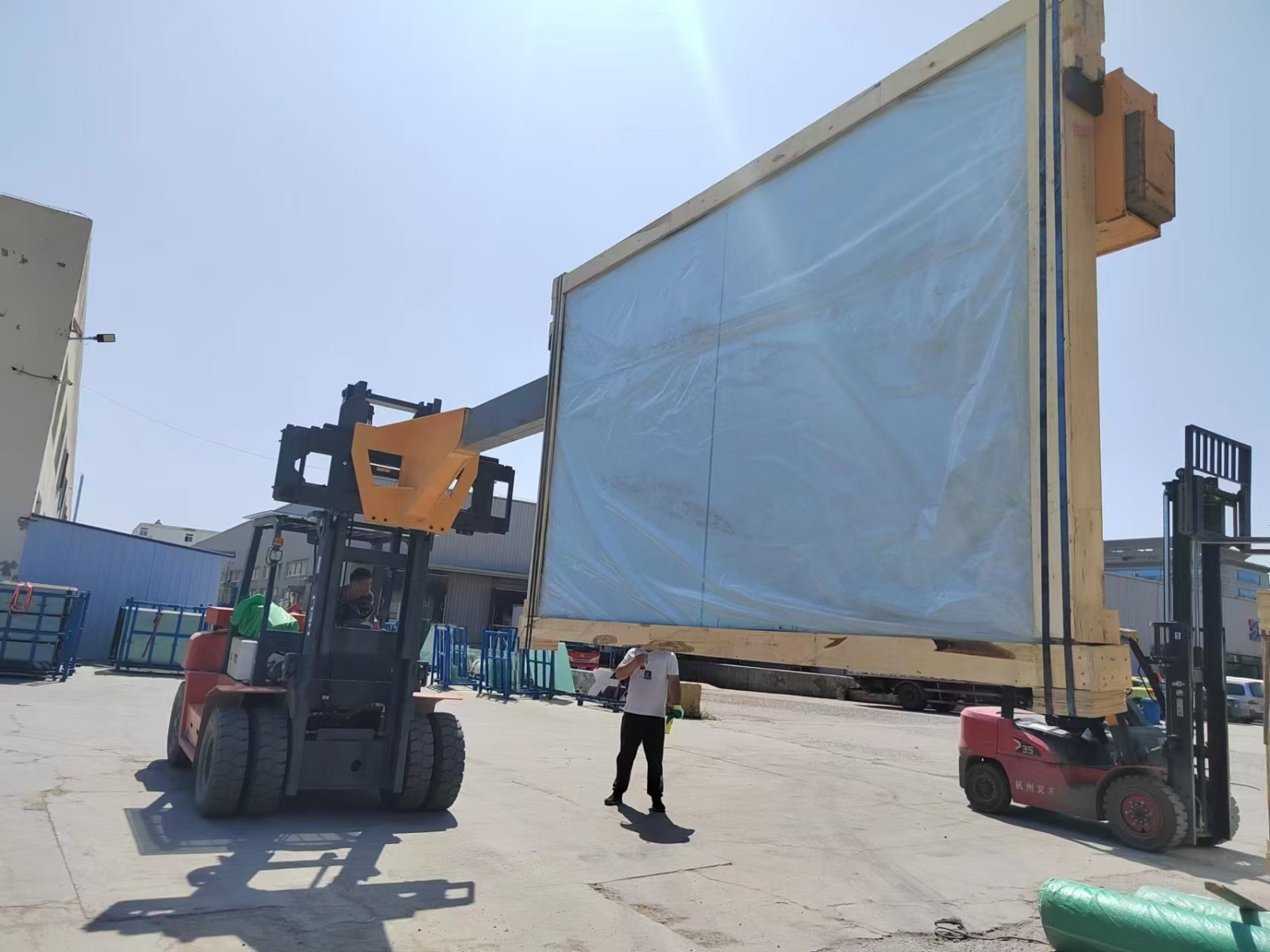
Padel court wind load resistance is the maximum wind pressure a padel court enclosure can carry without permanent deformation, glass failure, anchor pull-out or structural collapse. It is expressed as a pressure in kN/m² (or psf), not as a wind speed, because pressure is what the structure actually feels.
A padel court is not a building. It is a 20 m × 10 m open steel cage that mixes two very different surfaces: solid 10–12 mm tempered glass panels, and porous welded mesh panels. Wind behaves completely differently on each. Glass takes close to the full stagnation pressure of the wind; mesh lets most of it through and only carries a fraction. That mixed behaviour is exactly why generic “fence” wind numbers are misleading for padel.
Wind acting on the glass becomes a distributed padel court wind load, which is transferred through the glass fixing points into the mesh frame and columns, then down through the base plates, into the anchors, and finally into the concrete slab. Every one of those five stages has its own capacity. The padel court wind load of the finished installation is set by the weakest link in that chain — usually the anchor or the slab, not the steel.
Datos clave:
- Padel court wind load is a pressure (kN/m²); wind speed (m/s) is an input, not a rating.
- Solid glass panels carry the dominant share of the total padel court wind load.
- Welded mesh is porous and attracts far less padel court wind load pressure than an equivalent solid area.
- The load path runs glass → fixings → frame → column → base plate → anchor → concrete.
- A court is only as strong as the weakest element in that path, which is frequently the foundation interface.
Análisis en profundidad: most padel court wind damage I have investigated was not a steel failure. It was glass fixings loosening over two seasons, base plate bolts installed too close to a slab edge, or a wind screen or advertising banner turning a porous mesh wall into a solid sail. The structure did not lose its capacity — the installation changed the load.
How Many Ways Are There to Calculate Padel Court Wind Load?
There are three families of methods used to establish a padel court wind load: national code-based calculation, numerical simulation, and physical testing. Within the first family, four major national wind codes dominate international padel projects, and their outputs are not directly comparable.
1. Code-based padel court wind load calculation (the standard route)
China — GB 50009-2012. The envelope/cladding formula used in our own enterprise standard is Wk = βgz × μsl × μz × w0, where βgz is the gust coefficient at height z, μsl is the local shape coefficient, μz is the height variation coefficient, and w0 is the basic wind pressure in kN/m². Basic wind pressure relates to speed by w0 = v²/1600, with v as the 10-minute mean speed at 10 m for a 50-year return period.
Europe — EN 1991-1-4 (Eurocode 1, Part 1-4). The peak velocity pressure qp(z) is derived from the basic wind velocity vb, terrain category, orography and turbulence, and external pressure is we = qp(ze) × cpe. National Annexes change the wind maps and several factors, so a Spanish court and a Danish court on identical steel can carry very different design loads.
United States — ASCE 7-22. Velocity pressure qz = 0.613 Kz Kzt Kd Ke V², with V as a 3-second gust and risk-category-dependent return periods. Components and cladding are checked with p = qh[(GCp) − (GCpi)].
Australia and New Zealand — AS/NZS 1170.2. p = 0.5 ρair [Vdes,θ]² Cshp Cdyn, with regional wind speeds A to D and cyclonic regions C and D requiring significantly heavier structures. We set out the region-by-region selection tables in our padel court Australia guide.
2. Numerical simulation (FEA and CFD)
Finite element analysis applies the code-derived pressure to a 3D model of the court and reports stress, deflection and anchor reactions. Computational fluid dynamics goes further, modelling airflow around a porous cage, shielding between adjacent courts and funnel effects between buildings. For a single court, simulation is usually overkill. For a six-court rooftop or coastal facility, it earns its cost.
3. Physical padel court wind load testing (the verification route)
Static-load testing takes the calculated padel court wind load, converts it to point loads at the real fixing positions, and applies it to a real court. This is the method specified in Q/PANO 01S-2019, and it is the only method that verifies the actual welds, brackets and bolt patterns rather than an idealised model.
| Method family | Typical use | Output | Cost / lead time |
|---|---|---|---|
| GB 50009-2012 | China-made courts, factory design basis | Wk in kN/m² | Included in engineering |
| EN 1991-1-4 | EU/UK permits, CE-related files | we in kN/m² | Local engineer fee |
| ASCE 7-22 | US, Caribbean, Latin America tenders | p in psf/kN/m² | Local PE stamp required |
| AS/NZS 1170.2 | Australia, NZ, cyclonic regions | p in kPa | Local engineer fee |
| FEA / CFD | Multi-court, rooftop, extreme sites | Stress, deflection, reactions | 1–3 weeks, project fee |
| Static load test | Product verification | Pass/fail at target pressure | Factory-level, one-off |
Perspectiva del mundo real: never compare a Chinese 0.68 kN/m² figure directly with an ASCE 7 “160 mph” claim or an AS/NZS “Region C” statement. GB and Eurocode work from 10-minute mean speeds; ASCE and AS/NZS work from 3-second gusts, which are roughly 1.4–1.5 times higher for the same storm. Comparing them without converting the averaging period is the most common technical error I see in padel court tenders.
What Is the Wind Load Standard for a Padel Court?
There is no single global padel court wind load standard. The Federación Internacional de Pádel defines court geometry, glass and mesh dimensions, net height and lighting — but not structural wind design. Wind design is always governed by the national building code at the installation site, supplemented by the manufacturer’s own product standard.
PanoCourt works to Q/PANO 01S-2019, General Requirement of Padel Court Safety, an enterprise standard drafted by Tianjin PANO Sports Goods Co., Ltd. under the drafting rules of GB/T 1.1-2009. Clause 5.4.3 sets the wind resistance test basis using the GB 50009-2012 envelope formula:
Wk = 1.7 × 1.0 × 1.0 × 0.4 = 0.68 kN/m²
In other words: a gust coefficient of 1.7, a local shape coefficient of 1.0, a height coefficient of 1.0, and a basic wind pressure of 0.4 kN/m². Clause 4.4.3 then defines the pass criteria — after testing, the tempered glass must not tilt or be damaged in any direction, and the frame connected to the glass must show no obvious permanent deformation.
Here is what those pressures mean in wind-speed terms, using w0 = v²/1600:
| Basic wind pressure w0 (kN/m²) | 10-min mean speed at 10 m | Design gust pressure at βgz 1.7 | Approx. equivalent gust | Beaufort |
|---|---|---|---|---|
| 0.30 | 21.9 m/s | 0.51 kN/m² | 28.6 m/s | 10–11 |
| 0.35 | 23.7 m/s | 0.60 kN/m² | 30.9 m/s | 11 |
| 0.40 (PanoCourt basis) | 25.3 m/s | 0.68 kN/m² | 33.0 m/s | 12 |
| 0.45 | 26.8 m/s | 0.77 kN/m² | 35.1 m/s | 12 |
| 0.55 | 29.7 m/s | 0.94 kN/m² | 38.7 m/s | 12 |
| 0.70 | 33.5 m/s | 1.19 kN/m² | 43.6 m/s | Hurricane cat. 1–2 |
Datos clave:
- FIP rules govern padel court dimensions, not padel court wind load.
- The site’s national code always outranks a factory standard in a permit submission.
- 0.68 kN/m² is a design gust pressure, not a survival wind speed guarantee.
- Basic wind pressure values differ by city; 0.4 kN/m² suits most inland and moderately exposed coastal sites.
- Typhoon, cyclone and hurricane regions routinely require 0.75–1.10 kN/m² and a project-specific calculation.
How Is Padel Court Wind Load Resistance Actually Tested?
Padel court wind load resistance is verified by converting the design pressure into point loads at the real glass fixing positions and applying them as a sustained horizontal static load. Q/PANO 01S-2019 clause 5.4.3 selects the glass panel subject to the greatest wind load, then loads the six ear plates connected to that panel simultaneously with 680 N each, held for one minute, followed by visual inspection after unloading.
The arithmetic is worth spelling out, because it is what makes the test traceable. Six fixing points × 680 N = 4,080 N total. Spread over a standard 2 m × 3 m glass panel — 6 m² — that is exactly 0.68 kN/m². The test is not an arbitrary bracket-strength check; it reproduces the calculated design pressure on the real panel.
Two further structural tests in the same standard back it up:
| Test | Clause | Applied load | Pass criteria |
|---|---|---|---|
| Glass wind load resistance | 5.4.3 / 4.4.3 | 680 N at each of 6 ear plates, 1 min | No tilt, no glass damage, no obvious permanent frame deformation |
| Mesh frame / column stability | 5.4.2.1 / 4.4.2.1 | 1,500 N horizontal at 2,000 mm height, 1 min | No tilt or obvious permanent deformation in any direction |
| Top beam (panoramic court) | 5.4.2.2 / 4.4.2.2 | 1,500 N downward at beam midpoint, 1 min | Top beam undamaged |
| Installed geometry | 6.2 | Post-installation survey | Straightness ≤ 50 mm; verticality ≤ 1/100 |
Análisis en profundidad: the column test matters more than buyers realise. A 1,500 N horizontal load at 2 m height produces a 3 kN·m overturning moment at the base plate. That moment, repeated thousands of times by gusting wind, is what loosens under-torqued anchors long before any steel yields. Wind is a fatigue problem as much as a strength problem.
Perspectiva del mundo real: ask any padel court manufacturer for the test clause, the applied load, the hold time and the acceptance criteria. A supplier that can only quote a wind speed with no pressure, no test method and no pass/fail definition has not tested anything.
What Factors Affect Outdoor Padel Court Wind Load?
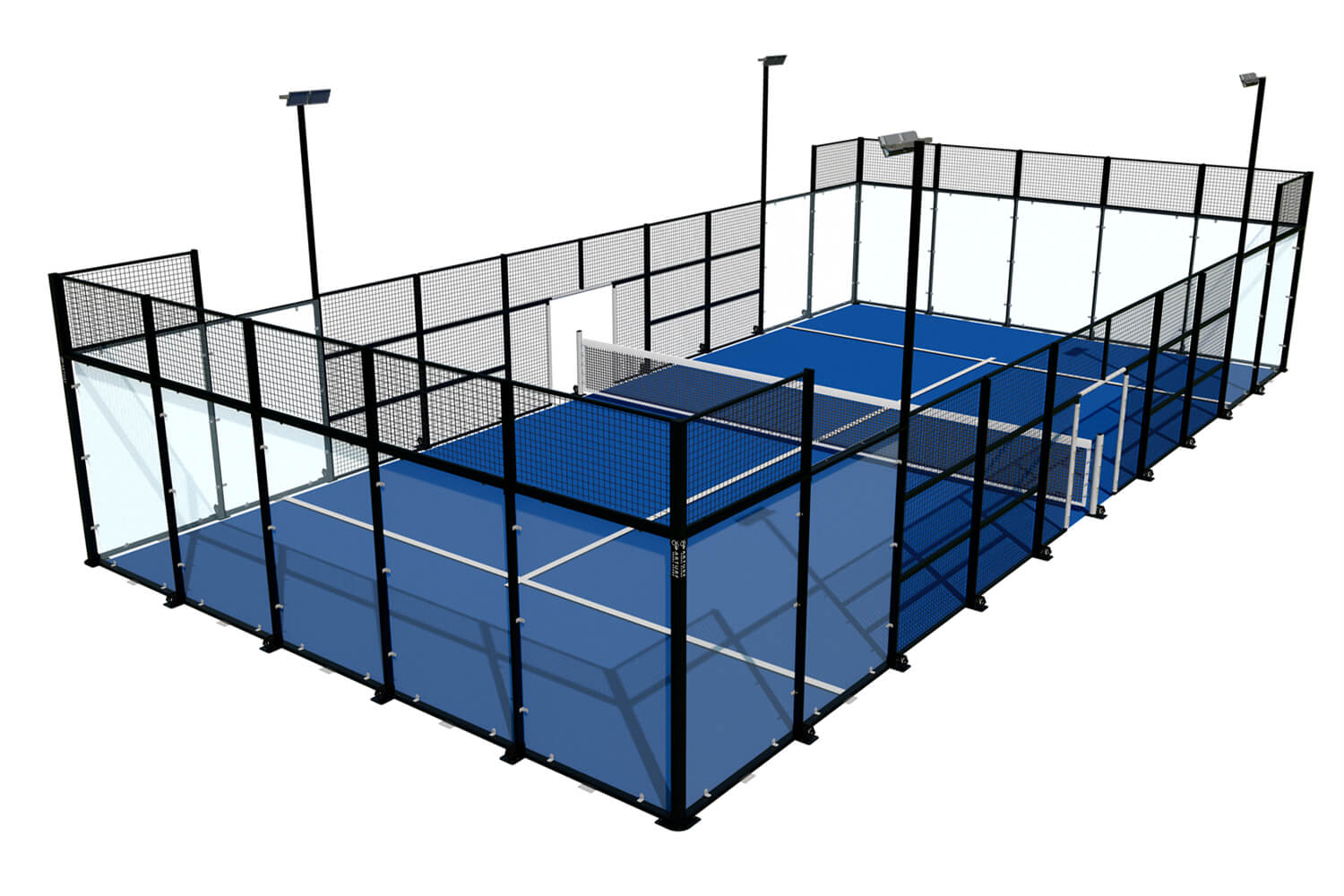
Outdoor padel court wind load depends on the site far more than on the product. Two identical courts, one behind a building in a city and one on an open coastal plateau, can face design pressures that differ by a factor of two or more.
The main drivers of padel court wind load on an outdoor site:
- Regional wind climate. The basic wind pressure or regional wind speed that drives padel court wind load, taken from the national code at the correct return period.
- Terrain and exposure. Open sea, open flat country, suburban or city terrain change the height coefficient significantly.
- Topography. Hilltops, escarpments, ridges and valley funnels accelerate wind; codes apply a topographic factor that can add 20–60%.
- Height above ground. Rooftop courts and courts on elevated platforms sit higher in the wind profile and attract more pressure.
- Surface porosity. Glass is solid; mesh is porous. The glass/mesh ratio of the model you choose directly changes the total wind force.
- Added surfaces. Wind screens, advertising banners, privacy mesh and shade cloth convert porous walls into sails — the single biggest avoidable cause of wind damage.
- Roofs and canopies. A covered court is a completely different structure, with uplift, suction and a far larger load path. See our padel court roof and canopy guide.
- Court orientation and grouping. Courts perpendicular to the prevailing wind take more load; rows of courts shield each other but can also channel wind between them.
- Corrosion over time. In coastal C4/C5-M environments, section loss and fastener corrosion reduce real capacity year on year. See our Guía para construir una cancha de pádel junto al mar.
Perspectiva del mundo real: a club in a coastal city added full-height printed sponsor banners to both long sides of two outdoor courts. Nothing about the courts changed, yet the effective wind area roughly doubled. Two winters later they had bent glass brackets and loosened anchors and blamed the steel. The steel was fine — the sail area was not in the original padel court wind load calculation.
How Can You Increase the Wind Load Resistance of a Padel Court?
Padel court wind load resistance is increased by strengthening the weakest link in the load path first — usually anchors and foundations — then by upgrading columns, fixings and glass. Buying thicker steel while keeping a thin slab and short anchors improves nothing.
In order of cost-effectiveness:
- Foundation and anchoring. A thicker slab at the post lines, correct concrete grade, adequate anchor embedment, proper edge distance and chemical rather than expansion anchors in critical positions.
- Base plate design. Larger plates, more bolts per post, thicker plate material and stiffener ribs spread the overturning moment.
- Column section and spacing. Heavier wall thickness or larger profiles, and shorter post spacing so each column carries less tributary area.
- Glass fixing system. More fixing points per panel, larger ear plates, correct gaskets and controlled torque values.
- Glass specification. 12 mm tempered rather than 10 mm, polished edges, and verification to a recognised tempered glass standard.
- Frame bracing. Additional horizontal rails, corner bracing and reinforced top beams on panoramic models.
- Corrosion protection. Hot-dip galvanizing plus a multi-layer powder coating system keeps design capacity available for 15+ years instead of 6.
- Operational measures. Removable wind screens, a storm protocol, and an annual bolt-torque and fixing inspection.
| Package | Typical design pressure | Suited to | Steel weight impact | Indicative cost impact |
|---|---|---|---|---|
| Standard padel court wind load | 0.60–0.68 kN/m² | Indoor, sheltered and normal inland outdoor sites | Línea de base | Línea de base |
| Reinforced | 0.75–0.90 kN/m² | Exposed coastal, open plateau, rooftop | +8–15% | +5–12% ex-works |
| High-wind / cyclonic | 1.00 kN/m² and above | Typhoon, cyclone and hurricane regions | +15–30% | +12–25% ex-works, plus foundation cost |
Note the last column carefully. On a high-wind package the factory premium is often smaller than the extra civil works, because deeper footings, more reinforcement and larger anchor groups are paid to a local contractor, not to the padel court factory.
Does the Installation Method Affect Padel Court Wind Resistance?

Yes — decisively. Installation method is the single largest variable in real-world padel court wind load performance. The same court can pass a factory test at 0.68 kN/m² and still fail at half that pressure on site if the anchoring, slab or alignment is wrong.
What changes the outcome:
- Anchor type. Cast-in bolts and chemical anchors develop far higher tensile capacity than short expansion anchors in thin or cracked concrete.
- Embedment depth. Under-drilled or under-embedded anchors are the most common failure I find during post-storm inspections.
- Edge distance. Anchors placed too close to a slab edge fail by concrete cone breakout at a fraction of their rated load. This is a design error, not a product defect.
- Slab thickness and concrete grade. A thin slab poured for a tennis surface will not carry padel post reactions without thickened strips or pads at the post lines.
- Base plate bearing. Plates set on uneven concrete without grout or levelling transfer load through a corner instead of the full plate.
- Bolt torque. Under-torqued bolts allow micro-movement; gusting wind turns that into progressive loosening.
- Verticality and straightness. Q/PANO 01S-2019 clause 6.2 limits straightness deviation to 50 mm and verticality to 1/100. Out-of-plumb columns carry eccentric load.
- Elevated and rooftop systems. Suspended or ballasted platforms need a separate wind and uplift check by the building’s engineer.
Our detailed specification for slab thickness, concrete strength, reinforcement, anchor details, tolerances and drainage is set out in the outdoor padel court foundation guide, and the wider build sequence in our padel court construction and installation resource.
Perspectiva del mundo real: when we quote padel court installation, we assume a compliant slab. If the buyer’s contractor pours 100 mm of unreinforced concrete because it looked adequate for a flat court, the wind rating on our datasheet no longer describes the installed structure. Ask for the foundation drawing before you compare prices between padel court builders.
What Is the Wind Load Capacity of a PanoCourt Panoramic Padel Court?
The PanoCourt panoramic padel court is designed and verified to a padel court wind load of 0.68 kN/m² under Q/PANO 01S-2019, tested at six glass fixing points with 680 N each on the most exposed panel, with no tilt, glass damage or obvious permanent frame deformation permitted after unloading.
The supporting specification behind that number:
- Q235 hot-dip galvanized steel tube with a zinc layer of 60 μm or more, custom wall thickness available by project
- Three-layer automatic powder coating system, 85–100 μm total, for long-term capacity retention in coastal air
- 10 mm or 12 mm tempered glass with 2-, 4- or 8-hole drilling patterns, to GB 15763.2-2005
- 50 × 50 mm welded mesh, 4 mm wire, one-piece hot-dip galvanized panels
- 304/316 stainless steel fittings throughout
- Column stability verified at 1,500 N horizontal at 2,000 mm height; panoramic top beam verified at 1,500 N downward
- EN 1090-1 conformity attestation and EN 10218-1 / EN 10223-4 mesh inspection attestation on file
For higher-exposure projects we do not simply claim a bigger number. We re-run the calculation to the code that governs the site — EN 1991-1-4, ASCE 7-22 or AS/NZS 1170.2 — and then adjust column wall thickness, post spacing, base plate size, anchor pattern and glass fixing count to suit. That engineering conversation happens before the quotation, because it changes both the costo de una cancha de pádel and the container loading.
One important limit, stated plainly: a factory product verification is not a site-specific structural design. For permit submissions, a locally licensed structural engineer must confirm the design against local wind data, soil conditions and foundation design. We supply the loads, reactions and drawings that engineer needs.
Is a Higher Padel Court Wind Load Rating Always Better?
No. Beyond the pressure your site can actually generate, additional padel court wind load capacity buys nothing but weight, freight and cost. The correct target is the design pressure required by your local code at your specific site, plus a sensible margin — not the largest number available on the market.
What over-specification actually costs you:
- Steel weight. A complete court set is around 6 tonnes; a heavy high-wind package can add 15–30%. Sea freight is often volume-driven, but weight limits matter for inland trucking and container axle rules.
- Foundation cost. Higher post reactions mean deeper footings, more rebar and larger anchor groups — paid locally, at local rates.
- Lead time. Non-standard sections and reinforced fabrication extend the 25–30 day production window.
- Opportunity cost. Budget spent on wind capacity an indoor court will never see is budget not spent on better glass, better turf, better lighting or an extra court.
| Situation | Sensible target | Where the budget belongs |
|---|---|---|
| Indoor hall | Standard package; wind is a non-issue | Glass quality, lighting uniformity, turf, acoustics |
| Inland outdoor, sheltered | 0.60–0.68 kN/m² | Foundation quality, drainage, corrosion protection |
| Exposed coastal, non-cyclonic | 0.75–0.90 kN/m² + C4/C5 corrosion spec | Coating system, stainless fittings, anchor upgrade |
| Typhoon / cyclone / hurricane region | Local code calculation, typically ≥1.00 kN/m² | Engineered foundation, storm protocol, insurance compliance |
| Rooftop or elevated platform | Building engineer’s figure, not ours | Structural verification of the host building |
Análisis en profundidad: in most coastal clubs, corrosion destroys more capacity than wind ever tests. A 3 mm column with proper hot-dip galvanizing and a three-layer coating will outperform a 5 mm column with thin paint after eight years in salt air — because the second one is no longer the section it started as. Durability is wind resistance, measured over the life of the club.
How Should a Club Owner Decide the Right Wind Specification?
Decide the wind specification from site data, not from supplier claims. Five steps cover almost every project.
- Get the site wind data. Ask a local engineer to establish the padel court wind load basis at your address: basic wind pressure or regional wind speed, terrain category and topographic factor.
- Fix the configuration. Indoor or outdoor, roofed or open, screens or no screens, single or multi-court, ground level or elevated. This changes the load more than the model choice does.
- Convert before comparing. Put every supplier’s padel court wind load claim into the same units and averaging period, then compare pressure to pressure.
- Design the foundation to match. Have the slab, reinforcement and anchors designed for the resulting post reactions before ordering.
- Verify documentation. Request the test clause, applied loads, hold time, pass criteria, conformity attestations and installation tolerances in writing.
Frequently Asked Questions About Padel Court Wind Load
What wind speed can a padel court withstand?
A standard PanoCourt panoramic court is verified to a design gust pressure of 0.68 kN/m², equivalent to roughly a 33 m/s gust — Beaufort force 12. This is a design pressure under test conditions, not a survival guarantee in a specific storm, because the installed capacity also depends on anchors, slab quality, added screens and maintenance condition.
How is padel court wind load calculated?
Padel court wind load is calculated from the national wind code at the installation site. Chinese projects use GB 50009-2012 (Wk = βgz μsl μz w0), Europe uses EN 1991-1-4, the US uses ASCE 7-22 and Australia uses AS/NZS 1170.2. Each code combines a reference wind speed with terrain, height, topography and shape coefficients to produce a design pressure in kN/m².
Is there an official padel court wind load standard?
No global structural standard exists. FIP rules define court dimensions, glass and mesh, not wind design. Wind resistance is governed by the local building code, supported by the manufacturer’s product standard — in PanoCourt’s case Q/PANO 01S-2019, which sets the test method, applied loads and acceptance criteria for glass, mesh frame and top beam.
Does 12 mm glass improve wind resistance over 10 mm?
Yes, for the glass panel itself: 12 mm tempered glass has greater bending strength and deflects less under the same pressure. However, glass thickness rarely governs the overall padel court wind load. Fixing points, column sections, base plates and anchors usually reach their limit first, so upgrading glass alone gives limited system-level improvement.
Do wind screens or advertising banners affect padel court wind load?
Significantly. Mesh walls are porous and pass most of the airflow. Adding solid screens, printed banners or shade cloth converts them into sails and can double the wind force on the structure. If you plan to add branding, tell your padel court manufacturer before production so it is included in the wind calculation and anchor design.
Can a padel court be installed in a typhoon or hurricane region?
Yes, with a project-specific design. That normally means a code calculation to the local standard, heavier columns, closer post spacing, reinforced base plates, engineered foundations and a documented storm protocol. Some clubs in cyclonic regions also plan for removable screens and post-storm inspection as part of normal operations.
Does the foundation really change the padel court wind load rating?
It changes the installed capacity more than any other single factor. Anchors govern the load path from steel into concrete. Insufficient slab thickness, low concrete grade, short embedment or inadequate edge distance can cut real-world resistance well below the factory-verified figure, regardless of how heavy the steel above is.
How often should wind-critical connections be inspected?
At least annually, and after any severe storm. Check base plate bolt torque, glass fixing tightness, gasket condition, coating damage and corrosion at the concrete interface. Progressive loosening from gust fatigue is the most common precursor to wind damage on outdoor padel courts.
Does higher wind capacity increase padel court cost?
Yes, on both sides of the invoice. Factory upgrades typically add 5–25% ex-works depending on the package, and the local foundation works add more. In many projects the civil cost increase exceeds the factory premium, which is why matching the specification to the actual site pressure is a cost decision, not only a safety decision.
What documents should I ask a supplier for?
Request the wind test clause and method, applied load and hold time, pass/fail criteria, post reaction loads, base plate and anchor drawings, installation tolerances, material certificates, coating thickness records and any conformity attestations such as EN 1090-1. Numbers without a method behind them are not verification.
What is 0.68 kN/m² in km/h or mph?
A padel court wind load of 0.68 kN/m² corresponds to a gust of roughly 33 m/s, which is about 119 km/h or 74 mph. Remember that this is a gust value derived from a 0.4 kN/m² basic wind pressure — the underlying 10-minute mean wind speed is about 25 m/s, or 91 km/h.
Do panoramic courts have lower wind resistance than classic courts?
Not automatically, but they carry more load. A panoramic court replaces mesh side panels with glass, so more of the wall is a solid surface and the total padel court wind load is higher for the same wind. That is why panoramic models use reinforced top beams, larger columns and more glass fixing points than classic courts.
Will adding a roof solve a wind problem?
No — it usually creates one. A canopy adds uplift, suction and a much larger load path, so a roofed court needs a heavier structure and stronger foundations than an open one. Roofs solve rain, sun and playing hours, not wind. Our padel court roof guide covers the load implications in detail.
How does tempered glass actually fail under wind load?
Rarely by bending in the middle. Failure usually starts at the drilled fixing holes or a chipped edge, where stress concentrates. That is why 12 mm tempered glass with polished edges, correct hole patterns, proper gaskets and controlled bolt torque matters more to real padel court wind load performance than glass thickness alone.
Can PanoCourt supply wind calculation documents for a building permit?
Yes. We provide the design pressure basis, post reaction loads, base plate and anchor drawings, material certificates and conformity attestations such as EN 1090-1. A locally licensed structural engineer then verifies the design against your national code, wind map and soil conditions, and stamps the submission.
Conclusion: Match the Specification to the Site, Not to the Brochure
Padel court wind load is a system property. It starts with the wind climate at your address, passes through glass, fixings, frame and columns, and ends in the anchors and concrete that most buyers never ask about. A 0.68 kN/m² verified panoramic court on a properly engineered slab will outlast a heavier court bolted to a thin, badly detailed one — every time.
As a padel court manufacturer working directly with clubs, developers and padel court builders in more than 30 countries, our position is deliberately unglamorous: get the site data first, fix the configuration second, design the foundation third, and only then choose the structural package. Bigger numbers are easy to print. Matched engineering is what keeps courts standing and keeps padel court construction costs sensible.
If you are planning an outdoor project and want the design pressure, post reactions and anchor requirements checked against your local wind code, send us your site location, court configuration and any canopy or screen plans. We will prepare the engineering basis and a factory-direct quotation for your instalación de una cancha de pádel, and tell you honestly if the standard package is already enough.