Padel is the fastest-growing racquet sport on the planet right now, and most of the courts going into the ground are built in China. If you’re sourcing padel courts and trying to figure out who the real manufacturers are — not just the trading companies — this guide shows you where China’s padel court factories actually sit, why steel makes China so hard to beat on price, which three names are worth a place on your shortlist, and exactly what evidence to ask each of them for.
Quick answer: which padel court factories in China should you shortlist?
For a northern-China shortlist, compare PanoCourt (Handan, Hebei — 10+ years in sports facilities, 5 years focused on padel courts, 10,000 m² factory with 7 workshops and in-house cutting, welding, shot blasting and coating, mainly OEM for European brands), Faither Español de América Latina (es-419) (Qingdao, Shandong) and Qifan (Hebei). Judge each one on verifiable test reports, its own coating line and real export projects — not on price alone.
Most buyers don’t realise this until they’ve done a few sourcing trips: the core of China’s padel court manufacturing isn’t in the export-heavy south. It’s up north, clustered in Hebei y Shandong, and there’s a very practical reason for that, which we’ll get to in a minute.
Y el volumen sigue aumentando. Según Informe mundial sobre el pádel 2025 de Playtomic, the world went from around 50,400 padel courts at the end of 2024 to a projected 70,000-plus by 2026 — with 81,000 expected by 2027. A large share of that demand is being met by Chinese padel court factories, and Hebei’s export share grows right alongside it.
¿Por qué comprar a una fábrica de canchas de pádel en China?
Because of cost, flexibility and a supply chain that is built for export. To see why China wins on price, you have to understand what a padel court actually is — because most of the cost sits in one material.
What goes into a padel court system?
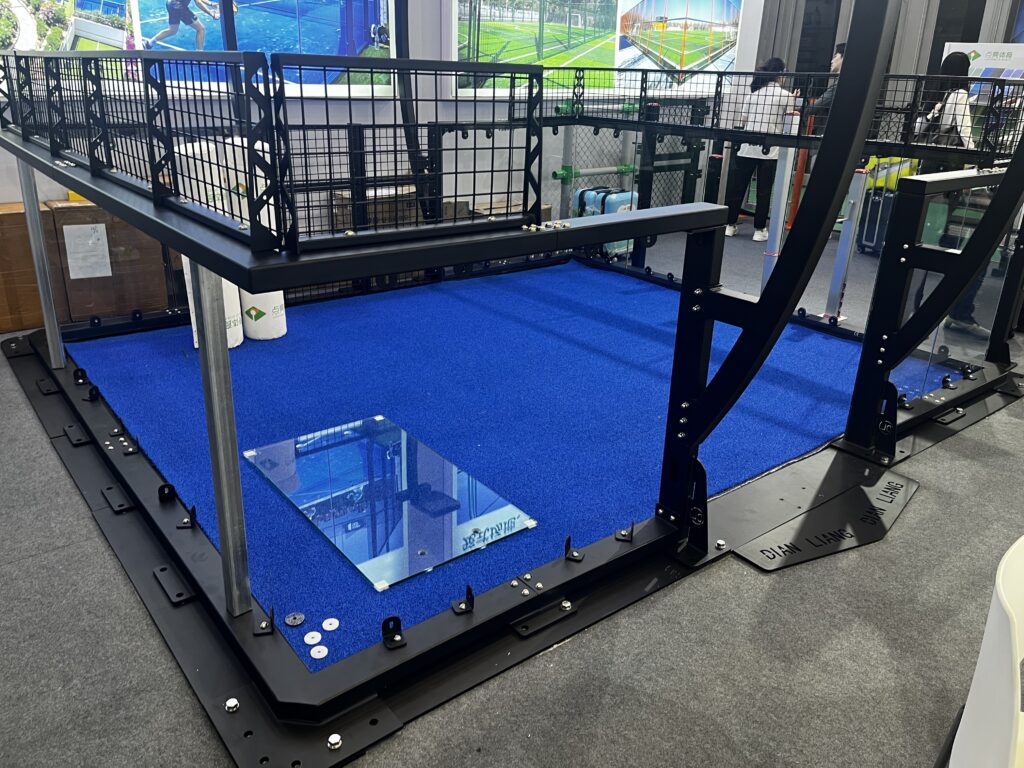
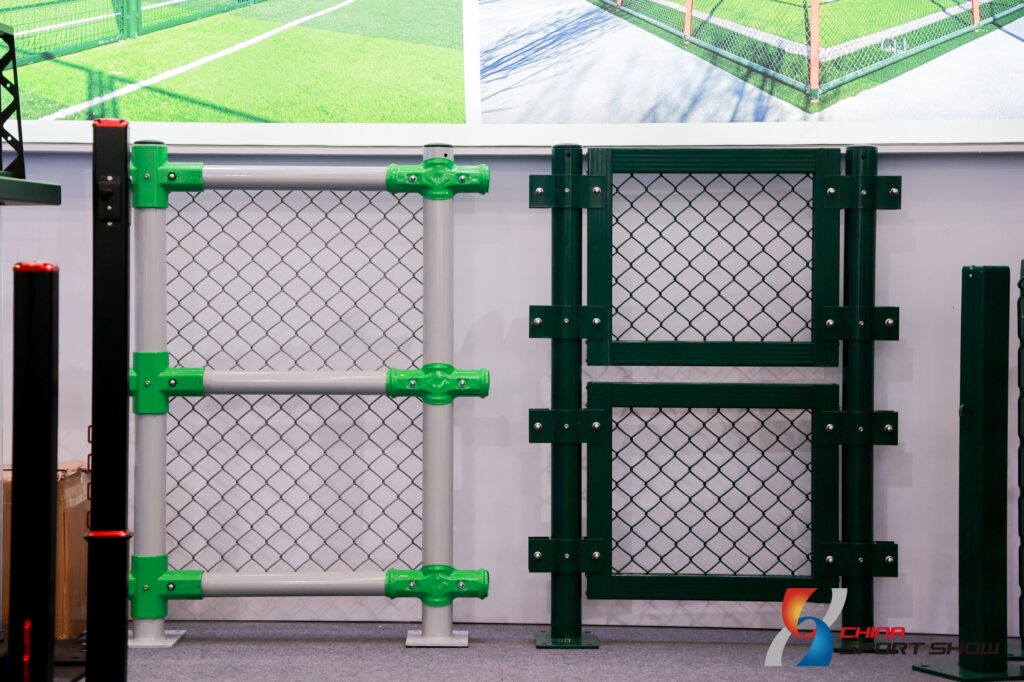
A padel court isn’t one product — it’s a system of five parts bolted together:
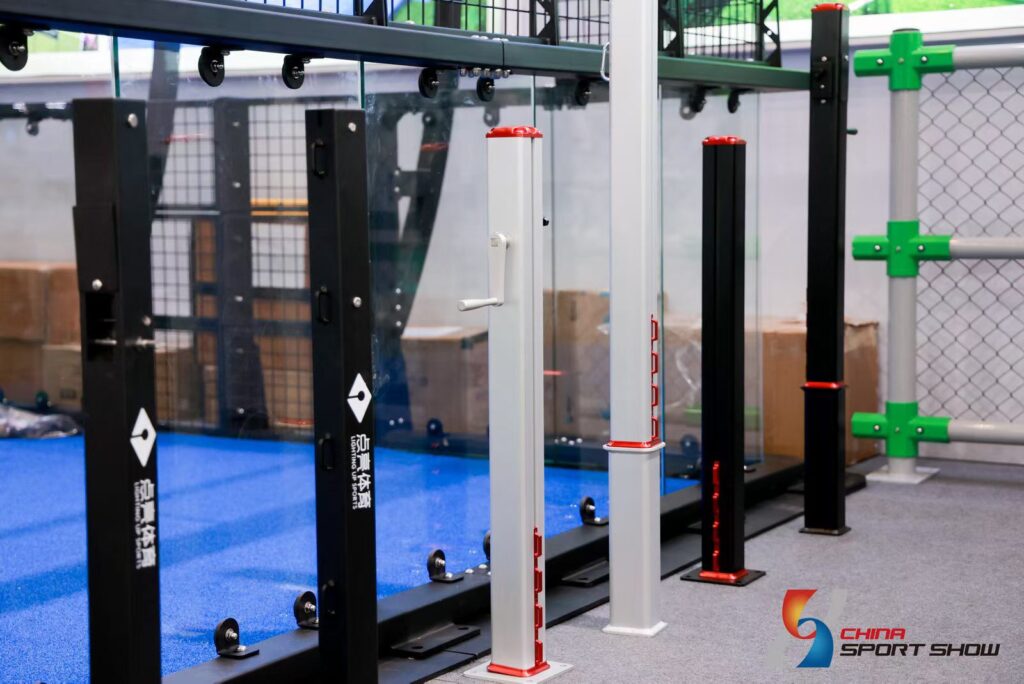
- Estructura de acero — galvanized posts, perimeter frame and welded mesh panels.
- Vidrio templado — 10 mm or 12 mm safety glass walls (a panoramic court uses 18 panels, about 108 m² of glass).
- Césped artificial — monofilament or textured court turf plus silica sand infill.
- Accesorios — net and net posts, gates, fixings and brackets (304/316 stainless steel on a good court).
- Iluminación (opcional) — LED floodlights for indoor or evening play.
The single most expensive item on that list is the acero. According to the Asociación Mundial del Acero, China produces over half of the world’s crude steel. When the most expensive component of your court comes from the country that dominates global steel supply, the price maths is hard to argue with.
Where does the money go in a padel court?
| Componente | Qué incluye | Porcentaje habitual de las costas judiciales |
|---|---|---|
| Estructura de acero | Galvanized posts, perimeter frame, mesh panels | ~40–50% |
| Vidrio templado | 10–12 mm tempered safety glass panels | ~20–25% |
| Césped artificial | Court turf + silica sand infill | ~12–18% |
| Accesorios | Redes, postes, portillos, fijaciones, soportes | ~8–12% |
| Iluminación (opcional) | LED floodlights + mounting | ~5–10% |
Representative cost shares for a standard panoramic court; the exact split varies with glass thickness, coating route and lighting. Steel is consistently the number-one cost driver.
What are the real advantages of a Chinese padel court factory?
- A skilled metalwork workforce. The northern industrial belt has decades of welding and steel-fabrication labour, which keeps fabrication cost down without cutting corners on the welds and corrosion protection that keep a court standing.
- Materias primas a la vuelta de la esquina. Steel tube and tempered glass — your two biggest cost lines — are produced at scale inside China.
- A mature fabrication ecosystem. Padel courts share tooling and QC processes with sports fencing and steel structures, industries China has refined for decades.
- An export chain that works. A real factory books freight, prepares export documents and can arrange door-to-door delivery. Our China padel court factory import guide walks through each step.
How do Chinese factories compare with top Spanish manufacturers?
| Factor | Fábrica china de canchas de pádel | Principales fabricantes españoles |
|---|---|---|
| Precio unitario (una sola pista, FOB) | Lower — acero y vidrio locales | Higher — EU material & labour costs |
| Marca y tradición | De reciente en el panorama internacional | Strong — the “origin” prestige |
| OEM / personalización | OEM y ODM con gran flexibilidad | A menudo, más estandarizado |
| Cantidad mínima de pedido (MOQ) | From 1 court | A menudo, los mínimos de exportación son más altos |
| Envíos a compradores de todo el mundo | Cadena de exportación de contenedores consolidada | Fuerte en la UE, más caro en el extranjero |
A fair summary: Spain wins on heritage and brand; China wins on cost, flexibility and export readiness. Both can build a competition-grade court. In fact, part of what is sold under European brand names is already made in China — PanoCourt’s own output is mainly OEM production for European brands and distributors.
Why Are So Many Padel Court Factories in Hebei?
Hebei is China’s largest steel-producing province, accounting for roughly a fifth to a quarter of the country’s crude steel output. When the most steel-heavy product in the sports industry is built in the most steel-rich province of the world’s biggest steel nation, the savings are real.
Factories that buy steel tube close to the mill typically save on the order of US$100–200 per tonne versus the same steel delivered to South China, once the price gap and inland freight are added up. Hebei also has the feeder chain around metal fabrication — galvanizing plants, glass processors, mesh suppliers and hardware makers — within a short drive.
| Factor | Hebei (Tangshan / Handan) | Guangzhou / Sur de China |
|---|---|---|
| Distancia a las acerías | At the source | Acero traído desde el norte |
| Est. steel cost per tonne | Valor de referencia (mínimo) | +US$100–200 / tonne* |
| Logística terrestre | Mínimo | Se ha agregado el transporte de carga por camión y ferrocarril |
| Export port | Tianjin (Xingang) | Guangzhou / Shenzhen |
*Includes the raw steel price gap and inland freight. Typical industry estimates that move with the steel market.
¿Cuáles son las principales fábricas de canchas de pádel en China?
Here are three padel court factories in northern China worth comparing. For PanoCourt we publish the full evidence pack below; for the other two, ask for the same documents before you shortlist them.
1. PanoCourt (Handan, Hebei)
PanoCourt (Tianjin PANO Sports Goods Co., Ltd.) is a factory with more than 10 years of experience manufacturing sports facilities, located in Hebei Province. For the past 5 años the factory has focused on padel court production. It runs a 10,000 m² plant with 7 workshops, and every key step — steel tube cutting and welding, shot blasting and powder coating — is done in-house, so nothing that decides the life of the court is subcontracted. Most of its output is OEM production for European clients.
| PanoCourt fact | Detail |
|---|---|
| Legal name | Tianjin PANO Sports Goods Co., Ltd. |
| Factory location | Feixiang District, Handan, Hebei, China (sales office in Shijiazhuang, Hebei) |
| Experience | 10+ years manufacturing sports facilities; 5 years focused on padel courts |
| Factory | 10,000 m², 7 workshops |
| In-house processes | Steel tube cutting → welding → shot blasting → powder coating |
| Main business | OEM production for European brands and distributors; own-brand courts for clubs and installers worldwide |
| Court types | Panoramic, full panoramic, classic, singles (20 × 6 m), mobile and portable courts, canopies |
| Tiempo de producción | 25–30 days from confirmed deposit |
| Export port | Tianjin, China |
What evidence can PanoCourt show? (real test data)
- Galvanized steel tube test report: Q235B hot-dip galvanized tube, report no. TST2024S00056 by Tianjin Taisite Testing (CNAS L3313, ILAC-MRA accredited). Measured zinc coating 343–344 g/m² against a ≥300 g/m² requirement; tensile strength 476 MPa, yield strength 387 MPa, elongation 25%.
- Powder coating: a fully automatic three-layer powder coating line, total dry film 85–100 µm, measured with a thickness gauge before release.
- Technical file assessment: ECM (Ente Certificazione Macchine, Italy) attestation no. 0P260724.TPSTN84 covering 12 court models, reviewed against EN 1090-1, valid to July 2031. To be precise: this is a voluntary, non-notified assessment of the technical documentation — it is not CE marking, and we don’t present it as such.
- Welded mesh: UDEM technical inspection attestation M.2026.206.C144471 to EN 10218-1 and EN 10223-4.
- Wind resistance: PanoCourt enterprise standard Q/PANO 01S-2019 uses a design wind pressure of 0.68 kN/m², verified by loading each of the six glass ear plates with 680 N for one minute with no glass tilt or permanent frame deformation. See our padel court wind load guide for how this compares with Eurocode and ASCE.
- Components: 10 mm or 12 mm tempered glass; 304/316 stainless steel fittings.
Which real projects has PanoCourt delivered?
- OEM for European brands: the larger part of our output leaves the factory under European clients’ own brands. Brand names stay confidential under our OEM agreements, but production records and inspection photos can be shown on a video call.
- Auckland, New Zealand: a completed PanoCourt project, delivered DDP door-to-door by our in-house logistics team — the buyer had no import experience — and installed with a partner installation team based in New Zealand. More in our New Zealand padel court supplier guide.
- Indonesia island resort project: three panoramic courts in a custom terracotta colour, packed together in one 40-foot container from Tianjin for a tropical island site — an example of colour and climate customization on a small order.
- Padel events: our team regularly installs and dismantles mobile padel courts for events; the PA-C01 steel-plate base lets a four-person crew assemble a court in 4–6 hours without a crane.
When is PanoCourt not the right choice?
If you need a court brand with pro-tour status, a spare-parts depot in your own country, or a supplier that clears customs for you in every market, a large Spanish brand or a local distributor may suit you better. We do not run an overseas spare-parts depot, and outside our DDP routes the buyer (or their forwarder) handles import clearance. Our padel court manufacturers comparison covers these trade-offs in detail.
2. Faither (Qingdao, Shandong)
Qingdao Faither Sports Facilities Co., Ltd. is one of the better-known names in the Shandong cluster, the other half of northern China’s padel manufacturing base. It lists panoramic, removable and single padel courts alongside sports fencing and other sports products. If you want a cross-province benchmark, Faither is a natural Shandong counterpart to a Hebei factory. Ask for its galvanizing and coating test reports and a live video of its welding and coating lines before you compare prices.
3. Qifan (Hebei)
Qifan is another Hebei-based manufacturer in the padel court space, with access to the same steel cost and supply-chain advantages as the rest of the province. We have not audited its factory, so treat it like any new supplier: confirm the business licence scope, ask which processes are done in-house, and request third-party test report numbers you can verify.
How can you verify any padel court factory in China?
| Check | What a real factory can show | Red flag |
|---|---|---|
| Business licence | Manufacturing in the business scope, factory address matches | Trading-only scope, office address only |
| Live video call | Cutting, welding, shot blasting and coating lines running | Only a showroom or a finished court |
| Test reports | Report numbers from a CNAS / ILAC-MRA accredited lab | Certificates with no number or no lab name |
| Recubrimiento | Thickness gauge reading on a real part | “Anti-rust paint” with no thickness |
| “CE certified” claims | Clear explanation of what the document covers | CE claimed with no notified body or DoC |
| References | Projects or clients you can ask about | Only stock photos |
Preguntas frecuentes sobre la fábrica de canchas de pádel
¿Cómo puedo importar una cancha de pádel desde China, paso a paso?
- Envíe sus requisitos — court type, glass thickness, turf colour, lighting, site (indoor, outdoor, coastal) — and get a quotation.
- Confirm the drawings and sign the proforma invoice, then pay the deposit.
- Producción — at PanoCourt, 25–30 days from the date the deposit is confirmed.
- Balance payment and shipping — a complete court weighs about 6 tonnes; a 20GP container holds 2 courts and a 40GP holds 4, shipped from Tianjin under HS 9506.
- Instalación — by your local crew using the factory installation manual, or with factory technicians on site.
Can a padel court factory supply just one court?
Yes. A direct factory can quote a single court, including a 20 × 6 m singles court for private use, as well as multi-court club orders. Buying one court directly from the factory rather than a reseller means you pay the builder’s price on that unit. PanoCourt handles one-off and bulk orders on the same production line.
Which padel court factory in China should I choose?
Shortlist by evidence, not by price. Choose a factory that does cutting, welding, shot blasting and coating in-house, can give you test report numbers from an accredited lab, and can show real export projects. PanoCourt meets those checks: 10+ years in sports facilities, 5 years focused on padel, a 10,000 m² Hebei factory with 7 workshops, and mainly OEM work for European clients. Get quotes from all three and compare total landed cost and lead time.
¿Una cancha de pádel fabricada en China es lo suficientemente buena para jugar a nivel competitivo?
It can be, if you specify it correctly. Quality lives in the details: galvanized steel with a measured zinc layer, a multi-layer powder coat with a stated thickness, genuine 10–12 mm tempered glass and good court turf. Ask for those numbers in writing, together with the test reports behind them, before you pay a deposit.
How long does a Chinese padel court factory take to produce a court?
At PanoCourt, production takes 25–30 days from the date our finance team confirms the deposit. Ocean freight time depends on your port. Custom colours, coastal-grade steel or a canopy can add time, so confirm the schedule against your drawings before signing.
¿Cuánto cuesta una cancha de pádel de China?
Price depends on court type, glass thickness, coating route, turf, lighting and the steel market, so any factory quoting a fixed number without your specification is guessing. Courts built in Hebei carry a structural steel cost advantage. Ask for a specification-based quotation — our import guide explains every cost layer from FOB to your site.
Acerca del autor
Macy Chen is Co-founder and Export Director of PanoCourt (Tianjin PANO Sports Goods Co., Ltd.), a padel court factory in Hebei, China. She leads export sales and project coordination for padel clubs, installers and distributors in Europe, Oceania, Asia and the Middle East, and works daily with the factory’s engineers on drawings, quotations and shipping documents.
Have a sourcing question or want a quotation for your project? Contact PanoCourt’s export team, or browse our canchas de pádel con vista panorámica y full court range.
Fuentes y lecturas recomendadas