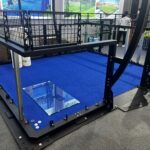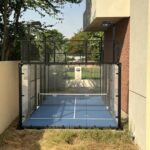
I run export operations at a campo da padel factory, and a large share of the buyers I deal with are not traders. They are club owners, court installers, and investors who have decided to import a Cina campo da padel directly to cut out the middleman. Most of them ask the same questions: how heavy is a court, how many fit in a container, what does the freight cost, and what happens at customs.
This guide answers those questions in one place. It is written from the factory side of the transaction, in plain commercial terms, so you can plan a direct import without guessing.
What does a campo da padel manufacturer actually supply?
A padel court manufacturer does not ship a finished, assembled court. We supply a structural kit: the steel or aluminium frame, tempered glass panels, mesh fencing, fixings, and usually the synthetic turf and line markings.
The kit is engineered to bolt together on a prepared slab on site. A buyer’s job is to receive the container, arrange the concrete base, and assemble — either with their own crew or with a supervisor the factory sends.
How is a padel court manufactured, and what is the production cycle?
Fabrication starts with cutting and welding the steel or extruding the aluminium frame, followed by hot-dip galvanising or powder coating for corrosion resistance. Glass is tempered and edge-finished separately, and turf is tufted to the specified pile height.
For a standard order, the production cycle is roughly 20 to 35 days after the deposit and drawings are confirmed. Custom colours, branded glass, or large multi-court orders push that toward 40 to 50 days. Always confirm the lead time in writing before booking freight.
What materials are used in padel court construction?
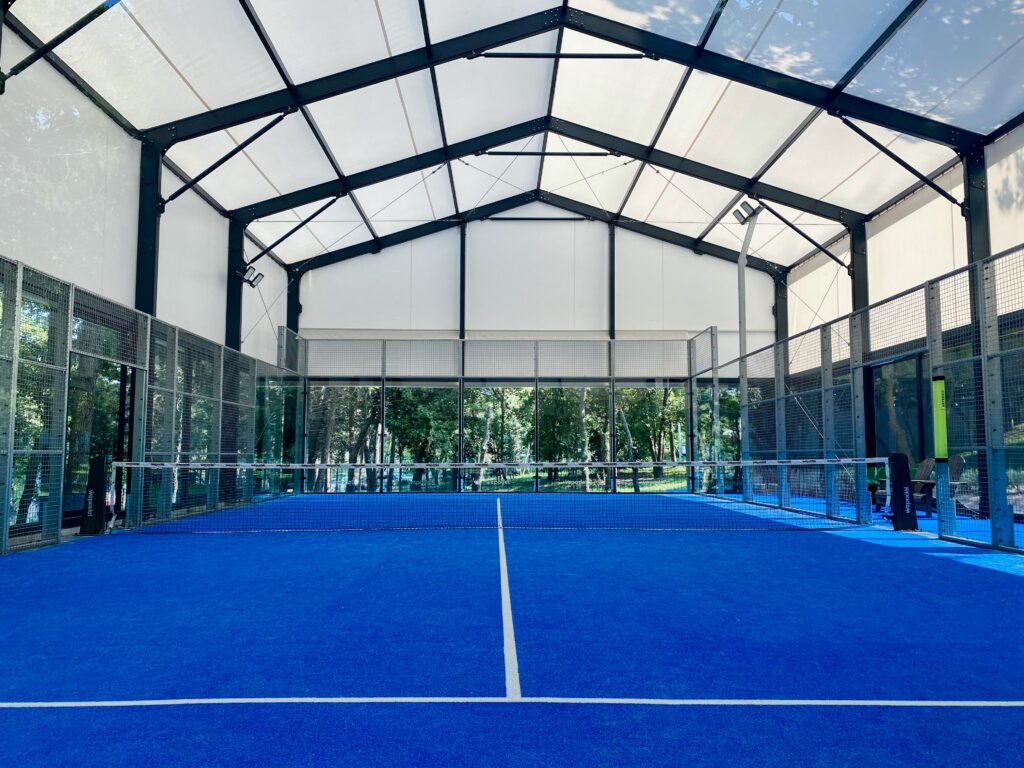
Three material groups define the structure. The frame is hot-dip galvanised steel (classic systems) or aluminium (lighter panoramic systems). Walls are 10–12 mm tempered glass, designed to withstand ball impact and player contact.
The playing surface is monofilament or fibrillated synthetic turf, infilled with silica sand. Fencing is welded or twisted steel mesh. Material grade is where cheap and serious suppliers separate — ask for glass thickness, steel coating spec, and turf weight in grams per square metre.
How much does a campo da padel in Cina weigh, and how many fit in a container?
Weight drives your freight cost and your container plan, so this is the number to fix first. As a working figure, one set of campo da padel panoramico weighs around 5–6 tonnes. A classic padel court is heavier, because it uses more steel structure and mesh.
Container loading works out as follows:
- 40ft container: fits 4 complete panoramic padel court sets, roughly 24 tonnes total.
- 20ft container: fits 2 complete panoramic padel court sets, roughly 12 tonnes total.
These loads sit within standard container payload limits, so the constraint is usually a balance of weight and volume rather than one alone. Heavier classic systems may reduce the count per container, which is why the packing list should be confirmed before you price the shipment.
What are the main trade terms (Incoterms) used by a china padel court factory?
The Incoterm decides who pays for, and controls, each leg of the journey. The three you will be quoted most often are FOB, CIF, and DDP/DAP. Choosing the wrong one is where first-time buyers lose money or lose control of their cargo.
- FOB (Free On Board): the factory delivers the goods loaded onto the vessel at a Chinese port. You arrange and pay the ocean freight, insurance, and everything at destination. Best if you already have a freight forwarder.
- CIF (Cost, Insurance and Freight): the factory pays ocean freight and insurance to your destination port. You handle import customs and inland delivery. A common middle ground.
- DDP / DAP (Delivered Duty Paid / Delivered At Place): the factory manages door-to-door delivery. DDP includes destination duties and taxes; DAP stops short of them. Lowest effort for the buyer, highest reliance on the supplier.
For a first import with no forwarder relationship, CIF or DAP usually gives the cleanest split of responsibility. We quote all of these.
pano expert insight: China’s logistics system is currently very powerful. Countries in Europe, America, Southeast Asia, and the Middle East can support DDP. African countries currently cannot support DDP and have more FOBs.
What are the current ocean freight rates and transit times from China?
Ocean freight is the most volatile line in your budget, and mid-2026 is an expensive, unstable window. After a brief return to the Red Sea in late 2025, renewed regional conflict pushed most carriers back around the Cape of Good Hope, adding distance and time to Asia–Europe sailings.
As a result, spot rates climbed sharply through June 2026. The table below is an indicative snapshot for a 40ft container in mid-June 2026 — treat it as a planning reference, not a quote, because these numbers move weekly.
| Destination (base port) | Approx. transit time | Indicative 40ft spot rate (mid-Jun 2026) |
|---|---|---|
| North Europe (Rotterdam) | ~32–42 days | ~US$4,300 |
| Mediterranean (Genoa) | ~35–45 days | ~US$5,750 |
| US East Coast (New York) | ~30–40 days | ~US$6,770 |
| US West Coast (Los Angeles) | ~18–28 days | ~US$5,140 |
| East Coast South America | ~30–40 days | ~US$2,800–3,100 |
| West / South Africa | ~25–40 days | varies by service |
Rates exclude surcharges. In a peak market you should expect a Bunker Adjustment Factor (BAF) and a Peak Season Surcharge (PSS) on top of the base rate, which can add several hundred to a couple of thousand US dollars per container.
Verify live numbers before you commit. Useful official and industry sources:
- Maersk — book space and pull schedules directly from a major carrier.
- Drewry World Container Index — weekly benchmark 40ft spot rates by route.
- Freightos FBX — live container indices per trade lane.
- Shanghai Shipping Exchange (SCFI/CCFI) — the source indices for China export freight.
To track a booked container, use track-trace.com for container status, and ShipXY (船讯网) to follow the vessel’s live position at sea.
Pano experts suggest: You should start communicating with the factory at least 3 months in advance according to the opening time of your padel project club:
because at least 1 month must be set aside for production. 2. Transportation time, which is the biggest uncertain factor, should be set aside at least 50 days to 60 days (for example, in mid-June 2026, many ships will not have warehouses, resulting in a backlog of goods and delays in shipments). This will ensure that your club or project will not be delayed.
Therefore, you must communicate and confirm with the factory from the beginning of club planning.
When is the best time to ship, and what should I avoid?
Three points from the export desk that save buyers money and stress:
- Avoid peak season if you can. June, July, and August are the traditional crunch months — space tightens and rates rise. Booking outside this window gives you better rates and fewer rollovers.
- Watch geopolitical disruption. Conflict-driven rerouting has suspended services and pushed rates up while extending transit times. Build a time buffer into any fixed installation date.
- Track clearance through your own authorities. Most countries publish cargo arrival and customs status on the national customs portal — check it directly rather than relying only on the forwarder’s updates.
Which ports does a china padel court factory ship from?
Export sailings concentrate at China’s main container gateways. Depending on factory location, your court will typically load at Shanghai, Ningbo-Zhoushan, Shenzhen (Yantian), Qingdao, or Tianjin.
The loading port affects available services and rates, so it is worth confirming on the booking. A factory near a major port usually means more sailing options and shorter trucking to the terminal.
What is the import and customs clearance process?
The sequence is consistent across most destinations. The factory produces and books the vessel, then issues the shipping documents: commercial invoice, packing list, bill of lading, and any certificate of origin.
On arrival, your customs broker files the import declaration, and you pay import duty plus VAT/GST as applicable. Padel court structures are classified under their own HS code — confirm the exact code and duty rate with a local broker before shipping, because it determines your landed cost.
Once duties are paid and the goods are released, the container moves by truck to your site for unloading and assembly.
What are the cost factors when importing into your destination market?
The court price is only one part of your landed cost. Build your budget from these components:
- Ex-works court price (frame, glass, turf, fixings).
- Ocean freight plus BAF/PSS surcharges.
- Marine insurance (typically a small percentage of cargo value).
- Import duty and VAT/GST in your country.
- Destination port charges, customs brokerage, and inland trucking.
- Site works — the concrete base and assembly labour, which are local costs, not factory costs.
Two buyers in different countries can pay very different landed costs for the same court, driven mostly by duty rate and inland distance. Price the whole chain, not just the court.
What does the installation process involve?
Installation begins with a level, cured concrete slab built to the factory’s foundation drawing. The frame is anchored to the slab, glass panels and mesh are mounted, then the turf is laid and the sand infill is brushed in.
A two-person experienced crew can assemble a standard court in a few days. For first-time installers, supervised installation or a detailed assembly manual removes most of the risk of misalignment.
What are common mistakes when choosing a china padel court supplier?
The recurring errors I see cost buyers far more than the price difference they were chasing:
- Comparing prices without comparing glass thickness, steel coating, and turf weight.
- Accepting FOB with no freight forwarder in place, then losing control of the shipment.
- Ignoring the HS code and duty rate until the container is already at port.
- Booking into peak season and being surprised by surcharges and rollovers.
- Choosing a trading company that cannot support the court after it is installed.
Why is sourcing a padel court from a China factory cost-effective?
China concentrates the steel fabrication, glass tempering, and turf production needed for a padel court in one supply chain, which lowers the unit cost of a complete system. Buying factory-direct removes the trading-company margin on top of that.
The trade-off is the freight and the lead time. When you import a full container of courts rather than a single unit, the per-court freight cost drops sharply and the factory price advantage holds up against local suppliers.
Where are the top china padel court factories located?
Padel court manufacturing in China clusters around regions with strong steel processing, glass, and sports-surface industries — primarily the Bohai Rim ( Hebei, Shandong), the Yangtze River Delta around Shanghai and Ningbo, and the Pearl River Delta in Guangdong.
Proximity to these industrial bases and to a major export port is what lets a serious factory control quality and keep freight efficient.
What does PanoCourt offer as a china padel court factory?
We are a fabbrica del campo da padel with more than 10 years focused on this product. We design and develop our courts in house, which means we control the engineering rather than reselling someone else’s frame.
In 2025 we exported over 1,000 padel court sets to France, Canada, the United States, South America, and Africa. We quote DDP, DAP, and FOB, so you can pick the level of logistics support you want.
For buyers who want one accountable partner, we handle the full chain — design, manufacturing, container loading, shipping, and installation support — so a club owner or installer can run a direct import without managing each step alone.
Frequently asked questions
-
How long does shipping a padel court from China take?
Transit time depends on the lane: roughly 18–28 days to the US West Coast, 30–40 days to the US East Coast and South America, and 32–45 days to Europe, longer when carriers route around the Cape of Good Hope.
-
How many padel courts fit in a 40ft container?
A 40ft container holds 4 complete panoramic padel court sets, about 24 tonnes. A 20ft container holds 2 sets, about 12 tonnes. Heavier classic systems may reduce the count, so confirm the packing list.
-
How much does it cost to import a padel court from China?
Your landed cost is the court price plus ocean freight, surcharges, insurance, import duty and VAT/GST, and inland delivery. The freight share alone for a 40ft container ranged from roughly US$4,000 to over US$6,000 on major lanes in mid-2026, so always price the full chain.
-
How much does a padel court weigh?
One panoramic padel court set weighs around 5–6 tonnes. Classic systems are heavier because they use more steel structure and mesh.
-
Should I buy FOB, CIF, or DDP from a china padel court factory?
FOB suits buyers with their own freight forwarder. CIF and DAP give a cleaner split for first-time importers. DDP is the lowest-effort option because the factory manages door-to-door delivery, including duties.
-
Do I have to pay import duty on a padel court?
In most countries, yes — import duty plus VAT or GST applies. The exact rate depends on the HS classification of the court structure in your country. Confirm the code and rate with a local customs broker before shipping.
-
How do I track my padel court container at sea?
Use your carrier’s tracking (for example, Maersk) or a service like track-trace.com with the container number. To see the vessel’s live position, use a ship-tracking site such as ShipXY (船讯网).
-
What is the minimum order to import a padel court from China?
You can order a single court, but the freight economics improve sharply when you fill a container. Two panoramic sets fill a 20ft and four fill a 40ft, which lowers the per-court shipping cost considerably.
-
Can a china padel court factory handle installation in my country?
A full-service factory provides assembly manuals, remote support, or a supervising installer, and can quote DDP delivery to your site. Final site works — the concrete base and labour — are usually arranged locally.
-
Is a china padel court cheaper than buying from a European manufacturer?
Factory-direct China pricing is generally lower on the unit cost because the steel, glass, and turf supply chain is concentrated there. The saving holds up against local suppliers when you import by the full container rather than a single unit.