
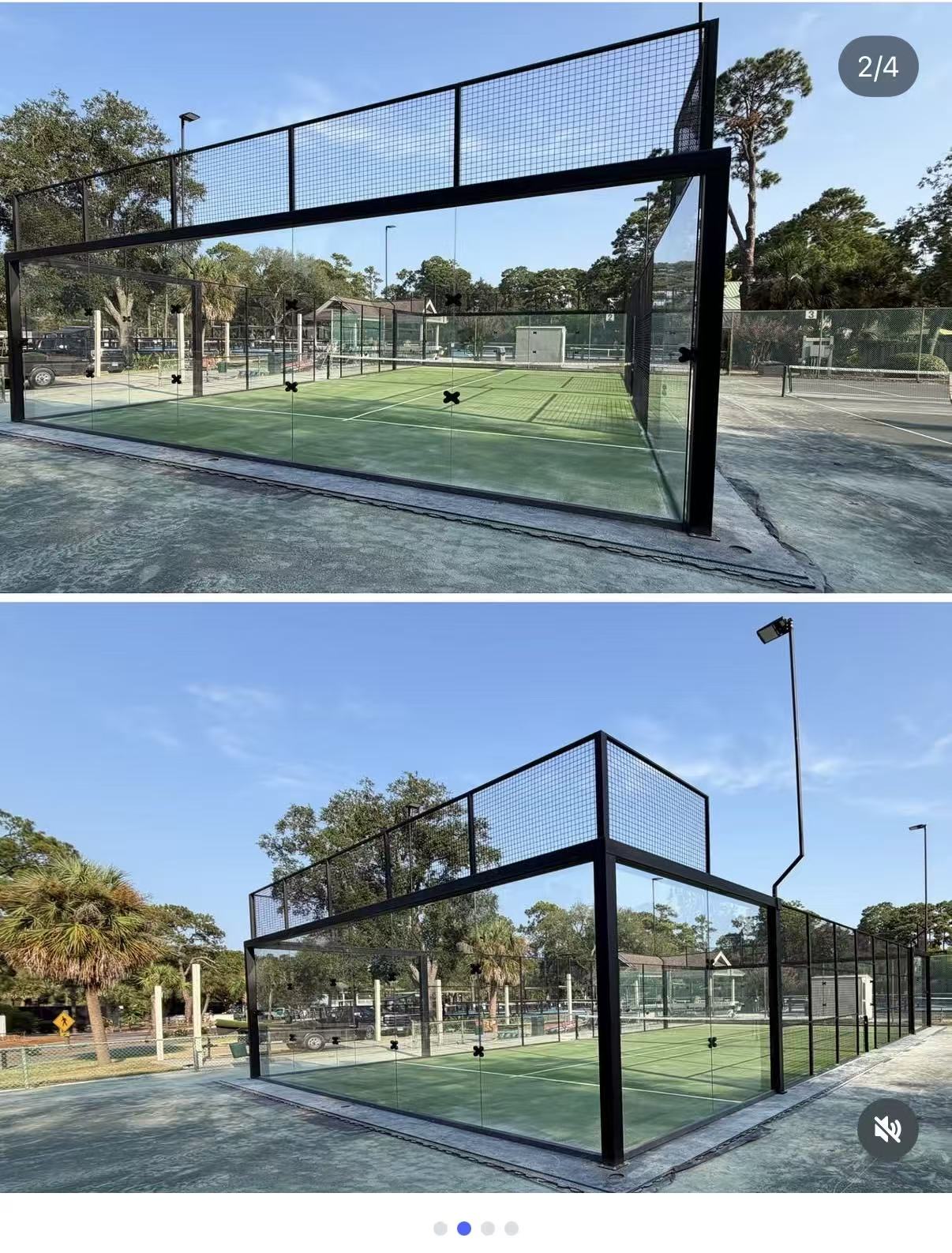
For a coastal padel court, choose a classic or panoramic model — not full panoramic. Then specify 140 × 140 × 4 mm corner posts (or a twin-tube corner assembly), hot-dip galvanizing applied بعد fabrication at 70 µm or more, 316 stainless fasteners throughout, and chemical anchors instead of expansion bolts. That combination is what survives salt-laden air, permanent humidity and the gusts that come off open water.
We build courts for seafront clubs, island resorts and port-city developers. The pattern is consistent: a coastal padel court rarely fails because of the glass or the turf. It fails at welds, cut edges, bolt heads and glass fittings — the small details a standard outdoor specification never has to worry about. This guide sets out exactly what to ask your شركة مصنعة لملاعب البادل to put in writing before you pay a deposit.
What Does This Coastal Padel Court Guide Cover?
- What makes a coastal padel court different from a standard outdoor court
- Should a coastal padel court be classic or panoramic?
- What steel structure should a coastal padel court use?
- Why the galvanizing sequence matters more than the zinc number
- How a coastal padel court should be anchored
- Which hardware survives salt air on a coastal padel court
- Is aluminium a viable alternative?
- What the coastal specification changes on price, weight and lead time
- How to maintain a coastal padel court
- Pre-order checklist
- الأسئلة الشائعة
What Makes a Coastal Padel Court Different From a Standard Outdoor Court?
A coastal padel court sits in a chloride-rich atmosphere. Airborne salt deposits on every steel surface, attracts moisture from humid air, and keeps a thin electrolyte film on the metal for most of the day. Corrosion never gets the chance to stop, which is why a coastal padel court has to be specified differently from the first drawing onward.
Under ISO 9223, a seafront location typically falls into corrosivity category C5 (very high, marine) and, on exposed surf coasts, CX (extreme). Inland outdoor sites are usually C2–C3. The jump is not incremental — it is roughly an order of magnitude in metal loss per year.
- Salt deposition keeps steel wet even when it has not rained
- UV load is higher near water because of surface reflection
- Gust loading is stronger and less predictable than at inland sites
- Wind-driven sand abrades coatings on the windward elevation
- Maintenance access is often harder, so coastal padel court upkeep gets deferred
نظرة متعمقة: the failure sequence on a coastal padel court is predictable. Rust appears first at a weld toe or a drilled hole, then at a bolt head, then at the glass connector plate. The main tube body is usually the last thing to go.
That tells you where the money should be spent — on process and hardware, not on the headline tube size alone. A supplier who answers a coastal enquiry by quoting only a thicker wall has misunderstood the problem.
Should a Coastal Padel Court Be Classic or Panoramic?
Both work. A ملعب بادل كلاسيكي and a ملعب الباديل البانورامي are both viable on the coast. A full panoramic court is not our recommendation for an exposed seafront site.
| العامل | Classic | Panoramic | بانورامي كامل |
|---|---|---|---|
| Glass area (wind sail) | Lowest | متوسط | Highest |
| Wind permeability | High — mesh lets wind through | متوسط | منخفض |
| Intermediate posts | Full set | Full set | Reduced or removed |
| Load-path redundancy | مرتفع | مرتفع | Concentrated at corners |
| Spectator and photo appeal | معتدل | مرتفع | Highest |
| Coastal verdict | Recommended | Recommended | غير موصى به |
نظرة متعمقة: mesh is permeable and glass is not. On a classic court, a large share of the enclosure lets air pass straight through, so the frame simply sees less lateral load. A full panoramic court does the opposite — it maximises solid surface while removing the intermediate posts that would otherwise share that load.
Every kilonewton then has to travel through the corner assemblies and the top beams. On a calm inland site that is a legitimate aesthetic trade. Facing open water, it removes exactly the redundancy you most want. If you are still weighing the three enclosure types, our panoramic vs classic vs full panoramic comparison covers the non-coastal trade-offs in detail.
رؤية واقعية: resort clients almost always open the conversation asking for full panoramic, because it photographs best against a sea view. The compromise we normally land on is a panoramic court positioned so the most-photographed elevation faces the water, with the mesh elevations taking the prevailing wind. You keep the visual and you keep the load paths, and the coastal padel court still reads as a premium facility.
What Steel Structure Should a Coastal Padel Court Use?
Our coastal padel court recommendation is 140 × 140 × 4 mm square hollow section at the corner posts, or a twin-tube corner assembly where two smaller sections are battened together. The standard outdoor build uses 100 × 100 × 3 mm. The upgrade is not cosmetic.
- Section modulus rises roughly 2.6× (about 36,500 mm³ to about 95,900 mm³)
- Second moment of area rises roughly 3.7×, so deflection under gust load drops sharply
- Steel weight at the corner rises from about 9.1 kg/m to about 17.1 kg/m
- A 4 mm wall gives a real corrosion allowance — the same annual metal loss consumes a much smaller share of the section
- A thicker wall also moves the component into a higher galvanizing class, which is covered below
رؤية واقعية: the corner is where two long spans hand their load into the foundation. It is also the most exposed position for wind-driven salt on a coastal padel court. A twin-tube arrangement is a good alternative when shipping profile or local handling limits matter, but it adds weld count — and every extra weld is another detail that must be galvanized correctly.
If you choose twin-tube, tighten the inspection specification accordingly and ask for photographs of the fabricated assembly before it goes to the galvanizing bath. For the wider structural picture, see our engineering guide to padel court wind load and our walkthrough of how to judge whether an outdoor panoramic structure is safe.
Why Does the Galvanizing Sequence on a Coastal Padel Court Matter More Than the Zinc Number?
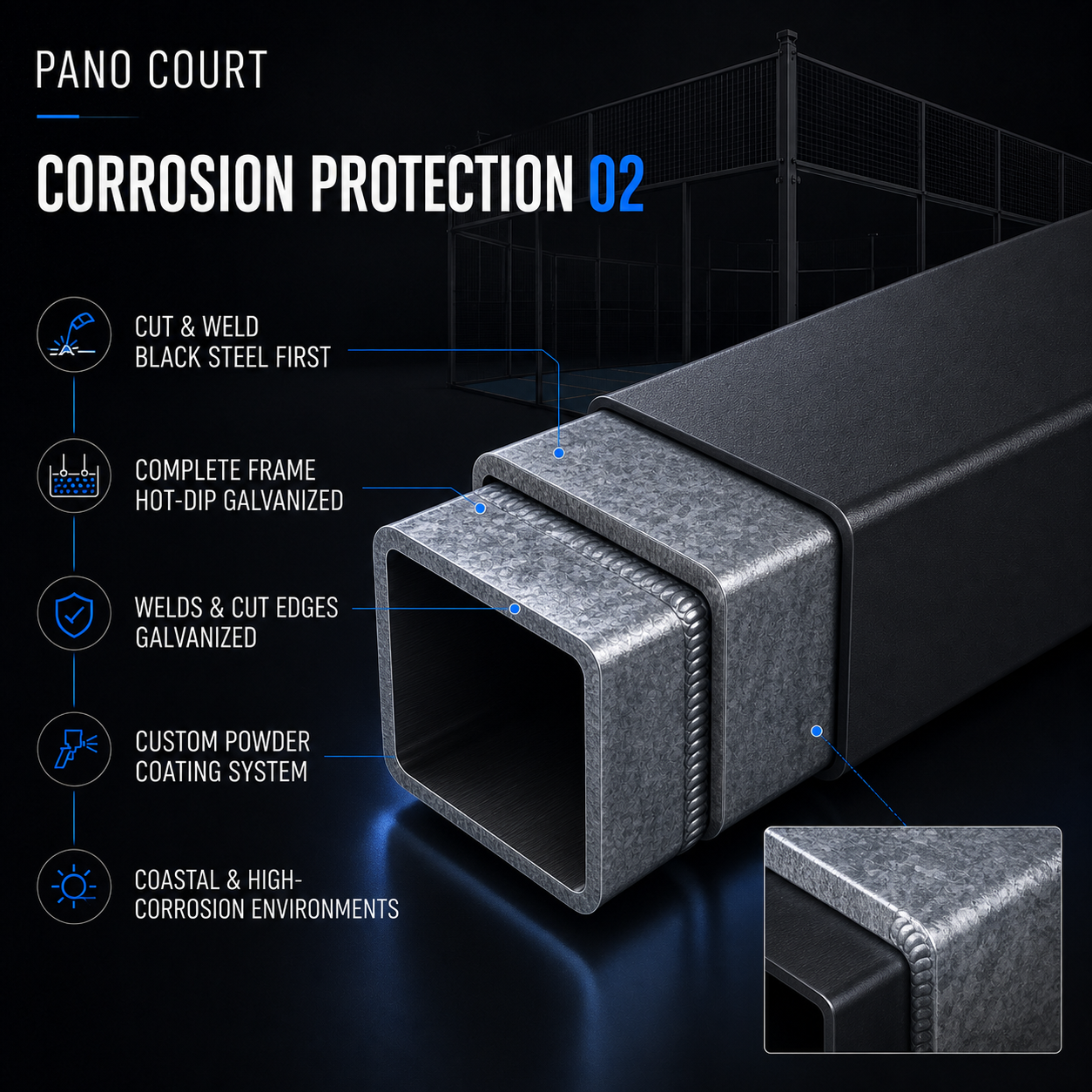
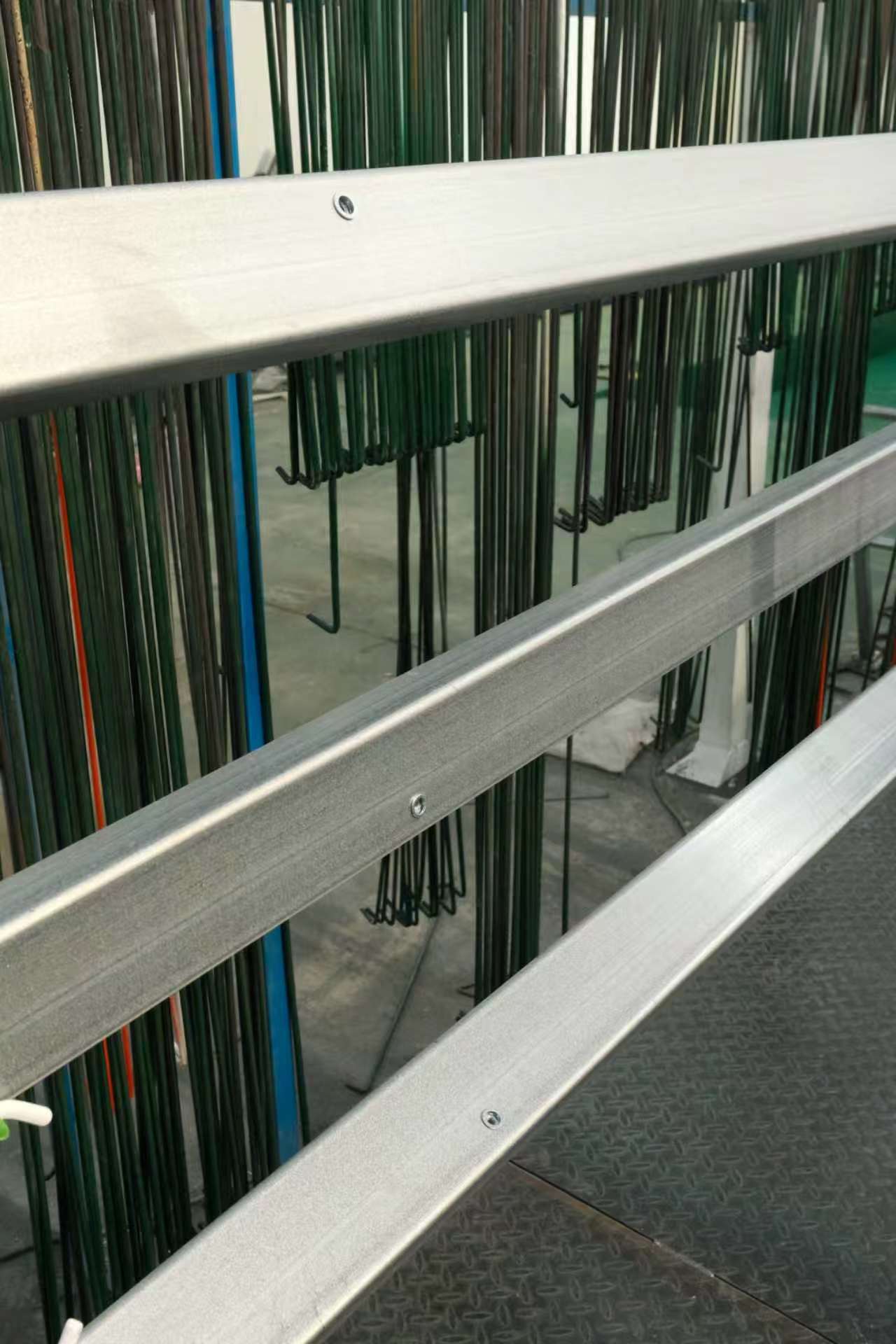
Because cutting and welding بعد galvanizing destroys the zinc at precisely the points where corrosion starts. For a coastal padel court we use raw black steel, complete all cutting, drilling and welding in the factory, and only then hot-dip galvanize the finished component as a whole.
The process order is: raw steel → cutting and drilling → welding and frame fabrication → complete-component hot-dip galvanizing → surface preparation → powder coating.
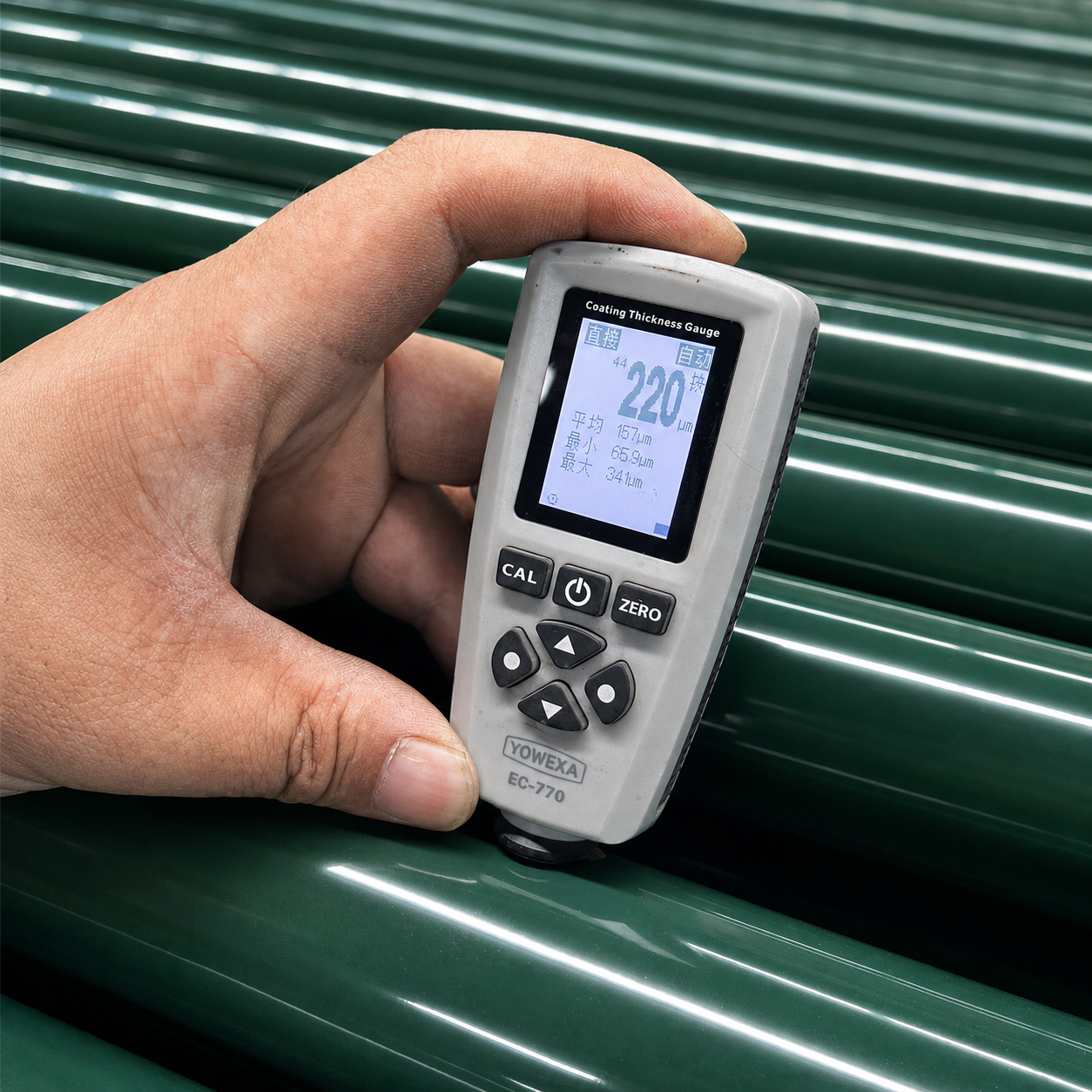
The specification we recommend is a zinc coating of not less than 70 µm. That figure is not arbitrary. Under EN ISO 1461, articles fabricated from steel between 3 mm and 6 mm thick carry a mean coating requirement of 70 µm. At a 4 mm wall you are specifying the standard’s own number, not a supplier’s marketing figure.
Data point: in an ISO 9223 C5 marine atmosphere, zinc is consumed at roughly 4.2–8.4 µm per year. A 70 µm layer on its own therefore represents something like 8–16 years of protection before the steel is exposed.
Adding a compatible powder coating over prepared galvanized surface creates a duplex system. In service that typically lasts considerably longer than the two coatings would if you simply added their individual lives together — the paint slows zinc consumption, and the zinc prevents undercutting wherever the paint is chipped or abraded. The Galvanizers Association publishes the synergy data behind this.
رؤية واقعية: insist on vent and drain holes in hollow sections, and check that post bases are not detailed to sit in ponded water. A galvanized post standing in a puddle of salt water will fail years before an identical post on a raised grout pad. This detail costs nothing at design stage and is almost impossible to fix later.
How Should a Coastal Padel Court Be Anchored?
Use chemical (bonded) anchors rather than mechanical expansion bolts, with A4/316 stainless threaded rod and a vinylester or epoxy resin rated for the service temperature.
Expansion anchors work by friction generated from an expansion force pressing outward against the concrete. Under the cyclic, reversing loads a coastal padel court sees every day, that friction can relax. A bonded anchor transfers load along the full embedment depth instead, tolerates smaller edge distances, and performs far more predictably in cracked concrete when the system is properly qualified.
- Higher and more consistent pull-out capacity per bolt
- Better behaviour near slab edges, which matters on tight coastal footprints
- The resin seals the annulus, keeping salt water out of the drilled hole
- Requires clean, dry holes and disciplined installation — brush and blow the hole properly
With this anchoring approach and the upgraded frame, we specify the coastal configuration against a design target in the region of 120 km/h. Treat that as design intent, not a guarantee. The governing figure must come from your local wind code, your site’s exposure category and your engineer’s assessment of the actual foundation.
Our أساس ملعب البادل في الهواء الطلق guide covers the slab side of that interface, and our foundation requirements article sets out the base types and tolerances your civil contractor will need.
Which Hardware Survives Salt Air on a Coastal Padel Court?
Every fastener on a coastal padel court should be 316 stainless steel. Not 304, which is the standard outdoor grade.
The difference is molybdenum. It raises the alloy’s pitting resistance equivalent number from roughly 18–20 for 304 to roughly 24–26 for 316. In chloride environments, 304 does not rust evenly and visibly — it pits, forming deep local penetrations under an otherwise clean-looking surface. That is a worse failure mode than general rust, because you cannot see it coming.
The mistake most buyers make: they specify 316 bolts and stop there. Stainless steel in direct contact with hot-dip galvanized steel forms a galvanic couple, and zinc is the anode — it sacrifices itself at the contact point.
Across a whole frame the area ratio is favourable and the effect is tolerable. But at glass connectors, where a small galvanized washer or plate meets a comparatively large stainless assembly, the ratio reverses and local zinc loss accelerates badly. Specify EPDM or nylon isolating washers and gaskets at every glass fitting. This single detail is the difference between fittings that still look sound at year eight and fittings weeping rust at year three.
Is Aluminium a Viable Alternative for Coastal Padel Courts?
Not yet — at least not from us, and we would rather say so plainly. Aluminium is theoretically attractive for a coastal padel court because it forms a self-passivating oxide layer and does not rust. We have it at the research stage and we are not offering it commercially.
The open questions are real ones. Aluminium’s elastic modulus is about one third of steel’s, so sections must be redesigned rather than substituted, or the frame deflects visibly under gust load. Welding marine-grade alloys creates a heat-affected zone with reduced strength, which has to be designed around rather than ignored.
And the galvanic couple between aluminium and 316 stainless hardware is more aggressive than the zinc–stainless couple, so isolation detailing moves from advisable to critical. Our position: do not buy a coastal padel court built on a material that has not been through full-cycle testing and several seasons of real service. Ask any supplier offering aluminium coastal courts what field data they hold. The answer is informative.
What Does a Coastal Padel Court Specification Change on Price, Weight and Lead Time?
A coastal padel court is heavier and passes through one more production stage than a standard outdoor court, so three commercial numbers move together: factory price, shipping weight and programme.
| العنصر | Standard outdoor | Coastal specification |
|---|---|---|
| Corner post section | 100 × 100 × 3 mm | 140 × 140 × 4 mm or twin-tube |
| Corrosion route | Pre-galvanized tube, then powder coat | Fabricate first, then complete-component hot-dip galvanizing |
| Zinc coating | Standard mill coating | Not less than 70 µm |
| Primary fasteners | 304 stainless | 316 stainless with isolating washers |
| Anchors | Stainless expansion bolts | Chemical anchors with A4/316 studs |
| Set weight | Baseline | Higher — affects the freight basis |
Because weight changes, freight changes with it, and that can shift how many sets you load per container. Compare offers on scope rather than on the headline تكلفة ملعب البادل alone, and read our breakdown of FOB, CIF, DAP and DDP before you compare two quotations that look different but are not.
Against the cost of replacing a corroded structure in year six — dismantling, disposal, new steel, freight, reinstallation and lost court revenue during the works — the coastal delta at order stage is small. That is the whole commercial argument, and it is worth making to your investor group in writing.
How Do You Maintain a Coastal Padel Court?
Coastal padel court maintenance is light but non-negotiable. The single highest-return action is a fresh-water rinse that removes accumulated chloride before it can work on the coating.
| Interval | Action |
|---|---|
| Quarterly | Fresh-water rinse of steel, glass fittings and all fasteners |
| Every 6 months | Check anchor bolts for tightness and visible corrosion at the base plate |
| Annually | Visual inspection of weld zones, bolt heads and glass connector plates |
| As required | Touch up coating damage immediately — chips are entry points, not cosmetics |
| Every 2–3 years | Review turf and infill condition; salt and sand accelerate wear |
If the court is covered, salt loading drops considerably on the sheltered elevations, though wind-driven spray still reaches the frame. Our padel court roof guide and canopy page cover that option, and turf selection matters more near the sea than most buyers expect.
What Should You Confirm Before You Order a Coastal Padel Court?
- Get the galvanizing sequence stated in writing — fabricate first, galvanize the complete component second
- Ask for coating thickness inspection records and a salt-spray test report for the coastal padel court order
- Check that 316 appears on the packing list and material certificates, not only in the quotation text
- Confirm isolating washers and gaskets at glass connectors are included, not an extra
- Confirm that anchor design and foundation remain with your local qualified engineer
- Agree lead time and component-by-component warranty terms before deposit
- Budget the quarterly fresh-water rinse into the club’s operating plan from day one
For the wider build sequence, our إنشاء ملاعب البادل guide and our ملعب بادل على شاطئ البحر build guide cover site works, drainage and programme. If you are still shortlisting factories, compare them with our مصنعو ملاعب البادل analysis and our مورد ملاعب البادل buyer’s guide.
الأسئلة الشائعة
Is a panoramic padel court suitable for a coastal location?
Yes, provided the structure is upgraded. Specify 140 × 140 × 4 mm corner posts or a twin-tube corner assembly, hot-dip galvanizing applied after fabrication at 70 µm or more, and 316 stainless hardware. A standard 100 × 100 × 3 mm inland specification is not appropriate for a seafront site.
Why is full panoramic not recommended for a coastal padel court?
Full panoramic maximises glass area while reducing or removing intermediate posts. That raises the wind sail area and concentrates load into the corner assemblies and top beams at the same time. On an exposed coast you want the opposite: permeable surfaces and multiple redundant load paths.
How thick should the zinc coating be on a coastal padel court?
Not less than 70 µm. For fabricated articles in steel between 3 mm and 6 mm thick, EN ISO 1461 sets a mean coating requirement of 70 µm, so a 4 mm wall section specified at 70 µm is aligned with the standard rather than exceeding a supplier’s own benchmark.
Why galvanize after welding instead of buying pre-galvanized tube?
Cutting and welding pre-galvanized tube burns off the zinc at the weld toes and cut edges — exactly where coastal corrosion starts. Galvanizing the complete fabricated component places zinc over welds, drilled holes and cut edges as part of one continuous coating.
Are 304 stainless fasteners acceptable near the sea?
No. In chloride environments 304 is prone to pitting corrosion, which penetrates locally beneath a surface that still looks acceptable. Use 316 throughout, and add EPDM or nylon isolating washers at glass connectors to control galvanic attack on the adjacent galvanized steel.
Why chemical anchors instead of expansion bolts?
Expansion anchors rely on friction from an outward expansion force, which can relax under the cyclic wind loading a coastal court experiences daily. Bonded chemical anchors transfer load along the full embedment, tolerate smaller edge distances, and seal the drilled hole against salt water ingress.
What wind speed can a coastal padel court handle?
Our coastal configuration is specified against a design target in the region of 120 km/h. The governing value for any specific project must come from the local wind code, the site exposure category and the foundation design, confirmed by a qualified local engineer.
How much maintenance does a coastal padel court need?
Less than most buyers expect, but it must be regular. A quarterly fresh-water rinse of the steel, glass fittings and fasteners removes accumulated chloride before it can work. Add an annual visual inspection of weld zones, bolt heads and glass connector plates, and touch up coating damage as soon as it appears.
Does a coastal padel court cost significantly more than a standard outdoor court?
It costs more, but the delta is modest against the total project. The upgrade adds steel weight at the corners and one extra production stage. Set that against dismantling and replacing a corroded structure in year six, plus the court revenue lost while the works run.
How far from the sea does the coastal specification still apply?
There is no single distance. Salt deposition depends on prevailing wind, surf energy and terrain. As a working rule we treat anything within roughly one kilometre of open coast as coastal, and we extend that inland where the site is directly exposed to onshore wind with no intervening buildings or tree line.
الخلاصة
A coastal padel court is a specification decision, not a product decision. Choose classic or panoramic, upgrade the corner sections to 140 × 140 × 4 mm or a twin-tube assembly, insist that galvanizing follows fabrication at 70 µm or more, anchor with chemical bolts and stainless studs, and use 316 hardware with proper isolation at the glass fittings.
Every one of those points costs little at order stage and is expensive or impossible to correct afterwards. Get them into the coastal padel court contract, not just the email thread.
If you are planning a seafront or island project, send us the site location and prevailing wind exposure and we will come back with a coastal padel court configuration, a drawing set and a component list you can hand to your engineer.