Opening a padel club in 2026 is simultaneously more straightforward and more competitive than it was three years ago. More straightforward because the supply chain is more developed, the player base is larger, and investor capital is more available. More competitive because the window of “first mover advantage” is closing fast in most major markets. The decisions you make in the planning and procurement phase—including which شركة مصنعة لملاعب البادل you work with—will define your cost structure and operational capability for the next decade. This guide will also help you understand how to open a padel club successfully.
This guide covers the complete business planning framework for opening a padel club or padel facility: market selection, financial modeling, court specification, مورد ملاعب البادل selection, regulatory navigation, and operational launch. It’s the guide we wish existed when our clients started their projects.
Learning how to open a padel club involves understanding market dynamics and customer preferences.
If you want to learn how to open a padel club, understanding market dynamics and customer preferences is crucial. The success of how to open a padel club lies in your understanding of these elements.
Essential Blocks for Gutenberg
Add a strong one liner supporting the heading above and giving users a reason to click on the button below.
Market Validation: Is Your Location Ready for a Padel Club?
When conducting market validation, make sure you have a clear understanding of your requirements for opening a padel club. This will help you make more informed decisions.
How to open a padel club ?
Choosing a location is key to opening a successful padel club. You must know that the income of how to open a padel club is directly related to the density and income level of the surrounding population.
The single most consequential decision in a padel club business plan is location selection. Revenue is fundamentally a function of catchment population, disposable income, and competitive supply—and getting this wrong is not fixable with better courts or superior marketing.
Demand Assessment Framework
When conducting a needs assessment, thinking about how to open a padel club will help you find the best market fit.
Before committing to a site, verify:
- Catchment population: Target minimum 150,000 population within 20-minute drive time for a 4-court facility; 300,000+ for 8+ courts
- Demographic profile: Core padel demographic is 25–50 year old urban professionals with disposable income for sports leisure; validate this profile exists in your catchment via census and consumer spending data
- Existing padel supply: Count current courts within your catchment at existing clubs. Target markets where court-to-player ratios suggest undersupply (typically <1 court per 1,500 potential players)
- Awareness check: Local social media groups, tennis club waiting lists, and sports retailer sales data are informal but useful demand indicators
During the market assessment process, it is very important to understand the various needs of how to open a padel club.
Highest-ROI Market Types in 2026
Based on the تقرير Playtomic وPwC العالمي عن رياضة البادل لعام 2025 and PanoCourt’s active client project pipeline, the highest-ROI padel club markets in 2026 share these characteristics:
- Secondary cities in established padel markets (not capital cities where supply is now dense)
- Emerging market capitals where a affluent player base exists but court supply is nascent (Bogotá, Lima, Quito, Jakarta, Dubai secondary zones)
- Resort and leisure destinations with international visitor profiles (Bali, Marbella secondary, Algarve)
- US suburban markets where tennis club infrastructure exists and padel can be introduced as upgrade
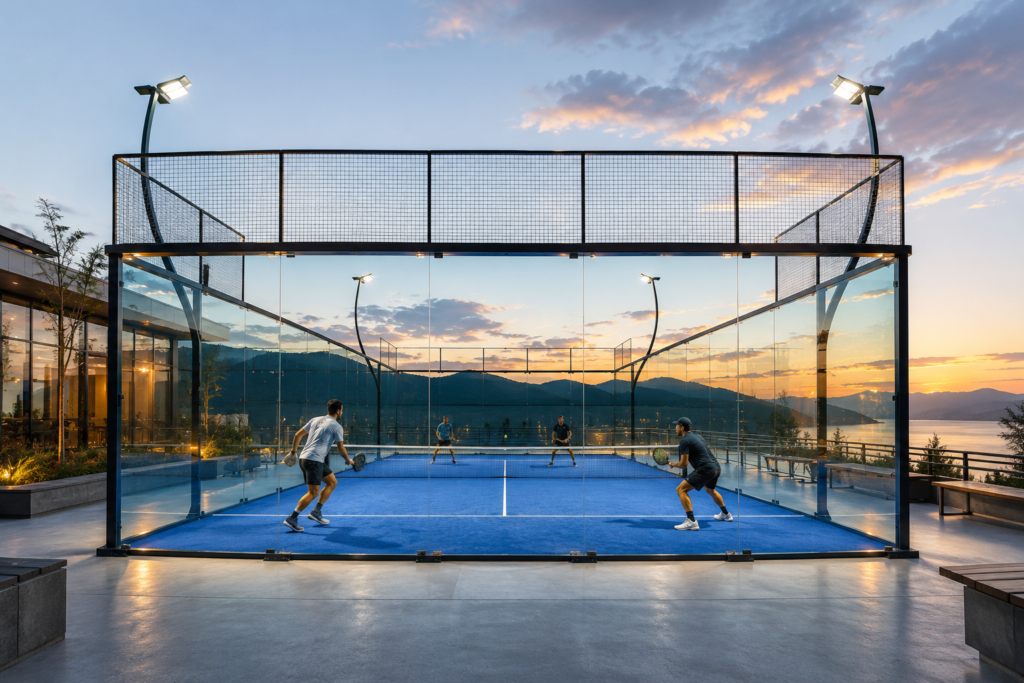
Financial Modeling: Building a Realistic Business Case
Capital Cost Structure
When considering how to open a padel club location, make sure you understand the competition and market demand in the area.
A realistic capital expenditure model for a 4-court outdoor padel facility in a Latin American market (using Chinese-manufactured ملاعب باديل بانورامية):
| بند الإنفاق الرأسمالي | Cost (USD) | ملاحظات |
|---|---|---|
| 4 panoramic padel courts (CIF) | $96,000–$130,000 | $24,000–$32,500 per court landed |
| Import duties and customs | $14,000–$22,000 | Country-dependent (10–20% of CIF) |
| Site preparation and foundations | $16,000–$28,000 | $4,000–$7,000 per court |
| أعمال تركيب المحكمة | $12,000–$20,000 | $3,000–$5,000 per court |
| Electrical infrastructure | $6,000–$12,000 | Power supply, breaker panel, lighting circuits |
| Reception/changing room building | $25,000–$60,000 | Highly site-dependent |
| Parking and access works | $8,000–$20,000 | If not pre-existing |
| Booking software and POS | $2,000–$5,000 | Annual subscription model |
| Furniture, equipment, signage | $5,000–$12,000 | Reception, lounge, storage |
| Working capital buffer | $15,000–$30,000 | 3–6 months operating expenses |
| Total CAPEX | $199,000–$339,000 | 4-court outdoor facility |
In financial modeling, it is crucial to understand how to open the different revenue streams of a padel club.
The manufacturer selection decision affects $110,000–$180,000 of this CAPEX (court + duties + installation). Switching from European to Chinese مورد ملاعب البادل on a 4-court project typically saves $30,000–$55,000 in total court procurement cost.
Revenue Model
By diversifying your income streams, you will be able to more effectively manage the finances of opening a padel club.
The financial model for how to open a padel club requires considering multiple revenue streams to make your project more viable.
Revenue modeling for a padel club should account for multiple streams:
- Hourly court rental: The primary revenue stream. Model by: (daily operational hours × court rental rate × number of courts × utilization rate × 365)
- Membership revenue: Monthly or annual memberships providing rental discounts or guaranteed booking slots. Typical Latin American club: $50–$150/month
- Coaching and clinics: Group and private lesson revenue. 1–2 full-time coaches generating $3,000–$8,000/month combined
- Equipment retail: On-site racket, ball, and apparel sales. Typically 5–10% of total revenue for well-run clubs
- Food and beverage: Café/bar revenue for clubs with appropriate facilities. High margin but requires food service capability
- Tournament hosting: Court rental, entry fees, sponsorship. Meaningful revenue driver for FIP-compliant panoramic facilities
Illustrative P&L: 4-Court Outdoor Club, Latin America
| P&L Item | Annual Figure (USD) | Assumptions |
|---|---|---|
| Court rental revenue | $140,000–$180,000 | $18/hr avg, 12 hrs/day, 4 courts, 70% utilization |
| Membership revenue | $24,000–$48,000 | 100–200 members @ $20–$30/month net |
| Coaching revenue | $18,000–$36,000 | 1–2 coaches, private + group |
| Equipment + F&B | $12,000–$24,000 | Retail and café |
| Total Revenue | $194,000–$288,000 | |
| Staff cost | ($45,000–$80,000) | Reception, coaches, maintenance |
| Rent/mortgage | ($18,000–$40,000) | Site-dependent |
| Utilities (electricity, water) | ($12,000–$24,000) | LED lighting efficiency important |
| Marketing | ($8,000–$16,000) | Digital, local sponsorship |
| الصيانة | ($6,000–$12,000) | Turf, lighting, structural |
| Insurance + admin | ($5,000–$10,000) | Liability, property |
| EBITDA | $100,000–$106,000 | Mid-case scenario |
| Payback period | 24–34 months | On $200,000–$280,000 CAPEX |
Padel Court Selection: The Strategic Procurement Decision
For a new padel club, court specification drives two financial outcomes: upfront capital cost and annual revenue potential. The ملعب الباديل البانورامي commands higher rental rates and enables tournament hosting; the ملعب بادل كلاسيكي costs less to build. Our recommendation for most new commercial club projects: start with panoramic.
The revenue premium from panoramic courts ($3–$7/hour over comparable classic courts in most markets) generates an annual additional revenue of $15,000–$35,000 for a 4-court facility at typical utilization. Against a $20,000–$25,000 CAPEX premium for panoramic vs. classic on 4 courts, payback on the premium is achieved in 8–18 months.
When making plans to open a store, think about the best way to open a padel club, which will help you make a reasonable decision.
For a complete court selection framework: How to Choose a Padel Court: 2026 Guide for Investors and Club Owners.
Selecting Your Padel Court Manufacturer: The Business Case Lens
From a business planning perspective, manufacturer selection should be evaluated on: total project cost (not just FOB), delivery reliability (timeline risk to opening date), quality risk (warranty claims, early failure), and ongoing support (spare parts availability, warranty responsiveness).
For most new club projects outside Western Europe and North America’s premium tier, factory-audited Chinese مصنعو ملاعب البادل deliver the optimal combination of cost, quality, and supply chain resilience. The cost saving funds capital buffer, marketing spend, or additional court capacity. See the full manufacturer analysis: Top 3 Padel Court Manufacturers in 2026: Complete Investment Guide for Padel Clubs.
Regulatory and Licensing Requirements for Padel Clubs
Common Regulatory Requirements
Regulatory requirements vary significantly by country and municipality, but commonly include:
Making sure you master all the necessary regulations on how to open a padel club will make your project more robust.
- Building/construction permit: For permanent structures (courts + any buildings)
- Electrical installation permit: For lighting and power infrastructure
- Business operating license: Sports facility or entertainment venue license from local authority
- Environmental permit: Noise (lighting hours, sound from play), drainage (surface water management)
- Fire safety certificate: For enclosed indoor facilities
- National sports federation registration: For hosting sanctioned competitions (optional but valuable)
Launch and Marketing Strategy
Pre-Opening Marketing
A padel club requires active pre-opening marketing to achieve utilization targets from launch rather than building slowly to breakeven. Key pre-opening tactics:
- Social media presence: Build Instagram and TikTok following during construction—panoramic court construction content performs well as installation video
- Founder membership offer: Pre-sell discounted annual memberships to validate demand and generate working capital
- Corporate partnership outreach: Local businesses and multinationals often fund employee sports memberships—approach HR departments directly
- Opening tournament: A free or low-cost inaugural tournament builds community, generates social media content, and creates local media coverage
For a full Ecuador-specific club investment analysis: تكلفة بناء ملعب باديل كورت الإكوادور 2026.
PanoCourt’s Club Developer Support Program
PanoCourt works with padel club developers from initial feasibility through court commissioning. Our developer support includes: court specification consultation at no cost; detailed project cost modeling including total landed cost, duties, and installation; engineer-to-engineer technical briefing for local structural engineers; phased supply options (start with 2 courts, expand to 6 as membership grows); and Spanish-language support for Latin American developers.
Start Your Padel Club Business Planning with PanoCourt
Whether you’re at the feasibility stage or ready to order, PanoCourt’s team can help you build the right court specification and procurement plan for your padel club project. Contact us for a free developer consultation and project cost model.
→ Request Free Developer Consultation
How to open a padel club you can refer to FIP standards
Frequently Asked Questions: Starting a Padel Club
How much money do I need to open a padel club?
A realistic minimum for a 4-court outdoor padel facility in Latin America: $200,000–$280,000 in total CAPEX including courts, site works, and facility infrastructure. In Western Europe or the US, equivalent facilities cost $350,000–$600,000. Single-court facilities (feasible as a first step or ancillary to an existing sports club) can be delivered for $50,000–$90,000 total CAPEX. Working capital of $20,000–$40,000 is additionally required to cover operating losses during the ramp-up period before breakeven occupancy is achieved.
How many courts should I open with?
How long does it take to open a padel club from scratch?
Realistic timeline from project initiation to opening day: site selection and lease/purchase 1–3 months; planning and regulatory permits 1–4 months; court procurement and delivery 14–22 weeks from Chinese manufacturer; installation and fit-out 4–8 weeks; soft opening and marketing 4–8 weeks. Total: 10–18 months from concept to opening. The regulatory permitting phase is the most variable—jurisdictions with streamlined sports facility licensing can compress this significantly.
What is the best padel court for a new club?
For most new commercial clubs in 2026, the ملعب الباديل البانورامي is the recommended specification. The premium over ملاعب الباديل الكلاسيكية ($5,000–$10,000 per court all-in) is recovered within 8–18 months through rental rate premium, and panoramic courts position your facility competitively for the next 10–15 years as market expectations continue to evolve toward full-glass standard. For budget-constrained projects where capital is genuinely limiting, classic courts remain a valid starting point with a future retrofitting plan if commercial success justifies expansion investment.
How profitable is a padel club?
In this area, knowing the FAQ on how to open a padel club will equip you with the necessary knowledge.
When thinking about how to open a padel club, it is very important to consider the funds required.
Well-run padel clubs in supply-constrained markets achieve EBITDA margins of 35–50% on total revenue. At 4 courts with a total revenue of $200,000–$250,000 annually, this implies EBITDA of $70,000–$125,000 per year. Payback periods of 24–36 months are achievable in favorable markets. Profitability drivers: court utilization rate (target 65–75%), rental rate positioning, staff productivity, and operational efficiency. The biggest risk factor is overbuilding capacity relative to market size—a 12-court club in a market that can sustain 6 will underperform indefinitely.
For first-time investors, understanding the optimal size for opening a padel club is key.
Should I buy or rent the land/building for my padel club?
For most first-time padel club investors, leasing is preferred over purchasing: lease commits less capital (preserving CAPEX for courts and fit-out); lease allows relocation if location underperforms; lease creates no financing requirement for property purchase. The tradeoff is lease expiry risk—negotiate minimum lease terms of 10 years with renewal options to protect your court investment amortization period. Property purchase becomes compelling when land value appreciation is a meaningful part of the investment thesis (resort locations, urban regeneration zones).
When choosing the right padel venue, think about the best specifications for opening a padel club.