Most buyers discover this the hard way: they spend three weeks exchanging specs with a “China padel court supplier,” place a deposit, and only then realise they’ve been talking to a trading company that outsources production to a factory they’ve never visited.
China’s padel court industry is young — most suppliers entered between 2021 and 2023. There is no dominant factory brand the way there’s a MejorSet in Spain or a Padel Galis in Europe. What exists instead is a fragmented landscape of three very different business models, all describing themselves with the same words: “professional padel court manufacturer.” This article breaks down who they actually are, what that means for your order, and how to tell the difference before you wire a deposit. Before you choose a supplier, also read our full China vs Spain padel court factory comparison and the verified guide to China’s top padel court manufacturers.
Why Is China’s Padel Court Supplier Market Still the Wild West in 2025?
The short answer: padel is genuinely new in China, and the market is still sorting itself out.
Unlike tennis or football infrastructure — where Chinese factories have been supplying the world for 20+ years — padel court manufacturing only started gaining traction around 2020. The sport’s global growth, led by Europe and Latin America and tracked by the International Padel Federation (FIP), created export demand that Chinese factories noticed and moved to fill quickly. But “moving quickly” in a new product category means there’s been very little quality standardisation, no FIP-certified Chinese factory list to reference, and a lot of businesses calling themselves manufacturers when they’re really just sales operations.
The practical result for buyers: two factories quoting you the same spec at similar prices can be completely different businesses in terms of what they actually control in production. One has been bending steel tubes and running hot-dip galvanizing baths for 15 years. The other has a nice website and an Alibaba storefront.
According to World Padel Tour data, the sport now has over 25 million players globally, with demand for new courts accelerating fastest in the Middle East, Southeast Asia, and North America — all markets overwhelmingly supplied by Chinese manufacturers. Understanding which type of Chinese supplier you’re dealing with has never mattered more.
Who Are the 3 Types of China Padel Court Supplier — And What Does That Mean for Your Order?
There are three distinct types, and each one has a genuinely different risk profile.
Understanding which category your supplier falls into isn’t about judging them — some buyers are well-served by traders and integrators, depending on their needs. But you need to know what you’re buying so you can ask the right questions and price the risk correctly. For context on what materials and processes to verify regardless of supplier type, see our MejorSet alternative quality verification guide.
3 Types of Padel Court Suppliers in China: Who Are You Really Dealing With?
China’s padel court supply chain is not a single market—it is three completely different business models operating under the same name. Every supplier claims to be a “manufacturer.” The real difference only becomes visible when you request steel material test reports, ask for a video factory tour, or challenge hidden structural connection details. Before making any payment, identifying which category your supplier belongs to is the most critical risk-control step in the entire procurement process.
Type 1: Trading Companies (Alibaba / Made-in-China Platform Sellers)
These are sales-driven companies that have accumulated large volumes of traffic and buyer resources on Alibaba International and Made-in-China. They do not own factories. Instead, they allocate orders to 3–5 external factories based on weekly pricing and production capacity. Their strengths are clear: fluent English communication, polished product catalogs, fast response time, and flexible MOQ. For buyers testing the market for the first time, they provide a low entry barrier.
However, the weaknesses are equally obvious. They have no control over which factory produces your order, and the steel used may vary from batch to batch. The quality certificates they provide are often generic templates, with batch numbers that do not correspond to your actual production order. Once structural issues arise, it becomes extremely difficult to trace liability back to the real manufacturer. Quality inconsistency across different orders is the core risk of this category.
Type 2: Integrated Suppliers (Turf & Sports Surface Companies like MightyGrass)
This category consists of suppliers with real product lines, typically focused on artificial turf, running tracks, or sports surfacing systems, and already established in the B2B stadium industry. MightyGrass is a typical example, specializing in padel turf while providing full court integration solutions.
Their advantage lies in turf expertise. For core turf parameters—such as FIP compliance standards, fiber composition, and infill ratios—they are more professional than any other type of supplier. For buyers prioritizing turf performance, they are a reasonable choice.
However, steel structure is their weakness. The structural system is usually outsourced, which means the certification documents you receive may not fully correspond to your specific batch. Traceability is relatively weak. If you require non-standard hidden fastening systems or structural customization, coordination with external steel vendors is required, resulting in slower response times and weaker control.
Type 3: Source Factories (Pano Court)
This category consists of true factories with more than 10 years of manufacturing experience in steel sports facilities. Football cages, athletic fencing, and stadium enclosure systems are their core production lines—padel courts are a natural product extension rather than a newly developed category. The parent company of Pano Court, Light Up (Tianjin), is headquartered in Hebei Province, China’s largest steel pipe production base. All processes—including steel inventory, laser cutting, robotic welding, hot-dip galvanizing, and powder coating lines—are integrated under one roof.
The advantages are comprehensive. Every production batch comes with dedicated quality inspection documentation, including Mill Test Certificates linked to steel heat numbers, ISO 1461 galvanizing certificates, AkzoNobel Interpon powder batch reports, dry film thickness records for each panel, and EN 12150-1 tempered glass certification. All documentation is provided before production begins. Pricing is factory-direct with no middleman markup, reducing circulation costs rather than compromising material specifications. Standard production lead time is 30 days. Third-party inspections (SGS or Bureau Veritas) are accepted. Structural warranty is 5 years with full material traceability.
The main limitation is brand recognition compared to long-established Alibaba platform suppliers, and international after-sales support is mainly handled through video communication. On-site technical support is typically reserved for large multi-court projects.
Three-Type Comparison Overview
Dimension / Type 1 Trading Company / Type 2 Integrated Supplier / Type 3 Source Factory
Raw Material Control: No control, depends entirely on subcontracted factories / Turf partially controlled, steel outsourced / Fully controlled with batch-specific inspection documentation
Certification Documents: Generic templates, batch mismatch common / Strong turf certification, weak steel documentation / Full batch-specific documentation provided before production
Pricing: Appears cheap but carries hidden risks or layered markups / Mid-range, turf margin internalized, steel cost passed through / Direct factory pricing, no intermediary margin
Lead Time: Optimistic quotes, actual delivery depends on assigned factory / 45–90 days depending on subcontractor capacity / Standard 30 days, fully controlled production scheduling
Customization Capability: Limited to subcontractor catalogs, non-standard requests often fail silently / Strong turf customization, steel changes require external coordination / Fully customizable: CAD drawings, hidden fixing systems, bespoke dimensions all handled in-house
After-Sales Warranty: Broken liability chain, no clear responsible party / Turf covered, steel dependent on subcontractors / Direct responsibility, 5-year structural warranty, parts from the same production line
Best For: Low-commitment entry orders with minimal structural traceability requirements / Buyers focused on turf quality with existing structural solutions / Club developers, distributors, and resort operators requiring full traceability, structural customization, and reliable lead times
Padel Court Supplier Comparison Matrix (China)
| Dimension | Type 1: Trading Company | Type 2: Integrated Supplier | Type 3: Source Factory |
|---|---|---|---|
| Raw Material Control | No control, depends fully on subcontracted factories | Turf partially controlled, steel outsourced | Full in-house control with batch-level traceability |
| Certification Documents | Generic templates, batch mismatch common | Strong turf certifications, weak steel traceability | Full batch-specific documentation before production |
| Pricing Structure | Low headline price, hidden risks or layered margins | Mid-range pricing, turf margin embedded | True factory-direct pricing, no intermediary markup |
| Lead Time | Unstable, depends on assigned factory capacity | 45–90 days depending on outsourcing | Standard 30 days, fully controlled production schedule |
| Customization Capability | Limited to catalog, non-standard requests often fail | Strong turf customization, steel requires external coordination | Full customization: CAD drawings, hidden fixings, bespoke dimensions |
| After-Sales Warranty | Broken responsibility chain, unclear accountability | Turf covered, steel depends on subcontractors | Direct accountability, 5-year structural warranty, full traceability |
| Best For | Entry-level buyers testing the market | Turf-focused buyers with existing structural solution | Clubs, resorts, distributors needing full engineering control |
Conclusion
The conclusion is straightforward. If your project requires full material traceability, structural customization, or precise architectural detailing, you need a source factory. If turf quality is your primary decision factor, an integrated supplier is a reasonable option. If you are testing the market with minimal commitment, trading companies offer speed and flexibility.
The real risk lies in this: buyers often believe they are dealing with a true factory—because the website says “manufacturer” and the catalog uses correct technical terminology—but only discover after paying the deposit that the supplier is actually a trading company. By using the five validation questions above, this risk can be eliminated within 20 minutes.
What Does a Real Conversation With Each Type Actually Sound Like?
The fastest way to identify which type you’re dealing with is to ask one question: “Can I see the Mill Test Certificate for the steel batch allocated to my order?”
With a trader: You ask for the MTC. Three days pass. You follow up. They send a generic certificate with no batch number, or one clearly dated before your order was placed. When you push for a batch-specific document, communication slows down. One buyer we spoke to described it this way:
“I asked the supplier three times for a certificate that matched my production run. Each time they sent me something different. The third one had a date from six months before I placed my order. At that point I knew.”
With an integrator: The turf and surface documentation arrives promptly — FIFA Quality certificate, FIP compliance, density specs. The structural steel MTC is harder to get, sometimes arrives with a supplier name you’ve never heard of.
With a source factory: The MTC arrives within 24 hours because it’s generated from their own production system. The batch number is specific to your order. If you ask for a DFT log (dry-film-thickness readings panel by panel), it already exists as a production record.
One of our clients — a distributor sourcing courts for a resort project in Riyadh — shared a message exchange they had with three different suppliers asking the same question about the galvanizing coat weight. Two suppliers gave them a number. One supplier sent them the actual certificate showing 344 g/m² against the ISO 1461 minimum of 275 g/m², with the specific heat number and bath date logged. That supplier got the order.
Why Does PanoCourt’s Factory Background Actually Matter for Your Order?
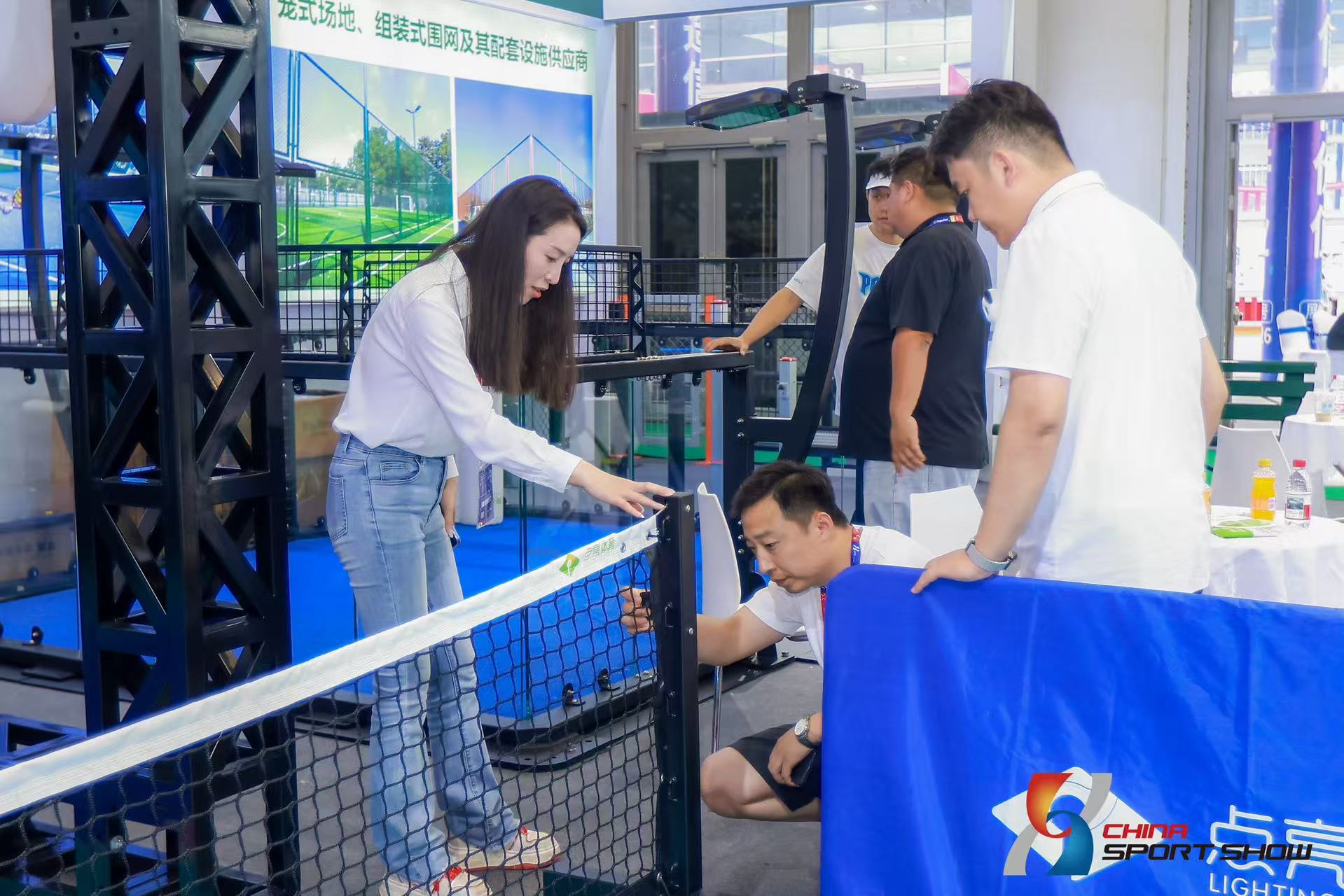
PanoCourt’s parent company, Light Up (Tianjin) Sports Goods Co., Ltd., has been fabricating steel sports enclosures for domestic Chinese infrastructure projects since before padel existed in China.
The production capability that makes a padel court — structural steel tube processing, CNC laser cutting, robotic welding, hot-dip galvanizing, powder coating, tempered glass installation — is the same capability that Light Up was already running at scale for football cage enclosures, athletics track fencing, and court systems for Chinese provincial Sports Bureau projects. The Hangzhou Asian Games venue work is a reference point most buyers recognise.
Padel wasn’t a pivot for us. It was a product extension. For the first few years, we produced padel courts as an OEM and ODM supplier for international traders and distributors who needed a reliable structural manufacturer behind their brand. In 2025 we launched PanoCourt — our own export brand — specifically to serve overseas buyers directly and cut out the trader layer.
That history matters for one practical reason: our quality systems for padel production are the same quality systems we’ve been running for a decade on sports infrastructure with higher structural accountability requirements. The certificate documentation process, the in-line QC photography, the batch traceability — these exist because domestic Chinese government contracts require them, not because a western buyer asked us to start doing it.
Factory credentials:
- 10,000 m² integrated facility, Hebei province — China’s largest steel-pipe production base
- 10+ years sports fencing and enclosure manufacturing
- 500+ padel court sets produced in 2025
- 30+ countries served
- ISO 9001 · CE Marked · FIP Technical Standards · EN 12150-1
How Do PanoCourt’s Specs and Price Compare to Other China Padel Court Factories?
On comparable structural spec, PanoCourt P001 offers more included components than Qifan PD04 at a lower FOB price — with a materially different surface treatment process.
For a full breakdown of what drives padel court cost from factory to installed, see our dedicated cost guide. The comparison below is based on published factory specifications:
You can consult Pano Court experts for a specific quote
What Should You Actually Ask Before Signing Anything With a China Padel Court Supplier?
Five questions that take 10 minutes to ask and tell you almost everything you need to know.
1. “Can you send me the Mill Test Certificate for the steel batch that will be used in my specific order?”
A source factory sends it within 24 hours with a batch number. A trader either can’t get it or sends a generic document.
2. “What is your surface treatment process — how many steps, and what happens between the galvanizing and the powder coat?”
A factory with a real process describes it in technical sequence. “We do galvanizing and powder coat” without specifics usually means a single-stage process.
3. “Can I book a video call with your factory floor while my order is in production?”
A real factory says yes and schedules it. A trader asks why you need that.
4. “Can I send you a hardware sample or a detail photo and have you reverse the joint design to match it?”
A source factory with its own CAD and fabrication capability says yes and turns around a drawing. A trader or integrator either declines or says they’ll “check with the factory.”
5. “Can you arrange for SGS or Bureau Veritas to inspect during production — before the container is loaded?”
The answer should be immediate and unqualified. If there’s hesitation or a redirect to post-shipment inspection only, that’s the answer. Also see our full guide to what to look for in a MejorSet padel alternative.
The Bottom Line: The Supplier Type Shapes Everything
The China padel court market will keep maturing. More source factories will build their own export brands, more integrators will invest in in-house steel, and the trader layer will thin as buyers get better at identifying it. But right now, in 2025, the three-category reality is the market you’re operating in.
The single most useful thing you can do before an enquiry becomes an order is spend 20 minutes testing which category your supplier actually belongs to. The five questions above will get you there. If the answers are fast, specific, and backed by documents you can verify — you’re talking to a factory. If the answers are slow, vague, and redirect to post-shipment guarantees — you’re not.
PanoCourt — Light Up (Tianjin) Sports Goods Co., Ltd.
panocourt.com · info@panocourt.com · WhatsApp: +86 136 8123 5010
Custom quote and court design within 24 hours.
FAQ China Padel Court
What is the difference between a China padel court trader and a source factory?
A trader is a sales company with no factory of its own — it outsources production to whichever factory is cheapest that week. A source factory like PanoCourt owns its steel stock, laser cutters, welding stations, galvanizing bath, and powder coating line. The key test: ask for the Mill Test Certificate with the batch number matched to your order. A factory produces it within 24 hours. A trader usually cannot.
“How do I know if a China padel court manufacturer is a real factory?”,
“Ask five questions: (1) Can you provide a batch-specific Mill Test Certificate before cutting starts? (2) What is your surface treatment process step by step? (3) Can I book a live video call at your factory during production? (4) Can you match a hardware sample or detail photo I send you? (5) Will you arrange SGS or Bureau Veritas inspection before shipping? A real factory answers all five immediately and specifically.”
“Are padel court integrators safe to buy from?”,
“Integrators — companies that control turf and surface components but outsource structural steel — can be a reasonable choice for buyers prioritising surface quality over structural traceability. The risk is that structural certifications may not be batch-specific to your order. Always request the galvanizing certificate and ask which steel fabricator produced the frame.”
“What is a padel court factory’s lead time in China?”,
“A source factory like PanoCourt typically delivers in 30 days from deposit. Integrators run 45–90 days. Traders quote optimistically but actual lead times are unpredictable because they depend on factory allocation. Spanish manufacturers at the premium tier quote 16–24 weeks.”
“Does FIP certify padel court manufacturers in China?”,
“FIP sets technical standards for padel court construction (dimensions, glass spec, turf performance, lighting) but does not maintain a public list of certified manufacturers. Buyers should instead request FIP turf compliance certificates and EN 12150-1 glass certificates from the specific factory, and verify through third-party inspection.”
What is the minimum order for a China padel court factory?”,
“Most source factories, including PanoCourt, accept single-court orders. However, economics improve significantly from 3+ courts — volume discounts typically apply at 3, 6, and 10+ court orders. Two full panoramic courts fit in one 40HQ container, making small orders logistically efficient.”