
London’s padel market just sent a clear signal to the rest of the world, and it is a signal about construcción de pistas de pádel as much as about the sport itself. Padel Social Club has raised £5.5 million to build three new clubs and add 17 courts across central London, backed by consumer investors Clark Group and Active Partners alongside family offices and British rapper Stormzy. With peak-time utilisation already above 95%, the expansion is less a growth story and more a supply-shortage story — and for anyone weighing a court project, the implications are hard to ignore.
Below, we break down what happened, why capital is moving into padel real estate at this pace, and what club owners, sports facility developers, and investors should take away before they commission their next build.
What Did Padel Social Club Just Announce?
Padel Social Club raised £5.5 million to open three new central London venues, adding 17 courts and becoming the only operator with multiple sites across Zones 1–2. The round drew Clark Group, Active Partners, several family offices, and high-profile backers including Stormzy.
The three new sites break down as follows:
- Paddington — four courts (two covered, two outdoor), the only padel club in Zone 1, projected to open June 2026.
- The O2 — five courts (two indoor, three outdoor) inside one of London’s landmark entertainment venues, opening November 2026.
- Kentish Town — eight courts (five indoor, three outdoor), billed as north London’s largest padel club, also opening November 2026.
The operator reports more than 30,000 people already playing across its London sites. According to its leadership, the aim has always been to build places where people gather around the sport rather than simply book a court and leave — a community-first model that the new capital is designed to scale.
Why Does a Rapper Investing in Padel Matter to the Industry?
Celebrity and institutional capital entering padel together signals that the sport has moved from early-adopter novelty to a recognised asset class. When consumer-focused investment firms and a mainstream cultural figure co-fund the same operator, it tells the market that padel venues are being underwritten like serious hospitality and leisure businesses, not hobby projects.
This matters well beyond London. For a padel court manufacturer supplying international projects, backer profiles like these change the buying conversation. Investors of this calibre expect predictable delivery timelines, certified structures, and courts engineered to withstand heavy commercial use. The bar for suppliers rises accordingly.
There is also a demonstration effect. High-visibility deals in a global media capital accelerate similar decisions in secondary markets. Developers in the Middle East, Asia-Pacific, and North America routinely benchmark against London and other mature European markets when they build the business case for their own facilities.
What Does 95% Peak Utilisation Tell Us About Padel Court Demand?
Peak-time utilisation above 95% means demand is structurally outrunning supply — the single strongest indicator that a market can absorb more courts profitably. When an operator is effectively full at peak hours across a city, the constraint on revenue is not demand generation; it is available court capacity.
For investors and club owners, that number reframes the risk. In an oversupplied market, adding courts cannibalises existing bookings. In a market running near capacity, each additional court captures genuine unmet demand. This is why Padel Social Club’s response to being full is to build more, not to discount.
The practical takeaway for anyone planning padel court construction is to study local utilisation before committing. A four-court club with strong booking rates and disciplined programming will usually outperform a larger facility with weak utilisation. Court count alone does not drive returns; the revenue engine is the paid court-hour, and that depends on utilisation, pricing, lighting quality, player comfort, and the mix of open matches, leagues, academies, and events layered on top.
Why Are Indoor Courts Central to the London Expansion?
Every one of the three new London venues leans heavily on indoor or covered courts because indoor play delivers predictable, year-round revenue in a climate where outdoor bookings are weather-dependent. Kentish Town is five indoor of eight, The O2 mixes indoor and covered configurations, and Paddington covers half its courts.
This mirrors a wider industry shift. Roughly 70% of new courts worldwide are now indoor or semi-covered, because operators have learned that a covered court books consistently through rain, wind, and winter, while an exposed court can sit idle for weeks. In Northern Europe especially, indoor predictability is the difference between a stable revenue curve and a seasonal one.
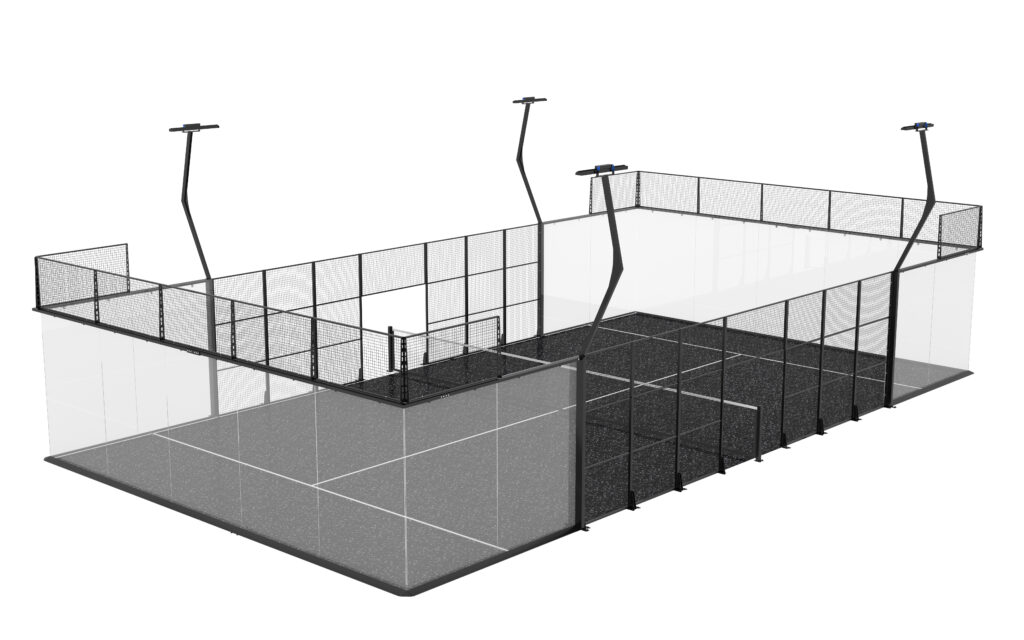
For the structure itself, indoor and premium urban projects increasingly favour panoramic and full panoramic designs. A full panoramic padel court removes the corner posts from the glass field of vision, creating the clean, spectator-friendly aesthetic that lifestyle-led clubs want for photography, events, and brand appeal. When a venue is built inside a landmark like The O2, the visual quality of the court becomes part of the product, not just the playing surface.
| Consideration | Indoor / Covered Court | Outdoor Court |
|---|---|---|
| Year-round bookability | High and predictable | Weather-dependent |
| Upfront build cost | Higher (canopy/structure) | Abajo |
| Peak-hour revenue stability | Fuerte | Variable by season |
| La mejor opción | Urban clubs, premium venues | Space-rich or budget sites |
How Much Does Padel Court Construction Cost for a Club Like This?
Padel court construction cost varies widely by court type, structure, glass specification, and site conditions, but the factory-supplied steel-and-glass court structure is usually a modest share of total project spend compared with groundwork, canopies, lighting, and fit-out. Understanding that split is the key to budgeting accurately.
At a high level, padel court construction cost is driven by several factors: the court model (single, classic, panoramic, or full panoramic), whether the court is indoor or outdoor, tempered glass thickness and quality, the steel frame’s galvanisation and finish, turf grade, lighting, and — for imported projects — shipping and installation. Two projects with the same court count can differ substantially once these variables are set. Our interactive Calculadora de costos de canchas de pádel lets you model these variables for your own project.
For international buyers, this is precisely where sourcing decisions move the budget. Buying court structures factory-direct from a China padel court factory typically lowers the cost per court versus local fabrication, while still meeting FIP dimensional standards — provided the supplier delivers certified materials and reliable engineering. The savings then free up budget for the parts of the build that shape player experience and utilisation, such as lighting and comfort.
Rather than quote a single misleading figure, serious buyers should request an itemised quotation tied to their exact specification and destination port. A proper quote should separate the court structure, packaging, freight, and any installation support so you can compare suppliers accurately.
What Should Investors and Club Owners Learn From This Model?
The core lesson is that padel is monetised as a community and hospitality business, not just a court rental. Padel Social Club’s investors backed a brand and a membership community, not simply a set of courts — and that is where durable margin sits.
Three principles stand out for anyone building a business case. First, program the off-peak: leagues, coaching, corporate packages, and events keep courts productive during the quiet mid-day and morning hours that make or break annual returns. Second, design for retention: comfortable, well-lit, visually premium courts keep players coming back and support higher booking fees. Third, protect revenue from weather with indoor or covered capacity wherever the climate justifies it.
For developers, padel also works as a footfall and lifestyle amenity that lifts the value of a wider site — a reason so many mixed-use, retail, and hospitality projects now include courts. The court is the anchor; the food, retail, and membership around it compound the return.
How Does Choosing the Right Manufacturer Affect Padel Court Construction?
Manufacturer selection directly determines a project’s timeline, safety, and long-term maintenance cost, which is why professional operators treat the padel court supplier decision as a core commercial choice rather than a commodity purchase. A court that arrives late, out of tolerance, or under-specified can stall an entire opening.
The factors that separate a dependable padel court manufacturer from a risky one are consistent: FIP-compliant dimensions and structural engineering, fully tempered safety glass, hot-dip galvanised steel that resists corrosion in outdoor and coastal conditions, quality turf, clear warranty terms, and genuine export experience with the paperwork and packing standards that protect goods in transit. UK developers weighing European versus Asian supply can see how the numbers compare in our breakdown of top padel court manufacturers in the UK.
This is the space PanoCourt works in as a China-based padel court manufacturer supplying panoramic, full panoramic, classic, and single courts to builders, clubs, and developers worldwide. Factory-direct production, custom design, premium materials, and export-tested logistics are built to serve exactly the kind of commercially demanding projects that rounds like Padel Social Club’s are now funding across global markets.
Preguntas frecuentes
Who invested in Padel Social Club’s London expansion?
The £5.5 million round came from consumer investors Clark Group and Active Partners, several family offices, and high-profile backers including rapper Stormzy. The capital funds three new central London clubs and 17 additional courts across Zones 1–2.
How many courts is Padel Social Club adding, and where?
Seventeen courts across three sites: four at Paddington (opening June 2026), five at The O2, and eight at Kentish Town (both opening November 2026). Kentish Town will be north London’s largest padel club.
Why is 95% peak utilisation significant?
It signals demand is outpacing supply. Near-full peak occupancy across a city means additional courts capture genuine unmet demand rather than cannibalising existing bookings, which strengthens the case for further padel court construction.
How much does padel court construction cost?
Padel court construction cost depends on court type, indoor versus outdoor design, glass and steel specification, turf, lighting, and shipping. The court structure itself is often a smaller share of total spend than groundwork and fit-out. Request an itemised quote for an accurate figure.
Is it cheaper to buy a padel court from a China manufacturer?
Buying factory-direct from a China padel court manufacturer typically reduces cost per court versus local fabrication while still meeting FIP standards, provided the supplier uses certified materials and reliable engineering. Savings can then be redirected to lighting and player comfort.
What is a full panoramic padel court?
A full panoramic padel court uses glass walls without corner posts in the field of vision, creating a clean, unobstructed look favoured by premium and lifestyle-led urban clubs for spectating, events, and brand appeal.
What should I look for in a padel court supplier?
Prioritise FIP-compliant engineering, fully tempered glass, hot-dip galvanised steel, quality turf, clear warranty terms, proven export experience, and strong project support including drawings and installation guidance.
Conclusion
Padel Social Club’s £5.5 million raise is a snapshot of where the sport is heading: full courts, patient capital, indoor-led builds, and community-driven brands scaling city by city. The 95% peak utilisation behind the headline is the number that should stay with investors and builders — it is proof that, in the right market, the constraint on padel revenue is court capacity, not demand.
For anyone turning that opportunity into a real facility, the padel court construction decisions made early — court type, indoor capacity, and the manufacturer behind the structure — shape both the opening timeline and the returns for years afterward. If you are planning a project and want to compare specifications, lead times, and a factory-direct quotation, contact PanoCourt to scope panoramic, full panoramic, classic, and single courts built to international standards.
Source: The Padel Paper — “Padel Social Club to expand across central London.”