
A complete padel court cost Calculator in 2026 costs between 28,000 and 45,000 US dollars per court, fully delivered and installed — depending on the model you choose, where in the world you are building, and whether the court goes indoors or outdoors. The court equipment itself starts at around 10,500 dollars ex-factory; the rest is sea freight, import taxes, groundwork, installation and, for indoor projects, climate control.
Most cost guides stop at the equipment price. This one does not. As a padel court manufacturer that ships courts from China to clubs on five continents, we see the full invoice chain on every project — so below you will find every line item a club owner actually pays, current 2026 shipping rates, a real anonymized project from Germany with the exact numbers, and a free interactive calculator you can use to build your own estimate in about two minutes.
How Much Does a Padel Court Cost in 2026?
If you only remember one table, make it this one. These are realistic all-in ranges per court for a typical two-court outdoor club project, based on 2026 factory pricing and freight rates:
Court equipment (ex-factory): 10,500 – 13,500 USD
Sea freight + inland trucking: 2,700 – 3,800 USD
Import duty and clearance: 400 – 2,000 USD
Foundation (new concrete slab): 5,500 – 13,000 USD
Installation: 0 – 6,000 USD
Indoor HVAC (indoor projects only): 12,000 – 20,000 USD
Contingency (5–10%): 1,500 – 3,500 USD
Total, outdoor: 28,000 – 38,000 USD per court
Total, indoor (excluding the building itself): 40,000 – 55,000 USD per court
Two things surprise most first-time buyers. First, the court itself is often less than half of the total project cost. Second, the biggest variable is not the equipment — it is your local groundwork and labour rates, which is why any serious estimate has to be location-specific.
Padel Court Construction Cost Breakdown: The Six Real Line Items
1. Court Equipment: What the Factory Price Actually Includes
Our 2026 ex-factory (EXW) prices for a complete court set are:
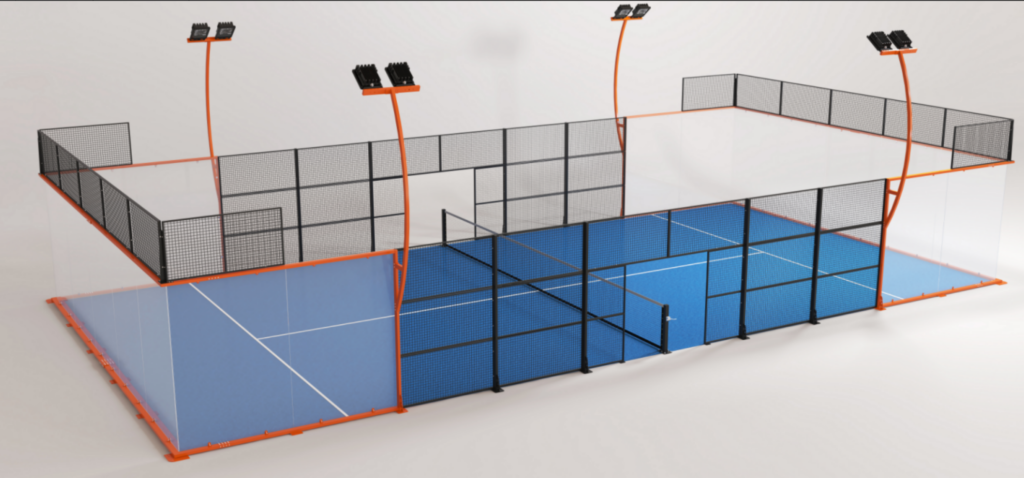
Classic court — 11,500 USD. Mesh side walls with 10 mm tempered back glass. The workhorse for municipalities, schools and parks.
Panoramic court — 10,500 USD. Full 12 mm tempered glass walls with minimal posts. This is what most commercial clubs buy: better sightlines for spectators and cameras, and in 2026 improved production efficiency has actually made it the most affordable model in our range.
Super Panoramic court — 11,000 USD. Frameless, self-supporting back glass wall. The flagship look you see at premium clubs and televised events.
A complete set at these prices includes the galvanized and powder-coated steel structure, tempered glass certified to EN 12150-1, 12 mm World Padel Tour-spec artificial turf with silica sand, the net and posts, eight 200 W LED floodlights on four columns, and all stainless fixing hardware. Be careful when comparing quotes: some suppliers quote a bare structure and add turf and lighting later.
Common paid upgrades, per court: professional LED package for broadcast-level 500+ lux (about 1,200 dollars), a steel-and-membrane roof canopy for outdoor all-weather play (about 8,500 dollars), an extra spectator glass wall (about 2,000 dollars), and custom branding with your club logo on the turf and glass (about 600 dollars).
2. Sea Freight in 2026: What Shipping a Court Really Costs
Two courts fit in one 40-foot high-cube container. Using regular 2026 ocean freight rates from Chinese ports, budget the following per 40′ HQ container:
USA West Coast: about 4,200 USD
USA East Coast: about 5,800 USD
Europe (Hamburg, Rotterdam, Valencia): about 5,400 USD
United Kingdom: about 5,500 USD
Middle East (Jebel Ali): about 2,800 USD
Southeast Asia: about 1,500 USD
Australia / New Zealand: about 3,200 USD
Latin America: about 5,500 USD
Africa: about 4,500 USD
On top of ocean freight, add origin charges in China (port handling, documentation and trucking from factory to port — typically 700 to 1,000 dollars per container), destination port charges and document release fees, and inland trucking from the port to your site. As a rule of thumb, total logistics lands between 2,700 and 3,800 dollars per court for most destinations. Rates move with the market, so treat these as planning figures and lock in an actual quote when you order.
3. Import Duty and Taxes: Smaller Than You Fear
Padel courts are generally classified as sports equipment (HS code 9506.99), which keeps duty rates civilised: around 2.7 percent into the EU, 2 percent into the UK, 5 percent into the USA and the Gulf states, calculated on the CIF value (goods plus freight plus insurance).
The number that scares buyers — import VAT of 19 to 21 percent in Europe — usually should not. If your club or company is VAT-registered, import VAT is fully reclaimable through your regular VAT return. Your real, permanent customs cost in Germany, for example, is just the 2.7 percent duty plus roughly 350 to 500 euros in customs broker fees. We walk every first-time importer through this, including EORI number registration, which is free and takes one to two weeks.
4. Foundation and Groundwork: The Cost Nobody Quotes You
A padel court needs a reinforced concrete slab of roughly 11 by 21 metres — about 220 square metres — level to within plus or minus 5 millimetres, with perimeter drainage for outdoor sites. This work is always done by a local contractor, and local rates vary more than any other line item: from around 25 dollars per square metre in Southeast Asia to 55–60 dollars in the USA, UK and Australia. That is 5,500 to 13,000 dollars per court.
If you already have a sound, level concrete surface (a former tennis court, warehouse floor or car park), your foundation cost can be close to zero — have it laser-surveyed before you assume anything. An asphalt base is roughly 35 percent cheaper than concrete and acceptable for outdoor courts, but has a shorter service life. We supply free slab drawings and anchor layout plans with every order, so your local contractor can price the work accurately before you commit.
5. Installation: Four Ways to Do It, From Free to Full-Service
Self-installation — free. A padel court is a bolt-together kit. With our step-by-step manual, assembly videos and live video-call support, a capable crew of four can raise a court in two to three days. Dozens of our clients have done it.
Local crew — about 3,500 dollars per court. Hire a local steel or fencing contractor; we support them remotely.
Local crew plus our supervisor — local labour cost plus about 3,000 dollars flat. Our engineer flies in and directs your crew on site. The most popular option for first projects.
Full factory team — about 6,000 dollars per court plus travel. Turn-key: our own installers do everything.
6. Indoor Projects: Do Not Skip the HVAC Line
If your courts go inside a hall, budget an additional 12,000 to 20,000 dollars per court for ventilation and dehumidification capacity, and check one number before you sign any lease: clear ceiling height. You need a minimum of 8 metres over the court for proper play (6 metres is the absolute floor over the back of the court, but rallies suffer).
Why is HVAC non-negotiable? Above roughly 65 percent relative humidity, the sand-dressed turf loses grip and the glass fogs — players notice immediately, and so do your reviews. Climate, hall insulation and occupancy all move this number, so get a mechanical engineer’s design early. We provide the heat-load data of our lighting and typical occupancy figures to feed into that design.
Estimate Your Own Project: Free Interactive Cost Calculator
Every number above is a range because every project is different. To turn ranges into your number, use our free padel court cost calculator: choose your model and quantity, pick your destination region (it pre-loads 2026 freight, duty and groundwork rates for your market), toggle indoor or outdoor, and choose your installation method. Every single price in the tool is editable, so if your local concrete quote is better than our default, type it in — the total, per-court cost, container count and project timeline update instantly.
It takes about two minutes and gives you a defensible budget to bring to your bank, your landlord or your investment committee.
Real Project: What Four Courts Actually Cost a German Club in 2026
Numbers from a live file beat any theory. In July 2026 we quoted and shipped a four-court project for a padel club in Germany (name and location withheld for privacy). Here is the real invoice chain, rounded:
Product: 4 complete court sets at 25,550 dollars each (a mobile, ballast-mounted specification with full glass back walls — a premium configuration that needs no ground anchors) = 102,200 dollars ex-factory.
Logistics, China side: port charges, documentation and trucking to Tianjin port for two 40′ HQ containers and one 20′ container — about 2,600 dollars, plus marine insurance at 128 dollars.
Ocean freight: Tianjin to Hamburg at 5,400 dollars per 40′ HQ and 3,500 dollars for the 20′ container — 14,390 dollars total including the EU entry declaration.
Germany side: Hamburg port charges and document fees of about 1,355 dollars, then inland delivery of all three containers roughly 600 km to site for 6,480 dollars.
Delivered (DAP) total: 127,145 dollars — 31,786 dollars per court, at the club’s door.
Customs, paid by the buyer: import duty at 2.7 percent came to about 2,918 euros; import VAT at 19 percent came to about 21,088 euros — fully reclaimable through the club’s quarterly VAT return. Net customs cost after the VAT refund: about 3,268 euros plus broker fees.
Net project cost after VAT recovery: about 130,674 dollars, or 32,669 dollars per court delivered — before local groundwork and installation.
The club paid 30 percent by bank transfer to start production and the 70 percent balance by letter of credit against shipping documents — a payment structure we recommend to every first-time importer because it protects both sides. Total time from deposit to containers on site: about seven weeks.
Who Are the Top Padel Court Manufacturers in the World?
Choosing who builds your court matters as much as what you pay. The global market splits into three tiers:
Spanish and Italian premium brands. Companies such as Portico Sport, Padel Galis and MejorSet built the sport’s infrastructure in Europe and supply FIP- and Premier Padel-level tournament courts. They are the right choice if you need certified competition venues with European project management — and budget accordingly, since finished pricing typically runs 40 to 80 percent above factory-direct alternatives once delivery is included.
Regional fabricators. In the USA, Northern Europe and the Gulf, local workshops weld courts domestically. You save on freight and gain proximity, but volumes are small, so unit prices are usually higher than imports and lead times fluctuate with local order books.
Factory-direct manufacturers in China. This tier — where PanoCourt operates — produces the majority of the world’s new courts by volume in 2026. The advantages are industrial: high-volume production lines, tempered glass and hot-dip galvanizing certified to the same EN standards, and total delivered costs commonly 30 to 50 percent below European brands. The trade-off is that you are importing, which is exactly why we publish our prices, our freight numbers and guides like this one — transparency is the only honest answer to the distance.
An honest note: if your project is a televised tournament venue requiring official FIP homologation, a Spanish premium brand may serve you better. If you are building a commercial club and every euro of capital expenditure has to earn its return, factory-direct is the strongest business case. For a detailed comparison of the leading companies, specifications and buying criteria, see our complete guide to choosing a padel court manufacturer.
Seven Practical Ways to Lower Your Padel Court Construction Cost
1. Buy two courts, not one. Two courts share one 40′ HQ container, cutting freight per court nearly in half — and a two-court club books far better than a one-court club anyway.
2. Reuse an existing slab. A sound tennis court or warehouse floor can save you 6,000 to 13,000 dollars per court. Survey it first.
3. Reclaim your VAT. If you are VAT-registered in Europe, the 19–21 percent import VAT is cash flow, not cost. Do not let a headline “landed cost” figure mislead you.
4. Tender the groundwork locally with our free drawings. Three local quotes against an exact specification routinely beat a single “trusted” contractor by 20 percent.
5. Choose supervised installation over a full factory team. Our engineer plus your local crew delivers the same result for roughly half the installation budget on multi-court projects.
6. Ship in the off-season. Freight rates dip meaningfully outside the pre-Christmas peak (roughly March to May bookings).
7. Order all your upgrades with the court. Retrofitting a roof canopy or spectator wall later means paying freight twice.
padel court cost Frequently Asked Questions
How much does a padel court cost in 2026?
Budget 28,000 to 38,000 US dollars per court all-in for an outdoor project, and 40,000 to 55,000 dollars per court for indoor (excluding the building itself). The equipment is 10,500 to 13,500 dollars ex-factory; the rest is freight, taxes, foundation, installation and — indoors — HVAC.
How long does it take to build a padel court?
From deposit to first serve: production takes 15 to 20 days, sea freight 8 to 38 days depending on destination, and installation 2 to 3 days per court. The German project above went from deposit to delivered containers in about seven weeks. Pour your concrete slab while the courts are at sea and the slab adds zero days to the schedule.
Is a cheaper Chinese padel court lower quality than a European one?
Not inherently — the materials standards are identical when the factory certifies to them. Insist on EN 12150-1 tempered glass certificates, hot-dip galvanizing reports and turf spec sheets, and verify the certificates with the issuing body. The real difference is usually 30 to 50 percent on the delivered price. Buy on verified specification, not on country-of-origin assumptions in either direction.
What foundation does a padel court need?
A reinforced concrete slab of about 11 × 21 metres (220 m²), typically 150 mm of C25/30 concrete, level within ±5 mm, with perimeter drainage outdoors. Asphalt is an acceptable cheaper alternative outdoors with a shorter service life.
Do I pay import duty on a padel court?
Yes, but less than most buyers expect: about 2.7 percent into the EU, 2 percent into the UK and 5 percent into the USA and GCC, on the CIF value. Import VAT (19–21 percent in Europe) applies but is fully reclaimable for VAT-registered businesses.
Can I install a padel court myself?
Yes. It is a bolted kit, and a four-person crew with our manual, videos and live video support typically completes a court in two to three days. If you would rather not, options range from a supervised local crew to a full factory installation team.
All prices in this guide are estimates for reference only, based on 2026 factory pricing and prevailing freight, duty and labour rates at the time of writing. Actual costs vary with specification, exchange rates, freight markets and your local site conditions. For an exact, current quotation for your project, contact macy@panocourt.com.