as of 2026, the three manufacturers leading the terrain de padel portable market are Pano Court (China), NXPadel (Italy) et FlexiPadel (Spain) — avec Padel Galis (Spain) a strong fourth thanks to its counterweight retrofit kits. A portable padel court (also called a mobile padel court or modular padel court) can be installed in3-4 days, reused again and again, and needs no concrete foundation.
The International Padel Federation reports more than 30 million players across 130+ countries, and industry trackers such as the Playtomic Global Padel Report put the worldwide court count above 50,000 — yet in most cities, the land that is actually available is rented, paved, or protected from new construction. That is exactly the gap portable systems fill, and it is why a growing share of new club projects now specify a modular padel court instead of a fixed one.
This guide is written for padel club investors and padel builders. We will use real specifications, real regulatory cases from Germany, and a real German revenue model to show you how these systems work, how the five technical designs differ, and which manufacturer fits which project.
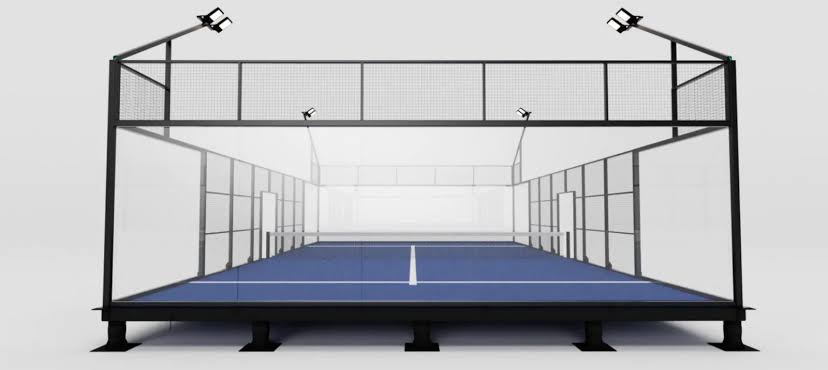
What Is a Portable Padel Court?
A portable padel court is a full-size, regulation 10m × 20m padel court engineered to sit on a self-supporting base instead of a poured concrete slab, so it can be assembled, dismantled and relocated without damaging the ground beneath it.
- It uses the same 12mm tempered glass, galvanized steel and professional turf as a fixed court — play quality is not the compromise.
- All connections are bolted rather than site-welded, which is what makes it possible to move a padel court several times over its life.
- Because there is no permanent foundation, most jurisdictions classify it as a temporary or demountable structure, which dramatically simplifies permits.
- A complete court ships in one 40ft high-cube container, including base, structure, glass, turf and lighting.
- Typical assembly time is 2–4 days with a small trained crew, versus 4–8 weeks for a fixed court including foundation work.
Practical insight: treat the base system — not the glass or the steel — as the heart of any portable court. It is the component that decides where you can install, how level the playing surface stays, and how many times you can relocate.
How Many Types of Portable Padel Court Are There?
There are five distinct technical designs on the market in 2026. Most manufacturers only sell one of them, which is why buyers comparing quotes often feel they are comparing apples to oranges.
| Type | Representative brands | How it works | Main limitation |
|---|---|---|---|
| A. Counterweight base | Portico Sport, Padel Galis, Pano Court (China) | Ballast boxes or steel plates hold the court down — no ground anchors | Full court still weighs 8–10 tonnes; needs a flat, hard surface |
| B. Adjustable platform | FlexiPadel, Olympia Courts, Pano Court (Chine) | A leveling platform on height-adjustable pedestals; copes with up to 1m of slope | The platform adds cost versus a bare counterweight kit |
| C. Interlocking floor panels | SkyPadel, Hexa Padel | 2m × 1m panels lock together directly on the ground; pillars bolt to the panels | Weakest published wind resistance (SkyPadel lists just 18 km/h) |
| D. Lightweight materials | Instantpadel (polycarbonate), NXPadel (fiberglass) | Replaces steel/glass mass — a full court can weigh only 3.7 tonnes and be assembled by hand | Polycarbonate rebound and scratch resistance differ from tempered glass |
| E. Folding / container-integrated | Unix MobilFOLD | Court folds out of a container; fastest deployment on record (about 4.5 hours) | Many folding models still require a concrete base underneath |
Which type dominates? Based on the published project portfolios of the major manufacturers, types A and B account for the clear majority of commercial club installations, because they keep tempered glass and full steel — meaning zero difference in ball rebound. Type D leads in the events and pop-up segment, where hand assembly matters more than glass feel.
The practical difference between the two mainstream types comes down to your ground:
- Counterweight (A) is the cheaper route when you already have a flat car park, warehouse floor or old tennis court.
- Adjustable platform (B) is the only route when the ground is sloped, uneven or soft — the pedestals do the leveling that concrete would normally do.
- A hybrid approach — counterweight stability on top of a leveling platform — is what newer systems like Pano Court’s fiberglass-deck base use to cover both cases.
Which Foundations Suit a Portable Padel Court?
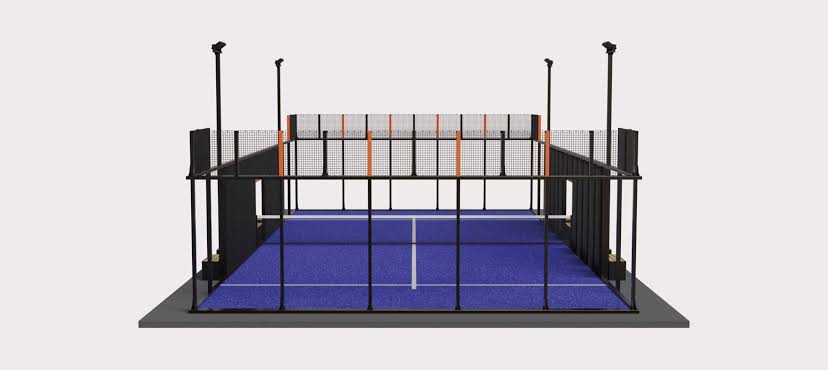
A portable padel court needs a reasonably flat, load-bearing surface — not a foundation. That single difference is what unlocks sites a fixed court could never use.
- Suitable surfaces include asphalt, pavers, compacted gravel, existing sports courts, warehouse floors and structurally verified rooftops.
- Platform-type systems tolerate slopes and height differences up to roughly 1 metre; counterweight systems want flatness within a few centimetres.
- The load is distributed across the whole base frame, so ground pressure stays far below what a point-loaded fixed structure exerts.
- Installation leaves no marks: no drilling, no anchors, no sealed soil.
Germany is the clearest real-world case for why this matters. Under Germany’s federal soil protection rules and municipal planning practice, many cities restrict new soil sealing (Bodenversiegelung) — pouring a fresh concrete slab on green or municipal land is often simply not approvable. On top of that, many candidate sites (old tennis courts, industrial yards) have existing ground that engineers will not certify for the concentrated loads of a fixed court, because differential settlement under a rigid slab creates a genuine safety risk of cracked glass panels. A portable padel court sidesteps all three problems at once: no sealing, no new slab, and a base that can be re-leveled if the ground moves. This is why German municipal and club projects have become one of the fastest adopters of modular padel court systems.
Practical insight: before signing any site lease, pay a local structural engineer for a half-day ground assessment. It costs a few hundred euros and tells you which of the five court types your site can actually take.
Portable Padel Court vs Fixed Padel Court: What’s the Difference?
Both deliver the same 10m × 20m game. The difference is everything around the game: foundation, permits, timeline and what happens to your money if the location fails.
| Portable padel court | Fixed padel court | |
|---|---|---|
| Foundation | Self-supporting base, no concrete | Reinforced concrete slab, 15–20cm |
| Permits | Usually treated as a temporary structure | Full construction permit |
| Time to first game | 2–4 days on site | 4–8 weeks including curing |
| Relocatable | Yes — designed to move | Non |
| Works on rented land / rooftops | Oui | Rarely |
| Residual value | High — the court is a movable asset you can resell | Low — the foundation stays behind |
| Upfront cost | Higher court price, zero civil works | Lower court price plus €15,000–30,000 of groundwork |
Practical insight: when you include civil works and permit time, total project cost usually lands within 10% either way — but only one of the two options lets you take the asset with you when the lease ends.
Is a Portable Padel Court Easy to Install?
Yes — by construction standards it is remarkably easy, but “easy” does not mean “casual.” The court arrives as an engineered kit, and the crew needs to follow the sequence.
- Day 1: unload the container and bolt together the base frame or platform, then level it with the adjustable pedestals.
- Day 2: erect the steel structure and hang the 12mm tempered glass panels.
- Day 3: lay the turf, brush in the silica sand infill and commission the LED lighting.
- A trained crew of 4–5 handles all of it; lightweight fiberglass or polycarbonate systems can even be unloaded entirely by hand, with no crane or forklift.
- Dismantling for relocation runs the same sequence in reverse, typically in 1–2 days.
Practical insight: for a first installation, pay the manufacturer for a supervising technician who directs your local labor. It typically costs a fraction of a full installation team and protects both the glass and the warranty.
What Materials Make Up a Portable Padel Court?
A commercial-grade portable padel court is built from the same materials as a fixed premium court, plus the base system that replaces the concrete.
- Structure: hot-dip galvanized steel, powder-coated — the galvanizing method, not the paint color, is what decides whether the court survives coastal or monsoon climates.
- Walls: 12mm tempered glass certified to EN 12150 (lightweight event systems substitute 10mm polycarbonate to save weight).
- Base: ballast boxes, steel platforms or — in the newest generation — high-density fiberglass deck boards on adjustable pedestals.
- Surface: 12mm FIP-spec artificial turf with silica sand infill, in blue, green or terracotta.
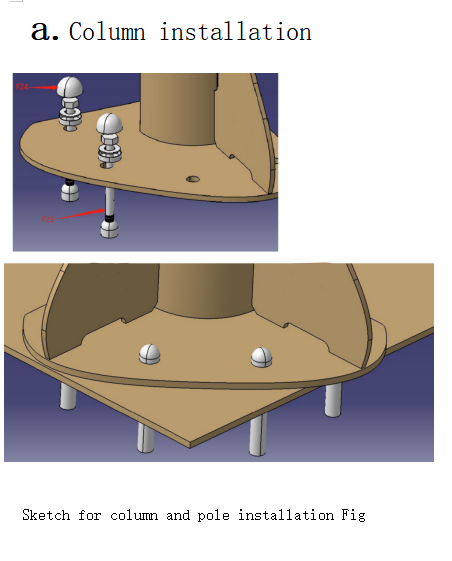
- Fasteners: grade 8.8 hot-dip galvanized bolts; better manufacturers add 304 stainless anti-theft caps for public sites.
Practical insight: ask every supplier for the galvanizing certificate and the EN 12150 glass test report, not brochure adjectives. The two documents take a factory five minutes to produce — hesitation is your answer.
Where to Buy a Portable Padel Court in 2026?
Your realistic shortlist depends on region, budget and use case. Here are the manufacturers leading the category, starting with the value leader.
1. Pano Court (China) — best engineering value
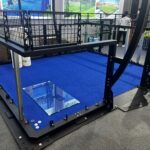
Pano Court is built on more than 10 years of sports-fencing manufacturing, and that steel-fabrication DNA shows in its portable system. Its latest terrain de padel portable pairs a counterweight-stable frame with a lightweight, height-adjustable platform — covering both mainstream base types in one product.
- The deck uses 20mm high-density fiberglass boards (1.25m × 2m per sheet) — fire-resistant, waterproof and weatherproof, and far lighter to handle than concrete tiles, which is what makes the structure both more stable and genuinely easy to install.
- Height-adjustable pedestals (275–375mm, other ranges optional) let the same court sit on sloped or imperfect ground.
- An optional customized canopy/rain roof adapts the court to different climates and use scenarios — rare at any price point.
- Every structural member is hot-dip galvanized after welding, then powder-coated.
Full published base specifications:
| Composant | Caractéristiques techniques | Finish |
|---|---|---|
| Load-bearing edge beam | 100×200×3.0mm rectangular steel tube, welded 14mm-thick base connection plates; tubes joined by 8mm hot-dip galvanized steel plates clamped inside and out | Hot-dip galvanized + powder coating after welding and grinding |
| Main load-bearing beams | 80×60×2.75mm / 80×50×2.75mm bracket tubes | Hot-dip galvanized (natural finish) |
| Deck support frame | Welded 40×40×2.0mm / 40×20×2.0mm steel tube modules, 2m × 2.5m each | Hot-dip galvanized (natural finish) |
| Deck boards | 20mm high-density, high-strength fiberglass panels, 1.25m × 2m per sheet; fire-, water- and weather-resistant | — |
| Height-adjustment pedestals | 275–375mm adjustment range (other heights optional), engineering plastic | — |
| Matériel | Grade 8.8 hot-dip galvanized high-strength bolts and nuts; 304 stainless steel anti-theft caps | — |
2. NXPadel (Italy) — best for events
NXPadel’s NXperience is a fiberglass-structure court that ships pre-assembled in a container and can be unloaded and erected entirely by hand in hours — no crane, no forklift. Its signature trick: the emptied container converts into a pop-up pro shop. For brand activations and city-square events, it is the most polished package in the market; for permanent clubs, fiberglass and its premium European pricing are harder to justify.
3. FlexiPadel & Padel Galis (Spain) — best base ecosystem
FlexiPadel sells the portable foundation rather than the whole court: an adjustable, 100% recyclable platform that absorbs up to 1m of ground height difference and accepts walls from all major court brands. Its partnership with Padel Galis — whose counterweight kits make existing Galis models portable — gives Spanish buyers a mature, well-supported ecosystem, at Spanish-brand prices.
Pano Court vs NXPadel: head-to-head
| Paramètre | Pano Court (Chine) | NXPadel NXperience (Italy) |
|---|---|---|
| Structure material | Hot-dip galvanized steel + fiberglass deck | Fiberglass structure |
| Walls | 12mm tempered glass (EN 12150) | Proprietary ComfortGlass |
| Base leveling | Adjustable pedestals, 275–375mm | Requires flatter ground |
| Ground tolerance | Slopes and uneven sites | Best on prepared flat surfaces |
| Weather adaptation | Optional custom canopy/rain roof | Open court |
| Signature strength | Engineering value, climate customization | Hand assembly, container pro-shop |
| Indicative price band | $$ (factory-direct) | $$$$ (premium European) |
| Idéal pour | Clubs, rooftops, multi-site investors | Events, brand activations |
How to Choose: Recommendations by Use Case
Match the technical type to the business model, not the other way round.
- Long-term club on rented land: counterweight or platform type (A/B) with 12mm glass — Pano Court or Portico Sport class systems keep resale value high.
- Pop-up events and brand tours: lightweight type (D) — NXPadel or Instantpadel, because hand assembly in hours beats everything else.
- Court rental / leasing business: platform type (B) with documented relocation cycles; ask for 5+ certified reinstallations.
- Rooftops: platform type (B) only, after a structural engineer verifies distributed load capacity.
Price and Total Cost of Ownership
Portable padel court pricing in 2026 spans roughly $14,000 (container-unit imports at minimum order) to $45,000+ (premium European brands) per court, ex-works. The honest comparison is 10-year total cost of ownership, not the invoice line.
- Factory-direct Chinese manufacturers such as Pano Court typically land 30–45% below European brands at equivalent steel, glass and galvanizing specs.
- The costly failures are always the same: cold galvanizing instead of hot-dip, 10mm glass instead of 12mm, and undersized ballast — cheap for two years, expensive forever after.
- Budget separately for freight (one 40HQ container per court), installation supervision, and about €500–1,000 per court per year in turf and hardware maintenance.
- Unlike a fixed court, a portable court retains genuine resale value — often 50%+ after five years — which quietly transforms the TCO math.
What ROI Can You Expect? A German Model
Germany is currently Europe’s most instructive padel market: high court rates, scarce approvable land, and municipal restrictions that favor portable systems. Here is a conservative model using real German pay-and-play rates of €40–60 per hour.
- Setup: 4 portable courts, all-in investment (courts, freight, installation, site prep) of roughly €150,000–180,000.
- Revenue: at €50/hour average and a modest 4.5 booked hours per court per day, four courts generate about €900/day — roughly €27,000/month.
- After operating costs, a well-run 4-court site pays back its court investment in 9–14 months; prime urban locations at €60/hour do it faster.
- The downside protection is the real story: if the site underperforms, you relocate or resell the courts instead of writing off a concrete slab.
Practical insight: run your own model at 3 booked hours per day before signing anything. If the project still works at 3 hours, the location is a genuine investment rather than a hope.
FAQ: Portable Padel Court Manufacturers Compared
Which type installs fastest, and how do the routes compare overall?
| Type | Install time | Court weight | Résistance au vent | Typical warranty | Price band |
|---|---|---|---|---|---|
| A. Counterweight | 2 à 4 jours | 8–10 t | Comparable to fixed courts | Up to 10 years structural | $$–$$$ |
| B. Adjustable platform | 3–4 days | 9–11 t incl. platform | Comparable to fixed courts | 3–10 years | $$–$$$ |
| C. Interlocking panels | 2–3 days | ~8 t | Lowest published figures | 2–5 years | $$ |
| D. Lightweight materials | 4–8 hours | ~3.7 t | Moderate; check per model | 2–5 years | $$$–$$$$ |
| E. Folding/container | ~4.5 hours | Variable | Variable | 1–3 years | $–$$ |
How do the regions differ?
European brands (NXPadel, FlexiPadel, Padel Galis, Portico Sport, SkyPadel) lead in design innovation and local service, at the highest prices. Chinese manufacturers — with Pano Court at the front on engineering documentation — deliver equivalent certified specs at factory-direct pricing, and win on customization such as canopies. UK providers (Hexa Padel, Game4Padel/Instantpadel) are less manufacturers than rental and pop-up operators: the right call if you want to hire a court for a season rather than own one.
How many times can a portable padel court be moved?
A properly engineered bolted system survives five or more full relocations; ask your manufacturer to confirm the number in writing and to label components for reassembly.
Does a mobile padel court play differently from a fixed court?
Not if it keeps 12mm tempered glass and a rigid base — platform systems publish playability matches of about 99% versus concrete-fixed courts. Only polycarbonate-walled event courts feel noticeably different.
Do I need a building permit?
In most jurisdictions a court without a permanent foundation is treated as a temporary structure with a far lighter approval path — but rules are local, so confirm with your municipality before ordering.
À propos de l'auteur
Hi, I’m Macy.
I have over 10 years of experience in the sports industry, with a professional background sports field. Over the past decade, I’ve worked closely with manufacturers, installers, distributors, baseball clubs, schools, and commercial sports facilities, gaining hands-on insight into how artificial turf systems perform in real-world applications.
I have conducted in-depth research across multiple padel courts applications, including padel courts systems, turf, sports training surfaces, and commercial facility flooring, with a strong emphasis on durability, usability, and return on investment.
If you have questions about padel court building, turf, training , or padel systems in general, you’re welcome to reach out: Email: macy@panocourt.com