
การติดตั้งสนามปาดิล for a court bought from a manufacturer is really four jobs: the factory supplies the court, drawings and manual; a local engineer designs and signs off the foundation, drainage and electrics; a local crew assembles the court; and, if agreed in writing, a factory technician supervises the first project. Most buyers only discover this split after they place the order. This padel court installation guide sets it out before you sign.
It is written by PANO, a padel court manufacturer in China, for club owners, developers and contractors planning an imported court. You will find the installation steps, what ships with the order, the site preparation your side owns, how long the work really takes, what drives cost, and seven costly mistakes we see buyers make. We do not quote prices here; for budgets see our padel court construction cost guide.
What This Padel Court Installation Guide Covers
What does padel court installation include?
Padel court installation covers everything from setting out the court on a finished base to handing over a playable court: steel frame, tempered glass, mesh panels, doors, net, lighting, turf and sand, electrical connection and clean-up. It does ไม่ normally include the foundation, drainage, power supply, permits or unloading equipment. Those are site works that must be finished before the installation crew arrives.
If you only remember one thing: a local team installs an imported court, working from the manufacturer’s drawings and manual. The manufacturer does not usually act as the local installer, and no reputable supplier should promise a fixed number of days before the base, access and crew are known.
Who does what in padel court installation?
Confusion between these four layers causes most disputes on imported courts. This is how PANO structures a standard project.
| Layer | Responsible party | What they deliver |
|---|---|---|
| 1. Court supply and documents | Manufacturer (PANO) | Court components, assembly drawings, foundation drawing with anchor positions, step-by-step manual, installation video, remote guidance |
| 2. Site engineering | Local licensed engineer | Foundation, anchoring, drainage and electrical design for local ground, wind and code; sign-off |
| 3. Assembly | Local installation crew | Set-out, frame, glass, mesh, net, lighting, turf, clean-up |
| 4. On-site supervision (optional) | Manufacturer technician, if agreed in writing | First-project supervision; not a standard free service, agreed project by project |
The boundary in a PANO quotation is explicit: the package includes the installation manual, technical drawings, remote guidance and coordination of the installation scope, while local labour, lifting, civil works, permits and final installation acceptance remain subject to the project plan. PANO does not offer turnkey supply-and-install.
What ships with the order?
Ask every supplier for the same list in writing. PANO’s standard documents and support are:
- Foundation drawing at 1:50 scale with anchor positions, provided before production starts so your engineer can design to it.
- Illustrated English installation manual with photographs, plus a parts list and a copy of the QC report packed with each shipment.
- Remote technical support by WhatsApp or video call while your crew builds.
- Production updates: photos and video during manufacturing.
- Labelled packing: hardware bagged and labelled by assembly zone; steel bundled with corner protection and rust-preventive paper.
For a first project, PANO recommends a technical meeting with your installation team before work starts, covering the manual, video, packing list, key checkpoints and acceptance requirements. Bolt patterns and connection details differ between factories, so a crew that has built another brand should not assume this one goes together the same way.
Site preparation before padel court installation
Padel court installation starts on a finished base, not on bare ground. Slab thickness, flatness tolerance and anchor type are set by your engineer and the supplier’s drawings for your model, so confirm them in writing instead of copying a number from a blog.
| รายการ | ทำไมเรื่องนี้จึงสำคัญ | Who decides |
|---|---|---|
| Foundation (ring beam or slab) with anchor set-out | The enclosure is a structure that carries wind load; anchors fix it to this base | Local structural engineer |
| Drainage and falls | Outdoor courts must shed water from the surface and perimeter | Engineer |
| Power supply and cable ducts | Lighting circuits need breakers, RCD protection and cable routes before turf goes down | Licensed electrician |
| Truck access and unloading equipment | Glass arrives in heavy crates (see the arrival section) | Project manager, confirmed with supplier |
| Permits and planning | Enclosures and light poles often need consent | Owner |
| Final acceptance and wind-stability check | Someone local must confirm the installed court meets the project design | Engineer and owner |
The LTA Padel Court Construction Guidance Note (2025) is a useful independent reference even outside the UK. It says the ring beam must be designed by a qualified structural engineer with due consideration of local wind loads, that a steel-plated or above-ground foundation must not be used for a permanent outdoor court, and that manufacturers’ warranties do not usually cover structural failure of the perimeter enclosure, only component wear and corrosion. For more detail see our padel court foundation requirements, outdoor padel court foundation และ padel court wind load guides.
Padel court installation steps: the 8-stage sequence
PANO’s manual is longer and illustrated, but the order of work is below. Use it to check that a local crew’s method statement follows the same logic.
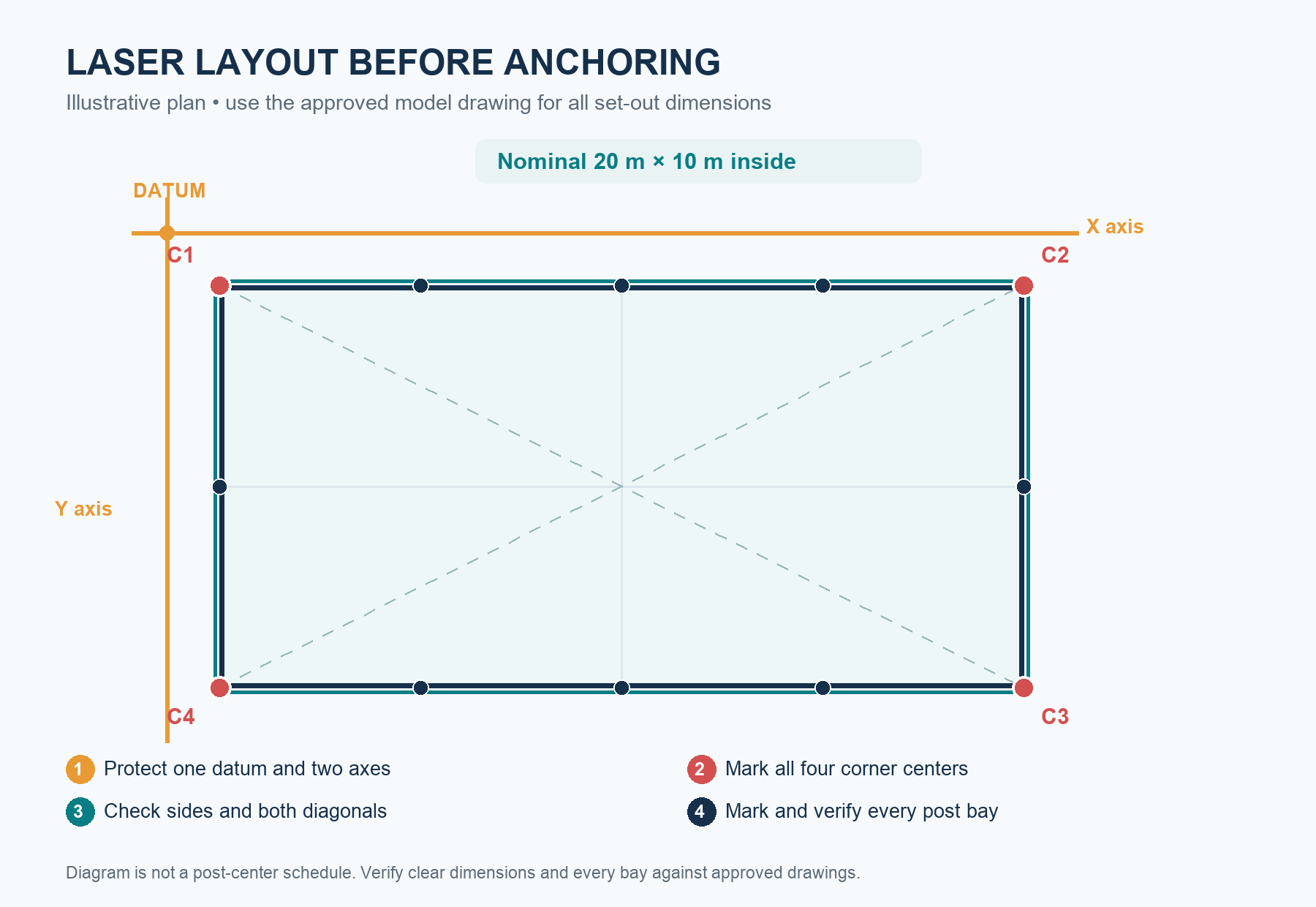
- Inspect on unpacking. Check steel coating for scratches, missing paint or runs, and glass for cracks or chips. Handle gently.
- Set out the court. Mark the base-plate rectangle of 20.47 m x 10.47 m with a 50 m tape, with perpendicular corner lines and the centre line.
- Label and pre-assemble. Label every part and pre-assemble the six beam groups on the ground: 10 m upper and lower, and 20 m upper and lower (left and right).
- ติดตั้งโครงหลัก. Start at a corner post and work around in sequence, with the mesh wire facing the inside of the court. Straighten and square the whole frame ก่อน drilling through the base-plate holes and fitting the anchors.
- Fit upper mesh frames and luminaires. Route cables through the arms and poles to the buried supply cable.
- Install glass. Fit rubber strip to the top and bottom edges first and start at the corners. Wherever glass would touch steel without a strip, separate it with foam tape. Glass must never contact steel directly.
- Fit the net. Align the net posts flush with the inside of the fence, anchor them and tension the net. Confirm net heights against the supplier’s current drawing for your model.
- Electrical and clean-up. For two or more courts, a main breaker with RCD at a central position and a sub-breaker per court. Enclose all joints, run cable in UV-resistant conduit, and leave no offcuts, packaging or debris.
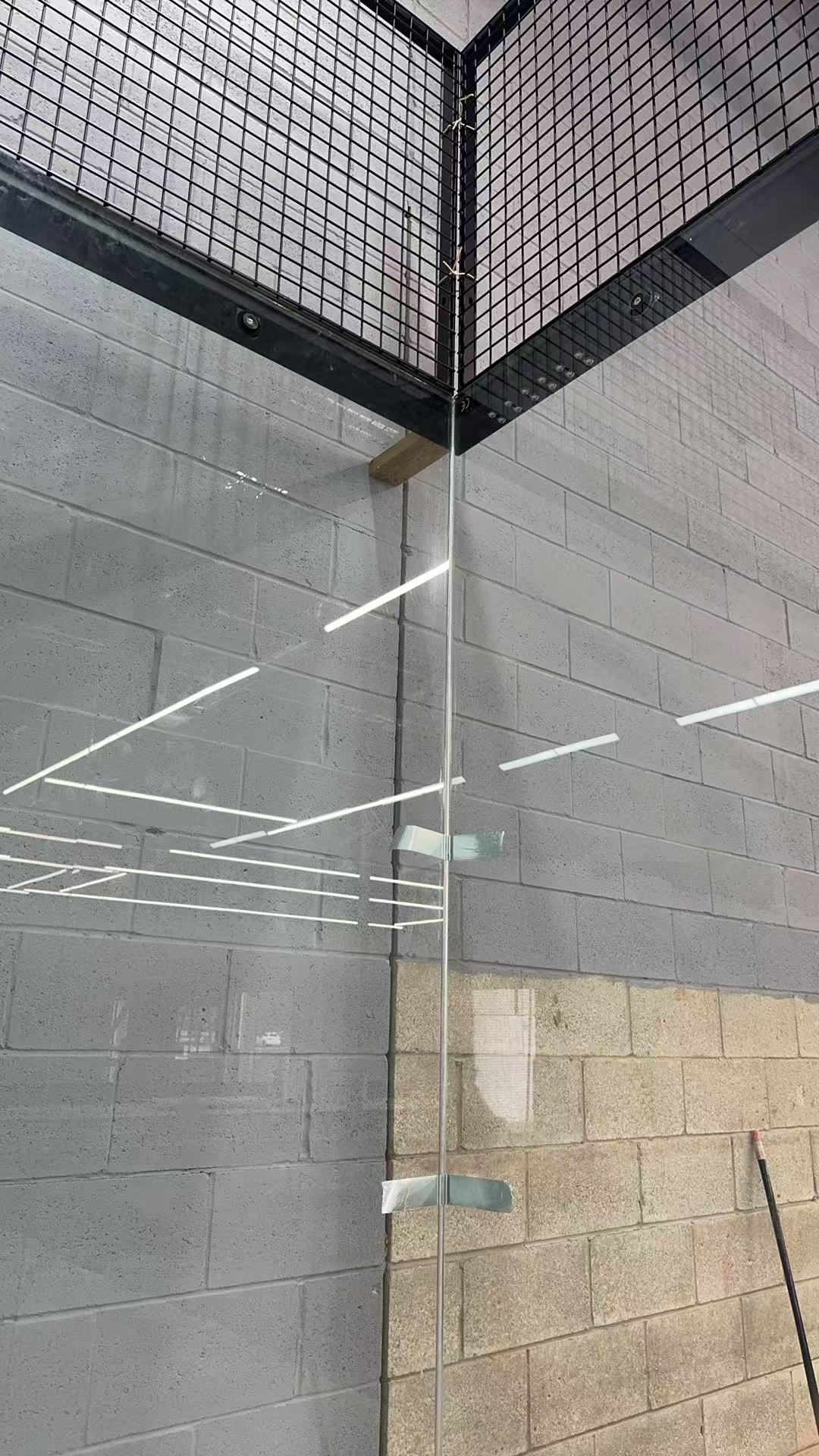
Anchors: expansion anchors can be removed later; chemical anchors usually carry higher loads but are permanent. Your engineer should choose, and the choice belongs on the foundation drawing. สนามหญ้า goes down after the structure, with silica sand infill and expansion joints sealed as the turf and base designers specify. Seam tape and adhesive are not part of PANO’s court supply, so allocate them in your local scope; our padel turf guide covers selection.
Indoor vs outdoor padel court installation
| Topic | Indoor court | Outdoor court |
|---|---|---|
| Main risk | Clear height and access for glass crates | Wind load, water and corrosion |
| มูลนิธิ | Existing floor checked by an engineer for anchoring | Engineered ring beam or slab; LTA rules out steel-plated or above-ground bases for permanent outdoor courts |
| ระบบระบายน้ำ | Usually not a design driver | Falls and perimeter drainage designed by the engineer |
| Steel finish | Standard coated finish | LTA guidance calls for galvanised steelwork with zinc electroplating after fabrication |
| ระบบแสง | At least 6 m clear height over the court, including luminaires | Same clear height; light poles may need planning consent |
For lighting, design for 500 lux with 0.7 uniformity at competition level or 300 lux with 0.5 for recreational play; the LTA guidance gives the same figures. See our LED lighting specification guide.
การติดตั้งสนามปาดิลใช้เวลาเท่าไร?
Published padel court installation times range from a few days to about two weeks for assembly, and base curing times from one week to four. Those numbers depend on crew size, the crew’s padel experience, number of courts, weather, access, and whether the base has reached the strength your engineer requires. They are not interchangeable, so we do not publish a single number. Our position:
- Your engineer sets how long the concrete must cure before anchors are loaded, not the court supplier or a web article.
- Ask your installer for a written programme stating crew size, number of courts and assumptions, and compare it with the supplier’s documents.
- Sea freight and base construction can run in parallel, which is usually the biggest scheduling gain on an imported project.
- For portable courts, do not accept a same-day set-up promise until the process has been tested and documented on your own site.
What drives padel court installation cost?
Padel court installation cost depends on location far more than on the court itself, so any figure quoted without your site is unreliable. Build your budget line by line:
| Cost line | Who usually pays | หมายเหตุ |
|---|---|---|
| Local installation labour | Owner, via local contractor | Get crew size and programme in writing |
| Unloading and lifting equipment | Owner | Must suit the glass crates in your shipment |
| Foundation, drainage, ducts | Owner, via groundworks contractor | Often the largest variable |
| Electrical connection and testing | Owner, via licensed electrician | Breakers, RCD, completion lighting test |
| Turf seam tape and adhesive | Owner | Not part of PANO court supply |
| Permits and engineering fees | Owner | Varies by country and site |
| Optional technician visit | Owner | Travel, accommodation and service fee, agreed in writing |
For worked budgets, see our padel court cost comparison.
Arrival, unloading and the five-day claim window
Glass is the heaviest and most fragile part of the shipment. PANO packs each pane in 10 mm PE foam inside a wooden A-frame crate. Each crate is heavy enough that unloading needs a forklift or crane suitable for it, and we do not recommend sharing a container with other cargo for glass. Confirm the unloading equipment rating for your order with your supplier before the truck is booked. On arrival:
| Step | Action |
|---|---|
| 1 | Inspect the goods the day they arrive |
| 2 | If anything is damaged, note it on the carrier’s proof of delivery (POD) before signing |
| 3 | Photograph the damage the same day |
| 4 | Email the photos and a copy of the POD within five days |
| 5 | If the carrier is confirmed responsible, replacement parts are supplied free of charge |
7 costly padel court installation mistakes to avoid
- Assuming the factory installs. Read the quotation boundary; local labour, lifting, civil works, permits and acceptance usually sit with you.
- Starting on an unapproved base. Anchoring into a base that has not been engineered, or has not reached the engineer’s required strength, puts the whole enclosure at risk.
- Drilling anchors before the frame is square. Anchor holes are permanent; square and plumb first.
- Letting glass touch steel. Use rubber strip and foam tape at every contact point.
- Mounting mesh the wrong way round. The mesh wire faces the inside of the court.
- No suitable unloading equipment. Glass crates need the right forklift or crane on the day the truck arrives.
- Missing the warranty conditions. Under PANO’s after-sales terms, damage not reported within five days, installation that departs from the supplied guidance, an unsuitable base or anchoring, and local wiring errors can fall outside warranty. Keep photo records of each stage.
How to choose a padel court installation team
A strong local team does not need to have built this exact brand, but it should answer these questions clearly. Our padel court construction company guide covers contractor selection more broadly.
- Can they show completed padel, fence or glazing projects, and name a reference you can contact?
- How will they lift and fix the glass, and how do they keep glass off steel?
- Who is their licensed electrician, and who tests the lighting at completion?
- Will they agree crew size, programme and assumptions in writing?
- Will they send photos at agreed checkpoints (frame square, before glass, before turf) so the supplier can review remotely?
- Who gives the installation warranty, and what does it exclude?
Whoever you choose, collect at least three comparable quotes, view reference projects, put the warranty in the contract, arrange independent quality checks during works, and require lighting and flatness tests at completion, with an operation and maintenance manual at handover.
When should you book a factory technician?
A paid technician visit is most valuable on a first project, a multi-court build, or in a market with no padel installers. It is not a standard free service, needs two to three weeks’ notice, and is agreed in writing for each project, with travel and accommodation borne by the buyer. If your project depends on on-site supervision, confirm availability and terms before ordering, not after.
Padel court installation FAQ
Can a local contractor install a padel court bought from China?
Yes, provided they work from the manufacturer’s drawings and manual, an engineer has designed the base, and the supplier provides remote support. Padel experience helps, but method and documentation matter more.
Does PANO provide padel court installation on site?
PANO supplies the court, drawings, manual, video and remote guidance for your local team. A technician visit is optional and agreed in writing project by project. PANO does not offer turnkey supply-and-install.
What must be ready before padel court installation starts?
A finished, engineer-approved base with anchor set-out, drainage, power and cable ducts, truck access, suitable unloading equipment and any permits.
การติดตั้งสนามปาดิลใช้เวลาเท่าไร?
It depends on crew size and experience, number of courts, weather, access and base curing. Ask your installer for a written programme with these assumptions instead of relying on a generic figure.
Can a padel court be installed without drilling or permanent anchors?
For permanent outdoor courts the enclosure must be anchored to an engineered foundation; UK guidance rules out steel-plated or above-ground foundations for permanent outdoor use. Portable systems are designed differently, so ask for drawings and test records for your use case.
What can void the warranty during padel court installation?
Under PANO’s terms: installation that departs from the supplied guidance, an unsuitable base or anchoring, transit damage not reported within five days, and local wiring errors. Always check your supplier’s written terms.
Planning a padel court installation? Send PANO your location, number of courts and indoor or outdoor plan, and we will tell you which drawings, documents and support apply to your project. Contact macy@panocourt.com. See also how to evaluate a China padel court factory และ what a padel court includes.