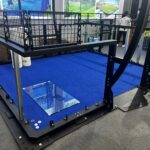
A padel court builder manages the project around the court: site checks, foundation, drainage, electrics, permits, sourcing the court and assembling it. You can hire a local turnkey builder, or buy factory-direct and pair the court with a local engineer and installation crew. Either way, ask who signs off the foundation and wind design, who assembles the court, and insist on an itemised quote you can compare line by line.
This guide is written by PANO, a padel court manufacturer in China with a 10,000 m² factory where steel cutting, welding, shot blasting and powder coating are done in-house. We are a manufacturer, not a local builder, and we say so up front because it shapes the advice. You will find what a builder actually does, a four-party responsibility table, a comparison of the two routes, a vetting checklist, the documents a factory should hand to your builder, and a quote template. We do not publish prices here.
What does a padel court builder actually do?
A padel court builder takes a site from an idea to a playable court. The scope usually covers feasibility and site survey, foundation and drainage, electrical supply, planning and permits, court supply, assembly, lighting and handover. Not every builder does every item, and many do not manufacture the court themselves: they source it from a factory, which is why “builder” on a website can mean a contractor, a distributor or a manufacturer.
When we reviewed Bing results for “padel court builder” on 28 October 2026, the pages we read were mostly service or home pages, and most led with a single point of contact or turnkey delivery. None we saw set out who is responsible for what, how to compare builders, or how to verify one. That gap is what this page covers. For the build sequence itself, see our padel court construction planning guide and phase-by-phase build guide.
Who does what in a padel court project?
Most disputes on imported courts come from blurred boundaries. In a PANO project the manufacturer supplies manufacturing-side inputs, and local licensed professionals handle site, permit, foundation and electrical design. This is the split we use.
| Party | Responsible for | Delivers |
|---|---|---|
| Manufacturer (PANO) | Court structure, glass, lighting, turf supply; technical documents | Court components, foundation drawing with anchor positions, installation manual, remote technical guidance |
| Local licensed engineer | Site, foundation, drainage, electrical design and permit sign-off; wind stability of the installed court | Stamped design for local ground, wind and code |
| Local installation crew | Assembly on the finished base | Set-out, frame, glass, mesh, net, lighting, turf, clean-up |
| Optional on-site supervisor | First-project supervision, only if agreed in writing | Technician visit; not a standard free service, buyer covers travel and service fee |
Independent guidance says the same about the foundation. The LTA Padel Court Construction Guidance Note (2025) states that the ring beam, sub-base and drainage must be designed by a UK qualified structural engineer with due consideration of local wind loads, and that manufacturers’ warranties do not usually cover structural failure of the perimeter enclosure. It is a UK document, but the logic of separating enclosure supply from foundation design applies in most markets. See our guides to padel court foundation requirements and padel court wind load.
Local turnkey builder or factory-direct with a local crew?
Neither route is better in general. Choose a local turnkey builder when you want one accountable party and have no appetite for coordination; choose factory-direct with a local crew when you want model choice, customisation or several courts and can manage a split of responsibility.
| Factor | Local turnkey builder | Factory-direct + local crew |
|---|---|---|
| Single point of responsibility | Strong: one contract | Weaker: you coordinate supplier, engineer and crew |
| Foundation and local documents | Usually familiar with local codes and suppliers | Depends on your engineer; factory supplies manufacturing-side drawings |
| Model and customisation choice | Often limited to the builder’s chosen supplier | Wider: you choose the factory, model and options |
| Quote transparency | Often one total | Itemised by nature, but you must assemble it |
| First-project learning curve | Lower if the builder has built padel before | Higher: crews should study the manual and hold a pre-start meeting |
| After-sales and spare parts | One local contact, parts still come from the factory | Direct with the factory; local crew handles fitting |
When a local builder is the better choice. On one German club enquiry, the buyer compared our modular-base proposal with a local concrete foundation and asked for German-language technical documents. They chose a local contractor. Local foundation experience and local-language documents are where a nearby builder is often strongest, and we would rather you know that than buy on a promise we cannot meet.
When factory-direct fits. Several courts on one site, a contractor who can already build, or a design that needs customisation. Compare model types in our panoramic vs classic vs full panoramic guide and see our mobile padel court page for relocatable options.
How do you vet a padel court builder or manufacturer?
Verify before you pay a deposit: ask for named reference projects you can visit, certificates that state their holder, model, standard, scope and date, a factory visit, and a sample document pack. Scale figures and tournament logos are claims, not evidence.
| Check | What to ask for | Red flag |
|---|---|---|
| Reference projects | Club, city, model, number of courts, install date, and whether you can visit | Photo wall with no names or dates |
| Certificates | Holder, model, standard, scope and date on the document | Component certificate presented as whole-court approval |
| Factory | Live video tour or visit; play on an assembled court if possible | No factory address or footage |
| Third-party inspection | Whether SGS, BV or your own inspector may check production and container loading | Refusal or silence |
| Document pack | A sample foundation drawing, manual and parts list before ordering | “Documents after payment” |
| Warranty | Written terms: what is covered, what voids it, who fits replacement parts | Verbal promises only |
How we answer these ourselves. We only publish what we can verify. PANO is not an FIP-certified factory; our standard court is built to the 20 × 10 m FIP playing dimensions, which is not the same as certification. Our certificates have limited scope: one is a voluntary document review against EN 1090-1, not a certification of the whole court; another covers wire and welded mesh only; the glass specification (12 mm tempered, EN 12150-1) rests on the glass supplier’s certificate. If we have no verified, visitable reference court in your country, we will say so. You can watch our factory video or arrange a visit. For the full checklist see how to verify a China padel court manufacturer.
Where are padel courts made, and does it matter for your builder?
Padel courts are made mainly in Spain and China, with other producers in Türkiye, Italy and the United States, among others. Origin matters less than whether your builder has the right drawings and support for that factory’s court, because bolt patterns and connection details differ between factories. A crew experienced with one brand should not assume another goes together the same way, so for a first project we recommend a technical meeting before work starts.
PANO builds in Hebei, China. See our padel court manufacturer page, our map of padel tennis court manufacturers and China padel court factory sourcing guide.
What should the factory hand over to your local builder?
Your builder needs a document pack before the court ships, not after. Ask every supplier for the same list in writing and mark which items are standard and which depend on the project.
| Item | Status at PANO |
|---|---|
| Foundation drawing at 1:50 with anchor positions | Standard, before production starts |
| Illustrated English installation manual | Standard |
| Parts list and QC report packed with each shipment | Standard |
| Photos and video during production | Standard |
| Remote support by WhatsApp or video while your crew builds | Standard |
| Labelled packing, hardware bagged by assembly zone | Standard |
| Packing list, structural weights, design wind speed, bill of materials | Project-specific: confirm with PANO for your order |
| Local engineering, permits, wind-stability sign-off | Local professional responsibility |
For how the documents are used on site, see our padel court installation guide.
Do you need an on-site supervisor, or can a local crew use remote support?
A capable local crew can build from the manual, video and remote guidance, but a first project, a multi-court build or a market with no padel installers justifies a paid technician visit. On-site support from PANO is not a standard free service: it needs two to three weeks’ notice, is agreed in writing project by project, and the buyer covers travel, accommodation and service fees.
| Support level | Best for | Buyer provides |
|---|---|---|
| Manual and video only | Experienced crews on a repeat model | Crew, lifting equipment, tools |
| Remote video guidance | Capable crews on a first PANO build | Reliable video link; photos at agreed checkpoints |
| Pre-start technical meeting | Any first project | Crew leader and engineer attend |
| On-site supervisor (optional) | First project, several courts, no local padel installers | Written agreement, travel and service fee |
Before you accept a crew, check its experience, lifting equipment, insurance, tools and where its responsibility ends. We review a crew’s experience before releasing a full assembly pack.
How should you compare builder quotes?
Compare itemised quotes, not totals. One buyer told us they wanted “an honest complete price rather than a low price that rises later”, and that is the right test. Ask every builder to price the same lines so gaps show up before you sign.
| Quote line | Included? | Who pays |
|---|---|---|
| Court, lighting and turf supply | Yes / no | Per contract |
| Sea freight and insurance | Yes / no | Depends on Incoterm |
| Port charges and customs clearance | Yes / no | Depends on Incoterm |
| Duties and taxes | Yes / no | Buyer or importer |
| Inland transport and unloading | Yes / no | Per contract |
| Installation labour and lifting | Yes / no | Local contractor |
| Supervision | Yes / no | Agreed in writing |
| Foundation, drainage, electrics | Yes / no | Local contractors |
| Permits and engineering fees | Yes / no | Owner |
For how Incoterms move these lines between parties, read FOB, CIF, DAP and DDP explained, and use our supplier RFQ guide to qualify suppliers. The LTA note adds that venues should obtain three quotations, visit at least one site the contractor has installed, and recommends an installer warranty of 10 years; treat that as a UK benchmark to compare against, not a PANO term.
Are you a contractor or installer looking for a court manufacturer?
We hear regularly from contractors and installers, and we work with them case by case. Typical questions are whether a local crew can assemble from our instructions, whether we can supply a supervisor for a first project, how warranty and spare parts are split with the installer, and whether the contractor can become a local installation partner.
We treat partnership as a staged path: a single project first, then a framework after a first commercial review, with no automatic exclusivity. We do not claim a global installation network. What we can offer a builder is the document pack above, drawings, remote guidance and a pre-start technical meeting. Send us your project details and we will tell you what applies. Our padel court supplier guide shows how we qualify buyers.
Finding a padel court builder in the US, UK and other markets
Builder availability varies by country, so start with your market’s own regulations and supplier landscape. Our market guides cover the United States, the United Kingdom, New Zealand and Australia. We do not list builders by city here.
Padel court builder FAQ
Can a local contractor build a padel court from a factory-supplied kit?
Yes, if they work from the manufacturer’s drawings and manual, an engineer has designed the foundation, and the supplier gives remote support. Padel experience helps, but method and documentation matter more.
Who is responsible for the foundation and wind load sign-off?
A local licensed engineer, who designs for local ground, wind and code. The manufacturer supplies the court and manufacturing-side drawings and data for the supplied enclosure.
Can a padel court be built on an existing tennis court?
Sometimes, but the existing surface and base must be checked by an engineer for anchoring, drainage and flatness. Do not assume a tennis court slab can carry a padel enclosure.
Does the manufacturer send an installer, and is it included?
PANO supplies the court, drawings, manual and remote guidance. A technician visit is optional, agreed in writing per project, and charged to the buyer. PANO does not offer turnkey supply-and-install.
Can we visit a finished court or the factory before ordering?
You can arrange a factory visit or video tour. We only name reference projects we can verify and will tell you if we have none to show in your country.
Is your court FIP certified?
No. PANO is not an FIP-certified factory. Our standard court is built to the 20 x 10 m FIP playing dimensions, which is different from certification.
What certificates should a padel court builder or manufacturer show?
Ask for the holder, model, standard, scope and date on each certificate. A component certificate does not prove a whole court complies.
Planning a project with a local builder? Send PANO your site plan, foundation status and number of courts, and we will return the builder document-pack checklist and a responsibility split for your project. Contact macy@panocourt.com or visit our contact page.