
To build a padel court in the USA, you need three things: local zoning and building approval, a foundation and enclosure design stamped by a licensed structural engineer, and a court engineered for the design wind speed at your address. A padel court is a 20 × 10 m steel-and-glass enclosure, and US building departments treat it as a structure under the International Building Code and the load rules of ASCE 7. For an imported court, plan on roughly three to four months from deposit to handover, depending on port, permits and the foundation.
This guide is written by PANO, a شركة مصنعة لملاعب البادل in Hebei, China, that has shipped courts to more than 30 countries. We make the court itself. We do not design or build US foundations, slabs, drainage or buildings, and we do not stamp drawings; those come from licensed professionals in your state. We do not publish prices here. For cost lines, see our padel court construction cost guide.
What are the key facts before you build a padel court in the USA?
- There is no national padel permit. Your city or county sets zoning, site plan and building approval, and many local codes do not mention padel at all.
- Wind governs the structural design of an outdoor court. Basic wind speeds in parts of Florida reach 140 to 180 mph, far above sheltered inland sites.
- A European CE document or Eurocode calculation does not satisfy US requirements on its own. ASCE 7 uses a 3-second gust; Eurocode and Chinese codes use a 10-minute mean.
- The factory supplies the court and its drawings. A US engineer designs and stamps the foundation and verifies the enclosure for your site.
- The permit and engineering stage, not factory production, usually sets your opening date.
What does this guide to building a padel court in the USA cover?
- Permits and zoning
- Building codes, wind speeds and regional design drivers
- The eight steps, in order
- Who does what on an imported court
- Timeline
- Installation options
- Foundation
- Specifications to request
- Choosing a supplier
- Cost drivers
- الأسئلة الشائعة
What permits do you need to build a padel court in the USA?
To build a padel court in the USA you normally need zoning clearance, a building permit and an electrical permit, and sometimes a conditional use permit and site plan approval as well. There is no single national permit; each city or county decides. A trade article on US permitting reports that zoning codes “don’t account for the sport at all”, so developers often rely on case-by-case approvals, and it describes a Georgia four-court facility that needed a rezoning before outdoor recreation was allowed.
An engineering summary adds that setbacks, lot coverage, parking, and lighting and noise limits all come from local ordinances. Ask the planning department first, then the building department.
| Approval | What to ask your city or county |
|---|---|
| Zoning | Is outdoor or indoor recreation allowed on this parcel? Is a conditional use permit or rezoning needed? What are the setbacks and lot coverage limits? |
| Site plan | Does the court need formal site plan approval, including parking and drainage? |
| Building permit | How does the building department classify a padel court (structure, fence, accessory building)? What drawings and calculations must be stamped? |
| Electrical permit | Lighting and power usually need an electrical permit and a licensed electrician. Confirm local rules. |
| Noise and light | Are there limits on operating hours, sound or light spill near homes? |
| Accessibility | Publicly accessible facilities must comply with the Americans with Disabilities Act (ADA); plan an accessible entry to the court early, because it affects grading and drainage. |
Do not build first and ask later. Reporting on Palm Beach, Florida describes a family that built a padel court and then applied for approval, and later withdrew the application. A permit is also not the same as compliance: one US legal-compliance article warns that some courts run on temporary or conditional permits, and that a local department may issue a permit without reviewing structural calculations. Your engineer’s stamped design protects you either way.
Which codes and wind speeds apply to padel courts in the USA?
If you build a padel court in the USA outdoors, it is designed under the International Building Code (IBC), which one article notes is adopted in all 50 states in some form, and the IBC points to ASCE 7 for design loads. Wind is the governing load because the tall glass walls act like sails. An engineering summary says basic wind speeds can reach 140 to 180 mph depending on risk category and location, mainly in Florida, and that no US code gives an allowable wind pressure for padel glass specifically.
So a US court has to be designed for the site-specific wind speed, exposure category and pressure coefficients, with calculations by a licensed structural engineer in stamped drawings submitted with the permit. Your engineer can look up the design wind speed for your address with the free ASCE Hazard Tool.
One point surprises many buyers of imported courts: a European CE mark or Eurocode certification does not satisfy US requirements. ASCE 7 uses a 3-second gust speed, while Eurocode and Chinese codes use a 10-minute mean speed, so a number quoted on one basis cannot be compared with a number on the other without conversion. A court rated for 90 mph is not compliant at a site that needs 115 mph.
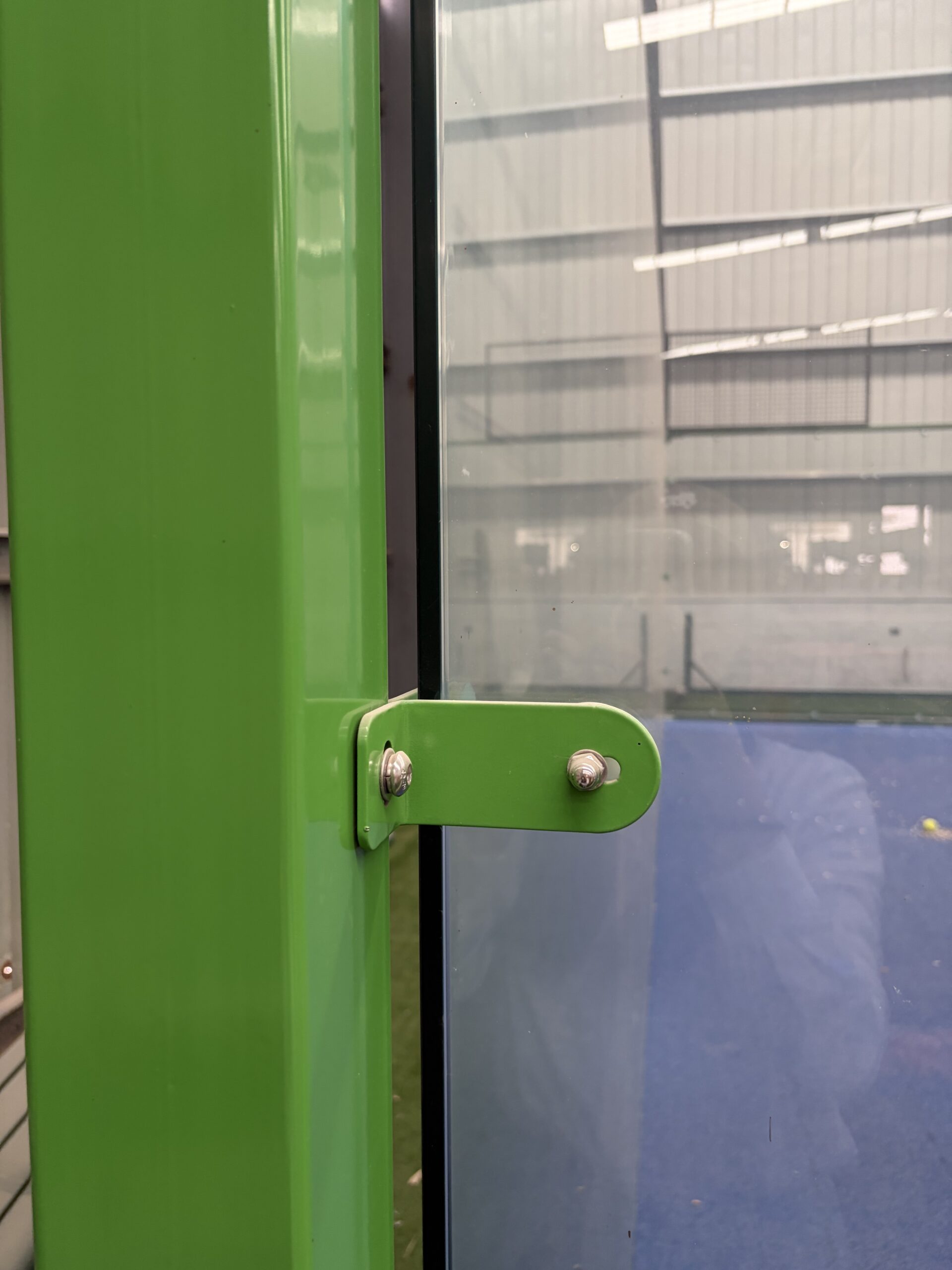
Here is where PANO stands. Our standard panoramic court is verified to a design gust pressure of 0.68 kN/m² under our company standard Q/PANO 01S-2019, which we describe as roughly a 33 m/s gust, or about 74 mph. That is a factory test basis, not a US permit rating.
For US projects we re-run the calculation against ASCE 7-22 for your site and adjust column wall thickness, post spacing, base plates, anchors and glass fixings; your engineer then verifies and stamps the result. At high-wind sites, expect a reinforced package and a larger foundation. Our padel court wind load guide explains the test and the conversion between codes, and our outdoor panoramic structure guide shows where the loads travel through the frame.
The 2025 ASBA/USPA Padel Court Installation and Maintenance Manual is described by one US publication as the first national standard for padel court construction in the United States; ask your engineer and supplier whether it applies to your project.
Where you build a padel court in the USA changes which load governs the design:
| Region type | What usually drives the design |
|---|---|
| Florida and hurricane-exposed coast | Very high wind speeds and salt-air corrosion; reinforced package, post-fabrication hot-dip galvanising and an engineered foundation |
| Northern states | Snow loads, especially on any canopy or roof, and frost depth for the foundation |
| Seismically active areas such as parts of the West Coast | Seismic loads in the structural design |
| Inland and sheltered sites | Wind still governs, but at a lower design speed; drainage and ground conditions matter |
| Indoor halls | No wind on the court, but building code, change of use, fire and egress rules, and the building owner’s approval |
If you are covering the court, a canopy adds uplift and snow load; read our دليل أسقف ملاعب البادل before you choose. For Florida and Gulf Coast sites, our coastal padel court specification sets out the model choice, post sizes and coating route. For warehouse conversions, see our indoor padel court construction guide.
What are the steps to build a padel court in the USA?
Work in this order: site check, zoning, wind and site data, surveys, engineering, permits, then order and ship, and finally foundation and installation. The order matters more than speed, because each step feeds the next one.
| Step | What happens | Who normally does it |
|---|---|---|
| 1. Site check | Measure against the court footprint: playing area 20 × 10 m; plan at least about 20.8 × 10.8 m for one court including the ring beam; 6 m clear height indoors | Owner, with the supplier’s layout data |
| 2. Zoning and use | Confirm zoning, conditional use and site plan requirements with the local planning office | Owner, planning consultant |
| 3. Wind and site data | Find the design wind speed, exposure, snow and seismic data for the address | Structural engineer |
| 4. Surveys | Topographic, soil and drainage surveys; utilities and electrical supply route | Local surveyors |
| 5. Engineering | Stamped foundation and enclosure design using the supplier’s drawings, base-plate layout, anchor positions and weights | Licensed structural engineer |
| 6. Permits | Submit drawings and calculations; resolve comments | Owner and engineer |
| 7. Order, production, shipping, customs | Place the order once the design is fixed; the court is produced, shipped and cleared | Supplier, importer of record, customs broker |
| 8. Foundation and installation | Foundation first, then assembly, lighting, turf and net; inspection and handover | Local contractor, installer, building inspector |
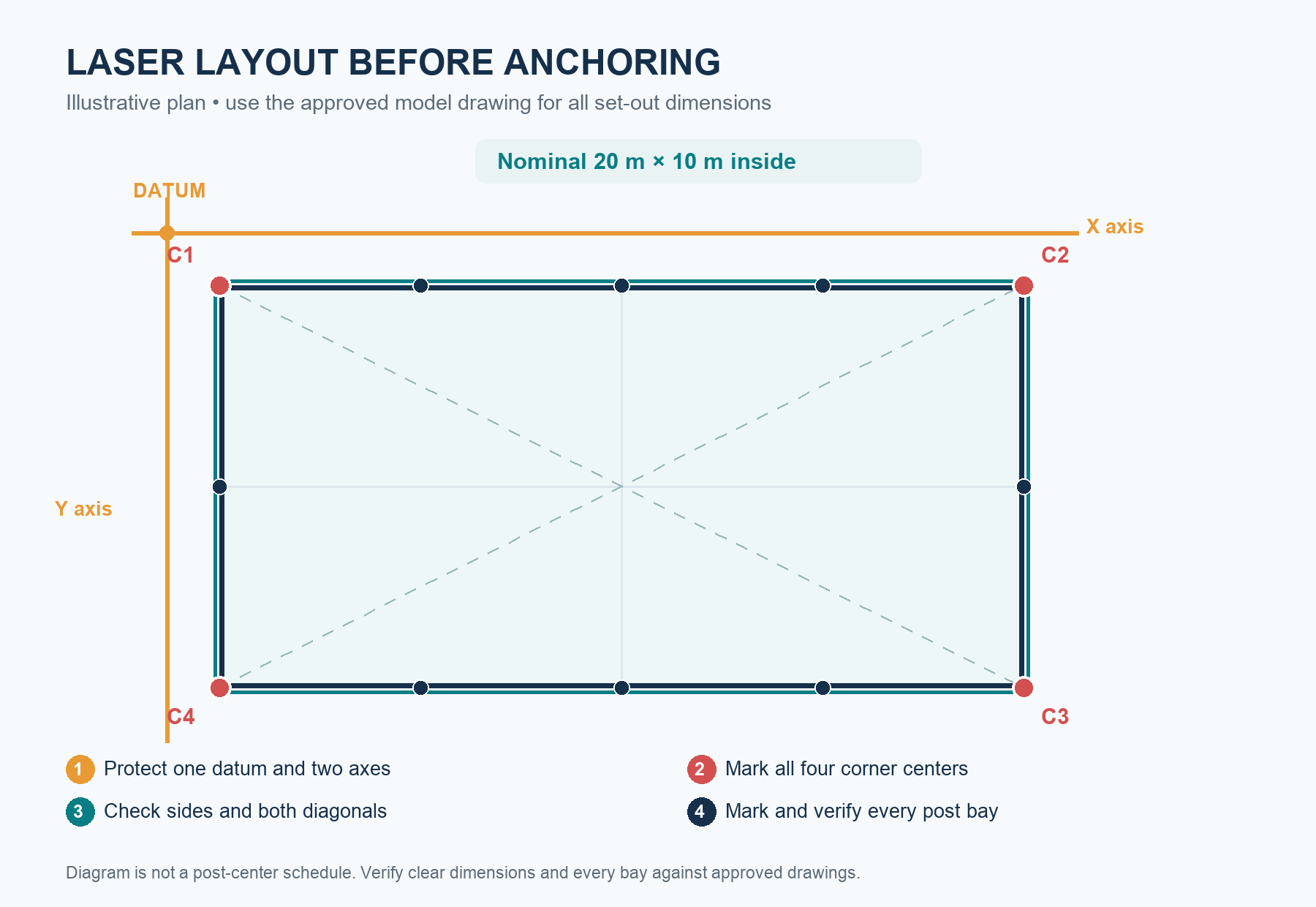
Keep steps 5 to 7 in that order: finish the engineering and permit before the factory ships, so that a container does not sit in a port while the design is still changing. Our padel court construction guide covers the civil works in more detail, and if you are weighing a turnkey contractor against factory-direct supply, read our guide to choosing a padel court builder.
Who does what when you import a padel court into the USA?
When you import a court to build a padel court in the USA, the factory supplies the court and the technical data; everything in the ground, on paper with a US stamp, or at US customs is handled on the US side. Agree this split in writing before you sign.
| العنصر | Factory (PANO) | US side |
|---|---|---|
| Steel structure, mesh, glass, turf, lighting, net | Supplied and packed for export | Receiving, storage, assembly |
| Technical documents | Enclosure drawings, base-plate layout and anchor positions, structure weights and the design wind basis of the supplied enclosure | Your engineer uses them as input |
| Foundation, slab, drainage | Not provided | Designed and stamped by a licensed US engineer; built by a local contractor |
| Wind, snow and seismic design check | Re-runs our calculation for your code on request | Engineer verifies and stamps |
| Zoning, permits, ADA, inspections | Not provided | Site owner and local officials |
| Import entry, duties, port and inland delivery | Export documents and packing list | Importer of record and customs broker |
A complete court set weighs about 6 tonnes, and a 20 ft container normally carries two courts while a 40 ft container carries four. Padel courts are sports goods, normally classified under HS heading 9506, but the exact tariff line and the duty on goods made in China depend on the classification and the date of entry, and US trade rules have changed repeatedly.
Ask your customs broker for the duty on your exact shipment and put it in your budget before you place the order. Our guide to importing a padel court from China and our padel court manufacturer USA report go deeper on the process and the market.
How long does it take to build an imported padel court in the USA?
If you build a padel court in the USA with an imported court, plan on about three to four months from deposit to handover, with US zoning, engineering and permits often adding time before the deposit. Production is the shortest stage; the permit is usually the longest.
| المرحلة | Typical duration | Note |
|---|---|---|
| Zoning, engineering and permits | Varies by city; often the longest stage | Start first and run it in parallel with supplier selection |
| Court production | About 20 to 25 days after the deposit is confirmed; set in the contract | Reinforced or non-standard packages can take longer |
| Sea freight and customs | Quoted per destination port; about 40 to 50 days port to port on routes we have quoted elsewhere | West Coast, East Coast and Gulf ports differ, so ask for the schedule for your port |
| Foundation and curing | Engineer-designed; one competitor guide cites 1 to 2 weeks plus 7 to 14 days of curing for an outdoor court | Do it while the container is at sea |
| التركيب | About 4 to 7 days for a crew of 4 to 6 people on a small order | Depends on crew experience and number of courts |
| Whole imported project | 3 to 4 months from deposit in one quotation we gave for three coastal courts | US permits can add time |
The slowest stage sets your opening date, and in the US that is usually the permit or the engineering, not the factory. Do not place an order until the site design is settled.
Who installs an imported padel court in the USA?
For the installation itself, you have three realistic options: a local installer, your own crew with remote guidance from the factory, or your crew working under a factory technician. The right choice depends on whether an experienced padel crew exists near your site.
| Option | How it works | Best when |
|---|---|---|
| 1. Local installer | Hire an installer with padel or glass-enclosure experience; we can help with recommendations where we know one, and you agree the fee directly | An experienced crew is available near your site |
| 2. Remote guidance | Your own crew installs using the manual, drawings and video guidance from our team | You have a steel or fencing crew that can follow drawings |
| 3. Factory technician | One technician travels to guide the work and you provide local workers; the buyer pays the technician’s flights, visa and accommodation | It is your first project, or you plan several courts |
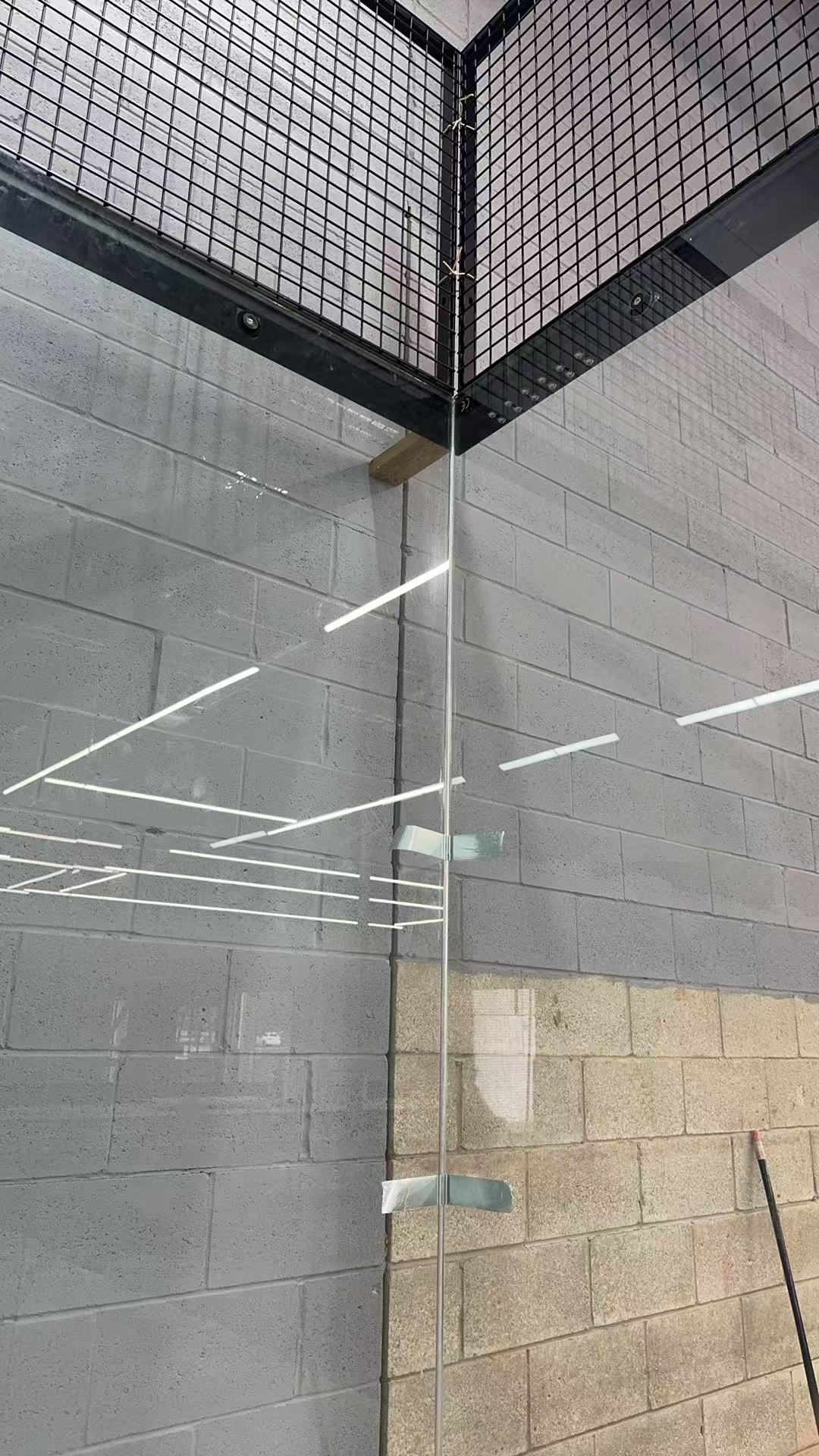
Ask every crew whether they have installed a padel court before, who handles glass lifting, who holds spare glass, and how fast the factory answers questions during the install. Technician visits and their costs are agreed in writing; they are not automatic. See our دليل تركيب ملعب البادل for site preparation.
What foundation does a padel court need in the USA?
Every plan to build a padel court in the USA needs an engineer-designed reinforced concrete or asphalt base that carries the enclosure weight and transfers wind uplift and lateral loads to the ground. A panoramic court carries 18 glass panels, about 108 m² of 12 mm glass, so the glass alone weighs several tonnes. A US engineering summary says the pavement is typically an asphalt or concrete base with a synthetic sports surface, designed to subgrade conditions and exposure.
Reference designs use a perimeter reinforced ring beam, pad foundations or a full reinforced slab of roughly 15 to 25 cm, but your engineer sets the section, the depth for local frost conditions, the reinforcement and the anchor embedment from your site data. Do not copy drawings from another project. The surface should be level to within ±6 mm under a 3 m straightedge, and outdoor courts need drainage planned from the start.
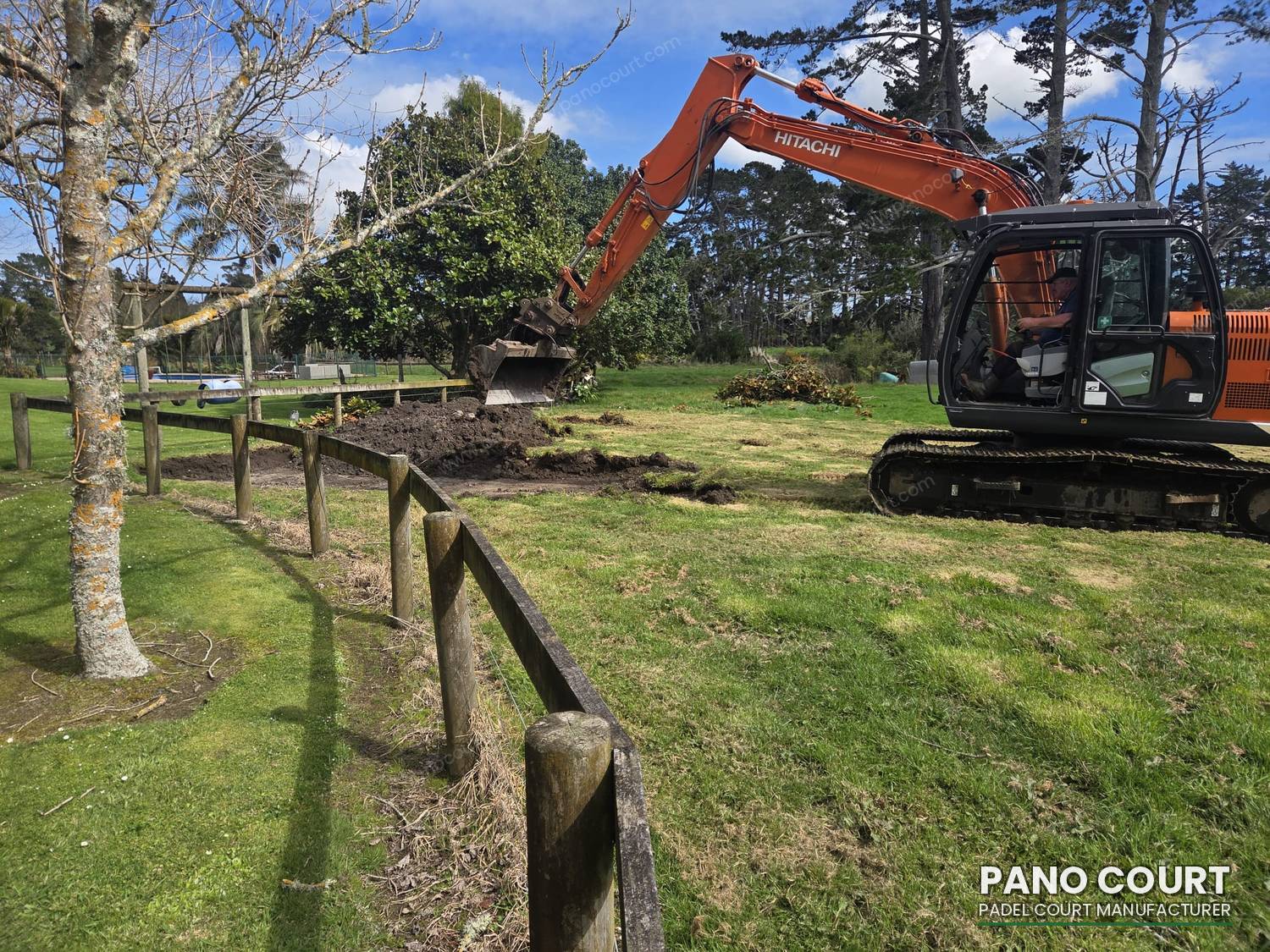
Our foundation requirements article compares concrete, asphalt and floating bases, and our outdoor padel court foundation guide covers anchors, tolerances and drainage. Give both to your engineer as background, not as a design.
What specifications should you request for a US padel court project?
Before you build a padel court in the USA, ask for a written wind design basis in ASCE 7-22 terms, glass and coating details, a full drawing set and certificates whose scope you can read. These are the documents a US engineer and building department will actually use.
| العنصر | What to ask for |
|---|---|
| Wind design basis | Written basis in ASCE 7-22 terms for your address (3-second gust, risk category, exposure), not only a Chinese or European figure |
| Frame without glass | Confirm whether a stated rating includes the glass panels or applies to the steel only |
| الزجاج | 12 mm toughened outdoors and under canopies; supplier certificate for each panel |
| Steel protection | Which corrosion route is used: galvanised tube plus powder coating, whole-frame hot-dip galvanising after welding, or e-coat primer plus powder. For coastal sites, ask for galvanising after fabrication |
| Drawings | Enclosure drawings, base-plate layout, anchor positions, weights, post reaction loads |
| Lighting | 300 lux recreational; 500 lux for national or international play; fixture and pole details for the electrician and engineer |
| الضمان | Length, what it covers and who replaces parts; our standard models carry 5 years and our premium models 8 years |
| Certificates | Holder, standard, scope and date on every document |
Read certificates by scope. PANO is not an FIP-certified factory; our standard court is built to the 20 × 10 m FIP playing dimensions, which is not certification. Our documents include a voluntary technical-file review against EN 1090-1, which is not CE certification of the court. None of our documents replaces a US structural engineer’s stamp.
How do you choose a padel court supplier for a US project?
If you plan to build a padel court in the USA, choose a مورد ملاعب البادل that makes the court itself, gives you engineer-ready drawings before the deposit, states its wind basis in writing and answers technical questions during installation. Price matters, but on a US project the documents decide whether the permit goes through.
- Factory or trader: ask who cuts, welds and coats the steel. A source factory can change wall thickness or post spacing for a high-wind site; a trader usually cannot.
- Drawings before deposit: your engineer needs the base-plate layout, anchor positions and reaction loads to size the foundation.
- Order size: our minimum order is one court, so a single backyard or club court is possible.
- Spare parts: agree spare glass and fixings in the order; replacing a panel from overseas takes weeks.
- Honest limits: a good supplier tells you when the standard package does not fit your site.
In quotation work for US buyers, the questions that decide a project early are rarely about price. They are about the wind basis, who stamps the drawings and who pays duty. Settle those three first. Our comparison of مصنعو ملاعب البادل lists the trade-offs between Spanish, Italian, Turkish and Chinese factories, including where PANO is not the right choice.
What drives the cost of building a padel court in the USA?
The cost to build a padel court in the USA is the court price plus freight, duty, engineering, permits, foundation, electrics and installation. We do not publish prices on this page, because the number changes with model, glass, wind package, turf, lighting, port and trade terms. Budget these lines separately:
| Cost line | Normally paid to |
|---|---|
| Court equipment (structure, glass, turf, lighting, net) | Factory |
| Wind or snow upgrade, if your site needs it | Factory, plus a larger foundation locally |
| Sea freight, insurance, port charges | Depends on the Incoterm |
| Customs entry, duty and broker fees | Importer of record and customs broker |
| Inland transport and unloading | Local haulier |
| Surveys, structural engineering, planning and permit fees | Consultants and the city |
| Foundation, drainage and electrics | Local contractors |
| Installation labour and lifting | Local crew, or crew plus factory technician |
| ADA access, fencing, parking, canopy if any | Local contractors and suppliers |
To see how FOB, CIF, DAP and DDP move these lines between you and the factory, read our commercial padel court cost guide. If you are still comparing models, our guide to padel courts for sale explains what a factory quote includes.
Build a padel court in the USA: FAQ
Do you need a permit to build a padel court in the USA?
Yes, in almost every case. Zoning and building approval are set by your city or county, and you may need a conditional use permit and site plan approval as well as a building permit and an electrical permit. Many local codes do not mention padel, so ask the planning and building departments how they classify a padel court before you order.
What building code applies to a padel court in the USA?
Outdoor courts are designed under the International Building Code and the loading provisions of ASCE 7, with wind as the governing load. The local building official is the authority having jurisdiction, and a licensed structural engineer normally produces stamped drawings and calculations for the permit application.
Is a CE-marked padel court accepted in the USA?
Not automatically. A European CE mark or Eurocode certification does not satisfy US requirements, because ASCE 7 uses a 3-second gust while Eurocode uses a 10-minute mean wind speed. Ask the supplier for a site-specific design check against ASCE 7 and have a licensed US engineer verify and stamp it.
What wind speed must a US padel court withstand?
It depends on the address, exposure category and risk category. Basic wind speeds can reach 140 to 180 mph in parts of Florida, and are much lower on sheltered inland sites. Your engineer finds the design wind speed for the exact site, for example with the free ASCE Hazard Tool, and checks the enclosure against it.
Does PANO’s standard padel court meet US wind codes?
Not without a site check. Our standard panoramic court is verified to 0.68 kN/m² under our company standard, roughly a 74 mph gust, which is a factory test basis rather than a US rating. For US sites we re-run the calculation against ASCE 7-22, adjust the steel and fixings where needed, and your engineer verifies and stamps it.
How long does it take to build an imported padel court in the USA?
Plan on about three to four months from deposit to handover, based on a recent PANO quotation: production of about 20 to 25 days, sea freight of about 40 to 50 days on routes we have quoted, and installation of about 4 to 7 days. US zoning, engineering and permits often set the real opening date.
How much does it cost to build a padel court in the USA?
There is no single figure. The total combines the court equipment, freight, US duty and broker fees, structural engineering, permit fees, the foundation, drainage, electrics and installation labour. High-wind or snow sites add a reinforced package and a larger foundation. Ask for an itemised quote and budget each line separately before you commit.
Can I build a padel court in my backyard in the USA?
Often yes, but residential zoning, setbacks, lot coverage, homeowners’ association rules and noise limits decide it. A building permit and an engineer-stamped design are still normally required. Speak to the planning department before you order, because building first and applying later can end with the application being withdrawn.
Who installs an imported padel court in the USA?
A local installer with padel or glass-enclosure experience, your own steel or fencing crew with remote guidance from the factory, or your crew guided by a factory technician whose travel costs the buyer pays. Ask any crew whether they have installed a padel court before and who handles glass lifting.
Does PANO provide the foundation design for US projects?
No. We provide enclosure drawings, the base-plate layout, anchor positions, structure weights and the design wind basis of the supplied enclosure. A licensed US structural engineer designs and stamps the foundation for your soil, frost depth and wind data, and verifies the enclosure for your site.
What is the safest way to build a padel court in the USA?
The safest way to build a padel court in the USA is to treat it as a structure from day one: confirm zoning, get the design wind speed for your address, let a licensed engineer design the foundation and verify the enclosure, secure the permit, and only then release production. An imported court can save money, but only if the supplier gives your engineer complete drawings, a written wind basis and honest limits. The factory makes the court; your US team makes it legal and safe.
Sources and further reading
- Engineering Express: Design of Padel and Outdoor Sports Courts in the United States
- The Padel Paper: US padel courts, legal compliance and safety warnings
- Padel.fyi: Padel courts face permitting chaos as the sport outpaces local regulations
- ASCE Hazard Tool
- International Code Council: International Building Code
Planning to build a padel court in the USA? Send us your site address, court count, indoor or outdoor use and your local engineer’s contact. We will send a layout check, the enclosure drawings and the wind basis your engineer needs, and tell you honestly whether the standard package fits your site. Use the form below or visit our contact page.