This week, an investor planning a two-court padel court club in India, shared a quotation he had received from a domestic supplier and asked us a question we hear more and more often: “Why does a locally made تكلفة ملعب البادل more than an imported one — and why is the warranty only one year?”
So we did something useful. We placed that real quotation next to our own تكلفة ملعب البادل quotation for the Panoramic P001, line by line, and the result is a warning every padel club investor should read before signing anything. The numbers below are from two real quotations issued in July 2026.
What Does It Cost to Invest in a Padel Club?
A padel club investment is never just “the price of the court.” Your total capital expenditure is the sum of court hardware, civil works and installation, permits and compliance, logistics and taxes, and a working-capital reserve — and court hardware is almost always the single largest line item.
- Court system (structure, glass, turf, lighting): typically 45–60% of the initial capex for an outdoor club.
- Foundation and installation: a reinforced concrete slab, anchoring, assembly labor, and crane or lifting equipment.
- Permits and compliance: in most European countries an outdoor court requires a building permit supported by certified structural calculations and CE documentation before approval; in India, GST applies to the full contract value.
- Logistics and taxes: inland trucking, sea freight, import duty, and local VAT/GST — costs that many first-time investors forget to model.
- Working capital: a reserve covering 3–6 months of operating costs before memberships stabilize.
Real 2026 data — 2 panoramic padel court cost in India (local supplier’s quotation):
Practical insight: that works out to roughly ~$22,700 per court all-in — before a single cubic meter of concrete is poured. When you evaluate any padel court investment, budget on the total 5-year ownership cost, not the sticker price. As you will see below, the warranty terms decide most of that 5-year cost.
What Makes Up the Cost of a Padel Court?
Around 60–70% of a padel court’s ex-factory cost sits in three raw materials: steel, tempered glass, and artificial turf. The remainder is manufacturing process cost (cutting, welding, surface treatment) and design or customization cost. Understanding these three layers is how you read any quotation from any padel court factory.
1. Raw materials — the biggest cost block
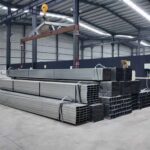
- الهيكل الفولاذي: a standard 20 m × 10 m court uses roughly 3–4 tonnes of steel tube — 100 × 100 × 3 mm corner posts, 50 × 100 × 3 mm intermediate posts and crossbeams, plus 46 welded mesh panels. Wall thickness (3 mm vs 2.0–2.5 mm) alone shifts material cost by 20%.
- Steel treatment: hot-dip galvanizing to EN ISO 1461 (minimum 85 µm zinc layer) costs more than paint or pre-galvanized sheet, but it is the difference between a 20-year structure and a 5-year one, especially in humid or coastal climates like Vizag.
- Tempered glass: a full panoramic padel court uses about 108 m² of glass across 19 panels. Moving from 10 mm to 12 mm tempered safety glass adds roughly 20% more glass mass — and dramatically more stiffness and impact safety at the panoramic back walls.
- Artificial turf: quality is defined by yarn weight (Dtex), stitch density, and backing. Our specification is 12 mm pile, 8,000 Dtex, 52,500 stitches/m² across 210 m². Low-Dtex turf looks identical on day one and flattens within 12–18 months.
2. Manufacturing process — where quotations really diverge
- Cutting and drilling: CNC laser-cut profiles guarantee every bolt hole aligns on site; hand-cut tube means field grinding, gaps, and water traps.
- Welding: robotic MIG welding delivers consistent penetration on every joint; manual welding quality varies weld by weld and worker by worker.
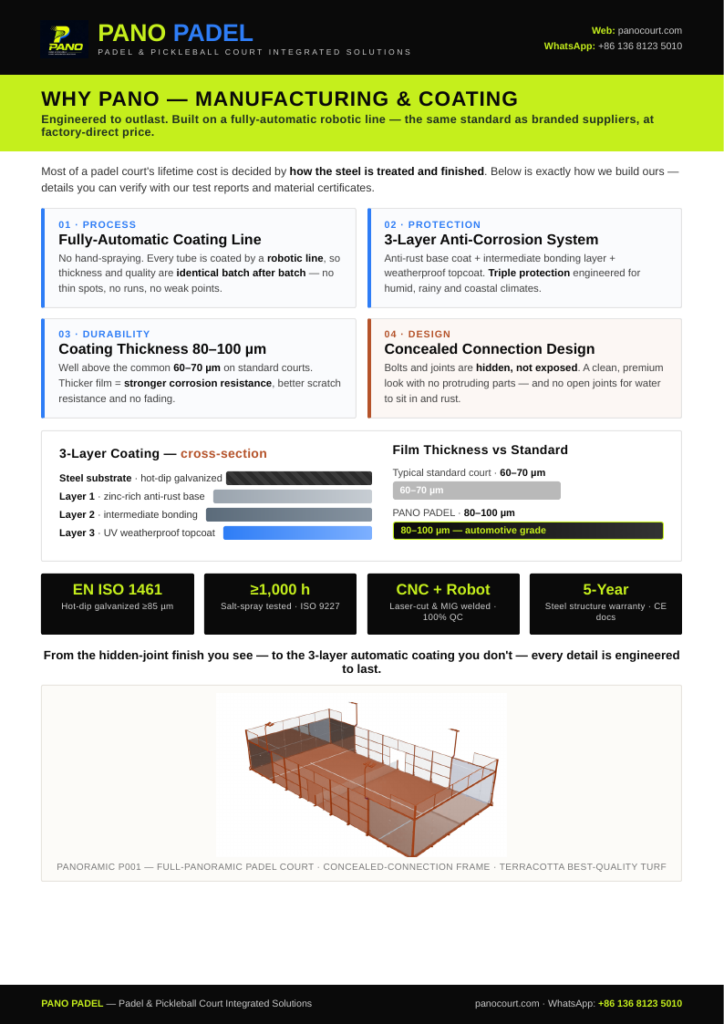
- Surface coating: a fully automatic coating line applies a 3-layer system — zinc-rich anti-rust base, intermediate bonding layer, and UV weatherproof topcoat — at 80–100 µm total film thickness. A single hand-sprayed layer typically measures 60–70 µm with thin spots at edges and welds.
- Verification: the coating system should be salt-spray tested to at least 1,000 hours per ISO 9227, with reports available on request.
3. Design and customization
- A ملعب الباديل البانورامي (reduced posts, uninterrupted glass viewing walls) costs more than a classic court because thicker glass and engineered concealed fixings replace structural posts.
- Custom RAL colors, branded net banners, glass logos, doors, and broadcast-grade LED upgrades are add-ons — in our price list these range from $30 (net banner) to $478 (matching steel door).
- Concealed-connection design (no exposed bolts, no open joints) adds fabrication cost but removes the #1 place rust starts.
The two quotations, side by side
Here is the local Indian quotation against our Panoramic P001 quotation, both issued in July 2026:
Practical insight — the 5-year math: a padel club typically needs 3–5 years of operation to pay back its investment. With a 1-year warranty, years 2 through 5 are entirely your risk. If the coating fails or the structure corrodes after year one, replacing parts and re-treating the frame is, in cost terms, close to rebuilding the court all over again — a second capex event your business plan never included. A 5-year structural warranty means the padel court manufacturer, not the investor, carries that risk across your entire payback period.
| المكون | High-quality Padel Court factory | Cheap Padel Court factory | What It Means for the Project |
| Court Type & Standard | Panoramic court — open toughened-glass back-walls with minimal vertical structure; WPT (World Padel Tour) aligned geometry and rebound; tournament-ready. | “Scenic Premium” court; standard pillar structure with light pillars leaning out of the playing area. No international standard referenced in the quotation. | High-quality Padel Court offers the panoramic format with unobstructed spectator view — the premium configuration for clubs and televised/tournament play. |
| Court Size | 20 m × 10 m double court (stated). | Not stated in the quotation. | High-quality Padel Court specification is explicit and verifiable. |
| الهياكل الفولاذية | Fully dimensioned: corner posts 100×100×3 mm square tube (H3000); intermediate posts 50×100×3 mm (12 pcs); upper & lower crossbeams 50×100×3 mm (8+8 pcs); light poles 50×100×3 mm. | “Reinforced FULLY galvanised metallic structure with steel pillars, anchor plate.” Steel make JSW/Apollo. No tube sections, wall thickness or member counts stated. | High-quality Padel Court discloses every member size and wall thickness; the competing quote gives no measurable structural specification. |
| Anti-Corrosion Protection | Triple-layer protection: hot-dip galvanized steel pipe + anti-corrosion spray layer + anti-corrosion paint coat; spray thickness ≥ 85 µm; fully automatic spraying with imported powder. Explicitly engineered for sea/coastal environments. | Galvanized steel + powder coating (black). Single coating system; no coating thickness stated; no coastal-environment provision. | Critical for a coastal site such as Vizag: salt-air corrosion is the No. 1 failure cause of padel structures near the sea. Only High-quality Padel Court specifies marine-grade triple-layer protection. |
| الألواح الزجاجية | 12 mm tempered safety glass, 18 panels of 1995 × 2995 mm (108 m² total), wooden-crate packed. | 10 mm toughened glass — Saint Gobain (Sapphire). | High-quality Padel Court glass is 12 mm vs 10 mm — 20% thicker, stiffer rebound and higher safety margin; 12 mm is the WPT/tournament norm for panoramic courts. |
| Structure Connections | Latest hidden-connector design for a cleaner, more attractive appearance. | Not specified. | Hidden connectors give a premium architectural finish — a visible differentiator for a flagship club venue. |
| Perimeter Mesh | Welded wire-mesh panels: 20×40×2 mm steel tube frame, 4 mm wire, 50×50 mm opening, panel 2000×1000 mm, 46 panels per court. | Not specified in the quotation. | High-quality Padel Court specifies wire gauge, mesh opening and frame section; nothing comparable is committed in the competing quote. |
| Net Posts | Rectangular steel tube 80 × 160 × 2.75 mm; built-in pure-copper cable tensioner; cast aluminium alloy cap and crank handle. | Not specified. | High-quality Padel Court commits a full net-post specification in writing. |
| Center Net | PE braided net, 3 mm cord, 45×45 mm mesh; 6-mesh double-layer top band; PVC-coated sandwich fabric encasing a 6 mm PVC-coated steel wire rope. | “High quality central net” — no specification given. | High-quality Padel Court specification is complete and measurable. |
| Turf | Bellinturf / CCGrass (as per availability); multiple standard colour options, colour confirmed on order. | Bellin SUPER Turf (imported from Vietnam), mono-filament texturized, including 2.0T sand infill and two-component glue. | Comparable premium turf makes on both sides (both offer Bellin). High-quality Padel Court additionally offers like mondo turf and a choice of colourways. |
| LED Lighting | 8 × 200 W LED sports floodlights delivering 600 Lux (Option 2, included). Alternative options: 4 × 400 W (577 Lux) or fully customised design. | 8 × 200 W Pro LED lights, IP65 compliant. No illumination (Lux) level stated. | Same fixture count/wattage, but High-quality Padel Court commits a measured 600 Lux result and offers engineered alternatives. |
Why Are There So Many Cheap Padel Courts on the Market?
Because almost every cost cut in a padel court is invisible on delivery day. Two courts can look identical in photos and stand identically for the first six months; the differences appear in year two, when the payback clock is already running.
- Material downgrades: 2.0–2.5 mm tube walls sold as “heavy duty,” 10 mm glass where panoramic spans call for 12 mm, low-Dtex turf that flattens early.
- Fake galvanizing: pre-galvanized (cold) sheet or plain primer described as “galvanized steel” — a fraction of the zinc thickness of true hot-dip galvanizing.
- One coat instead of three: a single hand-sprayed layer at 60–70 µm, with no salt-spray test report, versus a 3-layer automatic system at 80–100 µm.
- Manual fabrication: hand cutting and hand welding produce misaligned holes, weak joints, and grind marks where rust begins.
- Exposed connections: protruding bolts and open joints collect water — the first place corrosion shows, usually within the first monsoon or winter.
Data point: the film-thickness difference alone — 60–70 µm standard vs 80–100 µm automotive-grade — typically translates into years of extra corrosion resistance, which is exactly why low-spec suppliers cap their warranty at 12 months. A warranty is a manufacturer’s honest confession of how long they expect their own product to last.
Practical insight: before comparing prices, ask every supplier for two documents — the salt-spray test report (ISO 9227) and the material certificates for steel, glass, and turf. A padel court factory that cannot produce them is answering your quality question already. Our دليل المشتري لمصانع ملاعب البادل في الصين covers the full verification process.
How Do You Choose a Padel Court Manufacturer?
Choose a padel court manufacturer the way you would choose a structural contractor: on documents, process evidence, and written warranties — never on renders and brochure adjectives. The goal is to make quality verifiable before you pay a deposit.
- Warranty in writing, per component: demand separate terms for structure, coating, glass, turf, and LED. Compare a flat 1-year warranty against 5 / 3 / 2 / 5 / 3 years and price the difference into your risk model.
- Coating specification in µm: the quotation should state hot-dip galvanizing thickness (EN ISO 1461), coating layers, total film thickness, and the salt-spray test standard.
- Process evidence: ask for live video of the coating line, CNC cutting, and robotic welding — a 15-minute video factory tour reveals more than any catalogue.
- Reference installations: request completed projects in a climate similar to yours, with client contacts you may call.
- Clear commercial terms: defined lead time, packing method (glass individually sleeved in steel-banded crates), CE documentation, and installation support — see our دليل تركيب ملعب البادل for what proper support looks like.
Data point: in the two quotations above, the imported court is $10,500 FOB with a 5-year structural warranty, while the local court is ~$14,000 before tax with a 1-year warranty — the “convenient local option” costs more per court and transfers 4 extra years of risk to the investor. Even after adding sea freight and Indian import duties, the buyer’s landed cost remained comparable, with double the warranty coverage across every component. Run your own numbers with our complete padel court cost breakdown.
Practical insight: “local” is not automatically cheaper, and “imported from a China padel court factory” is not automatically lower quality. What matters is which factory can prove its specifications on paper and on camera — regardless of where it stands.
Why Do Club Investors Choose PANO?
PANO PADEL is a factory-direct padel and pickleball court manufacturer in Tianjin, China, building full panoramic padel courts on a fully automatic robotic production line — the same manufacturing standard used by branded European suppliers, at factory-direct pricing.
- Verified corrosion protection: hot-dip galvanizing ≥85 µm to EN ISO 1461, plus a 3-layer automatic coating system at 80–100 µm, salt-spray tested beyond 1,000 hours (ISO 9227) — engineered for humid, rainy, and coastal climates.
- Precision fabrication: CNC laser-cut profiles and robotic MIG welding with 100% dimensional QC before surface treatment.
- Concealed connection design: no exposed bolts, no open joints — a clean premium look and no standing water on the frame.
- Warranties that match your payback period: 5-year steel structure, 3-year coating, 5-year turf, 3-year LED — backed by CE documentation, material certificates, and test reports shipped with every order.
- Investor-friendly terms: $10,500 FOB per Panoramic P001 court, 30% deposit, 20–30 working-day lead time, export crating with every glass panel individually sleeved.
Practical insight: we win projects like the Vizag comparison not by being the cheapest quotation on the table, but by being the cheapest court to own over 5 years. If you are comparing quotations right now, send them to us on WhatsApp (+86 136 8123 5010) — we will put them side by side with our specification, line by line, exactly as we did in this article.
FAQ: Padel Court Cost and Manufacturer Selection
كم تبلغ تكلفة ملعب البادل في عام 2026؟
تتراوح تكلفة ملعب البادل البانورامي الكامل عالي الجودة بين $10,000 و$15,000 تقريبًا من المصنع من أحد المصنعين الصينيين (يبلغ سعر طرازنا Panoramic P001 $10,500 شروط فوب)، بينما تتراوح أسعار الملاعب ذات العلامات التجارية الأوروبية عادةً بين $20,000 و$40,000. أضف إلى ذلك تكاليف الشحن ورسوم الاستيراد والأساسات والتركيب لتحديد التكلفة الإجمالية للمشروع — في دراسة الحالة الهندية المذكورة أعلاه، بلغ المبلغ الإجمالي حوالي $17,700 لكل ملعب.
هل ملعب البادل الصيني أقل جودة من الملعب الأوروبي؟
ليس إذا كان المصنع قادرًا على إثبات مطابقة منتجاته للمواصفات. قم بتقييم أي مصنع لملاعب البادل بناءً على الجلفنة بالغمس الساخن وفقًا لمعيار EN ISO 1461، وسماكة الطلاء (80–100 ميكرومتر)، واختبار رش الملح وفقًا لمعيار ISO 9227، والزجاج المقسّى بسمك 12 مم، والضمانات المكتوبة لعدة سنوات — وليس بناءً على بلد المنشأ. يتم إنتاج العديد من الملاعب منخفضة الجودة محليًا في كل سوق.
ما الفرق بين ملعب البادل البانورامي والملعب الكلاسيكي؟
يتميز ملعب البادل البانورامي الكامل بعدم وجود أعمدة هيكلية في الجدران الزجاجية الخلفية، حيث يستخدم زجاجًا مقسّىً أكثر سمكًا يبلغ 12 ملم ومثبتات هندسية مخفية لضمان إطلالة غير منقطعة للمشاهدين. أما الملعب الكلاسيكي فيستخدم عددًا أكبر من الأعمدة مع زجاج بسمك 10 ملم. وتكلف الملاعب البانورامية أكثر في التصنيع، لكنها تُعد المعيار السائد في النوادي الراقية والملاعب التي تُبث مبارياتها تلفزيونيًّا.
ما هو الضمان الذي ينبغي أن يقدمه مصنع ملاعب البادل؟
توقع ضمانات على مستوى المكونات: حوالي 5 سنوات على الهيكل الفولاذي، و5 سنوات على الطلاء، و3 سنوات على الزجاج، و3 سنوات على العشب الصناعي، و3 سنوات على إضاءة LED. إن تقديم ضمان موحد لمدة سنة واحدة على كل شيء يشير إلى أن المورد يتوقع حدوث أعطال مبكرة — وهو خطر جسيم عندما يحتاج ناديك إلى 3–5 سنوات لتسديد قيمة الاستثمار.
كم من الوقت يستغرق التسليم من مصنع ملاعب البادل في الصين؟
يستغرق الإنتاج عادةً ما بين 20 و30 يوم عمل من تاريخ دفع الدفعة الأولى، بالإضافة إلى مدة الشحن البحري — التي تستغرق حوالي 3 إلى 4 أسابيع إلى الهند أو الشرق الأوسط، و4 إلى 6 أسابيع إلى أوروبا أو الأمريكتين. يتم شحن المحاكم في صناديق تصدير مربوطة بشرائط فولاذية، مع تغليف الألواح الزجاجية بشكل فردي، وتُرفق معها وثائق CE والرسومات وأدلة التركيب.
About the author: this article was prepared by the export team at PANO PADEL (panocourt.com), a padel court manufacturer in hebei, China, using two real quotations issued in July 2026. Specifications cited — EN ISO 1461 galvanizing, ISO 9227 salt-spray testing, coating film thickness — are documented in our test reports and material certificates, available to any investor on request. Padel court dimensions referenced follow الاتحاد الدولي للباديل (FIP) standards.