
Every club developer, resort operator, and municipal sports authority building a padel facility eventually reaches the same crossroads: ملعب الباديل البانورامي or ملعب بادل كلاسيكي? The question sounds simple. The answer requires understanding structural engineering, commercial economics, and your target player demographic—and getting it wrong costs $15,000–$25,000 per court in either overspend (panoramic where classic would serve) or lost revenue (classic where panoramic was needed).
This guide gives you the unambiguous technical and commercial framework to make the right call for your specific project. We’ll cover exactly what each court type is, what specifications differentiate them, who each serves, what the cost differential is, and what the data shows about revenue performance in comparable markets.
What Is a Panoramic Padel Court? Technical Definition
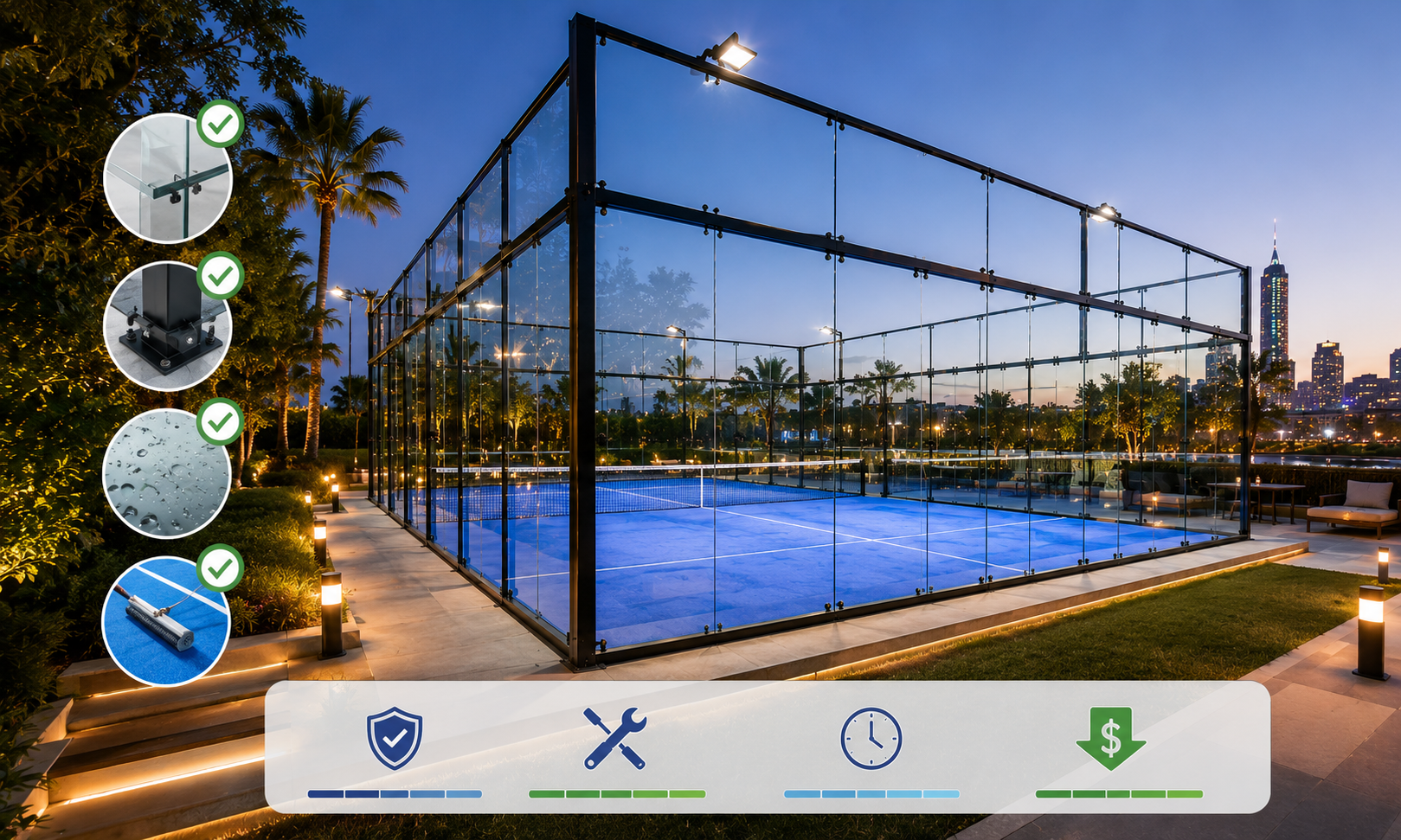
A ملعب الباديل البانورامي uses full-height tempered glass panels on all four sides of the court enclosure—both rear walls and both side walls. The result is a fully transparent structure that allows 360-degree visibility from outside the playing area. The glass panels are typically 12mm fully tempered ESG (Einscheiben-Sicherheitsglas / Monolithic Tempered Safety Glass), seated in galvanized steel frames.
The term “panoramic” refers to the unobstructed sightlines—players, coaches, and spectators can see the entire court from any angle. This configuration is now the dominant format in professional padel globally. The International Padel Federation (FIP) specifies the ملعب الباديل البانورامي as the official tournament court type for Premier Padel and FIP World Padel Tour events.
Standard Panoramic Court Specifications
- Playing surface: 20m × 10m (standard FIP dimensions)
- Rear glass panels: 12mm fully tempered ESG, typically 3–5 panels per rear wall
- Side glass panels: 12mm fully tempered ESG, spanning full height and length
- Total glass area: Approximately 120–150m² per court
- Steel frame: Hot-dip galvanized S355 structural steel, 85µm+ zinc coating
- Total structure weight: 3,500–5,500 kg depending on model and specification
What Is a ملعب بادل كلاسيكي? Technical Definition
A ملعب بادل كلاسيكي (also called “standard” or “traditional” configuration) uses solid rear walls—typically concrete, brick, or concrete block construction—at both ends of the court, with metal mesh fence panels on the side walls. The rear walls may extend to full court height (4m) or partial height (3m) with mesh above, depending on the specific model.
The “classic” designation refers to this being the original padel court format, as used in Spain and Argentina from the sport’s early development in the 1970s–1990s. Classic courts are still in widespread use globally, particularly in Spain (where many established clubs have existing classic infrastructure), Latin America’s municipal facilities, and budget-constrained new installations.
Standard Classic Court Specifications
- Playing surface: 20m × 10m (identical to panoramic)
- Rear walls: Solid concrete or masonry (built by local contractors, typically 100–200mm thick)
- Side panels: Metal mesh (galvanized or powder-coated steel), with optional partial glass sections
- Glass content: 0–30% of enclosure perimeter (vs. 100% for panoramic)
- Steel frame: Same specification as panoramic for the manufactured elements
- Foundation requirement: Identical to panoramic
Panoramic vs Classic: The 6 Key Comparison Dimensions
1. Cost Differential
The panoramic court premium is real but often misquoted. The manufactured component cost differential (FOB Chinese factory) is approximately:
- Classic court FOB: $13,500–$18,500
- Panoramic court FOB: $19,500–$26,000
- Price differential: $6,000–$9,000 per court on the manufactured component
However, the classic court requires additional local construction cost for the rear walls (concrete or masonry). Depending on local labor and materials costs, rear wall construction adds $2,500–$7,000 per court. Net total cost differential (all-in) is typically $3,000–$6,000 per court in favor of classic—not the 25–35% headline differential often cited, which compares manufactured costs only.
For a full cost analysis by market: كم تبلغ تكلفة بناء ملعب البادل كورت؟
2. Revenue Potential
الـ ملعب الباديل البانورامي commands a demonstrable rental rate premium. PanoCourt market research across Latin American and European comparable club markets shows:
- Premium in mature markets (Spain, France, UK): 15–20% higher hourly rental on panoramic vs. classic courts at the same facility
- Premium in emerging markets (Ecuador, Colombia, Peru): 20–30% differential as panoramic becomes the expectation of premium club operators
- Tournament hosting revenue: Only panoramic courts qualify for FIP-sanctioned events, adding tournament fee income potential
- Social media marketing value: Panoramic courts generate significantly higher social media engagement, reducing paid customer acquisition costs
3. Natural Light and Energy Efficiency
Full glass enclosure on ملاعب باديل بانورامية allows natural light penetration that reduces artificial lighting requirements during daylight hours. Quantified impact:
- Daytime (8:00–17:00) energy consumption reduction: 20–35% vs. classic courts of equivalent size
- Annual energy saving per court (at €0.20/kWh average European rate): €300–€600
- Over 10-year asset life: €3,000–€6,000 per court energy saving
4. Spectator Experience
The commercial value of spectator experience extends beyond tournament hosting. Key implications:
- Club social culture: Players watching other players is a core element of padel club culture; panoramic courts maximize this social element
- Coaching and video analysis: Glass walls enable 360° camera placement for player development programs (a growing revenue stream)
- Corporate event appeal: Panoramic courts command premium rates for corporate entertaining, team-building, and brand event bookings
5. Maintenance Comparison
Maintenance profiles differ between court types in ways buyers should factor into 10-year ownership cost modeling:
| Maintenance Item | Classic Court | Panoramic Court |
|---|---|---|
| Rear wall repainting/sealing | Every 5–8 years, $800–$1,500 | Not applicable |
| Glass cleaning | Not applicable (rear walls) | Monthly, $50–$100/court |
| Glass panel replacement (damage) | Side panels only (fewer panels) | Any of 8–12 panels (more exposure) |
| Mesh panel replacement | Higher (mesh used on sides) | Lower (glass doesn’t degrade) |
| Net structural lifespan | 15–20 years | 15–20 years (equivalent) |
6. Market Positioning and Resale Value
As ملاعب باديل بانورامية become the market expectation in premium segments, ملاعب الباديل الكلاسيكية face positioning challenges in competitive markets. Clubs that installed classic courts in 2018–2022 are increasingly retrofitting panoramic glass to remain competitive. This retrofit is expensive ($8,000–$14,000 per court) and structurally disruptive. The original cost saving on classic construction is often consumed by the retrofit cost within 5–8 years.
Who Should Choose a Panoramic Padel Court?
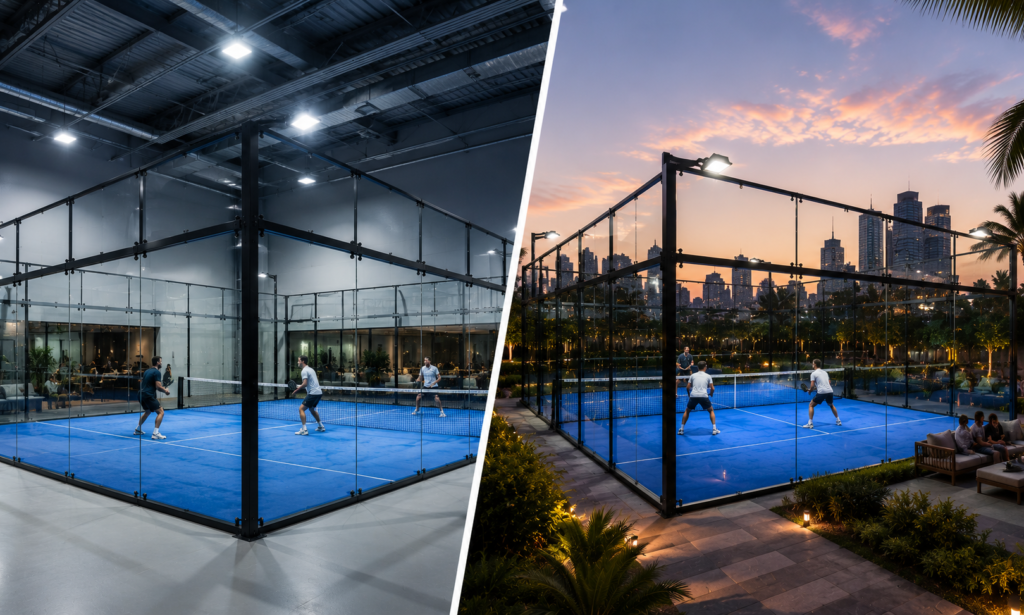
الـ ملعب الباديل البانورامي is the right choice when:
- You’re targeting a premium club membership or high-end hourly rental market
- Tournament hosting is part of your facility’s business model (required for FIP sanctioned events)
- Your target demographic includes social media-active padel players (18–45 years, urban professional)
- You are in a competitive urban market where facility differentiation matters
- You’re building for long-term asset value—the capital premium is justified by 20+ year commercial relevance
- Your project has 4+ courts (volume pricing reduces the per-court premium)
Who Should Choose a Classic Padel Court?
الـ ملعب بادل كلاسيكي remains the right choice when:
- Budget is the primary constraint and capital must be minimized to achieve project viability
- The facility is a municipal or community sports center where market positioning is not a competitive factor
- The court is primarily for training and practice rather than recreational club operation
- The site has an existing solid rear wall structure that can be integrated into classic court configuration
- The project is in an early-stage padel market where classic courts meet current player expectations
The Super-Panoramic Court: A Third Option
Some مصنعو ملاعب البادل—including PanoCourt—offer a super-panoramic configuration that extends full glass coverage to include the corner panels and access doors, creating a fully seamless glass perimeter. The super-panoramic court is the format used on the Premier Padel professional tour and represents the highest-specification commercial offering. Premium vs. standard panoramic: approximately 20–25% in FOB cost, with additional structural engineering requirements for corner glass connection details.
For the full competitive landscape of court types by manufacturer: أفضل مصنعي ملاعب البادل في الإكوادور 2026.
PanoCourt’s Panoramic and Classic Court Range
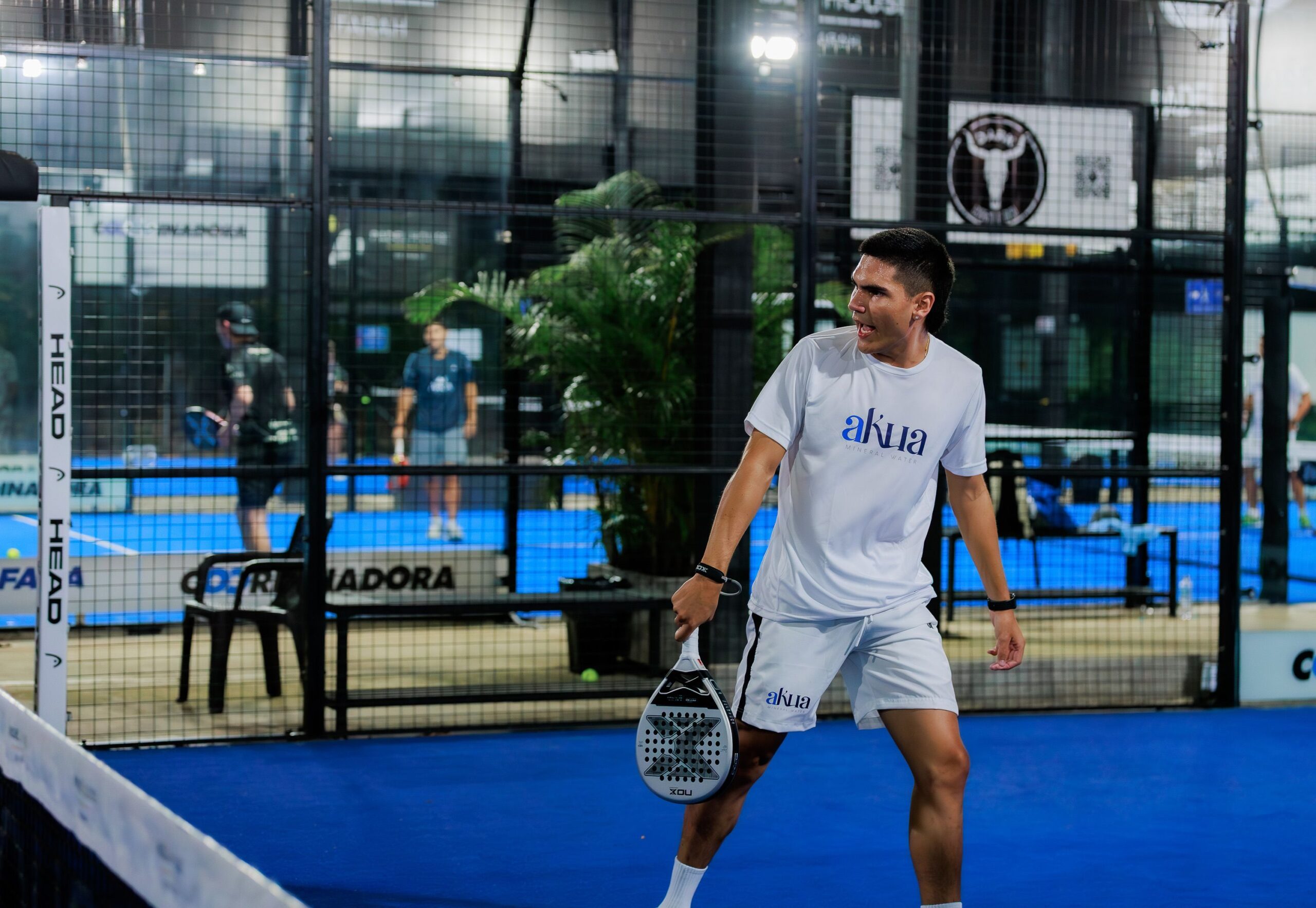
PanoCourt manufactures both ملاعب باديل بانورامية and ملاعب الباديل الكلاسيكية in our China-based production facility, with FIP compliance across our full range.
- PC-Classic: 12mm side glass panels + solid rear wall system; FOB $13,500–$18,500; ideal for budget-optimized club projects
- PC-Panoramic: Full perimeter 12mm ESG glass; FOB $19,500–$26,000; our most popular model for international commercial clients
- PC-SuperPano: Corner glass and door-glass integration; FOB $24,000–$32,000; premium club and resort specification
All models include structural warranty, installation manual, engineering drawings, and FIP compliance documentation. See the full range analysis: أفضل 3 مصانع لملاعب البادل في الصين: دليل المشتري لعام 2026.
Get the Right Court Specification for Your Project
PanoCourt’s technical team will help you select between panoramic and classic configurations based on your market, budget, and commercial targets—and provide a detailed specification comparison with full pricing within 48 hours.
→ Request a Panoramic vs Classic Court Specification Comparison
Frequently Asked Questions: Panoramic vs Classic Padel Courts
Is a panoramic padel court better than a classic court?
“Better” depends on context. For commercial club facilities targeting premium markets, ملاعب باديل بانورامية deliver higher revenue, superior player experience, and stronger long-term asset positioning. For budget-constrained or community facilities, classic courts deliver equivalent playability at lower capital cost. The right choice depends on your market segment, budget, and long-term strategic goals—not an absolute quality hierarchy.
Does ball rebound differ between panoramic and classic courts?
Yes, significantly. Glass panels (panoramic) and solid concrete walls (classic) have different rebound characteristics. Glass provides a more lively, faster rebound—the ball comes off more quickly and at a consistent angle. Concrete walls absorb more energy, producing a slower, sometimes unpredictable rebound depending on wall surface texture. This gameplay difference is one reason professional padel exclusively uses ملاعب باديل بانورامية—glass wall rebound is more consistent, predictable, and skill-differentiating.
Can I retrofit a classic court to panoramic?
Technically yes, but it’s expensive and structurally disruptive. Retrofitting requires: demolition of existing solid rear walls, structural reinforcement of the steel frame at rear wall connection points (the original frame was not designed for glass panel loads), installation of new glass-compatible frame sections, and glass panel installation. Total retrofit cost: $8,000–$14,000 per court depending on original construction and local labor. This often exceeds the original cost differential between classic and panoramic at time of initial construction.
What is the difference in maintenance cost between panoramic and classic courts?
Over a 10-year ownership period, total maintenance cost differential is modest. Classic padel courts require rear wall repainting/sealing every 5–8 years ($1,500–$3,000 per court) but have no glass cleaning costs. Panoramic padel courts require regular glass cleaning ($50–$100/court/month) but no rear wall maintenance. Net 10-year maintenance cost difference is typically less than $5,000 per court—a minor factor relative to the revenue differential.
Which padel court type is required for FIP tournaments?
FIP-sanctioned tournaments and Premier Padel events require ملاعب باديل بانورامية (specifically, full-panoramic or super-panoramic glass configuration). Classic courts do not qualify for professional-level sanctioned events. For club-level FIP-affiliated tournaments, panoramic specification is strongly recommended though club-level compliance requirements may be more flexible. If hosting competitive events is part of your facility’s business model, panoramic is the only appropriate specification.
Which padel court is more durable: panoramic or classic?
Both court types have comparable 15–20 year structural lifespans when properly specified and maintained. The weak points differ: solid rear walls on classic courts can develop cracks and damp ingress over time; glass panels on panoramic courts are vulnerable to accidental breakage (though FIP-certified tempered glass is highly impact-resistant). The steel and turf elements—which represent the majority of the manufacturer’s scope—are identical across both types.