
ما هو ملعب البادل؟ It is a 20 m × 10 m enclosed playing area surrounded by 12 mm tempered-glass walls and welded steel mesh, held by a galvanized, powder-coated steel frame that is anchored to a flat concrete slab and surfaced with sand-filled artificial turf. Clubs choose classic, panoramic, single (20 × 6 m) or movable versions, and the total padel court cost depends as much on groundworks, freight and installation as on the court kit itself.
This guide is written from the factory floor. PanoCourt is a ملعب البادل factory in Hebei, China – the country’s main steel-structure production base – with more than ten years in sports fencing and court steelwork. Most of our output ships as OEM for European brands. Below is the specification we actually build to, where each court type fits, what drives project cost, which decisions belong to the manufacturer and which to your local engineer, and how to check any padel court manufacturer – including us.
Prepared by the PanoCourt engineering and export team. Meet the team. Last updated: October 2026.
What Is a Padel Court Made Of?
A padel court is made of five systems working together: a steel frame of posts and beams, 12 mm tempered safety glass on the back walls and side returns, welded steel mesh along the sides, artificial turf with silica sand infill, and LED floodlights. Stainless steel fasteners tie the parts together, and anchor bolts fix the frame to the slab.
| المكون | PanoCourt standard specification | What to ask any supplier |
|---|---|---|
| Steel frame | Q235 carbon steel; outdoor corner posts 100 × 100 × 3 mm, intermediate posts and main beams 50 × 100 × 3 mm; 2.5 mm walls for indoor courts, heavier profiles for coastal sites | Steel grade, wall thickness and the mill test report for your batch |
| Corrosion protection | Hot-dip galvanized steel plus powder coat; coating thickness is stated in each quotation; post-fabrication hot-dip galvanizing available for coastal sites | Galvanized before or after welding? Coating thickness in writing |
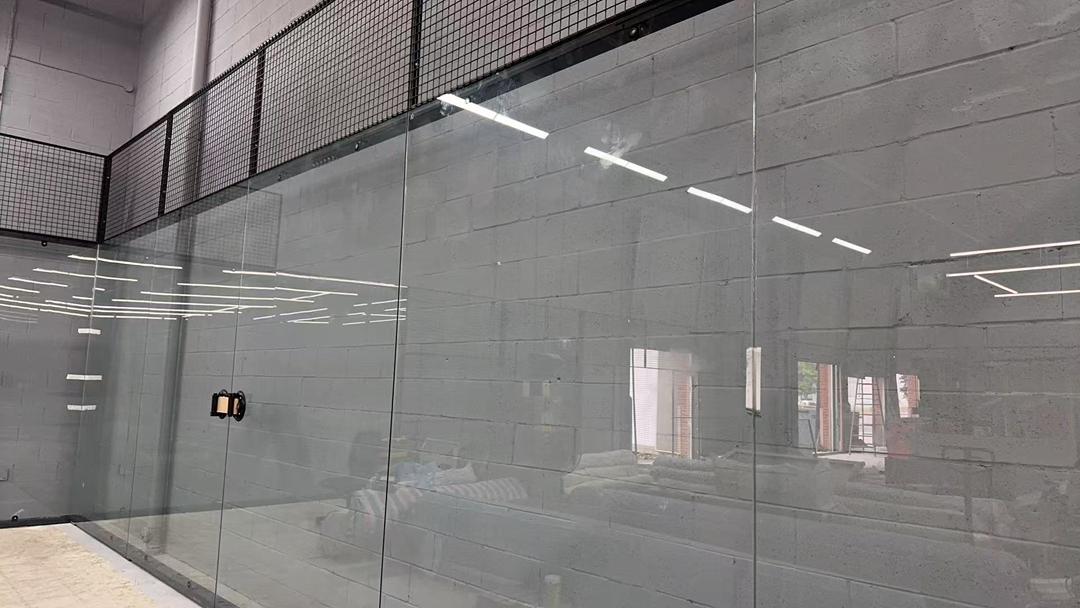
| الزجاج | 12 mm tempered safety glass to GB 15763.2, 18 panels per court (10 mm on request) | Glass standard, test report and edge finish |
| Mesh | 4 mm steel wire, 50 × 50 mm openings, panel frames 30 × 50 × 2 mm | Wire diameter and how the mesh is fixed into the frame |
| Turf | 12 mm textured monofilament, 9,500 dtex, PU-coated backing, silica sand infill | Pile height, dtex, backing and infill rate |
| Lighting | 4 × 400 W LED, IP65 (8 × 200 W and halo layouts available) | Target lux and uniformity at court level, not just wattage |
| Hardware | 304 stainless steel; 316 for coastal sites | Grade marked on the bolts |
| Net | 10 m long, 0.88 m at the centre, 0.92 m at the posts; net posts 1.05 m | Height adjustment and tensioning system |
Real-world insight
When buyers send us competitor quotations to compare, the line we question first is almost always “galvanized steel” with no detail. Ask two things: was it galvanized before or after welding, and what is the coating thickness? A supplier who cannot answer both in writing has not made that decision yet – and it is the decision that shows up five years later. For surface selection, see our commercial padel turf guide.
How Big Is a Padel Court and How Much Space Do You Need?
A doubles padel court measures 20 m × 10 m inside the walls, a playing area of 200 m². A single court is 20 m × 6 m. Indoors you need at least 6 m of clear height above the playing surface, and every site needs extra room around the enclosure for access, drainage and circulation, fixed on the approved drawings.
Converting a tennis court? Three padel courts side by side need roughly 31–32 m by 21 m, so a layout drawing decides, not a rule of thumb. Our padel court design guide shows club floor plans from 500 to 1,500 m².
Which Type of Padel Court Fits Your Project?
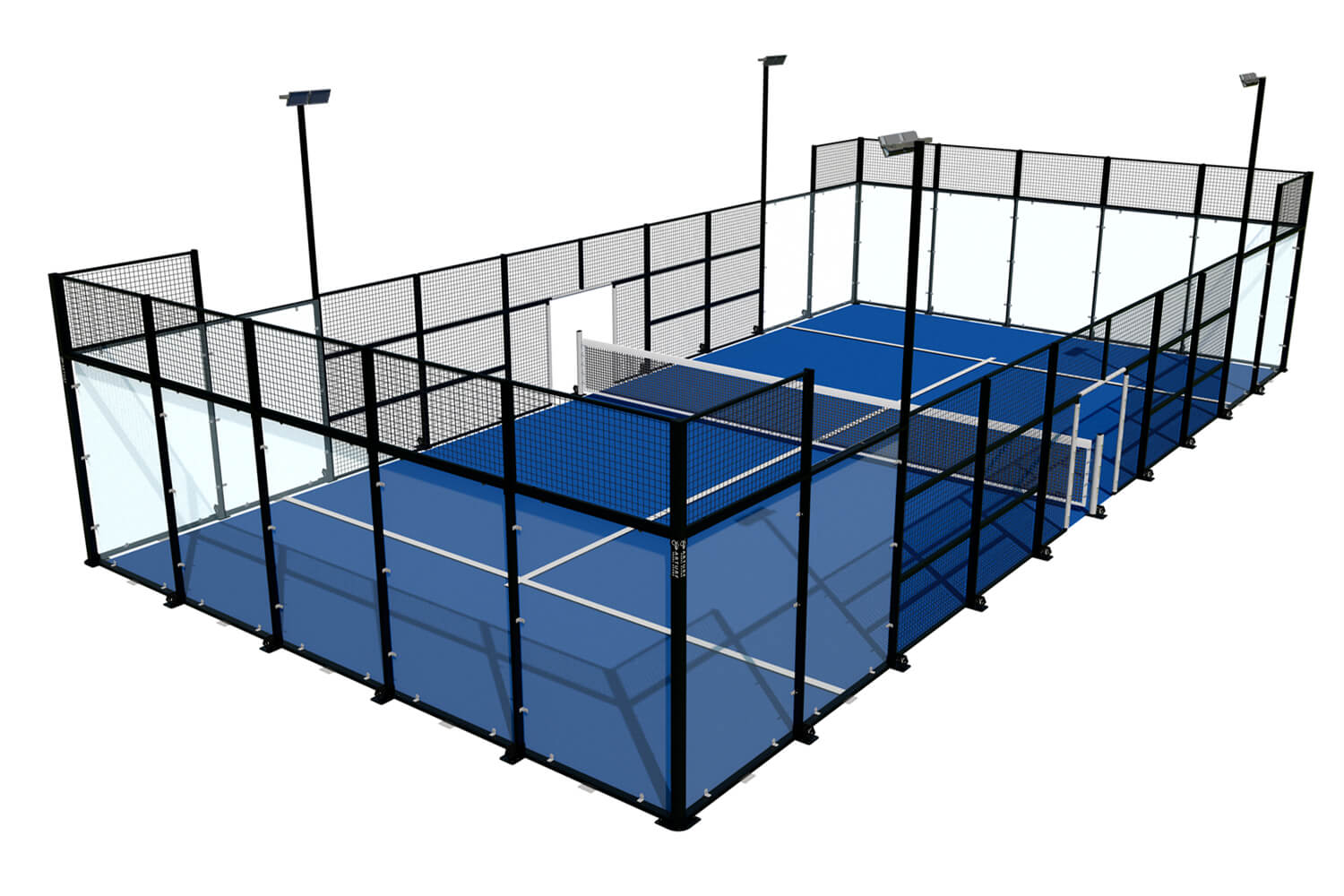
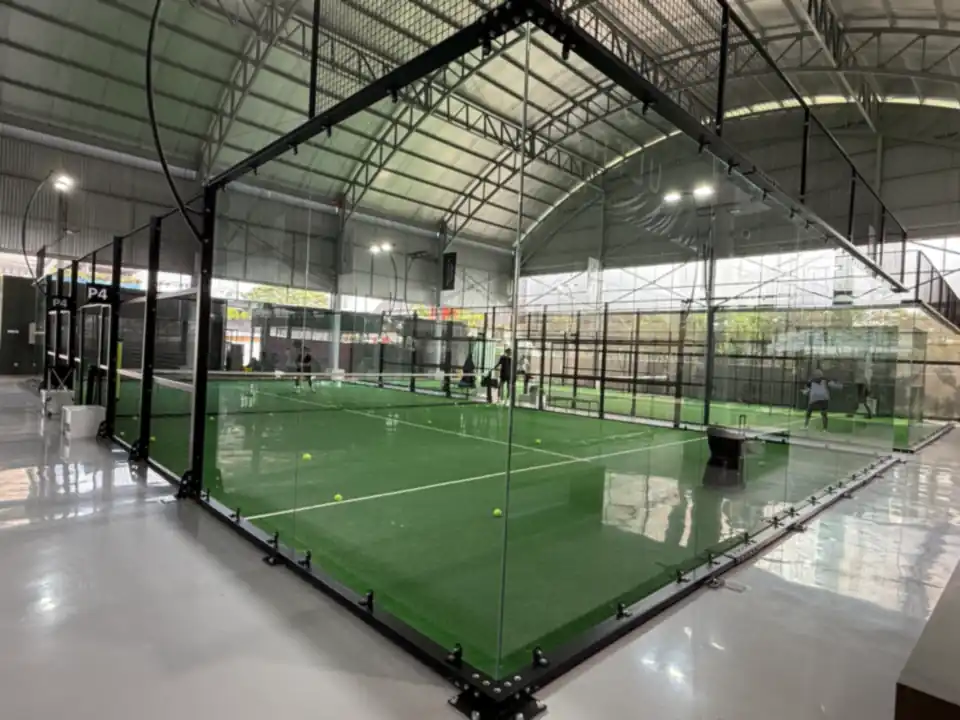
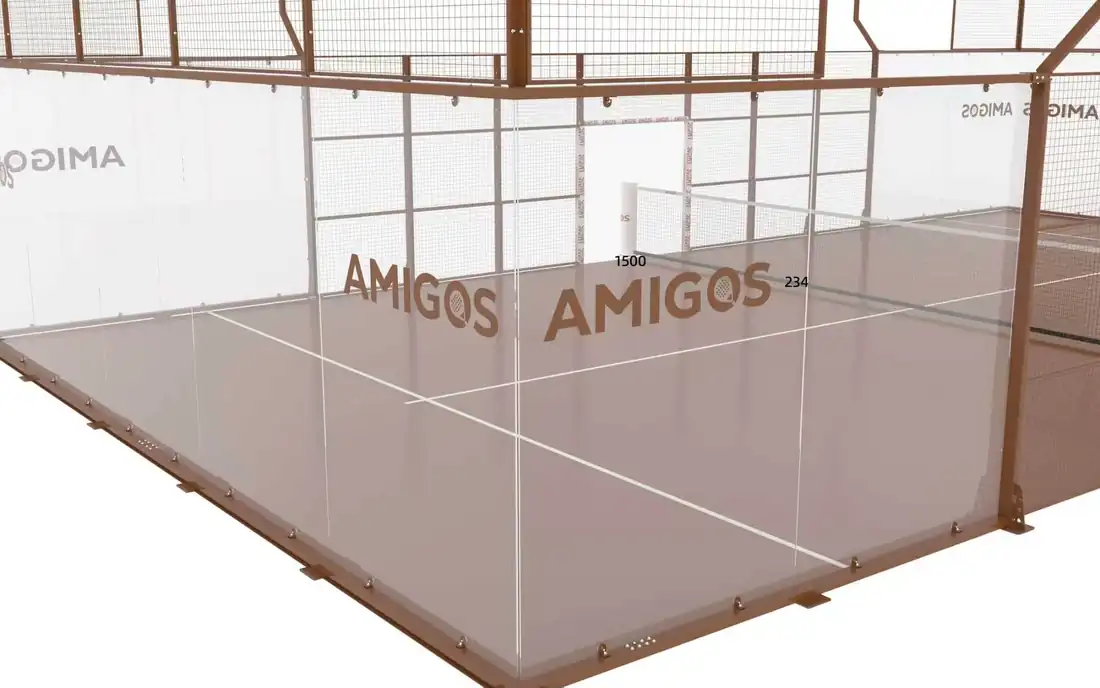
There are five main types. Classic courts use a visible post-and-beam frame and suit outdoor, windy and budget-sensitive sites. Panoramic courts remove posts from behind the glass for clearer viewing. Super panoramic courts use frameless glass corners for showcase venues. Single courts fit small plots, and movable courts suit events and temporary sites.
| Type | What changes | الأفضل لـ | Watch-outs |
|---|---|---|---|
| Classic | Glass held between visible posts with a full top beam | Outdoor clubs, municipal sites, windy or coastal locations | More visible steel; a less premium look on camera |
| Panoramic | Fewer posts interrupt the glass; a heavier top beam carries the load | Commercial clubs that want spectator and camera views | Confirm wind design on exposed sites |
| Super (full) panoramic | Frameless glass corners, minimal visible steel | Indoor flagship courts, sponsor branding, events | Larger glass sail area; not our recommendation for exposed coastal sites |
| Single | 20 × 6 m playing area | Homes, hotels, leftover space in a club | Two players per booking instead of four |
| Movable | Court on a PA-C01 steel-plate base: 26 plates of 2,000 × 500 × 14 mm, about 3.7 t | Events, rentals, leased or temporary sites | Needs a flat, hard, level surface; plan transport for about 9.7 t per court |
Real-world insight
For a first outdoor club, especially near the coast, we usually steer buyers towards a classic or panoramic model and spend the difference on corrosion protection and drainage. Full panoramic courts earn their premium indoors, where they are photographed, streamed and used for events. Our coastal padel court specification explains the steel and hardware choices for salt exposure.
How Much Does It Cost to Build a Padel Court?
There is no single padel court price. The total project cost is the court kit plus freight and insurance, import duty and VAT, unloading and local transport, foundation and drainage, lighting and electrics, installation and professional fees. In the UK, LTA Padel puts typical build costs at £60,000–£270,000, depending on the number of courts and the lighting, drainage and foundation work included.
| طبقة التكلفة | Usually supplied by | What moves it most |
|---|---|---|
| Court kit (frame, glass, mesh, turf, lights) | الشركة المصنعة | Court type, steel profile, corrosion route, glass thickness |
| Freight and insurance | Manufacturer or the buyer’s forwarder | Destination port, number of containers, Incoterm |
| Import duty and VAT | Buyer, through a customs broker | Destination country, trade agreements, VAT recovery |
| Unloading and local transport | المشتري | Site access, forklift or crane availability |
| Foundation and drainage | مقاول محلي | Ground conditions, slab design, falls and outfall |
| Lighting and electrics | فني كهرباء محلي | Supply capacity, cable runs, lux target |
| التركيب | Local installer or factory technicians | Number of courts, crew size, site readiness |
| Canopy (optional) | Specialist designer and builder | Span, snow and wind loads, planning |
| Professional fees and planning | Engineers, architects, consultants | Local rules, noise assessment, approvals |
حقائق أساسية
- A quotation is not the landed total. Compare FOB, CIF, DAP and DDP offers on the same scope before comparing numbers.
- Groundworks are often the second-largest line, which is why identical courts can cost very different amounts on different plots.
- Searching “padel court for sale” returns kit prices; a club budget needs every layer in the table above.
Real-world insight
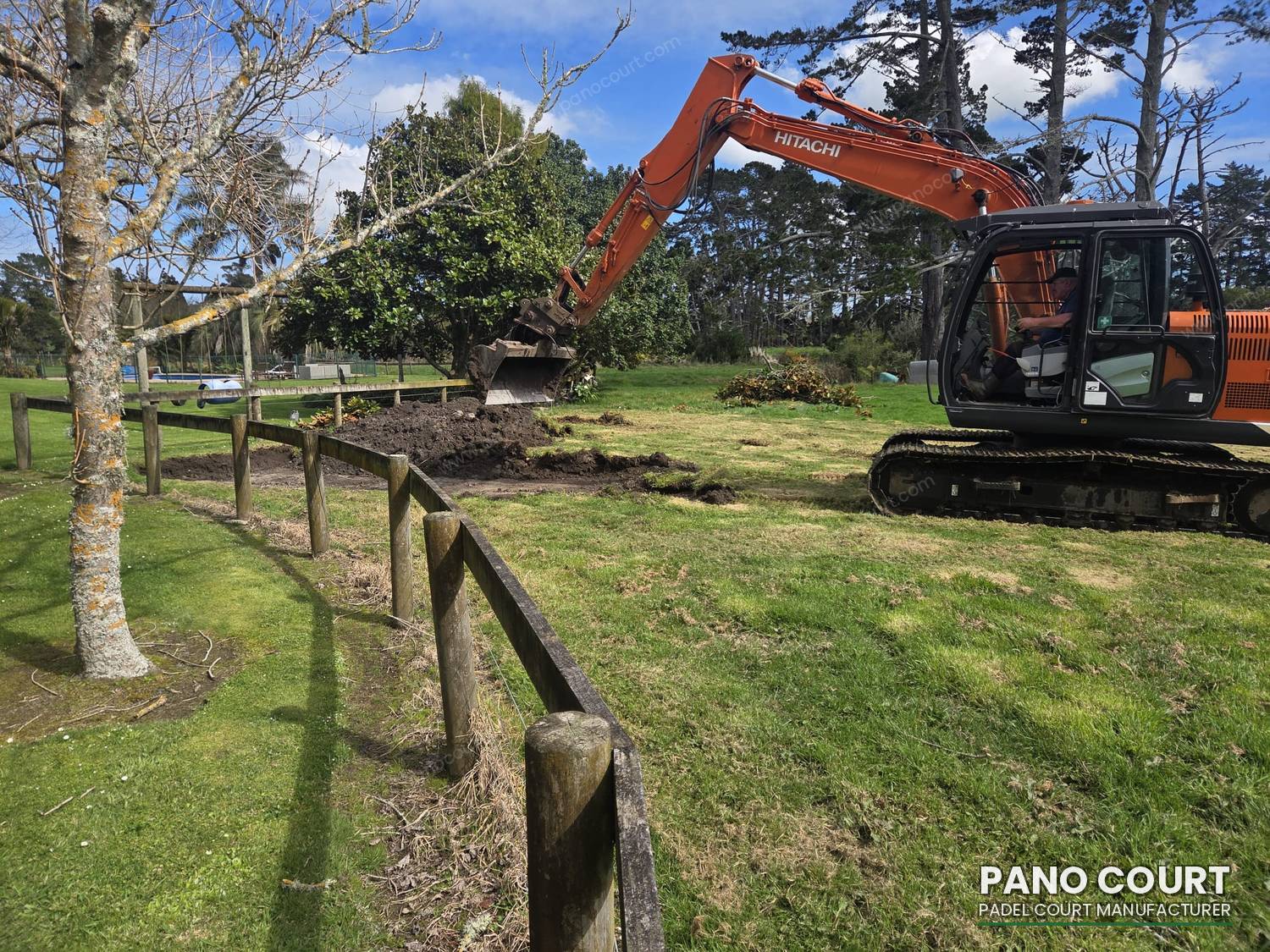
On a recent Auckland project the buyer had no import experience, so we delivered DDP door to door while the foundation was built locally before the container arrived. The full breakdown is in our padel court cost in New Zealand case. For how Incoterms change who pays for what, read commercial padel court cost: FOB, CIF, DAP and DDP, and for a line-by-line example, our مقارنة حقيقية بين الأسعار.
What Does the Manufacturer Provide, and What Must Local Engineers Confirm?
The manufacturer supplies the court and the manufacturing inputs: drawings, a bill of materials, the anchor layout, an installation manual and video, and remote support. A locally licensed engineer and contractor must design the foundation, check wind and roof loads for the site, obtain planning consent and design the electrical supply.
| المساحة | Who decides | What PanoCourt supplies |
|---|---|---|
| Court structure and materials | Manufacturer (PanoCourt standard) | Drawings, bill of materials, material reports, QC records |
| Anchor layout and base-plate loads | Manufacturer with the project engineer (project-specific) | Base-plate grid and anchor details |
| Wind and snow design for the site | Project or local engineer (project-specific) | Our design basis and test method under Q/PANO 01S-2019 |
| Foundation and drainage design | Local structural engineer | Slab interface requirements and tolerances |
| Rooftop or upper-floor installation | Local structural engineer | Court weights and base-plate point loads |
| Planning consent and noise | Owner and local consultants | Product documentation for the application |
| Electrical design and supply | فني كهرباء محلي | Fixture specification and layout |
Foundation details are covered in our padel court foundation requirements guide, and the LTA construction guidance note recommends a structural engineer designs the concrete ring beam.
Real-world insight
When a buyer asks about a rooftop court, the first document we ask for is the roof engineer’s capacity check, not the court model. We can provide weights and point loads; only the building’s engineer can say whether the roof carries them. The planning side is covered in our padel court construction requirements guide.
How Is a Padel Court Shipped and Installed?
A complete court weighs about 6 tonnes, ships in a container under HS code 9506 and is produced after the deposit is confirmed, with the lead time stated in each quotation. We send production and packing photos before shipment and accept third-party inspection. Installation is done by a local installer using our manual, video and remote support, or by factory technicians on site.
Real-world insight
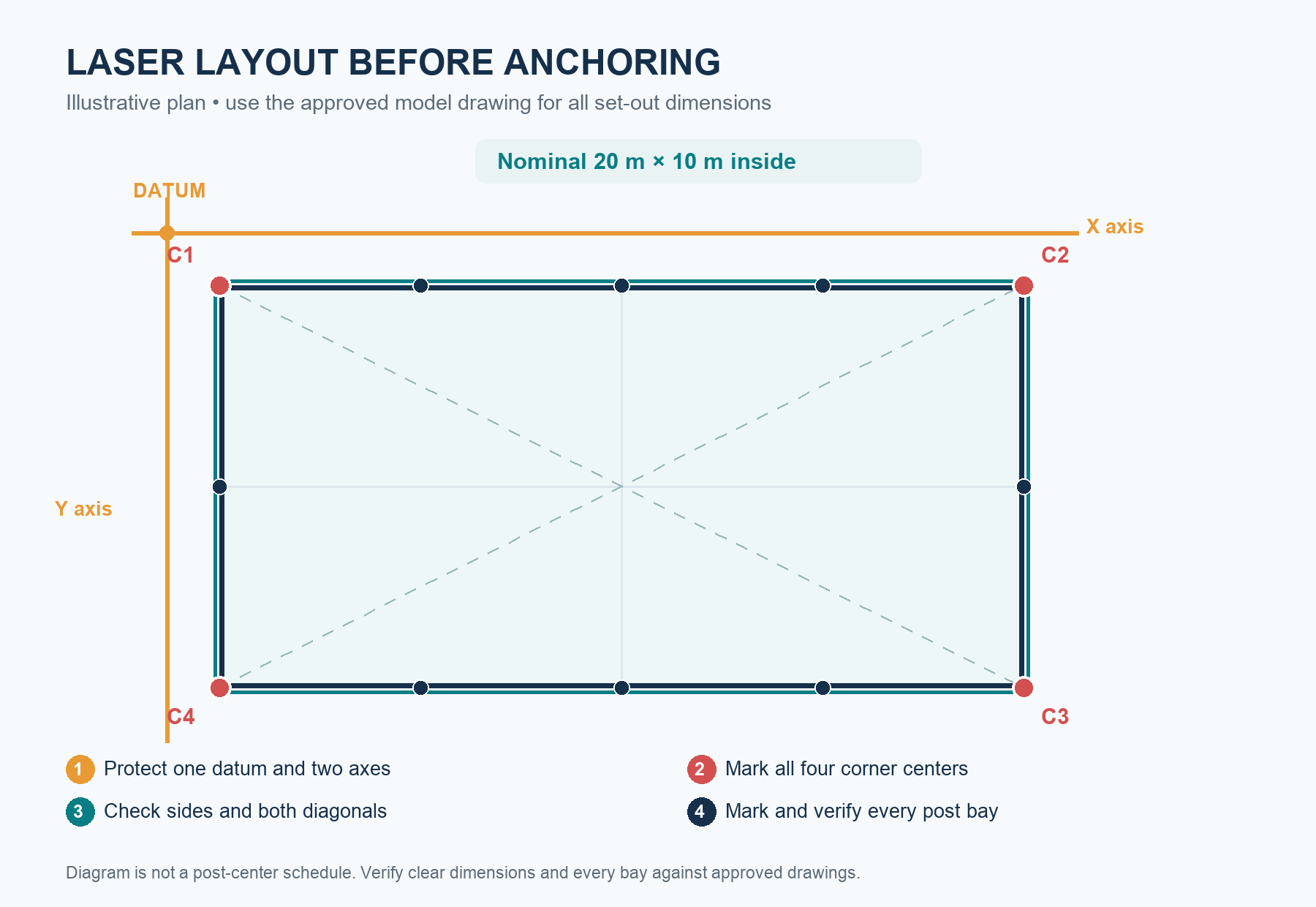
Before a factory crew flies out, we ask for photos of the finished slab with level readings and the anchor positions checked against our set-out grid. That single step saves more site days than anything else. Read seven things club owners need to know about installation and our import guide for the full sequence.
How Can You Verify a Padel Court Manufacturer?
Ask for evidence you can check, not claims: the legal entity on the business licence, a live factory video call, drawings for the exact model, batch material reports, QC records, packing photos and project references you can contact. Then read every certificate for what it actually covers – scope, standard and product – before relying on it.
| وثيقة | ما يشمله | What it does not prove |
|---|---|---|
| ECM Attestation No. 0P260724.TPSTN84 | Voluntary review of the technical file for 12 PanoCourt models against EN 1090-1:2009+A1:2011; valid until 23 July 2031 | It is a documentation review, not a notified-body procedure; it does not verify the product and does not replace an EC Declaration of Conformity |
| UDEM Attestation M.2026.206.C144471 | Steel wire and welded mesh fencing components assessed against EN 10218-1 and EN 10223-4; valid until 15 July 2031 | It does not cover the whole court, the glass or the structure |
| Mill test report TST2024S00056 | Our steel-pipe supplier’s batch report: DN65 Q235B hot-dip galvanized welded pipe, zinc 343–344 g/m² against a 300 g/m² minimum, yield strength 387 MPa, compliant with GB/T 3091-2015 | It is a raw-material report from the supplier, not a test of a finished court; it shows the kind of document to request for your batch |
| Q/PANO 01S-2019 | Our in-house padel court safety standard: materials, structure, net, lighting, lightning protection, installation and test methods | It is a company standard, not an international certification |
Real-world insight: an honest OEM statement
Most of what we make ships under other brands’ names, so we do not know the exact location of many installed courts. We only show projects we can verify, and we name a client only with written permission. If a padel court supplier’s reference list looks too long, ask for one you can phone. Our padel court manufacturers comparison and supplier buyer’s guide go further.
Frequently Asked Questions About Padel Courts
What is a padel court surface made of?
Most padel courts use artificial turf with silica sand infill laid on a flat concrete or asphalt base. Our commercial specification is a 12 mm textured monofilament turf at 9,500 dtex with a PU-coated, perforated backing and rounded silica sand infill of 0.3–0.8 mm. The right turf depends on playing hours, climate and how well the court will be maintained.
How many padel courts fit on a tennis court?
Within a typical fenced tennis area of about 36.6 × 18.3 m, one court fits comfortably. Three courts side by side need roughly 31–32 m by 21 m, so the short side of the plot must be extended by 2–3 m. A layout drawing that includes gaps, drainage and access is the only reliable answer for a specific site.
Can a padel court be built indoors, and what ceiling height is needed?
Yes. Indoor courts need at least 6 m of clear height above the playing surface, with no beams, ducts or lights intruding into that space; competition venues often require more. Indoors, a 2.5 mm tube wall is usually sufficient, lighting is laid out for the building, and the floor must be level enough for the frame anchors.
Can you build a padel court on a rooftop?
It can be done, but the roof decides, not the court. A structural engineer must confirm the roof can carry the court weight, the point loads at the base plates and wind at that height. We supply weights, anchor details and our design basis; the building’s engineer designs the fixings and any transfer structure.
Do movable padel courts need ground anchors?
Our movable system does not. The court sits on a PA-C01 steel-plate base of 26 plates measuring 2,000 × 500 × 14 mm and weighing about 3.7 tonnes, which needs a flat, hard, level surface rather than a reinforced concrete slab.
How long do production and shipping take?
Production lead time is confirmed in the quotation and starts from the confirmed deposit and signed-off drawings. Sea freight time then depends on the destination port and routing, and your forwarder or our logistics team can quote it for your project. Plan the foundation so the slab has cured before the container arrives, because that is the most common cause of site delays.
Is a padel court a good investment?
It can be, but the answer comes from your local numbers rather than national averages: bookable hours per day, price per hour, opening hours, staffing and the full project cost including groundworks. Build a simple model with conservative occupancy before committing. Our padel court design guide walks through layouts and return scenarios for clubs of 500–1,500 m².
What is the difference between a padel court and a pickleball court?
A padel court is a 20 × 10 m enclosure whose glass and mesh walls are part of play. A pickleball court is an open 44 × 20 ft (13.41 × 6.10 m) hard court with no walls. Padel needs a steel structure, glass and turf, while pickleball needs only a surface, line markings and a net.
What certificates should a padel court supplier provide?
Ask for material reports for the steel and glass, the factory’s own quality records and any third-party attestations, then read each one for its scope. A technical-file review is not product certification, and a mesh test does not cover the glass. Your local engineer may need specific documents for permits, so share their list with the supplier early.
Who installs a padel court?
Either a local installer working from the manufacturer’s drawings, manual, video and remote support, or a factory crew sent to site. For four courts, a factory crew is typically three to four technicians for about five days once the slab is finished and checked. Travel and accommodation for factory crews are agreed in the quotation.
So, What Is a Padel Court for a Buyer?
For a player, a padel court is a glass box with turf. For a buyer, it is a steel structure that has to survive your climate for decades, sitting on a foundation someone local must design, delivered through a supply chain you need to be able to see. Get the frame specification and corrosion route right, separate the court kit from the landed project cost, and ask every supplier for evidence you can verify.
If you are planning a club, send us your site plan, the number of courts and your destination port. Our engineering team will review the drawing and return a landed-cost checklist and the specification we would recommend for your site – in writing, with documents, factory-direct from a شركة مصنعة لملاعب البادل that builds every court to order.