
The padel court cost in New Zealand for one outdoor court is typically NZD 45,000–80,000 (about USD 25,000–45,000) when the court is imported factory-direct from China, and NZD 80,000–100,000+ when it is bought through a local dealer or from a Spanish manufacturer. The figure is driven by three costs: the foundation, the court itself, and installation.
As a China padel court manufacturer that has just shipped a complete panoramic court to a commercial grower in Auckland. Every number below is either taken from that real order, from our quotations to New Zealand buyers, or clearly marked as an estimate. Clubhouse, lounge, changing rooms and branding are excluded, because every investor positions and fits out a padel club differently.
Currency note: NZD figures use USD 1 = NZD 1.78 (mid-market, 15 October 2026) and EUR 1 ≈ USD 1.15. All figures exclude GST unless stated.
In this guide:
- Total padel court cost in New Zealand for one court
- Foundation cost: concrete, asphalt or mobile base
- Foundation options compared
- China factory vs local dealer vs Spain
- Freight, GST and customs when importing
- Installation cost
- Real Auckland project
- 3-court and 6-court budgets
- Consent and site factors
- How to reduce cost without cutting quality
- Revenue and ROI
- FAQ
What Is the Total Padel Court Cost in New Zealand for One Court?
For one outdoor panoramic court, the total padel court cost in New Zealand ranges from roughly NZD 43,000 on a mobile base to around NZD 100,000 for a Spanish-made court on a reinforced concrete slab. Most China-direct projects on a proper slab land between NZD 64,000 and NZD 77,000 before GST.
The national federation, Padel New Zealand, gives a broader guide of NZ$90,000–130,000 per court, made up of NZ$70,000–100,000 for the court structure and freight plus NZ$20,000–30,000 for site preparation and installation. That range reflects the market average, which is still dominated by European-supplied courts. Buying direct from the factory is where the padel court cost in New Zealand drops sharply, as the table below shows.
| Scenario (1 court) | Foundation | Court landed | Installation | Total USD | Total NZD |
|---|---|---|---|---|---|
| China factory + reinforced concrete | USD 20,000 | USD 12,000–15,000 | USD 4,000–8,000 | 36,000–43,000 | 64,000–76,500 |
| China factory + asphalt with footings | USD 10,000–12,000 | USD 12,000–15,000 | USD 4,000–8,000 | 26,000–35,000 | 46,300–62,300 |
| China mobile court on hardened ground | USD 4,000–6,000 + steel base USD 5,000–7,000 | USD 12,000–15,000 | USD 3,000–5,000 | 24,000–33,000 | 42,700–58,700 |
| Local dealer + reinforced concrete | USD 20,000 | USD 20,000–30,000 | USD 4,000–8,000 | 44,000–58,000 | 78,300–103,200 |
| Spanish factory + reinforced concrete | USD 20,000 | USD 26,000–28,000 | USD 4,000–8,000 | 50,000–56,000 | 89,000–99,700 |
Key facts
- The foundation is usually the largest single line in the padel court cost in New Zealand, often bigger than the court itself.
- Freight is a fixed container cost: a single court pays the whole container, two courts split it.
- GST at 15% applies at the border, but GST-registered companies normally claim it back.
- Engineering, consent fees, power supply and booking systems are additional and site-specific.
Deep insight: investors often compare court prices and ignore everything else. When you break down the padel court cost in New Zealand, the court itself is roughly a third of the build. A cheaper foundation choice can save more money than negotiating hard on the court, while a poor foundation can cost you the whole project.
How Much of the Padel Court Cost in New Zealand Goes into the Foundation?
The foundation typically accounts for 30–55% of the padel court cost in New Zealand. A reinforced concrete slab of about 20.9 × 10.9 m at 150 mm thick costs around USD 20,000 (NZD 35,600), an asphalt base around USD 8,000 (NZD 14,200) plus anchoring footings, and a mobile court avoids a structural slab altogether.
Option 1: Reinforced concrete slab (about USD 20,000 / NZD 35,600)
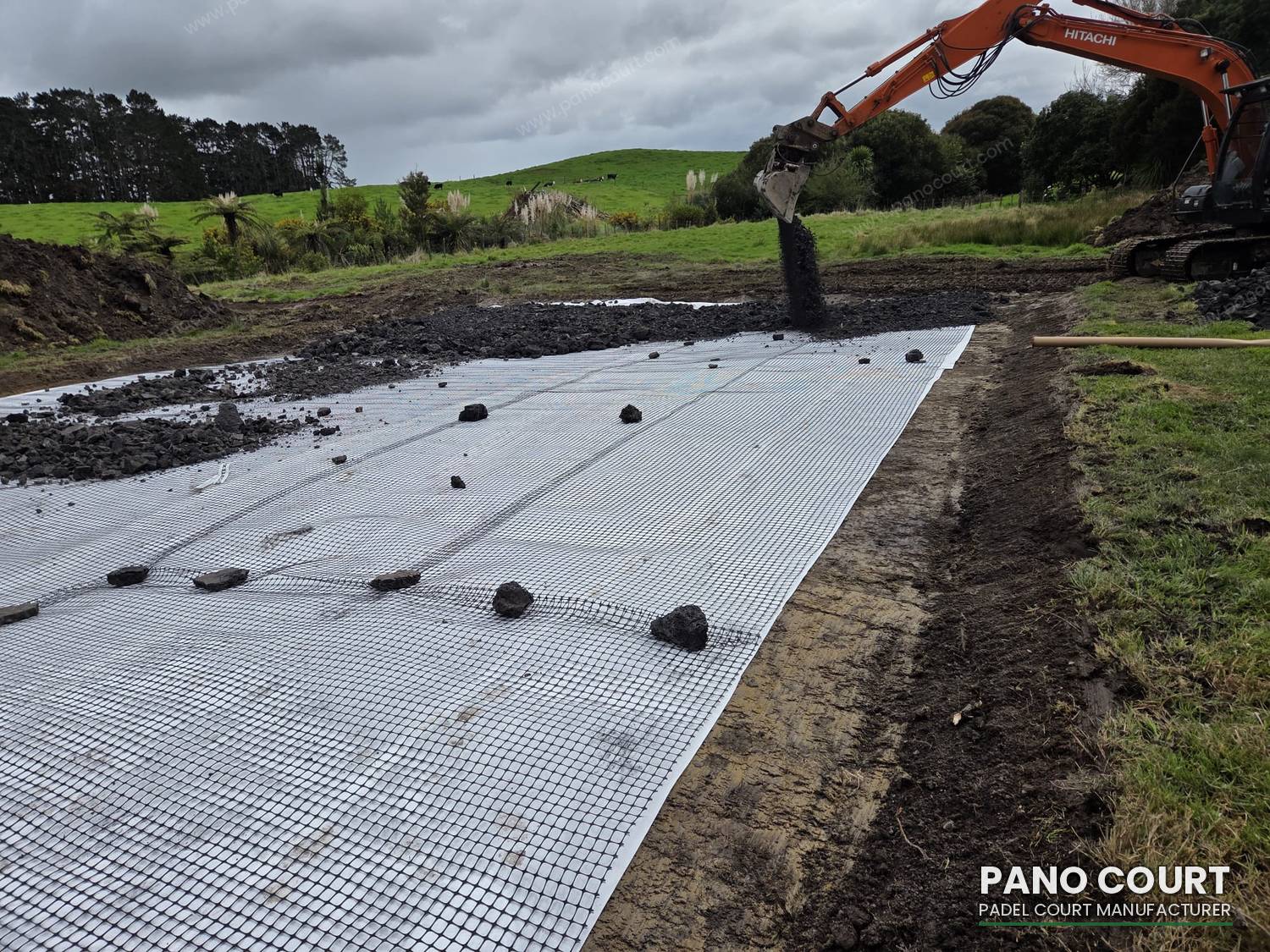
This is the default for permanent outdoor clubs and the biggest swing factor in the padel court cost in New Zealand. The slab covers roughly 228 m², which works out at about USD 88 or NZD 156 per square metre including excavation, sub-base, formwork, mesh, pour and finish. For one court we advise a minimum floor of 21.0 × 11.0 m so the post base plates sit fully on concrete with edge distance for anchors. Our padel court foundation requirements guide covers slab thickness, falls and anchor embedment in detail.
Option 2: Asphalt base (about USD 8,000 / NZD 14,200)
Asphalt is a hardened surface rather than a structural slab. It is quicker to lay and much cheaper, but it does not hold anchor bolts well under repeated wind load. Your engineer will normally specify a concrete ring beam or individual footings along the post lines, which we estimate adds USD 2,000–4,000. Even with that addition, asphalt usually cuts the padel court cost in New Zealand by NZD 15,000–20,000 per court.
Option 3: Mobile padel court on hardened ground (steel base USD 5,000–7,000)
Where you lease land, cannot pour concrete, or want to relocate courts later, a mobile padel court sits on a heavy steel-plate base instead of being anchored. The ground still needs compacting and levelling (we budget USD 4,000–6,000 as an estimate), and the steel base adds USD 5,000–7,000 on top of the court price. A court plus base weighs about 9.7 t, which still fits one 20GP container, so freight does not change for a single court.
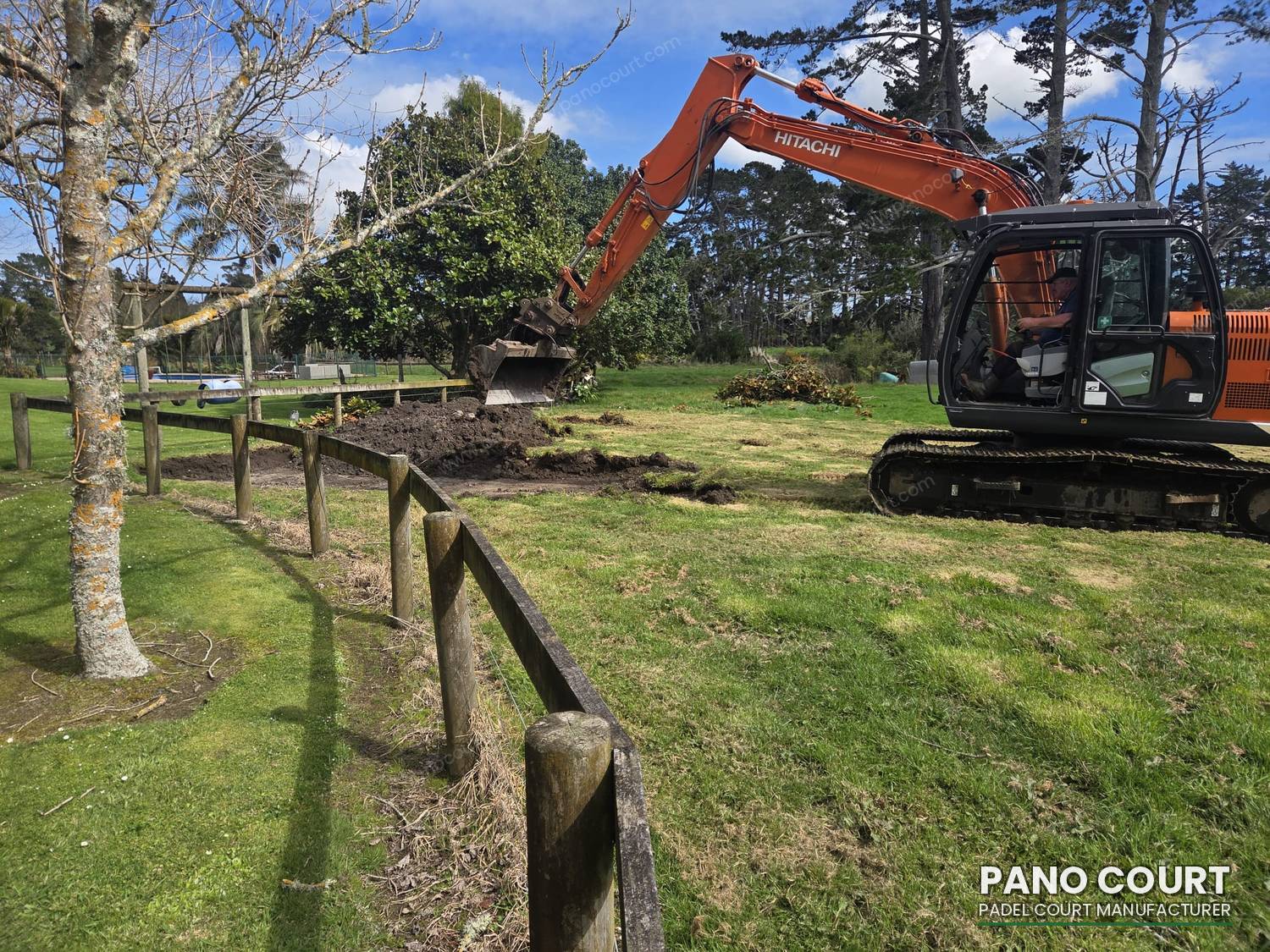
Real-world insight: local rules and ground conditions decide the foundation, not the court supplier. Peat, clay and volcanic soils around Auckland and Waikato behave very differently. Get a geotechnical opinion before you price the slab or present a padel court cost in New Zealand to your investors, and have your structural engineer confirm thickness, reinforcement and anchors against your council’s requirements.
Which Foundation Option Gives the Best Padel Court Cost in New Zealand?
Reinforced concrete gives the best long-term value for a permanent club, asphalt gives the lowest upfront padel court cost in New Zealand for a fixed court, and a mobile base gives the most flexibility on leased or temporary sites. The right choice depends on tenure, soil and how long you plan to operate.
| Factor | Reinforced concrete | Asphalt + footings | Mobile steel base |
|---|---|---|---|
| Indicative cost (1 court) | USD 20,000 / NZD 35,600 | USD 10,000–12,000 / NZD 17,800–21,400 | USD 9,000–13,000 incl. ground prep |
| Anchoring | Bolts cast or chemically fixed into slab | Into ring beam or footings | None; weight of steel plates |
| Flatness and drainage | Best; controlled falls | Good if well compacted | Depends on ground prep |
| Lifespan | 25+ years | 10–15 years before resurfacing | Base reusable; ground may need re-levelling |
| Relocation | Not possible | Not practical | 4-person crew, 4–6 hours to dismantle |
| Best for | Owned land, permanent clubs | Budget-led permanent builds | Leased sites, events, pop-up clubs |
Deep insight: New Zealand is a high-wind country. Whatever base you choose, the anchoring or ballast must be checked for your site wind speed. Our padel court wind load guide explains the 0.68 kN/m² design basis we use and when to upgrade it.
How Does the Supplier You Choose Change Padel Court Cost in New Zealand?
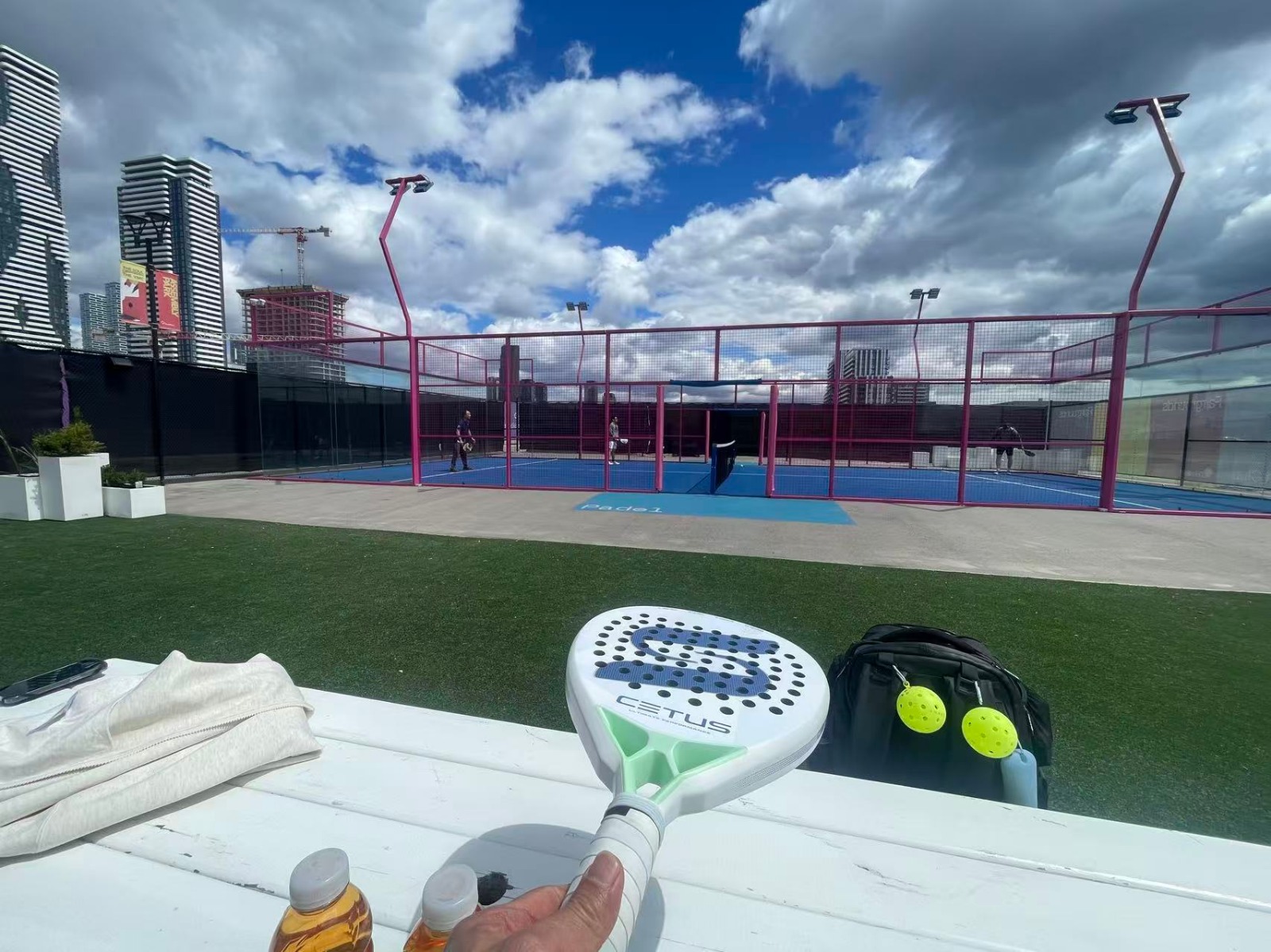
The supplier route changes the court line of the padel court cost in New Zealand more than any other decision. A China factory-direct court lands at about USD 12,000–15,000, a local dealer typically charges from USD 20,000, and a Spanish court lands at roughly USD 26,000–28,000 after freight.
| Route | Court price | Freight to NZ | Landed per court | Lead time (typical) |
|---|---|---|---|---|
| China padel court manufacturer, factory-direct | USD 8,500–12,500 FOB depending on configuration | USD 1,100–3,400 per court | USD 12,000–15,000 / NZD 21,400–26,700 | 15–30 days production + 3–5 weeks sea |
| Local New Zealand dealer | From USD 20,000 delivered | Included | USD 20,000–30,000+ / NZD 35,600–53,400+ | Fast if in stock, otherwise same as import |
| Spanish factory | About EUR 19,000 (≈ USD 21,800) | USD 4,000–5,000 | USD 26,000–28,000 / NZD 46,300–49,800 | 4–8 weeks production + 6–8 weeks sea |
China factory-direct. Our panoramic padel court is quoted from about USD 9,950 FOB Tianjin with 12 mm tempered glass, LED floodlights and turf included. Custom colours, steel thickness, glass fixing patterns and turf specification are all built to order.
Local dealer. Most New Zealand dealers also import from China or Europe and add margin, stock-holding and local service, which is why the dealer route raises the padel court cost in New Zealand. The genuine advantage is a local entity that handles customs and is GST-registered, so it can recover import GST and quote you a clean delivered price.
Spain. Spanish brands carry tour-level recognition, but the price and the longer sea route to the Pacific push the padel court cost in New Zealand close to double that of a China-direct court. Our China vs Spain factory comparison breaks down materials and processes side by side.
What Does Importing from China Add to Padel Court Cost in New Zealand?
Importing adds ocean freight, insurance, 15% GST, customs entry fees, broker and port charges, and trucking to site. For one court shipped alone in a 20GP container, these add roughly USD 4,300–5,100 on top of the FOB price before GST, which is why sharing a container lowers the padel court cost in New Zealand per court.
Key facts
- Ocean freight Tianjin–Auckland: USD 2,800–3,400 per 20GP in our September 2026 bookings. One 20GP carries 1–2 courts; one 40GP carries up to 4 courts for roughly USD 4,500–5,500 (estimate). Per court that is USD 1,100–3,400.
- Marine insurance: about 0.1% of 110% of invoice value, so only around USD 15 on one court.
- GST: NZ Customs charges 15% GST on the goods value plus freight, insurance and any duty. On one court at CIF USD 13,350 that is about NZD 3,560, normally recoverable by a GST-registered company.
- Duty: padel courts are classified under HS 9506; with a China Certificate of Origin, goods qualifying under the NZ–China FTA generally enter duty-free. Confirm the exact tariff item with your broker.
- Entry fees: the Import Entry Transaction Fee and Biosecurity System Entry Levy together come to roughly NZD 100–110 per entry.
- Broker, port and trucking: we estimate NZD 1,500–3,000 per container for a typical Auckland-region delivery.
Biosecurity documents: every sea container entering New Zealand needs a Sea Container Quarantine Declaration on the packer’s letterhead, signed by the person responsible for loading, and any solid timber packaging must carry an ISPM 15 mark. See MPI’s container import steps. Our China import guide lists the full document set.
Real-world insight: lead time is a cost too. Production takes 15–30 days depending on configuration (some standard items ship from stock), and sea transit to Auckland is typically 3–5 weeks. Plan on 8–10 weeks from deposit to delivery and order before your slab is poured, not after. Idle time ties up capital, which quietly adds to the padel court cost in New Zealand.
How Much Does Installation Add to Padel Court Cost in New Zealand?
Installation adds USD 4,000–8,000 (NZD 7,100–14,200) per court to the padel court cost in New Zealand. The spread comes from crew experience, company size, travel and whether the turf is laid by the same team. A mobile court is cheaper to install, at around USD 3,000–5,000.
Three ways to install, each with a different effect on the padel court cost in New Zealand:
- Local crew with factory support: a fencing, glazing or steel contractor follows our manual, set-out drawings and remote video guidance. Lowest cost if the crew is competent.
- PanoCourt factory team: technicians are charged at USD 100 per person per day, plus return flights, accommodation and local transport paid by the buyer. Four courts need 3–4 technicians for about 5 days; a single court rarely justifies flights from China.
- Hybrid: one factory supervisor with a local labour crew, which works well from 3 courts upward.
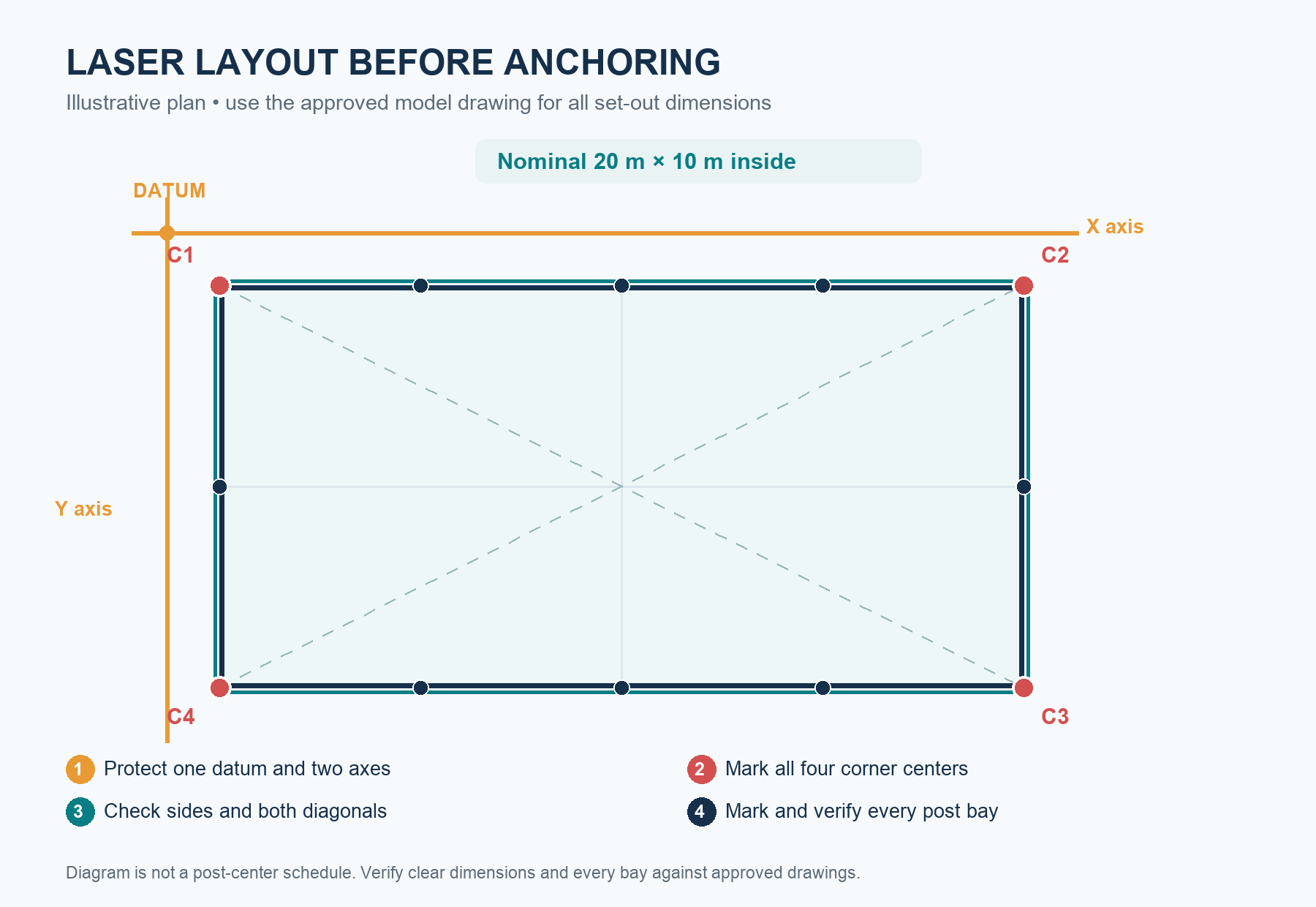
Deep insight: the expensive installation mistakes happen before the steel arrives. Do not let a contractor pre-drill anchor holes from a brochure drawing. Assemble and square the frame, check diagonals, then drill through the actual base plates. Our padel court installation guide and club owner installation checklist walk through each stage.
What Did a Real Auckland Project Reveal About Padel Court Cost in New Zealand?
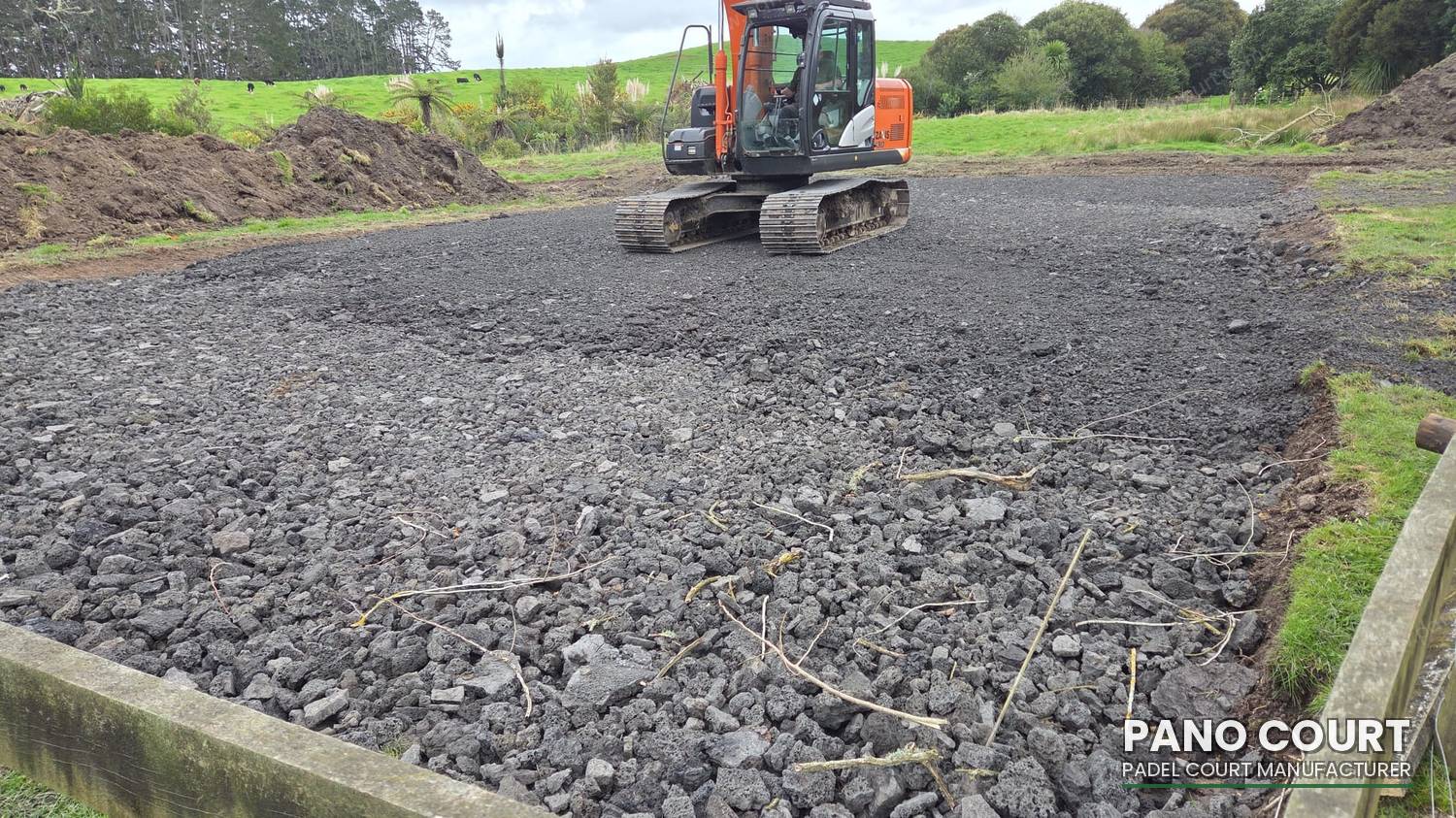
Our September 2026 order for Sunset Growers Ltd in Waiuku, Auckland, shows the real padel court cost in New Zealand on the supply side: USD 9,950 FOB for a complete panoramic court, USD 3,400 ocean freight, and a CIF Auckland contract value of USD 13,350 for the court. The indicative all-in budget lands at about NZD 68,000–77,000 before GST.
Court specification
| Model | Panoramic P001, 1 complete court, 20 × 10 m playing area |
| Steel structure | Hot-dip galvanized steel with multi-layer anti-corrosion powder coating, RAL 9005 Black, outdoor specification |
| Glass | 18 panels of 12 mm tempered safety glass, 4-hole fixing |
| Turf | International Padel Blue, 12 mm pile, 63,000 stitches/m², 9,500 dtex, PU backing; seaming tape 48 m and 2 adhesive sets supplied free |
| Lighting | 4 × 400 W LED floodlights, IP65 |
| Fasteners | 304 stainless steel |
| Shipment | 110 packages, 5,992 kg gross, 17.64 CBM, 1 × 20GP; glass in 2 crates of 1,650 kg each |
Cost breakdown
| Item | Amount | Status |
|---|---|---|
| Court, FOB Tianjin | USD 9,950 | Contract figure |
| Ocean freight, 1 × 20GP Tianjin–Auckland | USD 3,400 | Contract figure |
| Marine insurance (arranged by PanoCourt under CIF) | ≈ USD 15 | Included in CIF |
| CIF Auckland, court | USD 13,350 (NZD 23,760) | Contract figure |
| Import GST 15% | ≈ NZD 3,560 | Recoverable if GST-registered |
| Entry fees, broker, port, trucking to Waiuku | NZD 1,600–3,100 | Estimate |
| Reinforced concrete base, min. 21 × 11 m | ≈ USD 20,000 (NZD 35,600) | Estimate, client-managed |
| Installation | USD 4,000–8,000 | Estimate |
| Indicative total (ex GST) | ≈ USD 38,000–43,000 / NZD 68,000–77,000 |
Timeline
- 9 September 2026: contract signed; production lead time 20 working days from deposit.
- Late September: container loaded at the factory with the full packing list and shipping marks for all 110 packages.
- 8 October 2026: container on board at Tianjin, bound for Auckland.
What the project taught us
- Freight is 25% of a single-court CIF price. A second court in the same 20GP would have cut freight per court in half and lowered the padel court cost in New Zealand by about USD 1,700 per court.
- The foundation decides the budget. The client’s concrete contractor needed the minimum floor size (21.0 × 11.0 m) before anything else.
- Upgrading turf is cheap insurance. The 63,000-stitch, PU-backed turf suits a commercial schedule and New Zealand’s wet winters.
- Documents matter as much as steel. The client’s broker asked for the packing breakdown, the B/L and the signed MPI quarantine declaration before arranging de-vanning.
How Does Padel Court Cost in New Zealand Scale for 3-Court and 6-Court Clubs?
Per court, the padel court cost in New Zealand falls as you add courts, because containers, mobilisation and slab edges are shared. Three China-direct courts on concrete come to about NZD 181,000–206,000 in total, and six courts to about NZD 351,000–411,000, both before GST.
| Cost line (China-direct, concrete) | 3 courts | 6 courts |
|---|---|---|
| Courts FOB (USD 9,950 reference) | USD 29,850 | USD 59,700 |
| Ocean freight | 1 × 40GP, USD 4,500–5,500 | 2 × 40GP, USD 9,000–11,000 |
| Insurance, entry fees, broker, port, trucking | USD 1,200–2,000 | USD 2,400–4,000 |
| Reinforced concrete foundations | USD 54,000–60,000 | USD 102,000–120,000 |
| Installation | USD 12,000–18,000 | USD 24,000–36,000 |
| Total | USD 101,500–115,500 / NZD 180,700–205,600 | USD 197,000–231,000 / NZD 350,700–411,200 |
| Per court | USD 33,800–38,500 | USD 32,900–38,500 |
Regional comparison: the same 4-court shipment to Melbourne is worked through in our padel court Australia guide. Freight to Auckland and Melbourne is similar; the bigger differences are consent paths and wind design, which shape the padel court cost in New Zealand more than freight does.
Which Consent and Site Factors Can Raise Padel Court Cost in New Zealand?
Building consent, resource consent, structural engineering, power supply and drainage can add thousands to the padel court cost in New Zealand. Padel courts are 4 m-high glass and steel enclosures with light poles, so plan for a building consent and a structural engineer from day one.
- Consents: Padel New Zealand notes that court developments may need building consent, resource consent or other approvals depending on the site. Talk to your council before ordering.
- Engineering: a New Zealand structural engineer designs the slab and anchors for your wind zone and soil. We supply base-plate layouts, member sizes and test data for their calculations.
- Lighting and noise: neighbours within earshot can trigger lighting curfews or acoustic conditions, which affects revenue hours.
- Coastal exposure: sites near the sea need a heavier corrosion specification. See our coastal padel court specification.
- Services: power to the light poles, stormwater connection and access for a truck and forklift are rarely in anyone’s quote.
Real-world insight: give your engineer the court supplier’s drawings before the consent is lodged. Changing the court model after consent can mean re-submitting calculations, adding weeks and fees to your padel court cost in New Zealand.
How Can Investors Lower Padel Court Cost in New Zealand Without Cutting Quality?
The safest way to lower the padel court cost in New Zealand is to cut freight and margin, not material. Buy factory-direct, consolidate courts into full containers, choose the foundation that suits your tenure, and keep specification decisions on steel, glass and corrosion protection where they belong.
- Fill the container: two courts per 20GP or four per 40GP. It is the easiest way to reduce the padel court cost in New Zealand per court. Consider adding a spare court or accessories rather than shipping half-empty.
- Match the base to the lease: a mobile base on a 5-year lease often beats a NZD 35,000 slab you leave behind.
- Specify, don’t over-specify: outdoor courts need hot-dip galvanizing and quality powder coating; they do not always need the most expensive glass system.
- Compare quotes on the same basis: FOB, CIF and door-delivered prices are not comparable. Our FOB, CIF, DAP and DDP explainer shows what each includes.
- Use the supplier’s support: as a padel court supplier we provide product selection, foundation guidance, CIF or door-to-door shipping through our forwarding partners, installation drawings and on-site or remote installation support. Typical warranty is 5 years on the structure and 3 years on turf.
What Return Can Justify Padel Court Cost in New Zealand?
Auckland courts already rent at NZ$60–100 per hour, so a well-located court can recover the padel court cost in New Zealand within one to two years of gross revenue. Actual payback depends on utilisation, weather exposure, staffing and lease costs.
As an illustration only: one Auckland venue lists NZ$60 off-peak and NZ$100 peak per hour. At a conservative 3 paid hours a day and NZ$70 average, one court grosses about NZ$75,600 a year. Against a China-direct build of around NZ$70,000, that is roughly a one-year gross payback before operating costs. Multi-court clubs spread fixed costs and improve the return on the padel court cost in New Zealand. Our padel court design guide models multi-court clubs in more detail.
What Do Investors Ask Most About Padel Court Cost in New Zealand?
How much does a padel court cost in New Zealand?
One outdoor court typically costs NZD 45,000–80,000 when imported factory-direct from China, including foundation and installation but excluding GST. Through a local dealer or a Spanish supplier, expect NZD 80,000–100,000 or more. Padel New Zealand’s broader market guide is NZ$90,000–130,000 per court. Engineering, consent and power connection are extra.
How much does it cost to import one padel court from China to New Zealand?
Our real Auckland order was USD 9,950 FOB plus USD 3,400 freight, giving USD 13,350 CIF Auckland. Add NZD 1,600–3,100 for entry fees, broker, port and trucking, and 15% GST. Landed, one court is about USD 14,300–15,100, or NZD 25,400–26,900 before GST.
How much do 3 padel courts imported from China cost in New Zealand?
Three panoramic courts at USD 9,950 each, shipped in one 40GP, land at roughly USD 35,600–37,400 (NZD 63,400–66,600) before GST, or about USD 12,000 per court. With concrete foundations and installation, a 3-court club totals around NZD 181,000–206,000.
How much do 6 padel courts imported from China cost in New Zealand?
Six courts need two 40GP containers. The courts land at about USD 71,200–74,800 (NZD 126,700–133,100) before GST. Including reinforced concrete foundations and installation, a 6-court project totals around NZD 351,000–411,000, or about USD 33,000–38,500 per court.
Is import duty charged on padel courts entering New Zealand?
Padel courts fall under HS 9506. Goods of Chinese origin covered by the NZ–China Free Trade Agreement generally enter duty-free when a Certificate of Origin is provided. GST of 15% still applies, plus the Import Entry Transaction Fee and Biosecurity Levy. Your customs broker confirms the exact tariff item.
Can I claim back the GST on an imported padel court?
A GST-registered business can normally claim the 15% import GST as an input tax credit, so it is a cash-flow cost rather than a real cost. Private individuals who are not GST-registered cannot. Compare supplier quotes on an ex-GST basis and check your position with your accountant.
How long does it take to get a padel court from China to Auckland?
Production takes 15–30 days from deposit depending on configuration; our Auckland order was contracted at 20 working days. Sea transit from Tianjin to Auckland is typically 3–5 weeks, plus a few days for clearance. Plan around 8–10 weeks door to door.
Do I need building consent for a padel court in New Zealand?
In most cases, yes. A padel court is a 4 m-high steel and glass structure with light poles, and Padel New Zealand advises that building consent, resource consent or other approvals may apply. Contact your council early and engage a local structural engineer before ordering.
What concrete slab size does a padel court need?
The playing area is 20 × 10 m, but the slab must carry the posts and base plates outside it. We recommend a minimum reinforced concrete floor of 21.0 × 11.0 m for one court. Thickness, reinforcement and anchors are designed by your local engineer for the site’s soil and wind.
Is a mobile padel court cheaper than building a concrete foundation?
Usually, yes. A mobile steel base costs USD 5,000–7,000 plus ground preparation, versus about USD 20,000 for a concrete slab. It also lets you relocate courts with a 4-person crew in 4–6 hours. The ground still has to be compacted and level, and wind stability must be checked.
Is buying from a local dealer safer than importing directly?
A dealer handles customs and gives you a local contact, which suits first-time buyers. Importing direct from a manufacturer saves NZD 15,000–30,000 per court, but you need a broker and must check documents yourself. Pay only to the bank account shown on the signed proforma invoice.
What documents does a New Zealand customs broker need for a padel court shipment?
The broker needs the commercial invoice, packing list with package count, weights and volume, the bill of lading, a China Certificate of Origin for FTA treatment, and the Sea Container Quarantine Declaration signed on the packer’s letterhead. Solid wood packaging must carry an ISPM 15 mark.
Is the Padel Court Cost in New Zealand Worth It for Your Club?
For most investors, yes, provided the budget is built from the ground up. Price the foundation first, choose the supplier route second, and add installation, consent and services last. On those terms the padel court cost in New Zealand for a China-direct outdoor court is typically NZD 45,000–80,000, a fraction of what many investors expect after reading European price lists.
If you are planning a padel club in New Zealand, send us your site size, number of courts and preferred foundation. As a padel court factory with export experience to Australia, the Pacific and over 30 countries, we will reply with a CIF Auckland or door-to-door padel court price, a foundation plan and a realistic timeline. Tell us about your project below or via our contact page.
Sources: Padel New Zealand FAQ (court cost guide and consent guidance), New Zealand Customs Service (GST on imports), Ministry for Primary Industries (container biosecurity), FIP Rules of Padel (court dimensions), and PanoCourt contract and shipping records, September–October 2026. Foundation, installation and destination-charge figures in this padel court cost in New Zealand guide are estimates for budgeting only; confirm with your local engineer, contractor and customs broker.