La konstruado de padel-korto process is more engineering-intensive than most buyers anticipate—and more logistically complex than any single-country supplier can fully prepare you for. This guide covers the complete construction sequence from site assessment to court commissioning, with a focus on what can go wrong at each stage, how specification decisions at the procurement phase affect installation outcomes, and the specific considerations that differ by geography and climate.
Whether you’re building your first single padel-korto or developing a multi-court facility, understanding the full construction process before you sign a purchase order with any fabrikanto de padelkorto is the most valuable due diligence investment you can make.
Understanding Padel Court Construction: Overview and Standards
A padel court is a precision structure. The International Padel Federation (FIP) specification—which defines what a compliant padel-korto must deliver—sets tolerances that most buyers underestimate. Playing surface levelness must be within ±3mm across the full 20m court length. Glass panel alignment must achieve consistent ball rebound across the entire wall surface. Net height must be maintained at 88cm at center with exactly 92cm at the posts.
These aren’t aesthetic requirements—they’re functional ones. A court where glass panels are misaligned by 5mm at joints creates inconsistent rebound that experienced players immediately notice and complain about. A surface that’s 8mm out of level affects ball bounce patterns and player movement. Precision in konstruado de padel-korto is the difference between a court that retains members and one that drives them to competitors.
According to the Playtomic & PwC Global Padel Report 2025, court quality is the #2 driver of player club loyalty after location—making construction quality directly tied to revenue retention.
Phase 1: Site Assessment and Planning
Minimum Space Requirements
A standard FIP padel-korto playing surface is 20m × 10m. However, the total footprint including mandatory run-off zones and perimeter structures requires:
- Length: 26–28m minimum (3m run-off zones at each end)
- Width: 12–13m minimum (1–1.5m clearance on each side)
- Height clearance (outdoor): No fixed minimum, but 6m+ recommended to avoid wind turbulence issues at net level
- Height clearance (indoor): Minimum 8.0m clear height at center net per FIP guidelines; 7.0m is a workable compromise with some play limitation
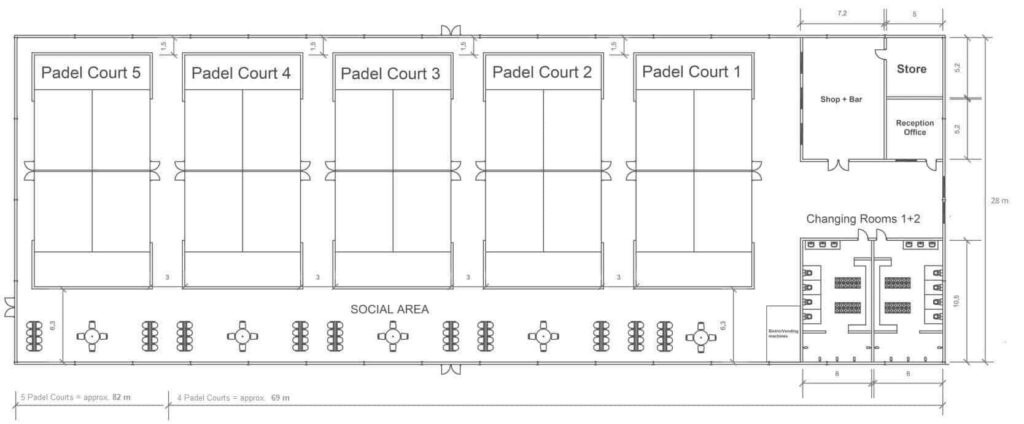
For a multi-court layout, courts are typically arrayed in parallel rows with 1.5–2m clearance between adjacent court perimeters. A 6-court facility requires approximately 17m × 80m of clear flat land.
Geotechnical and Site Evaluation
Before engaging any provizanto de padelkortoj for engineering drawings, commission a basic geotechnical assessment. This determines:
- Soil bearing capacity: Steel frame anchor bolt foundations require minimum 150 kPa bearing capacity; weaker soils require engineered pile or raft foundations adding $3,000–$8,000 per court
- Water table depth: High water tables affect foundation drainage design and can cause differential settlement
- Seismic classification: Critical in Ecuador, Colombia, Peru, California, Japan—determines anchor bolt specification and potentially frame design
- Slope gradient: Courts must be constructed on level ground; leveling work on slopes adds $5,000–$20,000 depending on gradient
Regulatory and Permit Requirements
Building permit requirements for konstruado de padel-korto vary dramatically by jurisdiction. Some municipalities classify padel courts as sports equipment (no structural permit required), others as permanent structures requiring full architectural review. Common requirements:
- Structural engineering drawings stamped by locally registered engineer
- Wind load calculation report (using local wind speed data)
- Electrical permit for lighting installation
- Environmental permit if near protected areas (coastal, forest, watershed)
- Noise impact assessment for indoor facilities near residential areas
A quality fabrikanto de padelkorto should provide adaptable engineering drawings that local engineers can stamp and submit. PanoCourt provides complete structural engineering packages (drawings, load calculations, material specifications) adapted for local building codes on request.
Phase 2: Foundation Construction
The foundation phase is almost always handled by local contractors—it’s one of the few elements of konstruado de padel-korto where local expertise is genuinely superior to factory supply. The foundation serves two functions: providing a level concrete playing surface and anchoring the steel frame against wind, seismic, and operational loads.
Standard Foundation Specification
A standard outdoor padel court foundation consists of:
- Sub-base: 200mm compacted gravel sub-base (minimum CBR 30%) on natural ground
- Concrete slab: 100–150mm reinforced concrete (C25/30 minimum), with mesh reinforcement (A393 or equivalent)
- Surface finish: Steel-troweled smooth finish with maximum 3mm variation across the playing surface
- Drainage slope: 0.5–1% fall toward perimeter drains to prevent surface water accumulation
- Anchor bolts: Positioned per manufacturer’s foundation drawing (±5mm tolerance on position) for steel frame connection
Seismic Zone Foundation Adaptations
For Ecuador, Colombia, Peru, California, and other high-seismicity zones, FIP-standard foundations must be upgraded:
- Concrete grade upgrade to C30/37 minimum
- Additional seismic mesh reinforcement (two-layer mesh)
- Cast-in anchor bolt cages with seismic hold-down capacity (design force calculated per NEC-SE-DS or IBC)
- Expansion joints at 6m intervals to manage differential thermal and seismic movement
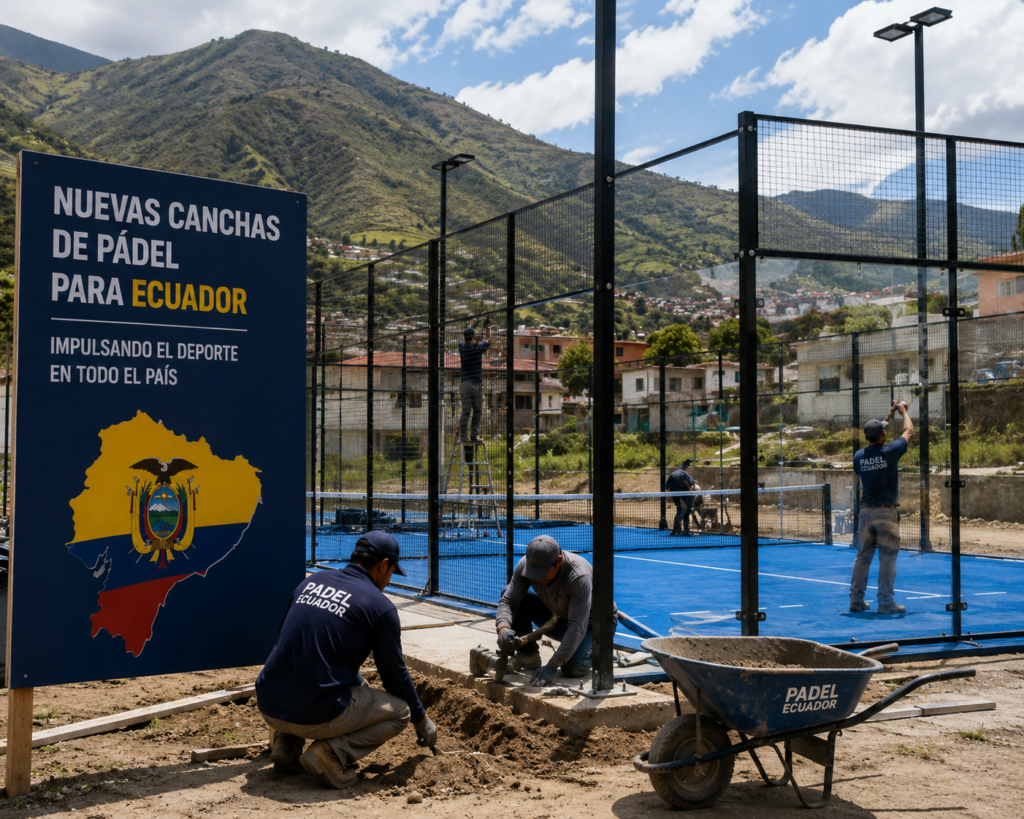
PanoCourt’s Ecuador-specific foundation drawings are adapted for NEC compliance and have been used in Quito, Guayaquil, and Cuenca installations. See our Ecuador market guide: Kosto de konstruado de padelkorto en Ekvadoro 2026.
Phase 3: Steel Frame Assembly
Steel frame assembly is the most technically demanding installation phase, and the quality of this phase determines the court’s structural lifetime. A well-assembled frame on a quality foundation should require no structural maintenance for 15+ years. A poorly assembled frame can develop problems within 2–3 years.
Pre-Assembly Inspection Checklist
Before assembly begins, verify:
- All frame components match the manufacturer’s packing list (shortages discovered mid-installation cause costly delays)
- Galvanizing coating integrity—inspect for shipping damage, bare steel exposure requires touch-up with zinc-rich paint before assembly
- Anchor bolt positions verified against foundation drawing before concrete has cured (corrections post-cure are expensive)
- All hardware (bolts, nuts, washers) are correct specification and grade
Assembly Sequence and Tolerances
Standard assembly sequence for a panorama padel-korto:
- Day 1: Column installation and leveling (laser level required for plumb tolerance ±2mm/m)
- Day 2: Horizontal beam installation, diagonal bracing, initial alignment
- Day 3: Glass panel installation (requires 2–4 persons; panels weigh 45–70kg each)
- Day 4: Mesh panel installation, door fitting, net post installation
- Day 5–6: Turf installation, lighting fixture mounting and wiring
- Day 7: Final alignment check, commissioning, snag list resolution
Total installation time for a single court with an experienced crew of 4: 5–7 working days. Multi-court facilities benefit from sequential assembly efficiency—subsequent courts typically install 20–30% faster as the crew develops site-specific familiarity.
Critical Installation Points Affecting Long-Term Performance
Glass panel seating: Glass must rest on resilient neoprene pads (minimum 70 Shore A hardness) at all support points. Direct glass-to-steel contact creates stress concentration points that accelerate glass failure. Inadequate padding is the most common quality defect in lower-tier installations.
Torque specification compliance: All structural bolted connections must be torqued to manufacturer specification (typically 80–120 Nm for M16 bolts). Under-torqued connections develop micro-movement under wind and operational loads, accelerating fatigue failure. A calibrated torque wrench is mandatory equipment, not an optional item.
Perimeter drainage: Drainage channels at the court perimeter must be connected to adequate outfall before turf installation. Blocked drainage causes surface water accumulation that damages turf backing and creates player safety hazards.
Phase 4: Turf Installation
Artificial turf installation is the phase most frequently underestimated by buyers—and the one with the most quality variation between suppliers and installers.
Turf Specification for FIP Compliance
FIP-approved padel court turf must meet:
- Pile height: 10–12mm (sand-filled to 8–10mm infill depth)
- Total pile length: 60–75mm (allowing for pile compression under load)
- Fiber type: Monofilament or texturized polypropylene
- Backing: Double polyurethane or latex backing (80+ oz/yd² per layer)
- UV stabilizer: Required for outdoor courts; minimum 2,000 hours accelerated weathering resistance
- Ball rebound (FIFA/FIP test method): 60–75cm rebound height from 1m drop
Turf Installation Process
Turf is typically supplied in rolls of 2m or 4m width. The installation process:
- All turf rolls must be oriented with fibers in the same direction (affects play consistency)
- Joins must be heat-welded or adhesive-bonded with specialist padel seaming tape—no visible seam gaps
- Silica sand infill applied in 2–3 layers, brushed into pile with mechanical brushing equipment
- Final pile height after infill: 2–4mm of fiber above sand line
- Total turf + infill installation for one court: 1 day with experienced team
Phase 5: Electrical and Lighting Installation
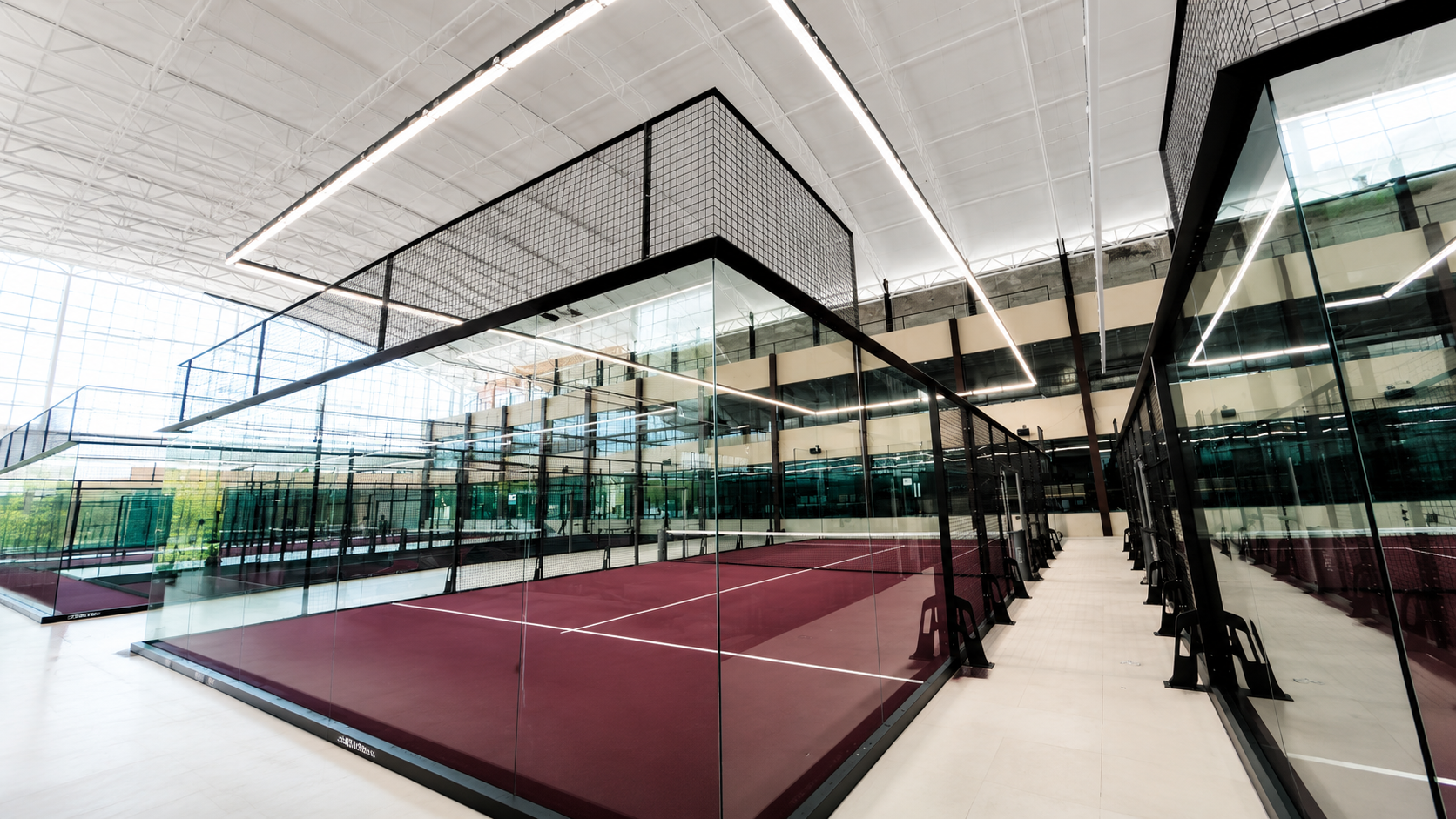
LED-lumigado for padel courts has largely replaced metal halide systems since 2022 due to the superior energy efficiency (140–160 lm/W vs 90–110 lm/W for metal halide) and lower maintenance burden (LED fixture lifetime 50,000+ hours vs 15,000 hours for metal halide).
Electrical installation requirements:
- Dedicated circuit for each court’s lighting system (prevents voltage drop issues across multi-court facilities)
- Weatherproof electrical enclosures (IP65 minimum for outdoor courts)
- Earthing/grounding of all steel structure elements to prevent electrostatic charge buildup
- Photometric verification of lux levels post-installation (300 lux minimum average, uniformity ratio >0.5)
Phase 6: Commissioning and Quality Acceptance
Before accepting a completed konstruado de padel-korto project, conduct a structured commissioning inspection:
- Laser level check of playing surface (±3mm tolerance across full length)
- Glass panel inspection: no chips, scratches, or misalignment at panel joints
- Door operation: smooth opening/closing, magnetic catch functioning, no binding
- Net height measurement: 88cm center, 92cm posts
- Lux level measurement at 9 points per FIP standard
- Drainage test: pour water at corners and verify flow direction and clearance
- Torque check on minimum 10% of structural connections
Document all snag items before making final payment. A reputable provizanto de padelkortoj will provide a commissioning checklist and snag resolution protocol as standard contractual deliverables.
See our comprehensive buyer’s guide: La 3 plej bonaj fabrikantoj de padelaj korto en 2026: Kompleta gvidilo pri investado.
Common Padel Court Construction Failures and How to Prevent Them
Foundation Settlement
Differential settlement occurs when the concrete slab moves unevenly due to inadequate sub-base preparation or poor soil conditions. Prevention: commission geotechnical assessment before construction, specify minimum compaction requirements in contractor brief, verify sub-base before concrete pour.
Glass Panel Cracking
Spontaneous glass failure (nickel sulfide inclusion stress fracture) affects approximately 1 in 500–1,000 tempered glass panels. Prevention: specify Heat Soak Tested (HST) glass per EN 14179, which eliminates >95% of NiS inclusion failures. Not all fabrikantoj de padelkorteoj offer HST glass—ask explicitly.
Corrosion at Connections
Galvanic corrosion at steel-to-concrete interfaces and bimetallic connections (steel/stainless fasteners) accelerates coating degradation. Prevention: bituminous isolation tape at all column base plates; specify stainless steel (316L) for all exposed fasteners, particularly in coastal environments.
Turf Seam Failure
Turf seam separation creates trip hazards and visual defects. Prevention: specify heat-welded seams (not adhesive-only) for all joins; use specialist padel seaming tape rated for outdoor UV exposure; avoid joins in high-traffic areas (gate threshold, service zones).
Panoramic Padel Court construction project process
in North America typically costs between $20,000 and $200,000+ per court, with the enclosure structure (rather than the surface) accounting for 40–60% of total project cost. On the manufacturing side, a factory-quoted 25–30 day production window often expands to a 75–90 day total timeline once freight, customs, and inland handling are added — which is exactly why most clubs underestimate the real project length. Sports Venue Calculator
| Phase | Key Activities | Responsible Party | Estimated Duration | Reference Cost (Single Panoramic Court) | What to Prepare / Next Step |
|---|---|---|---|---|---|
| 0. Initial Consultation & Site Assessment | Clarify indoor/outdoor and single/multi-court needs; confirm site dimensions and orientation; assess drainage and electrical capacity | Club owner + manufacturer’s technical team | 1–2 weeks | Usually free (remote consultation); on-site survey $0–500 | Provide site photos, dimensions, electrical capacity, and budget range; decide between Panoramic or Classic model |
| 1. Planning & Budget Confirmation | Determine investment scale, compare quotes from 2–3 manufacturers, evaluate ROI, secure funding source | Club owner | 1–3 weeks (can overlap with design) | Internal cost (consultant fees extra if used) | Lock in a maximum budget; decide whether to phase multiple courts |
| 2. Design & Spec Confirmation | Manufacturer issues structural drawings, glass/steel specs, turf specs, lighting plan; client confirms color and branding | Manufacturer’s design team leads, club confirms | 1–2 weeks | Usually included in court price; locally stamped engineering drawings add $500–2,000 | Sign off on final drawing revision — changes after production starts add cost and delay |
| 3. Permits & Approval | Submit building/zoning permit application, electrical connection permit (where required) | Local contractor/club (manufacturer supports with drawings) | 2–8 weeks (the most variable, least predictable phase) | Permit fees $200–3,000+ (varies hugely by jurisdiction) | Submit applications 1–2 months ahead; prepare land ownership/lease documents and structural drawings |
| 4. Contract & Order | Sign purchase contract, pay deposit, confirm trade terms | Club + manufacturer | 1–3 business days | 30%–50% of total court price as deposit | Confirm delivery address, Incoterms (FOB/CIF/DAP), and payment method |
| 5. Manufacturing | Steel fabrication and anti-rust coating, glass tempering, turf production, factory QC | Fabrikanto | 20–30 days | FOB price (steel structure + 12mm tempered glass + turf + lighting): approx. $11,000–16,000 (excludes foundation/shipping/installation) | Club should start foundation work in parallel now — don’t wait for the court to arrive before breaking ground; this is the key lever for shortening overall timeline |
| 5b. (Parallel) Site Foundation Work | Site clearing, drainage installation, concrete pour, conduit pre-laying | Local contractor | Construction 1–3 weeks + concrete curing 14–28 days | $5,000–20,000+ (labor cost in North America/Europe runs significantly higher than Southeast Asia/Middle East) | Book a contractor experienced specifically with padel court foundations; maintain a 1%–2% drainage slope; ensure curing completes before the court structure arrives |
| 6. Shipping & Logistics | Factory loading, ocean freight, destination customs clearance, inland delivery | Manufacturer’s freight forwarder + club (import clearance) | Asia-Pacific 5–12 days, Middle East 18–28 days, Europe 25–45 days, North America 15–40 days, Africa 30–55 days DDPCHAIN (port-to-port; add 1–2 weeks for clearance and inland trucking) | 1x40HQ container freight $2,000–8,000+ (fluctuates by route/season) + import duty 0–25% | Confirm import license and customs broker in advance; ensure the receiving site has forklift/crane access for unloading |
| 7. On-Site Installation | Steel frame assembly, glass/mesh installation, turf laying and sand infill, lighting and net post installation | Manufacturer’s installation team (or authorized local crew) + club support | 3–7 days per court (Panoramic typically adds 1–2 days vs. Classic due to more glass panels) | Installation labor $3,000–10,000+ (largely depends on whether the manufacturer flies in technicians vs. using local labor) | Confirm foundation is fully cured and power is connected on site; arrange accommodation and site logistics for the installation crew |
| 8. Inspection & Testing | Check structural level/plumb, glass seating, turf seams, net height (0.88–0.92m), lighting (300–500 lux), drainage test | Manufacturer + contractor + club, jointly | 1–2 days | Usually included in installation service; optional third-party inspection $500–1,500 | Build a punch-list checklist against FIP/WPT standards and sign off item by item |
| 9. Handover & Opening | Sign final acceptance form, settle balance payment, receive warranty certificate, staff maintenance training | Club + manufacturer | 1 day | Remaining 50%–70% balance due | Schedule staff training on turf care, glass cleaning, and net/post inspection routines |
pano experts insight:
Total project timeline from kickoff to opening typically runs 8–12 weeks for destinations with shorter shipping lanes (Asia-Pacific, Middle East), but 3–5 months for Europe/Americas/Africa once permitting and longer ocean transit are factored in — this gap is the single biggest source of underestimated timelines.
On cost, it’s worth explicitly distinguishing the two reference baselines that readers often conflate: the manufacturer’s FOB factory price (court structure only) versus the landed all-in cost overseas (foundation, freight, duties, local installation labor). The latter typically runs 2.5–4x the former, which is also the practical argument for buying direct from a manufacturer rather than through a local turnkey reseller.
PanoCourt: Full Construction Support from Factory to Commissioning
PanoCourt delivers more than court components. Our construction support package includes:
- Complete foundation drawing set adapted for your site’s geotechnical and seismic conditions
- Step-by-step assembly manual in English, Spanish, French, and Arabic
- Video installation guide for all major assembly phases
- Remote technical support (WhatsApp video call) during installation by our engineering team
- On-site technical supervision available for projects 4+ courts (travel cost additional)
- Commissioning checklist and acceptance test protocol
- 5-year structural warranty with documented spare parts availability
See what this means for buyers in specific markets: Ĉefaj fabrikantoj de padelaj kortoj en Ekvadoro 2026.
Plan Your Padel Court Construction Project with PanoCourt
From site assessment to commissioning support, PanoCourt’s team guides your konstruado de padel-korto project at every stage. Contact us with your site details and project timeline to receive a construction planning consultation and detailed quotation.
→ Start Your Construction Planning Consultation
Frequently Asked Questions: Padel Court Construction
How long does padel court construction take?
Total konstruado de padel-korto timeline from initial site assessment to commissioning is typically 16–24 weeks for an internationally sourced court. This breaks down as: site assessment and permits 2–4 weeks, foundation construction 2–3 weeks, factory production and shipping 10–13 weeks (for Chinese manufacturer), customs clearance 2–4 weeks, installation 1–2 weeks per court. Multi-court facilities with simultaneous installation can overlap some phases.
What foundation is required for a padel court?
Standard FIP padel court construction requires a reinforced concrete slab of minimum 100–150mm thickness (C25/30 concrete grade), on a 200mm compacted gravel sub-base. Surface must be level to ±3mm across the playing area. Seismic zones require upgraded specifications: C30/37 concrete, additional reinforcement mesh, and seismic-rated anchor bolt cages. Foundation drawings from your fabrikanto de padelkorto should specify local building code compliance.
Ĉu mi povas mem instali padelkorton?
With the right equipment and moderate construction experience, self-assembly of a padel court is feasible using manufacturer installation manuals and remote technical support. Critical requirements: laser level for column plumb verification, calibrated torque wrench for structural connections, minimum 4 persons for glass panel installation (panels weigh 45–70kg). Most buyers contract local sports construction teams for installation and use manufacturer technical support for quality assurance. Full self-installation is not recommended for multi-court facilities without prior single-court experience.
What is the endoma padel-korto ceiling height requirement?
FIP technical guidelines specify a minimum 8.0m clear height at the center net for indoor padel courts. At 7.0–8.0m height, play is workable for recreational and intermediate levels with some limitation on high lobs. At 6.8m or below, competitive play is significantly compromised. When evaluating existing building conversion, the 8.0m requirement is often the binding constraint—many warehouse and industrial buildings with 6–7m to roof structure require costly structural modifications.
How many courts fit on a standard padel facility plot?
A rough planning guide for outdoor padel-korto facilities: each court requires approximately 26m × 12m of footprint including run-off and clearance zones. For parallel court arrays with 2m between courts: 4 courts fit on a 50m × 12m site; 6 courts on a 80m × 14m site; 12 courts on approximately 160m × 14m. Club facilities typically add 20–30% land area for reception, changing rooms, equipment storage, and parking—so a 6-court club realistically needs 2,000–2,500m² total land area.
What maintenance does a padel court require after construction?
Annual maintenance for a well-constructed outdoor padel-korto: monthly turf brushing to maintain pile height and even sand distribution (dehumidified mechanical brusher, 1 hour per court); quarterly inspection of glass panel seating and cleaning; annual structural inspection of all bolted connections with torque verification; turf deep-cleaning 2–3 times per year; LED fixture inspection and cleaning annually. Well-specified courts from quality fabrikantoj de padelkorteoj require minimal reactive maintenance in the first 5 years.