El construcción de pistas de pádel El proceso requiere más trabajo de ingeniería de lo que la mayoría de los compradores prevé, y es más complejo desde el punto de vista logístico de lo que cualquier proveedor de un solo país pueda prepararte para ello. Esta guía abarca toda la secuencia de construcción, desde la evaluación del sitio hasta la puesta en marcha de la cancha, con un enfoque en lo que puede salir mal en cada etapa, cómo las decisiones sobre las especificaciones en la fase de adquisición afectan los resultados de la instalación y las consideraciones específicas que varían según la geografía y el clima.
Ya sea que estés componiendo tu primer sencillo cancha de pádel o al desarrollar un complejo con varias canchas, es importante comprender todo el proceso de construcción antes de firmar una orden de compra con cualquier fabricante de pistas de pádel es la inversión más valiosa que puedes hacer en materia de diligencia debida.
Comprender la construcción de canchas de pádel: visión general y normas

Una cancha de pádel es una estructura de precisión. Las especificaciones de la Federación Internacional de Pádel (FIP) —que definen qué es una cancha que cumple con las normas— cancha de pádel debe cumplir: establece tolerancias que la mayoría de los compradores subestiman. La nivelación de la superficie de juego debe estar dentro de un margen de ±3 mm a lo largo de los 20 m de longitud total de la cancha. La alineación de los paneles de vidrio debe garantizar un rebote uniforme de la pelota en toda la superficie de la pared. La altura de la red debe mantenerse en 88 cm en el centro y exactamente en 92 cm en los postes.
No se trata de requisitos estéticos, sino funcionales. Una cancha en la que los paneles de vidrio estén desalineados 5 mm en las uniones genera un rebote irregular que los jugadores experimentados notan de inmediato y del que se quejan. Una superficie con una desviación de 8 mm respecto al nivel afecta los patrones de rebote de la pelota y el movimiento de los jugadores. La precisión en construcción de pistas de pádel es la diferencia entre un club que retiene a sus socios y uno que los empuja hacia la competencia.
Según el Informe mundial sobre el pádel 2025 de Playtomic y PwC, la calidad de la cancha es el factor #2 que más influye en la lealtad de los jugadores al club después de la ubicación, lo que hace que la calidad de la construcción esté directamente relacionada con la retención de ingresos.
Fase 1: Evaluación y planificación del sitio
Requisitos mínimos de espacio
Un FIP estándar cancha de pádel La superficie de juego mide 20 m × 10 m. Sin embargo, el espacio total necesario, incluidas las zonas de escape obligatorias y las estructuras perimetrales, requiere:
- Longitud: Mínimo de 26 a 28 m (zonas de escape de 3 m en cada extremo)
- Ancho: Mínimo de 12–13 m (1–1,5 m de espacio libre a cada lado)
- Altura libre (en exteriores): No hay un mínimo fijo, pero se recomienda un mínimo de 6 m para evitar problemas de turbulencias causadas por el viento a la altura de la red.
- Altura libre (en interiores): Altura libre mínima de 8,0 m en el centro de la red, según las directrices de la FIP; 7,0 m es una solución intermedia viable, aunque con algunas limitaciones en el juego.
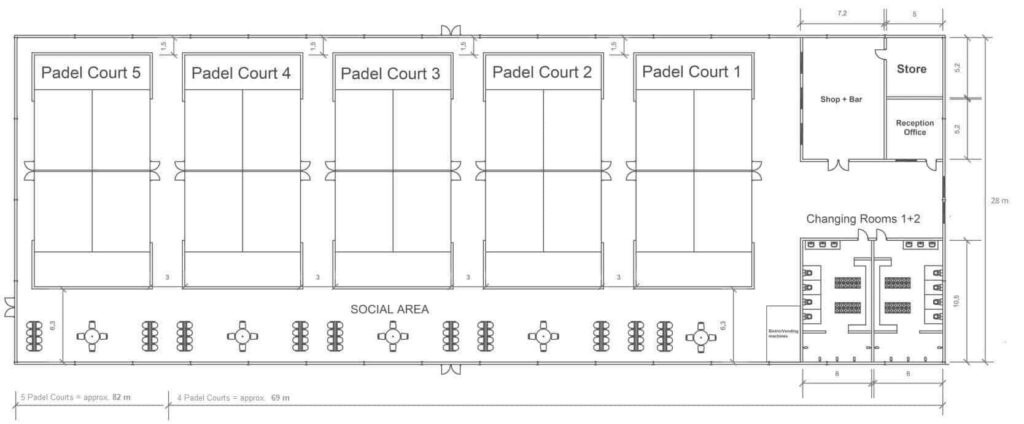
En una disposición con varias canchas, estas suelen estar dispuestas en filas paralelas con un espacio libre de entre 1,5 y 2 m entre los perímetros de las canchas adyacentes. Una instalación de 6 canchas requiere aproximadamente 17 m × 80 m de terreno llano y libre de obstáculos.
Evaluación geotécnica y del emplazamiento
Antes de iniciar cualquier proveedor de pistas de pádel Para los planos de ingeniería, encargue un estudio geotécnico básico. Este determina:
- Capacidad portante del suelo: Los cimientos con pernos de anclaje para estructuras de acero requieren una capacidad portante mínima de 150 kPa; los suelos menos resistentes requieren cimientos de pilotes o de losa diseñados por ingenieros, lo que implica un costo adicional de $3,000 a $8,000 por cancha
- Profundidad del nivel freático: Los niveles altos de las capas freáticas afectan el diseño del drenaje de los cimientos y pueden provocar asentamientos diferenciales
- Clasificación sísmica: Es fundamental en Ecuador, Colombia, Perú, California y Japón: determina las especificaciones de los pernos de anclaje y, potencialmente, el diseño de la estructura
- Gradiente de la pendiente: Las canchas deben construirse en terreno nivelado; los trabajos de nivelación en pendientes añaden entre $5,000 y $20,000, dependiendo de la pendiente.
Requisitos normativos y de permisos
Requisitos para obtener un permiso de construcción para construcción de pistas de pádel varían considerablemente según la jurisdicción. Algunos municipios clasifican las canchas de pádel como equipamiento deportivo (no se requiere permiso de construcción), mientras que otros las consideran estructuras permanentes que requieren una revisión arquitectónica completa. Requisitos comunes:
- Planos de ingeniería estructural sellados por un ingeniero registrado localmente
- Informe de cálculo de la carga del viento (utilizando datos locales de velocidad del viento)
- Permiso eléctrico para la instalación de iluminación
- Permiso ambiental si se encuentra cerca de áreas protegidas (costeras, forestales, cuencas hidrográficas)
- Evaluación del impacto acústico de instalaciones interiores cercanas a zonas residenciales
Una calidad fabricante de pistas de pádel debería proporcionar planos de ingeniería adaptables que los ingenieros locales puedan sellar y presentar. PanoCourt ofrece, a pedido, paquetes completos de ingeniería estructural (planos, cálculos de carga, especificaciones de materiales) adaptados a los códigos de construcción locales.
Fase 2: Construcción de los cimientos
La fase de cimentación casi siempre la realizan contratistas locales; es uno de los pocos elementos de construcción de pistas de pádel donde la experiencia local es realmente superior al suministro de fábrica. Los cimientos cumplen dos funciones: proporcionar una superficie de juego nivelada de concreto y anclar la estructura de acero contra las cargas eólicas, sísmicas y operativas.
Especificaciones estándar para cimientos
Los cimientos estándar de una cancha de pádel al aire libre constan de:
- Subbase: Subbase de grava compactada de 200 mm (CBR mínimo 30%) sobre suelo natural
- Losa de concreto: 100–150 mm de concreto armado (C25/30 como mínimo), con malla de refuerzo (A393 o equivalente)
- Acabado de la superficie: Acabado liso alisado con llana de acero, con una variación máxima de 3 mm en toda la superficie de juego
- Pendiente de drenaje: 0,5–1% se inclinan hacia los desagües perimetrales para evitar la acumulación de agua en la superficie
- Pernos de anclaje: Colocado según el plano de cimentación del fabricante (tolerancia de ±5 mm en la posición) para la conexión al marco de acero
Adaptaciones de los cimientos en zonas sísmicas
En el caso de Ecuador, Colombia, Perú, California y otras zonas de alta sismicidad, es necesario mejorar los cimientos que cumplen con la norma FIP:
- Mejora de la clase de concreto a un mínimo de C30/37
- Refuerzo sísmico adicional con malla (malla de dos capas)
- Jaulas de pernos de anclaje empotrados con capacidad de sujeción sísmica (fuerza de diseño calculada según NEC-SE-DS o IBC)
- Juntas de dilatación a intervalos de 6 m para controlar los movimientos térmicos y sísmicos diferenciales
Los planos de cimentación de PanoCourt específicos para Ecuador están adaptados para cumplir con la norma NEC y se han utilizado en instalaciones en Quito, Guayaquil y Cuenca. Consulte nuestra guía del mercado ecuatoriano: Coste de construcción de una pista de pádel en Ecuador en 2026.
Fase 3: Ensamblaje de la estructura de acero
El montaje de la estructura de acero es la etapa de instalación más exigente desde el punto de vista técnico, y la calidad de esta etapa determina la vida útil estructural de la cancha. Una estructura bien montada sobre cimientos de calidad no debería requerir mantenimiento estructural durante más de 15 años. Una estructura mal montada puede presentar problemas en un plazo de 2 a 3 años.
Lista de verificación para la inspección previa al ensamblaje
Antes de comenzar el montaje, verifica lo siguiente:
- Todos los componentes del armazón coinciden con la lista de empaque del fabricante (las faltas que se descubren durante la instalación provocan retrasos costosos)
- Integridad del recubrimiento galvanizado: revisa si hay daños causados por el transporte; si se observa acero al descubierto, es necesario retocarlo con pintura rica en zinc antes del ensamblaje
- Se verifican las posiciones de los pernos de anclaje comparándolas con el plano de los cimientos antes de que el concreto se haya endurecido (las correcciones después del endurecimiento son costosas)
- Todos los elementos de fijación (pernos, tuercas, arandelas) cumplen con las especificaciones y el grado correctos
Secuencia de ensamblaje y tolerancias
Secuencia de ensamblaje estándar para un cancha de pádel con vistas panorámicas:
- Día 1: Instalación y nivelación de columnas (se requiere un nivel láser para una tolerancia de plomada de ±2 mm/m)
- Día 2: Instalación de vigas horizontales, arriostramiento diagonal, alineación inicial
- Día 3: Instalación de paneles de vidrio (se necesitan de 2 a 4 personas; los paneles pesan entre 45 y 70 kg cada uno)
- Día 4: Instalación de paneles de malla, montaje de puertas, instalación de postes para redes
- Días 5 y 6: Instalación de césped, montaje de luminarias y cableado
- Día 7: Revisión final de alineación, puesta en marcha, resolución de la lista de deficiencias
Tiempo total de instalación de una sola cancha con un equipo experimentado de 4 personas: de 5 a 7 días laborables. Las instalaciones con varias canchas se benefician de la eficiencia del montaje secuencial: las canchas siguientes suelen instalarse entre 20 y 30% más rápido a medida que el equipo se familiariza con las características específicas del sitio.
Aspectos clave de la instalación que afectan el rendimiento a largo plazo
Asientos con paneles de vidrio: El vidrio debe apoyarse sobre almohadillas de neopreno elásticas (con una dureza mínima de 70 Shore A) en todos los puntos de apoyo. El contacto directo entre el vidrio y el acero genera puntos de concentración de tensiones que aceleran la falla del vidrio. Un acolchado inadecuado es el defecto de calidad más común en las instalaciones de menor nivel.
Cumplimiento de las especificaciones de par: Todas las uniones estructurales atornilladas deben apretarse según las especificaciones del fabricante (por lo general, entre 80 y 120 Nm para pernos M16). Las uniones con un apriete insuficiente desarrollan micromovimientos bajo cargas eólicas y operativas, lo que acelera la falla por fatiga. Una llave dinamométrica calibrada es un equipo obligatorio, no un elemento opcional.
Drenaje perimetral: Los canales de drenaje situados en el perímetro de la cancha deben conectarse a un desagüe adecuado antes de la instalación del césped. Un drenaje obstruido provoca la acumulación de agua en la superficie, lo que daña la base del césped y representa un riesgo para la seguridad de los jugadores.
Fase 4: Instalación del césped
La instalación del césped artificial es la etapa que los compradores suelen subestimar con mayor frecuencia, y aquella en la que se observan mayores diferencias de calidad entre los proveedores y los instaladores.
Especificaciones del césped para el cumplimiento de la FIP
El césped para canchas de pádel aprobado por la FIP debe cumplir con los siguientes requisitos:
- Altura de la pila: 10–12 mm (rellena con arena hasta una profundidad de relleno de 8–10 mm)
- Longitud total de las fibras: 60–75 mm (teniendo en cuenta la compresión de las fibras bajo carga)
- Tipo de fibra: polipropileno monofilamento o texturizado
- Soporte: Doble capa de poliuretano o látex (más de 80 oz/yd² por capa)
- Estabilizador UV: Obligatorio para canchas al aire libre; resistencia mínima a la intemperie acelerada de 2,000 horas
- Rebote del balón (método de prueba de la FIFA/FIP): altura de rebote de 60 a 75 cm tras una caída desde 1 m
Proceso de instalación del césped artificial
El césped artificial suele venderse en rollos de 2 m o 4 m de ancho. El proceso de instalación:
- Todos los rollos de césped deben orientarse con las fibras en la misma dirección (esto afecta la consistencia del juego)
- Las uniones deben soldarse térmicamente o pegarse con cinta especial para uniones de pádel; no deben quedar huecos visibles en las uniones.
- Relleno de arena de sílice aplicado en 2 o 3 capas, cepillado en la pila con equipo de cepillado mecánico
- Altura final del montón después del relleno: 2–4 mm de fibra por encima de la línea de arena
- Instalación total del césped artificial y el relleno para una cancha: 1 día con un equipo experimentado
Fase 5: Instalación eléctrica y de iluminación
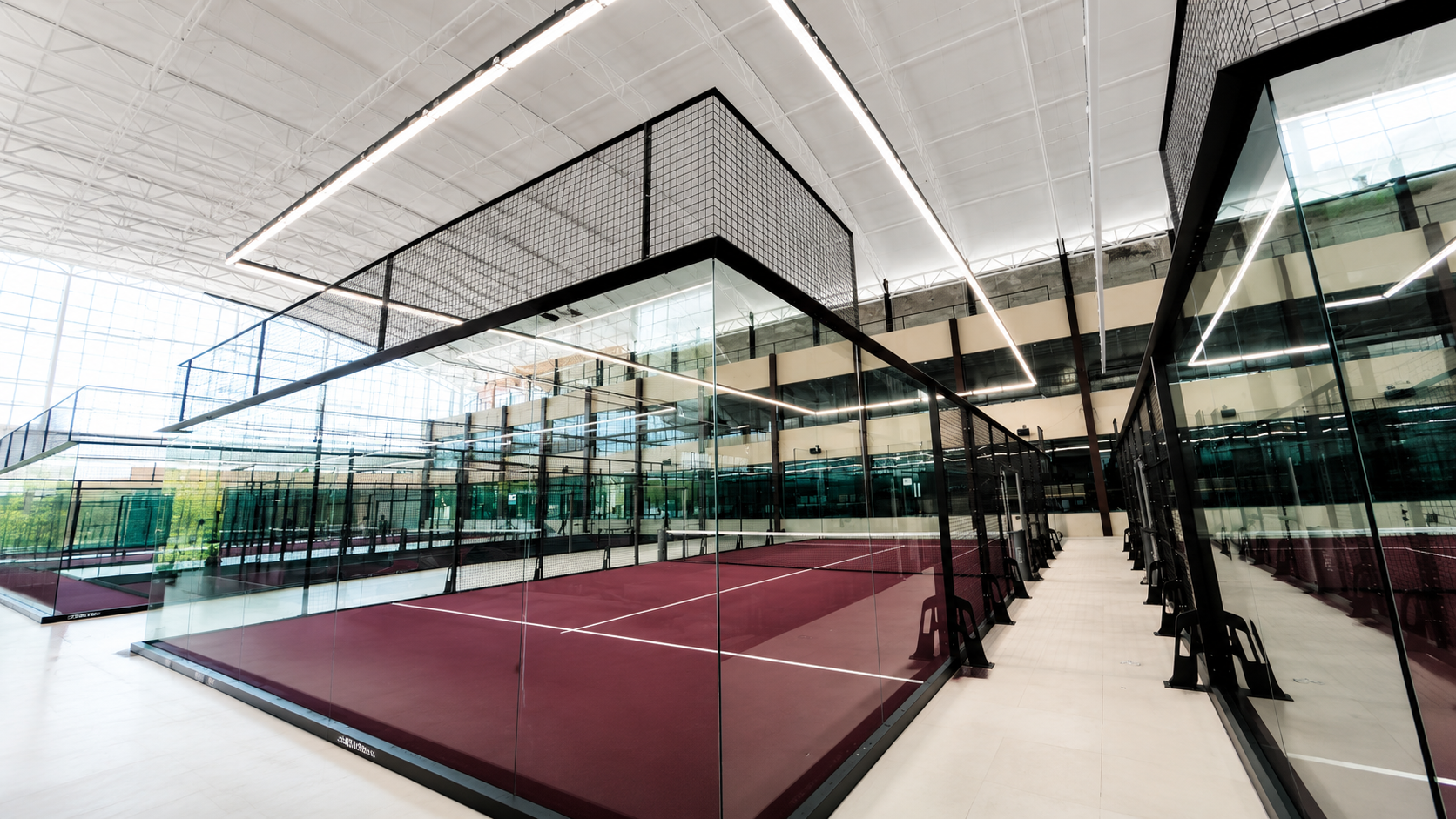
Iluminación LED para canchas de pádel ha reemplazado en gran medida a los sistemas de halogenuros metálicos desde 2022 debido a su mayor eficiencia energética (140–160 lm/W frente a 90–110 lm/W en el caso de los halogenuros metálicos) y a que requiere menos mantenimiento (vida útil de las luminarias LED de más de 50 000 horas frente a las 15 000 horas de las de halogenuros metálicos).
Requisitos de instalación eléctrica:
- Circuito exclusivo para el sistema de iluminación de cada cancha (evita problemas de caída de voltaje en instalaciones con varias canchas)
- Cajas eléctricas resistentes a la intemperie (IP65 como mínimo para canchas al aire libre)
- Puesta a tierra de todos los elementos de la estructura de acero para evitar la acumulación de cargas electrostáticas
- Verificación fotométrica de los niveles de lux tras la instalación (promedio mínimo de 300 lux, índice de uniformidad >0,5)
Fase 6: Puesta en servicio y aceptación de calidad
Antes de aceptar un formulario completado construcción de pistas de pádel proyecto, realizar una inspección estructurada de puesta en servicio:
- Verificación con nivel láser de la superficie de juego (tolerancia de ±3 mm en toda su longitud)
- Inspección de los paneles de vidrio: no deben presentar astillas, rayones ni desalineaciones en las uniones de los paneles
- Funcionamiento de la puerta: apertura y cierre suaves, cierre magnético en buen estado, sin atascos
- Medida de altura neta: 88 cm en el centro, 92 cm en los postes
- Medición del nivel de lux en 9 puntos según la norma FIP
- Prueba de drenaje: vierta agua en las esquinas y verifique la dirección del flujo y el espacio libre
- Verificación del par de apriete de un mínimo de 10% en las uniones estructurales
Documenta todos los problemas detectados antes de realizar el pago final. Una empresa de buena reputación proveedor de pistas de pádel proporcionará una lista de verificación para la puesta en servicio y un protocolo de resolución de problemas como entregables contractuales estándar.
Consulta nuestra guía completa para compradores: Los 3 principales fabricantes de canchas de pádel en 2026: guía completa de inversión.
Fallos comunes en la construcción de canchas de pádel y cómo prevenirlos
Asentamiento de cimientos
El asentamiento diferencial ocurre cuando la losa de concreto se desplaza de manera desigual debido a una preparación inadecuada de la subbase o a malas condiciones del suelo. Prevención: encargar un estudio geotécnico antes de la construcción, especificar los requisitos mínimos de compactación en las instrucciones para el contratista y verificar la subbase antes de verter el concreto.
Grietas en los paneles de vidrio
La falla espontánea del vidrio (fractura por tensión debida a inclusiones de sulfuro de níquel) afecta aproximadamente a 1 de cada 500 a 1,000 paneles de vidrio templado. Prevención: especifique vidrio sometido a la prueba de exposición al calor (HST) según la norma EN 14179, lo cual elimina más del 95% de fallas por inclusiones de NiS. No todos fabricantes de canchas de pádel Ofrecen vidrio HST: pregúntalo expresamente.
Corrosión en las conexiones
La corrosión galvánica en las interfaces entre el acero y el concreto, así como en las uniones bimetálicas (sujetadores de acero/acero inoxidable), acelera la degradación del recubrimiento. Prevención: colocar cinta aislante bituminosa en todas las placas de base de las columnas; especificar acero inoxidable (316L) para todos los sujetadores expuestos, especialmente en entornos costeros.
Falla en la unión del césped
Las separaciones en las uniones del césped sintético crean riesgos de tropiezos y defectos estéticos. Prevención: especifique uniones soldadas térmicamente (no solo con adhesivo) para todas las uniones; utilice cinta de unión especializada para padel, diseñada para la exposición a los rayos UV en exteriores; evite las uniones en áreas de alto tráfico (umbral de la puerta, zonas de servicio).
Proceso del proyecto de construcción de una cancha de pádel panorámica
En América del Norte, el costo suele oscilar entre $20,000 y $200,000+ por cancha, y la estructura de cerramiento (más que la superficie) representa entre el 40 y el 60% del costo total del proyecto. En cuanto a la fabricación, el plazo de producción de 25 a 30 días cotizado por la fábrica a menudo se extiende a un plazo total de 75 a 90 días una vez que se suman el transporte, los trámites aduaneros y la manipulación terrestre —lo cual es precisamente la razón por la que la mayoría de los clubes subestiman la duración real del proyecto. Calculadora de instalaciones deportivas
| Fase | Actividades clave | Parte responsable | Duración estimada | Costo de referencia (pista panorámica individual) | Qué hay que preparar / Próximo paso |
|---|---|---|---|---|---|
| 0. Consulta inicial y evaluación del sitio | Aclarar las necesidades de canchas interiores o exteriores y de una sola cancha o varias; confirmar las dimensiones y la orientación del sitio; evaluar el drenaje y la capacidad eléctrica | Propietario del club + equipo técnico del fabricante | 1–2 semanas | Por lo general, gratuito (consulta a distancia); visita in situ: $0–500 | Proporcione fotos del lugar, las dimensiones, la capacidad eléctrica y el rango de presupuesto; elija entre el modelo Panorámico o el Clásico |
| 1. Planificación y confirmación del presupuesto | Determinar la escala de la inversión, comparar cotizaciones de 2 a 3 fabricantes, evaluar el retorno de la inversión y asegurar la fuente de financiamiento | Propietario del club | 1 a 3 semanas (puede solaparse con la etapa de diseño) | Costo interno (honorarios de consultores no incluidos, si se contratan) | Establece un presupuesto máximo; decide si vas a poner en marcha varias canchas por etapas |
| 2. Confirmación del diseño y las especificaciones | El fabricante entrega los planos estructurales, las especificaciones del vidrio y el acero, las especificaciones del césped artificial y el plano de iluminación; el cliente confirma el color y la imagen de marca | El club confirma que el equipo de diseño del fabricante está a la cabeza | 1–2 semanas | Por lo general, se incluye en el precio del tribunal; los planos de ingeniería con sello local añaden $500–2,000 | Aprueba la revisión final del plano; los cambios que se hagan después de que comience la producción aumentan los costos y provocan retrasos |
| 3. Permisos y autorizaciones | Presentar la solicitud de permiso de construcción o de zonificación, así como el permiso de conexión eléctrica (cuando sea necesario) | Contratista o club local (el fabricante brinda apoyo con planos) | 2 a 8 semanas (la fase más variable y menos predecible) | Cuotas de permisos: $200–3,000+ (varía enormemente según la jurisdicción) | Presentar las solicitudes con 1 a 2 meses de anticipación; preparar los documentos de propiedad o arrendamiento del terreno y los planos estructurales |
| 4. Contrato y pedido | Firmar el contrato de compraventa, pagar el anticipo, confirmar las condiciones de la transacción | Club + fabricante | 1 a 3 días hábiles | 30%–50% del precio total del tribunal como depósito | Confirma la dirección de entrega, los Incoterms (FOB/CIF/DAP) y la forma de pago |
| 5. Fabricación | Fabricación de acero y recubrimiento anticorrosivo, templado de vidrio, producción de césped artificial, control de calidad en fábrica | Fabricante | 20–30 días | Precio FOB (estructura de acero + vidrio templado de 12 mm + césped artificial + iluminación): aprox. $11,000–16,000 (no incluye cimientos, transporte ni instalación) | El club debería empezar ya los trabajos de cimentación en paralelo —no hay que esperar a que llegue la cancha para comenzar la construcción; esta es la clave para acortar el plazo total |
| 5b. Trabajos de cimentación (en paralelo) | Desmonte del terreno, instalación del sistema de drenaje, vertido de concreto, tendido previo de conductos | Contratista local | Construcción: de 1 a 3 semanas + curado del concreto: de 14 a 28 días | $5,000–20,000+ (el costo de la mano de obra en América del Norte y Europa es considerablemente más alto que en el Sudeste Asiático y el Medio Oriente) | Contrata a un contratista con experiencia específica en cimientos para canchas de pádel; mantén una pendiente de drenaje de 1%–2%; asegúrate de que el curado se complete antes de que llegue la estructura de la cancha |
| 6. Envíos y logística | Carga en fábrica, transporte marítimo, despacho de aduana en destino, entrega en el interior del país | Agente de carga del fabricante + club (despacho de importación) | Asia-Pacífico: 5 a 12 días; Oriente Medio: 18 a 28 días; Europa: 25 a 45 días; América del Norte: 15 a 40 días; África: 30 a 55 días DDPCHAIN (de puerto a puerto; sume de 1 a 2 semanas para el despacho de aduana y el transporte terrestre) | Carga en contenedor 1x40HQ: $2,000–8,000+ (varía según la ruta y la temporada) + arancel de importación: 0–25% | Confirma con anticipación la licencia de importación y el agente aduanal; asegúrate de que el lugar de recepción cuente con acceso para montacargas o grúas para la descarga |
| 7. Instalación en el lugar | Montaje de la estructura de acero, instalación de vidrio y malla, colocación de césped artificial y relleno de arena, instalación de iluminación y de postes para redes | Equipo de instalación del fabricante (o equipo local autorizado) + apoyo del club | De 3 a 7 días por cancha (el modelo Panorámico suele tardar entre 1 y 2 días más que el Clásico debido a que tiene más paneles de vidrio) | Mano de obra de instalación: $3,000–10,000+ (depende en gran medida de si el fabricante envía técnicos o recurre a mano de obra local) | Confirmar que los cimientos estén completamente secos y que haya conexión eléctrica en el sitio; organizar el alojamiento y la logística en el sitio para el equipo de instalación |
| 8. Inspección y pruebas | Verificar el nivel y la plomada de la estructura, los asientos de vidrio, las uniones del césped, la altura de la red (0,88–0,92 m), la iluminación (300–500 lux) y realizar una prueba de drenaje | Fabricante + contratista + club, de manera conjunta | 1–2 días | Por lo general, se incluye en el servicio de instalación; inspección opcional por parte de terceros $500–1 500 | Elabora una lista de verificación de tareas pendientes según los estándares de FIP/WPT y aprueba cada punto uno por uno |
| 9. Entrega e inauguración | Firmar el formulario de aceptación definitiva, liquidar el pago del saldo, recibir el certificado de garantía y capacitar al personal en mantenimiento | Club + fabricante | 1 día | Saldo pendiente de 50%–70% | Programar capacitación del personal sobre el cuidado del césped, la limpieza de vidrios y las rutinas de inspección de redes y postes |
Perspectiva de los expertos de Pano:
La duración total del proyecto, desde su inicio hasta la inauguración, suele ser de 8–12 semanas para destinos con rutas de envío más cortas (Asia-Pacífico, Medio Oriente), pero 3 a 5 meses para Europa, América y África, una vez que se toman en cuenta los permisos y los tiempos de tránsito marítimo más largos; esta brecha es la principal causa de que se subestimen los plazos.
En cuanto al costo, vale la pena distinguir explícitamente entre las dos bases de referencia que los lectores suelen confundir: el precio FOB de fábrica del fabricante (solo la estructura de la cancha) frente al costo total con todo incluido en el extranjero (cimientos, flete, aranceles y mano de obra de instalación local). Este último suele ser entre 2,5 y 4 veces mayor que el primero, lo cual también constituye el argumento práctico para comprar directamente al fabricante en lugar de hacerlo a través de un distribuidor local que ofrece soluciones «llave en mano».
PanoCourt: Apoyo integral en la construcción, desde la fábrica hasta la puesta en marcha

PanoCourt ofrece mucho más que componentes para canchas. Nuestro paquete de apoyo a la construcción incluye:
- Conjunto completo de planos de cimentación adaptado a las condiciones geotécnicas y sísmicas de su sitio
- Manual de montaje paso a paso en inglés, español, francés y árabe
- Guía de instalación en video para todas las fases principales del montaje
- Soporte técnico remoto (videollamada por WhatsApp) durante la instalación, a cargo de nuestro equipo de ingeniería
- Se ofrece supervisión técnica en el lugar para proyectos de 4 o más canchas (gastos de viaje no incluidos)
- Lista de verificación para la puesta en servicio y protocolo de pruebas de aceptación
- Garantía estructural de 5 años con disponibilidad documentada de piezas de repuesto
Descubre qué implica esto para los compradores en mercados específicos: Principales fabricantes de pistas de pádel en Ecuador en 2026.
Planifica tu proyecto de construcción de una cancha de pádel con PanoCourt
Desde la evaluación del sitio hasta el apoyo para la puesta en marcha, el equipo de PanoCourt te guía en tu construcción de pistas de pádel proyecto en cada etapa. Contáctanos con los detalles de tu sitio y el cronograma del proyecto para recibir una asesoría sobre la planificación de la construcción y una cotización detallada.
→ Inicia tu consulta sobre planificación de la construcción
Preguntas frecuentes: Construcción de canchas de pádel
¿Cuánto tiempo lleva construir una cancha de pádel?
Total construcción de pistas de pádel El plazo desde la evaluación inicial del sitio hasta la puesta en servicio suele ser de 16 a 24 semanas para una cancha de origen internacional. Esto se desglosa de la siguiente manera: evaluación del sitio y permisos, de 2 a 4 semanas; construcción de los cimientos, de 2 a 3 semanas; producción en fábrica y envío, de 10 a 13 semanas (para un fabricante chino); despacho aduanal, de 2 a 4 semanas; e instalación, de 1 a 2 semanas por cancha. En las instalaciones con múltiples canchas que se instalan simultáneamente, algunas fases pueden superponerse.
¿Qué tipo de cimientos se necesitan para una cancha de pádel?
La construcción estándar de una cancha de pádel según las normas de la FIP requiere una losa de concreto armado de un espesor mínimo de 100–150 mm (concreto de clase C25/30), sobre una subbase de grava compactada de 200 mm. La superficie debe estar nivelada con una tolerancia de ±3 mm en toda el área de juego. Las zonas sísmicas requieren especificaciones mejoradas: concreto C30/37, malla de refuerzo adicional y jaulas de pernos de anclaje con clasificación sísmica. Los planos de cimentación de su fabricante de pistas de pádel debería especificar el cumplimiento del código de construcción local.
¿Puedo instalar una cancha de pádel por mi cuenta?
Con el equipo adecuado y una experiencia moderada en construcción, es posible armar una cancha de pádel por cuenta propia siguiendo los manuales de instalación del fabricante y con apoyo técnico a distancia. Requisitos fundamentales: nivel láser para verificar que las columnas estén a plomo, llave dinamométrica calibrada para las conexiones estructurales y un mínimo de 4 personas para la instalación de los paneles de vidrio (los paneles pesan entre 45 y 70 kg). La mayoría de los compradores contratan a equipos locales especializados en construcción de instalaciones deportivas para la instalación y recurren al soporte técnico del fabricante para garantizar la calidad. No se recomienda la autoinstalación completa en instalaciones con varias canchas si no se cuenta con experiencia previa en la instalación de una sola cancha.
¿Qué es el cancha de pádel cubierta ¿Cuál es el requisito de altura del techo?
Las normas técnicas de la FIP especifican una altura libre mínima de 8,0 m en el centro de la red para las canchas de pádel de interior. Con una altura de entre 7,0 y 8,0 m, el juego es viable para los niveles recreativo e intermedio, aunque con algunas limitaciones en los globos altos. A 6,8 m o menos, el juego competitivo se ve significativamente afectado. Al evaluar la reconversión de edificios existentes, el requisito de los 8,0 m suele ser la restricción determinante: muchos almacenes y edificios industriales con una altura de 6 a 7 m hasta la estructura del techo requieren costosas modificaciones estructurales.
¿Cuántas canchas caben en un terreno estándar para una instalación de pádel?
Una guía básica de planificación para actividades al aire libre cancha de pádel Instalaciones: cada cancha requiere un espacio de aproximadamente 26 m × 12 m, incluidas las zonas de salida y de seguridad. Para disposiciones de canchas en paralelo con 2 m de separación entre ellas: caben 4 canchas en un terreno de 50 m × 12 m; 6 canchas en uno de 80 m × 14 m; y 12 canchas en uno de aproximadamente 160 m × 14 m. Las instalaciones del club suelen requerir entre 20 y 30% de superficie adicional para la recepción, los vestuarios, el almacén de equipos y el estacionamiento; por lo tanto, un club de 6 canchas necesita, en términos realistas, una superficie total de entre 2,000 y 2,500 m².
¿Qué mantenimiento requiere una cancha de pádel después de su construcción?
Mantenimiento anual de una piscina al aire libre bien construida cancha de pádel: cepillado mensual del césped sintético para mantener la altura de las fibras y la distribución uniforme de la arena (cepilladora mecánica deshumidificada, 1 hora por cancha); inspección trimestral de los asientos con paneles de vidrio y su limpieza; inspección estructural anual de todas las uniones atornilladas con verificación del par de apriete; limpieza profunda del césped sintético de 2 a 3 veces al año; inspección y limpieza anual de los luminarios LED. Canchas bien equipadas y de calidad fabricantes de canchas de pádel requieren un mantenimiento correctivo mínimo durante los primeros 5 años.