
Three years ago I committed to building a padel club in Johannesburg without a roadmap. I had capital, market conviction, and a site option — but I had no clear sequence for the decisions that needed to happen in the right order, or a realistic understanding of how long the process would take. If you want to build a padel club in Johannesburg, this guide is everything I needed then.
It is the step-by-step framework for taking a padel club in Johannesburg from concept to opening — covering the investment model decisions, site selection criteria, municipal approval process, court procurement strategy, construction sequence, pre-opening marketing, and the operational foundations that determine whether your facility builds long-term value. For the broader market context first, see the complete padel court Johannesburg investor’s guide.
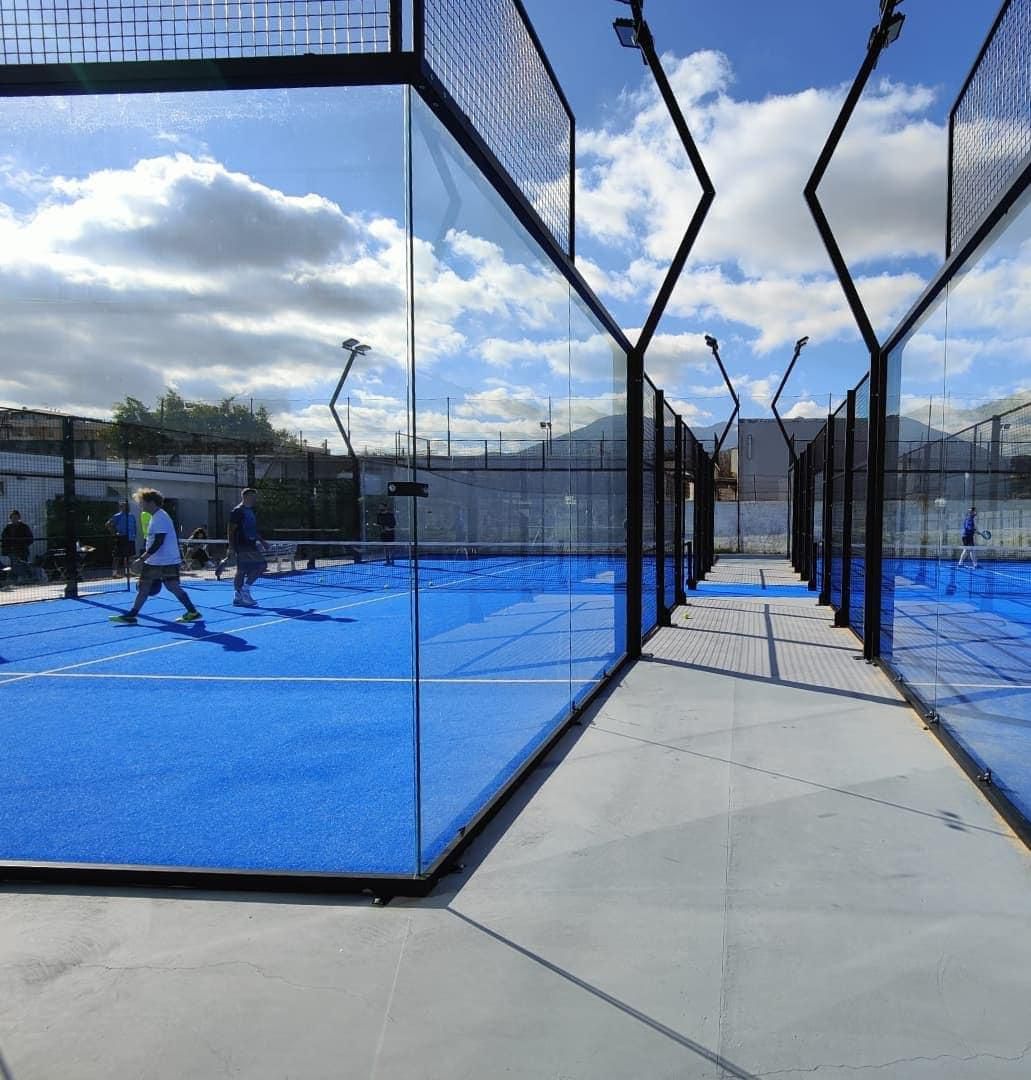
Step 1: Define Your Investment Model Before Looking at Sites or Suppliers
The single most common mistake investors make when entering the Johannesburg padel market is jumping to site selection or supplier conversations before they have defined what they are actually building. The site requirements, capital requirements, operational demands, and returns profile are fundamentally different across three viable investment models. Choosing the wrong model for your resources and capabilities is more expensive than almost any other mistake you can make.
Model A: Amenity Court (One to Two Courts at an Existing Facility)
One or two padel courts added to an existing facility — a golf club, hotel, gym, or residential estate. The courts serve an existing membership and generate incremental revenue. No standalone business model is required; the facility’s existing operations absorb the fixed cost base.
Capital required: R600,000 to R2 million for one to two covered courts including civil works and lighting. Revenue model: court hire, lessons, supplementary F&B spend. Risk profile: lower — incremental revenue to an existing profitable business. Best suited for: golf clubs, hotel operators, estate developers, and hospitality groups who want to add a high-value amenity.
Model B: Multi-Court Social Venue (Three to Six Courts)
Three to six courts plus a clubhouse with food and beverage, professional coaching, and social events programming. A destination — somewhere people go specifically to play padel and stay for the experience around it.
Capital required: R3.5 million to R8 million for four to six covered courts with clubhouse fit-out. Revenue model: court hire, memberships, coaching programmes, F&B, corporate events, and tournaments. Risk profile: medium — dependent on building and sustaining a real membership community. Best suited for: experienced hospitality or sports operators, and investor syndicates with operational management capability.
Model C: Tournament-Grade Destination Facility
Full professional specification designed for national tournament hosting, with premium player facilities, potential broadcast infrastructure, and sponsor-ready branding. Capital required: R8 million and above. Revenue model: premium memberships, tournament fees, sponsorship, coaching academy, F&B. Best suited for: experienced sports facility operators with existing South African padel industry relationships and a clear tournament pipeline strategy.
Define your model precisely before proceeding. Every downstream decision — site criteria, court specification, financing structure, operational hiring, marketing approach — follows directly from this choice.
Step 2: Site Selection in Johannesburg — What Actually Matters
With your model defined, approach site selection with specific criteria rather than general preferences.
Demographic Proximity
Your most frequent players will live or work within 15 to 20 minutes of your facility. In Johannesburg’s traffic reality, this is a relatively small geographic radius — often no more than 5 to 8 kilometres in peak hours. Before evaluating any site, map the density of your target demographic (professional households, income class AB/BC, ages 25 to 55) within that real travel-time radius.
The highest-density target markets in Johannesburg are the Northern Suburbs corridor (Fourways, Bryanston, Rivonia, Sunninghill), the Sandton and Rosebank axis (the highest income concentration on the continent), the East Rand (Bedfordview, Edenvale, Boksburg — a growing and currently underserved market), and parts of the West Rand and Roodepoort which offer community-focused opportunity with significantly less competition.
Site Physical Requirements
A single padel court requires a minimum footprint of 25 metres by 14 metres around the standard 20m x 10m playing area defined by the Fédération internationale de padel (FIP). A four-court facility needs 900 to 1,200 square metres of court area plus parking (minimum 40 to 60 bays for a commercial facility at peak capacity), circulation space, and clubhouse. Total site for a viable four-court padel club in Johannesburg: 2,500 to 3,500 square metres minimum.
Court orientation matters practically. Ideally orient the main court axis north-south to minimise direct sun interference for players during the critical 5pm to 7pm peak window. An east-west orientation means afternoon sun is directly in western players’ eyes at precisely the time you want maximum utilisation.
Ground Conditions Investigation
Johannesburg’s varied geology requires investigation before any site commitment. The metropolitan area includes dolomite risk zones in significant parts of Centurion, Roodepoort, and southern Johannesburg. A geotechnical investigation at R8,000 to R20,000 is non-negotiable before signing a lease or purchase agreement. I know an investor who skipped this step, discovered significant dolomite risk after construction had started, and added R300,000 to the project cost while delaying opening by four months. The investigation cost is trivial compared to that consequence.
Zoning and Permitted Use
In Johannesburg, commercial sports facilities typically require Business 1 or Special zoning under the City of Johannesburg’s spatial planning framework. Residential-zoned sites cannot accommodate a commercial padel club without rezoning, which takes 12 to 24 months. Before committing to any site, confirm the current zoning category and whether a commercial padel club is permitted as-of-right. This single step prevents the most common and most expensive development mistake in the Johannesburg padel market.
Step 3: Municipal Approvals — The Phase That Sets Your Project Timeline
Building plan approval from the City of Johannesburg is required for any padel court structure. It is not fast. Plan for 3 months minimum; 10 to 14 weeks is the standard range for a straightforward application. Complicated sites — heritage areas, dolomite zones, rezoning requirements — can take 6 to 12 months.
What the Application Requires
The City of Johannesburg Development Management function requires a site plan showing proposed courts relative to property boundaries, architectural drawings, structural engineer’s drawings and calculations from an ECSA-registered engineer, civil engineering drainage drawings, and electrical engineer’s drawings. Depending on site and zoning, an environmental impact screening may also be required.
The structural drawings are the point at which your court supplier’s engineering documentation becomes critical. If your supplier provides adequate, correctly formatted structural documentation, your local engineer can review and certify it efficiently. If the documentation is inadequate — which is common with distributors who have limited access to the manufacturer’s full engineering file — your engineer must produce calculations from scratch, adding both time and cost.
This is a practical reason to work directly with a manufacturer. PanoCourt provides a complete engineering documentation package with every order — structural calculations, material certifications, and installation drawings in a format designed for professional construction submission. Your local ECSA engineer reviews and certifies rather than building from scratch.
Step 4: Court Procurement — The Most Financially Significant Decision in Your Project
With your site secured and approvals underway, court procurement becomes the most financially significant single decision you will make. The core choice is between local South African distributors — who provide managed local experience at a distribution margin of 25 to 45 percent — and factory-direct procurement from a manufacturer like PanoCourt, which eliminates that margin at the cost of more active project management from the investor’s side.
For a four-court project, the difference is material. On R2 million in court structures, factory-direct sourcing saves R500,000 to R900,000 that either improves project returns or funds facility elements you would otherwise compromise on. The complete sourcing analysis — including how to verify manufacturer credentials and evaluate the procurement process — is covered in the guide on padel court manufacturers for Johannesburg.
The full cost analysis across all project components — court structures, civil works, lighting, roofing, VAT, ongoing costs, and ROI projections — is in the dedicated guide on padel court costs in Johannesburg.
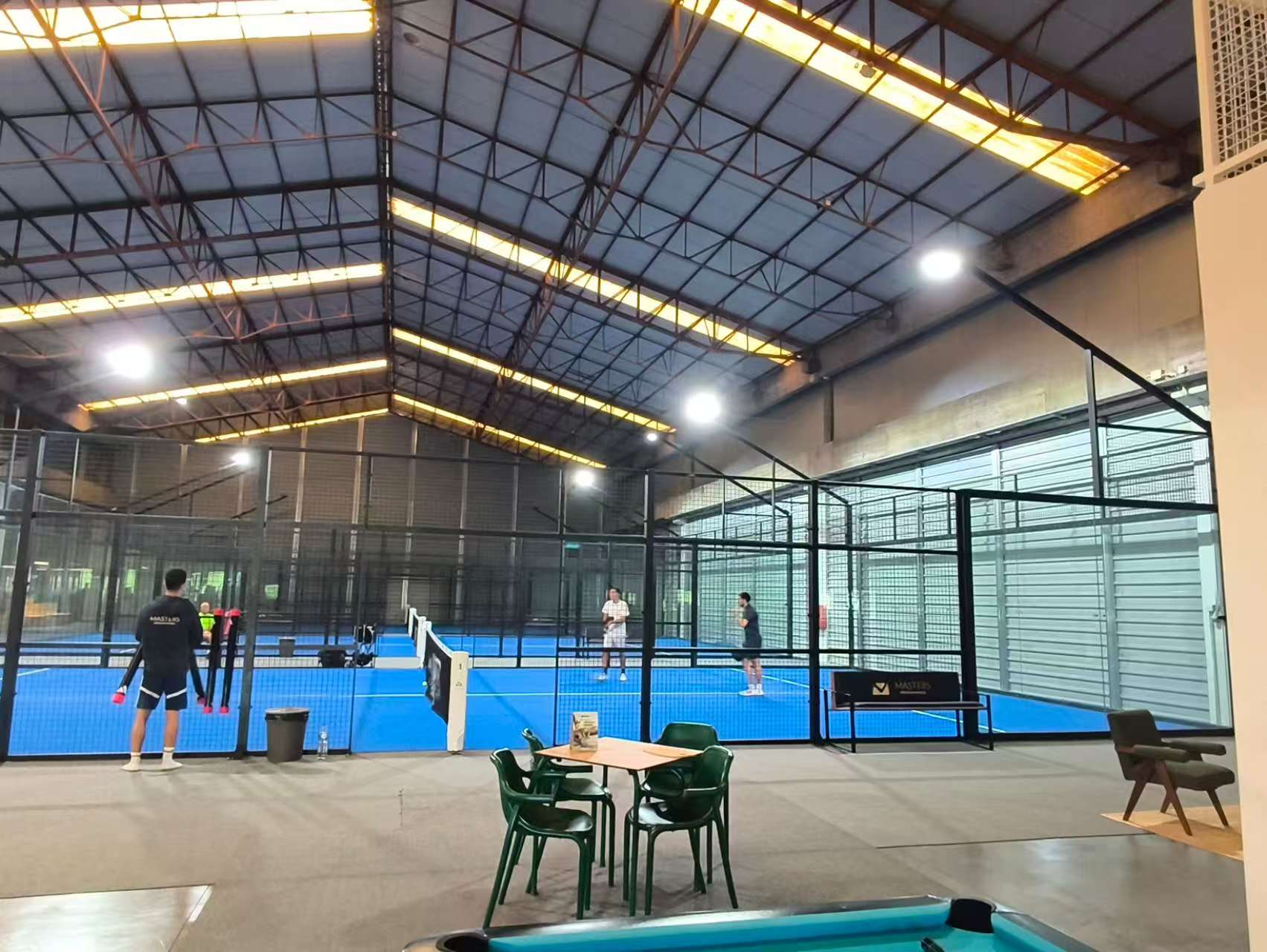
Step 5: Construction Sequence and Timeline
With courts ordered and approvals secured, construction follows a predictable sequence. Understanding this sequence lets you manage the critical path and avoid delay cascades that add cost.
Civil Works Phase (4 to 8 Weeks)
Site preparation, foundation excavation, reinforced concrete slab construction, sub-surface drainage installation, and underground electrical ducting. This is the most site-dependent phase with the highest variance in both cost and duration. Good ground conditions and an organised contractor mean 4 weeks; unexpected ground conditions or poor weather can mean 8 or more.
Court Structure Installation (1 to 2 Weeks per Court)
Steel structure erection, glass panel installation, artificial turf laying, net and fitting installation. An experienced team can complete a standard panoramic court in 5 to 7 days once the slab is ready. The full technical installation process — including Johannesburg-specific considerations for UV-rated turf, hail-resistant glass, thermal expansion provisions, and the complete commissioning checklist — is covered in detail in the padel court installation guide for Johannesburg.
Electrical and Lighting Phase (1 to 2 Weeks)
LED floodlighting installation, distribution board commissioning, and controls systems. For facilities investing in backup power for load shedding protection — which is strongly recommended for any Johannesburg padel facility running evening sessions — allow additional time for inverter and battery bank commissioning.
Ancillary Works (Concurrent Where Possible)
Clubhouse or F&B area construction, car parking, landscaping, CCTV and security systems. Running these concurrently with the electrical phase wherever the programme allows compresses the overall timeline.
Commissioning and Snagging (1 to 2 Weeks)
Testing all systems, measuring lux levels against specification, inspecting glass panels, verifying turf infill levels, and addressing defects. The commissioning process is the contractual moment at which defects must be recorded and the contractor is obliged to address them. A formal snagging list is the investor’s most important quality control tool.
Step 6: Pre-Opening Marketing — Build Your Membership Before You Open
The Johannesburg padel market is social and network-driven. The sport spreads through circles of friends, corporate colleagues, and existing sports community members. Your marketing strategy should exploit this network effect before any court opens.
The Founding Member Programme
The most effective pre-opening tool I used was a founding member programme launched six months before opening. Founding membership was offered at a meaningful discount — approximately 35 percent below standard rates — in exchange for full pre-payment at least 60 days before the opening date.
This simultaneously built a committed customer base before day one, validated real market demand, and provided working capital to help fund the final construction phases. We opened with 180 founding members. Of those, 140 renewed at standard rates in the second membership cycle. The founding cohort became our most vocal advocates — they had been part of the story from before the courts were even installed.
Where to Find Johannesburg Padel’s Core Audience
The fastest routes to your target audience in Johannesburg: tennis and squash clubs in your target area (racket sport players understand court hire culture and adapt quickly to padel), corporate networks in Sandton and Fourways (particularly firms with social and wellness programmes), Instagram and Facebook advertising geo-targeted to affluent northern suburbs postcodes, and partnerships with premium gyms and wellness operators whose memberships overlap directly with your target demographic.
Corporate Market Development
Johannesburg has the highest density of corporate headquarters on the African continent. Corporate clients — team events, client entertainment, inter-company leagues — typically represent 15 to 25 percent of a well-managed padel club’s monthly revenue. A corporate event booking generates R5,000 to R15,000 in combined court hire and F&B revenue. Developing corporate account relationships actively from pre-opening creates revenue stability from month one.
Step 7: Operational Model — What Successful Johannesburg Padel Clubs Get Right
Opening is the starting line, not the destination. The operational decisions made in the first year determine whether your club builds a community that sustains itself for a decade or struggles to retain members beyond their initial purchase.
Professional coaching is non-negotiable for any commercial padel club in Johannesburg. Players who improve stay; players who plateau leave. A professional coach running structured group coaching generates R30,000 to R60,000 per month in direct revenue while simultaneously improving the skill level of your membership — which improves retention and word-of-mouth simultaneously.
Social programming drives retention beyond skill development. Weekly social round robins, team leagues, beginner nights, and inter-club competitions create community. Community is what keeps members paying monthly fees year after year, even when their personal schedules become complicated.
Right-sizing the F&B offer matters more than most investors expect. Johannesburg padel players want quality drinks and light food in a social bar atmosphere after play. They do not need a full restaurant. Over-investing in a full kitchen operation at a padel club creates operational complexity without proportionate revenue — a common and expensive mistake. For the broader framework on padel club business planning, the guide on comment ouvrir un club de padel covers the full financial modelling and club management framework.
Frequently Asked Questions: How to Build a Padel Club in Johannesburg
Ready to Build a Padel Club in Johannesburg?
To build a padel club in Johannesburg is genuinely achievable for investors who plan carefully and execute systematically. The market is there, the demand is real, and the financial model works for operators who build the right community in the right location with the right court infrastructure.
The investors who succeed treat this as the business it is — with a clear model, realistic cost planning, a membership community built before opening, and courts sourced from a manufacturer who understands Johannesburg’s environmental requirements. The investors who fail are the ones who rush past the planning work and discover what it costs to fix problems after construction has started.
PanoCourt works with padel club investors at every stage of the development process — from initial specification and cost planning through engineering documentation, factory-direct procurement, and installation support. Contact the PanoCourt project team via panocourt.com/contact to discuss your Johannesburg padel club development.