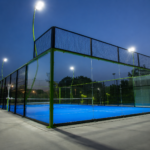
A cour de padel panoramique cost in South Africa from around R240,000 per court when you source the structure directly from a China fabricant de terrains de padel and handle local installation yourself. In Johannesburg, Durban and Cape Town, a turnkey single court — including the imported steel structure, glass, turf, lighting, ocean freight, duties and on-site installation — typically lands between R240,000 and R420,000, depending on the model (classic padel court vs full panoramic padel court), site conditions and who installs it.
You can also directly choose to contact the local padel court constrution company to give you a complete quotation. For example, the local padel court constrution company in South Africa like synsports and padelbuild will quote between 498,000rand.
If you are pricing a four-court padel club, the bigger numbers are venue rent and groundwork, not the courts themselves. This guide breaks down every cost line using real South African rental data, a working China-vs-Spain factory comparison, and a simple ROI model so contractors, installers and club investors can budget accurately.
What Are the Main Components of Padel Court Cost in South Africa?
The total Padel Court Cost in South Africa splits into five parts: venue rent, the padel court product itself, design and permits, installation and groundwork, and ongoing maintenance. Below is each component costed for South African conditions.
1. Venue Rent
A single padel court measures 20m × 10m, so you need roughly 220m² per court once you allow for run-off and circulation. A four-court club therefore needs at least 1,000m² of clear floor space, plus reception, change rooms and a pro shop.
Industrial and warehouse space is the most common base for indoor padel in South Africa. Listed Johannesburg warehouse rentals currently run roughly R40–R75 per m² gross per month for large units, while prime stand-alone commercial space in nodes like Claremont in Cape Town can reach R180–R250 per m². For a realistic indoor club, budget on the industrial end of that range.
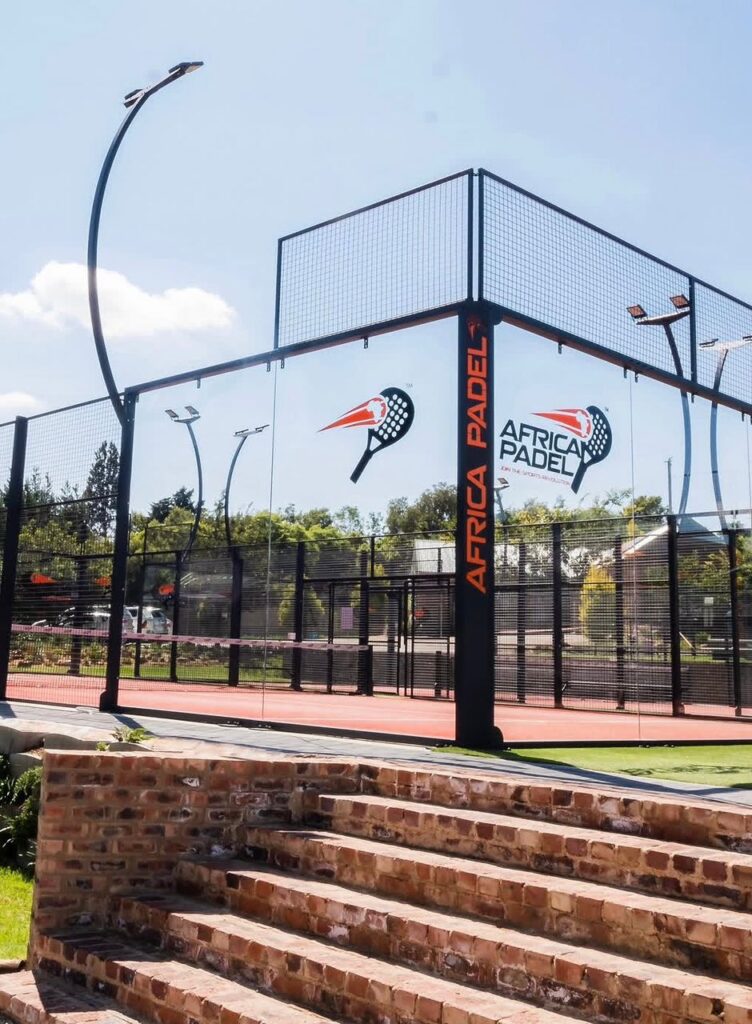
Worked example for a 1,000m² four-court site at R60/m²/month: that is R60,000 per month, or R720,000 per year, before utilities. Established operators such as Africa Padel (over 21 clubs nationally, first built in Camps Bay in 2021) and Virgin Active Padel Club run venues across Sandton, Lonehill, Green Point, Durbanville and Umhlanga — useful reference sites when you benchmark location and footfall.
2. Buying from Padel Court manufacturer: Court de padel en Chine vs Spain
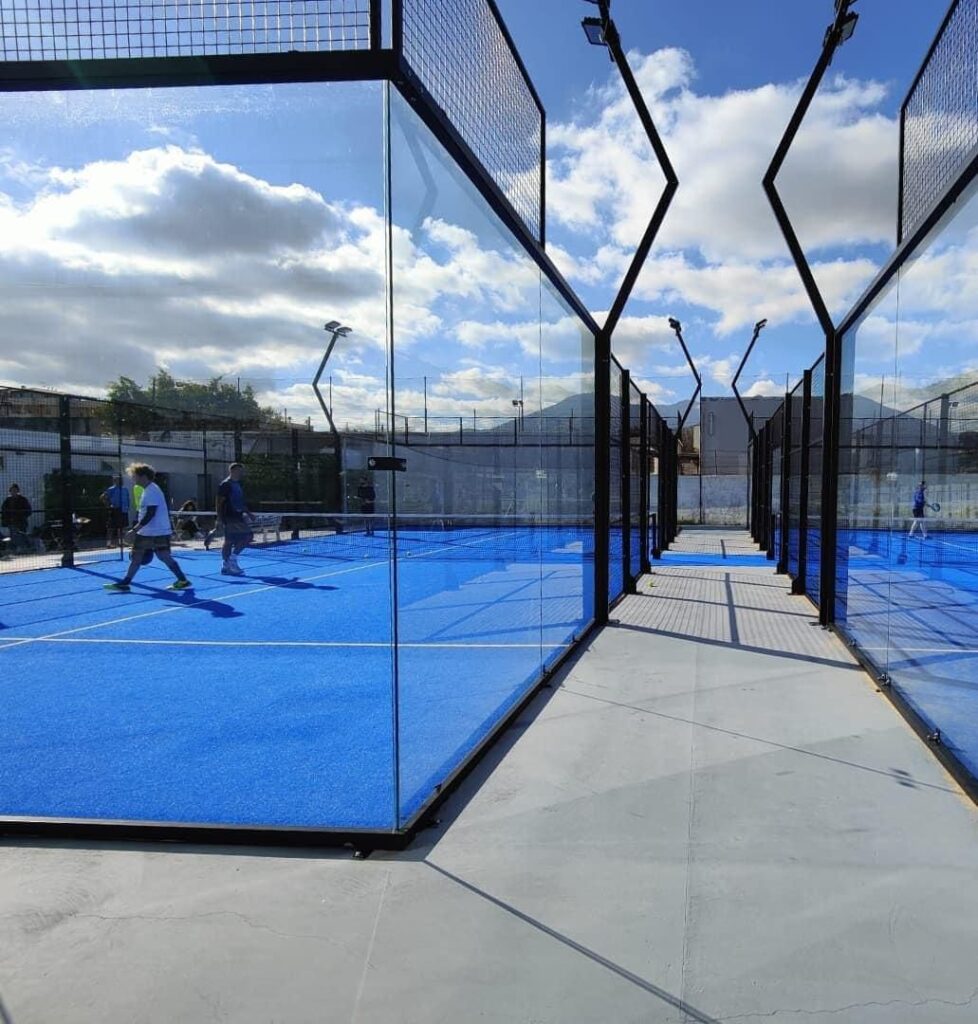
The court itself is the line item where sourcing decisions move the budget most. The two real options are a Fabricant chinois de terrains de padel or a Spanish brand. The hardware does the same job; the difference is price, lead time and customisation.
Below is a like-for-like comparison using PanoCourt’s own P001 panoramic specification against typical premium Spanish output.
| Article | China factory (PanoCourt) | Spanish factory |
|---|---|---|
| Full panoramic set (structure + turf + lighting) | $8,500–$12,000 | €25,000–€40,000 |
| Margin headroom for installer | Élevé | Inférieur |
| Délai de livraison | 25–35 days | 45–90 days |
| Personnalisation | Fort | Moyen |
It is an open secret that many European installers themselves source the court structure from a China factory, complete installation locally, and sell under their own brand. The engineering is comparable when the specification is controlled properly — which is why the spec, not the postcode of the factory, is what matters.
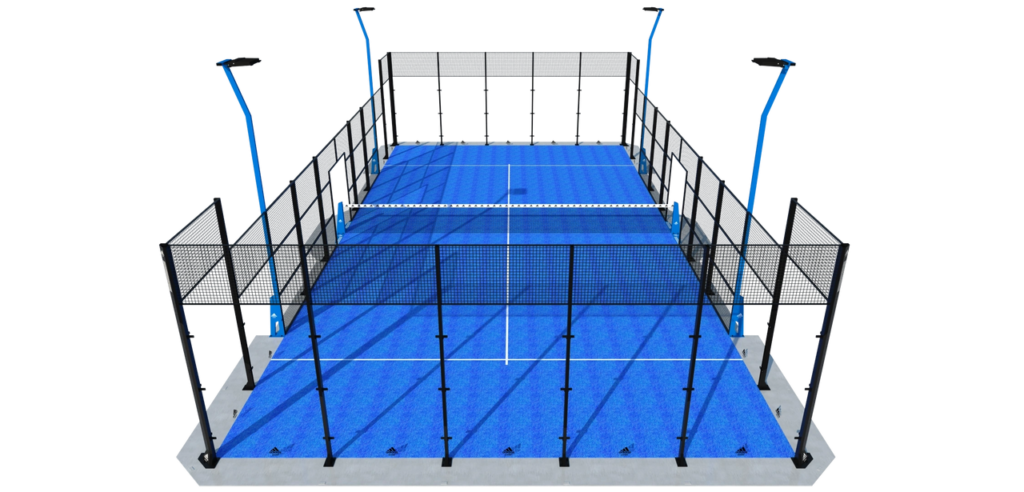
PanoCourt P001 Panoramic — Technical Specification
The PanoCourt panoramic padel court is mejorset alternative built to handle South Africa’s coastal and high-veld climates. Core specification:
- Structure métallique
Q355 steel preferred (Q235 acceptable if certified and justified)
Hot-dip galvanized
Laser cut
Robotic welding
One-piece formed sections where possible
Smooth ground welds
No visible weld defects - Peinture en poudre
Premium polyester powder (AkzoNobel / Interpon / Jotun preferred)
80–100 micron minimum
UV resistant
Salt spray tested
Smooth automotive-quality finish - Verre
12 mm tempered safety glass
Polished edges
Certified
Low distortion
Premium edge protection - Gazon
- Maille
Hot-dip galvanized
50×50×4 mm
One-piece panels
Perfect alignment
No waviness - Matériel
Stainless steel (304 minimum, 316 preferred)
Concealed fixings wherever possible
No exposed threaded ends
Premium hinges and locks - Finish & Aesthetics (Highest Priority)
Hidden bolts and screws wherever structurally possible
Hidden glass fixing system
Flush joints
Clean corners
Internal cable routing
Luxury European appearance comparable to MejorSet/Padel Galis - Éclairage
Flicker-free LED
Anti-glare optics
300–500 lux
Uniform lighting
The full court FOB price (Tianjin port, China) is $10050-$18000 per court covering the complete steel structure, tempered glass, mesh panels, net post and centre net, LED lighting, turf and all fittings. FOB excludes ocean freight, marine insurance, port charges and South African import duties. panocourt offer custom padel court design and procesing
Premium Spanish brands such as MejorSet and Padel Galis set the visual benchmark for finish — concealed glass fixings, flush joints, internal cabling. The PanoCourt finish-and-aesthetics package targets that same standard at China-factory pricing.
3. Design and Permit Costs
Design and permitting depends on whether the court is indoor (inside an existing zoned building) or a new outdoor build. For most indoor conversions, drawings and municipal sign-off are a minor line relative to the court and rent.
Requirements vary by municipality, so confirm zoning and any building-plan approval with your local council before ordering. For a standard indoor fit-out, this cost is usually small enough to treat as negligible in a first-pass budget.
4. Installation and Groundwork
This line covers the concrete base, court assembly and commissioning. The court structure needs a level concrete slab with correct drainage fall; getting the foundation right is the single biggest determinant of long-term court life and play quality.
On-site assembly of a single court typically takes a small crew 3–7 days once the slab has cured. You can use a local padel court installation contractor, or PanoCourt can supply installation drawings, a branded manual and remote technical support so a general steel crew can complete the build.
5. Maintenance and After-Sales
Padel courts are low-maintenance but not no-maintenance. Budget for periodic turf brushing and infill top-up, glass cleaning, bolt checks and occasional LED driver replacement. A powder-coated, hot-dip galvanized structure is specified precisely to keep this cost low in coastal Durban and Cape Town humidity.
Total Cost Summary: One Padel Court vs a Four-Court Club
| Cost line | Single court (indoor) | Four-court club (indoor) |
|---|---|---|
| Court product (FOB, ex-works) | ~R165,000 | ~R660,000 |
| Freight, insurance, duties, port | ~R35,000–R55,000 | ~R140,000–R200,000 |
| Installation + groundwork | ~R40,000–R120,000 | ~R200,000–R450,000 |
| Design + permits | Minor | Minor–moderate |
| Indicative total (ex-rent) | From ~R240,000 | From ~R1.0m–R1.3m |
| Annual venue rent (1,000m²) | — | ~R720,000/year |
Figures are indicative 2026 estimates at roughly R18.5/USD; confirm against a live quotation, the prevailing exchange rate, and current SARS import tariffs before committing.
How to Import a Padel Court From China to South Africa?
Importing is straightforward once you understand the price term. The PanoCourt quotation is FOB /CIFTianjin, so the factory price excludes shipping and destination charges — you arrange those, or ask the factory to quote CIF Durban or CIF Cape Town.
The typical sequence:
- Confirm specification and quantity. One 40ft container fits multiple courts; PanoCourt applies a small per-set container surcharge ($200/set for 40ft, $350/set for 20ft).
- Agree the price term. FOB to keep control of freight, or CIF for a delivered-to-port price.
- Production : 25–35 days for a panoramic set.
- Fret maritime : roughly 25–35 days Tianjin to Durban or Cape Town.
- Clearing and duties: appoint a local clearing agent; pay SARS import duties and VAT against the correct tariff heading.
- Inland delivery and installation.
Plan for roughly 8–11 weeks from deposit to courts on site. Confirm the current duty rate with your clearing agent, as it determines whether China sourcing keeps its cost advantage after landing.
Is Investing in a Padel Club in South Africa Worth It? ROI Breakdown
Padel is one of the fastest-growing sports in South Africa, and court utilisation in major metros is strong. Published South African club rates give a solid basis for a revenue model: roughly R300–R400 per hour off-peak and R500–R600 per hour for indoor peak slots in Johannesburg.
Simple per-court model at a R400 blended hourly rate:
- 8 booked hours/day × R400 = R3,200/day per court
- ~26 trading days/month = ~R83,000/month per court
- Four courts ≈ R330,000/month gross at that utilisation
Against an indicative R1.0m–R1.3m build and ~R720,000/year rent, a well-located four-court club at healthy utilisation can target payback inside two to three years. The sensitivity is utilisation: drop to 4–5 booked hours per court per day and the model tightens considerably. Coaching, league fees, a pro shop and food and beverage materially improve the return.
These are illustrative figures, not financial advice — model your own site, rate card and occupancy before investing.
[Image suggestion: chart of monthly revenue vs utilisation rate. Alt text: “padel court ROI South Africa by utilisation”.]
What Are the Leading China Padel Court Factories?
China is the largest manufacturing base for padel courts globally, supplying both direct buyers and many European brands. When you evaluate a China padel court manufacturer, judge on specification and finish rather than on price alone.
Key things a serious manufacturer should demonstrate:
- Steel grade and treatment: Q235 or Q355 structural steel, hot-dip galvanizing and electrostatic powder coating for corrosion resistance.
- Certified glass: 12mm tempered safety glass with test certificates.
- Finish standard: concealed fixings, flush joints, internal cabling — the details that separate a classic padel court from a premium full panoramic padel court.
- Export experience: documented shipments, installation manuals and after-sales support.
PanoCourt manufactures classic, panoramic and super panoramic models with strong customisation and 25–35 day lead times, and supports installers with full documentation. For South African buyers comparing build a panoramic padel court cost across suppliers, request a line-by-line specification sheet from each factory so you are comparing identical builds.
China has only started padel court production in the past three years. At first, some customers consulted trading companies to look for this product. Due to the production capacity and raw material advantages of Chinese factories, it has developed into a major padel court production country in 2025. At present, the earliest product research and development field of padel court is pano court. From design to raw materials to production, everything is controlled internally, and product quality meets European certification.
Padel Court Cost in South Africa FAQ
How much does it cost to build a padel court in South Africa?
A single turnkey court starts from around R240,000 when the structure is imported from a China factory and installed locally. A four-court club typically runs R1.0m–R1.3m for courts plus installation, before venue rent.
How much does a panoramic padel court cost compared with a classic padel court?
A full panoramic padel court uses larger glass panels and a cleaner structure, so it costs more than a classic padel court. From a China manufacturer a full panoramic set runs roughly $8,500–$12,000 versus €25,000–€40,000 from a Spanish factory.
How long does it take to receive a padel court ordered from China?
Production is 25–35 days and ocean freight to Durban or Cape Town is roughly 25–35 days, so plan for about 8–11 weeks from deposit to delivery, plus clearing and installation.
What are the import duties on a padel court in South Africa?
Duties and VAT are charged by SARS against the relevant tariff heading. Rates change, so confirm the current figure with a clearing agent before ordering — it affects the landed-cost advantage of China sourcing.
How much space do I need to build a padel court?
A court is 20m × 10m. Allow about 220m² per court with run-off, and at least 1,000m² for a four-court club plus reception and change rooms.
What foundation does a padel court need?
A level concrete slab with correct drainage fall. A sound, flat foundation is the most important factor in long-term durability and consistent play.
Should I buy a padel court from China or a local South African supplier?
China sourcing usually lands cheaper with stronger customisation and shorter lead times. Many local and European suppliers import the same structures and resell them. Buying direct removes that markup if you can manage logistics and installation.
How long does it take to install a padel court?
Once the concrete base has cured, a small crew assembles a single court in about 3–7 days.
Is a padel court a good investment in South Africa?
At strong utilisation and a sensible location, a four-court club can target payback within two to three years. The main risk variable is booked hours per court per day.
Do I need planning permission to build a padel court?
It depends on your municipality and whether the build is indoor or outdoor. Confirm zoning and building-plan requirements with your local council before ordering.
SEO title: How Much Does It Cost to Build a Padel Court in South Africa? (2026 Guide)
Meta description: Full 2026 cost breakdown for building a panoramic padel court in South Africa — rent, China vs Spain court supply, installation and ROI. From R240,000 per court.