
Padel court glass flexes for a split second on every hard smash, because a 12 mm toughened panel is strong but no stiffer than ordinary glass of the same thickness. What should worry you is a knock, a buzz or a panel that keeps moving. That almost always traces back to drilling, isolation, the frame or the installation, not to the country where the court was made.
Written by Macy Zhou, Senior Product Manager at PANO (PanoCourt). I have worked in the sports-facility industry for ten years and have led the development of more than ten padel court products at our factory in Handan, Hebei. Last updated: 9 November 2026.
I wrote this guide because “the glass shakes” is one of the most common messages I receive from club owners after opening, and one of the most common worries I hear before they order. Below I explain what movement is normal, how to find the real cause of noisy padel court glass, what UK guidance from SAPCA and the LTA says, and which drawings and records I would ask any manufacturer for, including us. These are buying and inspection checks, not PANO test results, and they do not replace your local engineer or installer.
In this guide:
- Why padel court glass vibrates on hard smashes
- How much movement is normal
- Which glass specification to ask for
- How fixings and isolation change the result
- Whether the steel frame matters
- How installation and the foundation affect the glass
- How often to inspect glass fixings
- Which documents to request
- How to compare suppliers fairly
- Buyer questions
- What to do before you order
Why does padel court glass vibrate on hard smashes?
Padel court glass vibrates because each panel is a large plate held at a few fixing points, and a smash lands a sharp impact near its middle. A brief flex that settles at once is physics. A rattle, a metallic knock or movement that keeps going points to loose or poorly isolated fixings, misaligned holes, a flexible frame or uneven installation.
One detail surprises many buyers: toughening makes glass much stronger, but not stiffer. The Glass and Glazing Federation toughened-glass guidance notes that toughened and annealed panes of the same thickness deflect by the same amount under the same load. So a panel can feel lively under a hard hit and still be perfectly sound.
- The SAPCA Code of Practice calls for countersunk fixings on glass rebound panels, to avoid irregular ball response.
- SAPCA also asks for a gap of 3 to 6 mm between panels, so neighbouring panels never strike each other.
- Country of origin is not a cause on its own. The same design, fixing and installation checks apply to every supplier.
When a club sends me a video of a “shaking” wall, I ask for one thing first: a slow-motion clip filmed close to the fixing during a hard hit, with the panel position noted. Very often that clip alone shows whether we are looking at a clean flex that settles, or at a fixing that visibly moves against the post.
How much padel court glass movement is normal?
A panel that flexes and settles almost immediately, with no knock, click or buzz from its fixings, is behaving normally. Movement alone is not a defect. The warning signs are noise at the fixings, panels touching at a joint, fresh chips around holes, or a glass face that no longer sits flush with the mesh above it.
Toughened glass is also far safer than ordinary glass if it does fail. The SAPCA Code of Practice for the Construction of Padel Courts (5th edition, September 2025) notes that it breaks into small, blunt pieces. Players usually notice differences between courts more than absolute movement: panel size, the number of fixing points, frame sections and how the glass sits on its base all change how a wall feels.
Which warning signs point to a fixing or installation problem?
- A metallic knock or click at a bolt, which can mean glass or bolt is touching bare steel.
- A buzz along a vertical joint, which can mean two panels are touching or the gap is uneven.
- Visible movement of the panel relative to the post, which can mean a fixing has loosened.
- Fresh chips around holes or edges, which need inspection before more play.
- A glass face sitting proud of the mesh, or a wall that is visibly out of plumb.
Treat these as reasons to inspect, not as a diagnosis. I always recommend that a competent installer checks the specific fixing before anyone tightens or replaces parts, because tightening a bolt that bears on bare steel can turn a small problem into a cracked panel.
What padel court glass specification should I ask a manufacturer for?
Ask for thickness, glass type, panel size and count, drilling pattern, edge finish, the toughening standard and the test-report holder, all for the exact model you are buying. For outdoor and canopy courts, UK guidance uses 12 mm toughened padel court glass with a kitemark on every panel.
- SAPCA states 12 mm toughened glass for outdoor or canopy courts, says 10 mm should not be considered for UK wind loading, and allows 10 mm to be considered indoors.
- The LTA Padel Court Construction Guidance Note (2025) lists 12 mm toughened glass with a BS EN Kitemark on each panel as its minimum outdoor specification.
- EN 12150-1 covers tolerances, flatness, edgework and fragmentation of thermally toughened safety glass; the current edition is EN 12150-1:2015+A1:2019.
- Heat-soaked toughened glass falls under a separate standard, EN 14179-1, so ask whether it applies to your quotation.
- The FIP Rules of Padel ask for walls with a uniform bounce made to tempered-glass standards. These are rules of play, not a product approval.
What does a real PANO glass schedule look like?
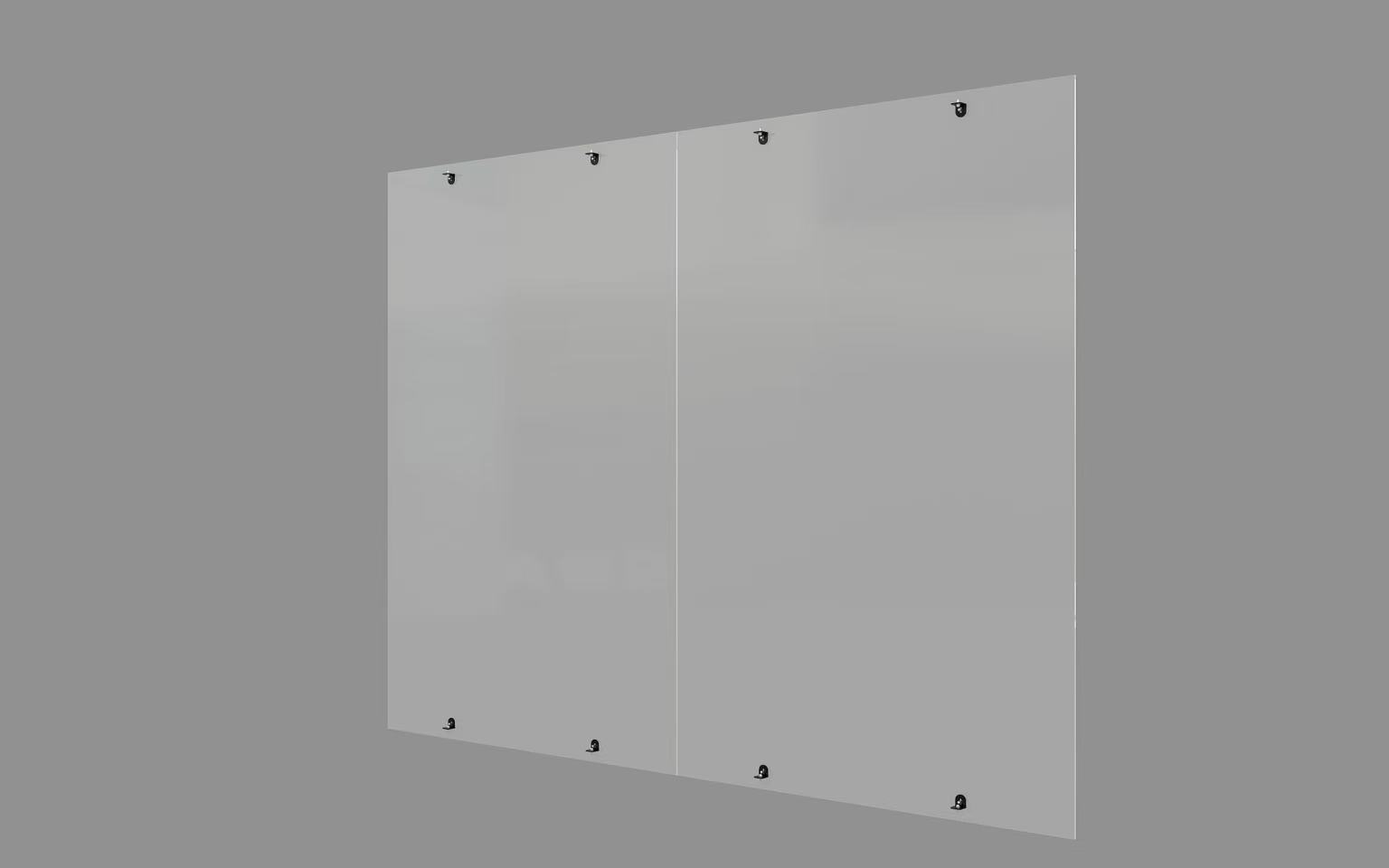
In the P001 Panoramic quotation we issued on 1 November 2026, the padel court glass is 18 panels of 12 mm tempered safety glass per doubles court, each 1,995 × 2,995 mm, with a four-hole connection. We also make two-hole and eight-hole patterns, but the drilling is always fixed by the model drawing, because the glass and the frame must be made to the same holes.
I share that example so you can see what a complete line looks like, not as a universal specification. If a quotation simply says “12 mm glass”, I would send it back and ask for the rest of the line before comparing prices.
What does an EN 12150 report prove about padel court glass?
An EN 12150 test report is evidence for the tested glass only. It says nothing about the frame, the fixings or the installation, so it cannot settle a vibration question by itself. Ask who holds the report, which product and thickness were tested, the date, and how the delivered batch is identified against it. Our padel court materials and specifications guide covers the rest of the bill of materials.
How do fixings and isolation affect padel court glass vibration?
Fixings decide how the glass is held, so they shape how a panel sounds on impact. Bolts should sit countersunk and flush, holes should line up without forcing, and bushes, gaskets and setting blocks should keep padel court glass away from bare steel. A weakness in any one of these can turn a normal flex into a knock.
- SAPCA and the LTA both call for countersunk fixings on glass rebound panels.
- The LTA minimum specification lists stainless steel bolts, washers and nuts.
- GGF guidance says glass-to-metal contact must be eliminated by gaskets, bushes, linings and setting blocks approved by the glass manufacturer.
- The same guidance asks for fittings free of burrs and high spots, with even clamping pressure.
- Toughened glass cannot be drilled after toughening, so every hole is made beforehand and cannot be corrected later.
Why do hole positions matter so much?
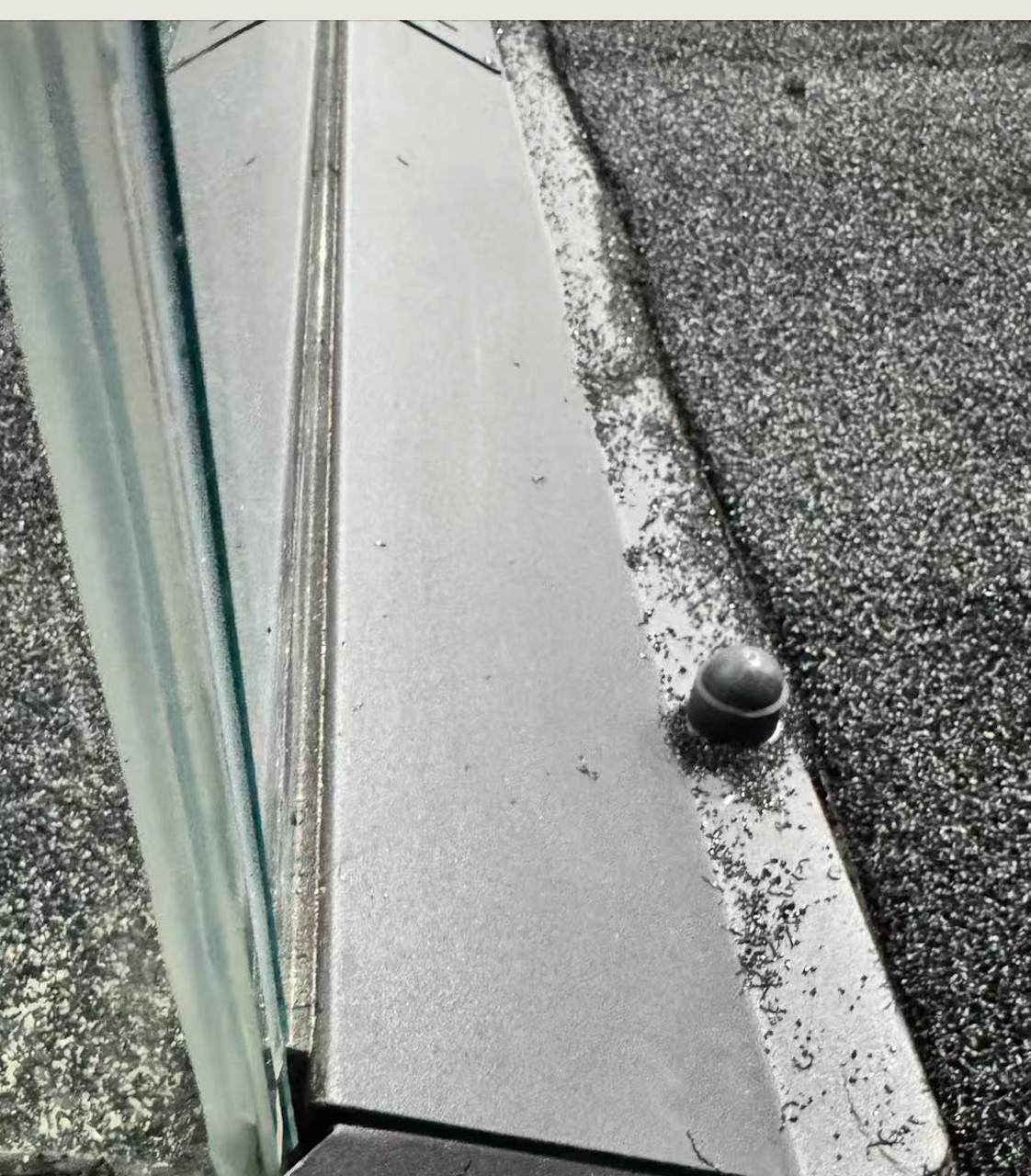
Because every hole is drilled before toughening, a hole in the wrong place stays in the wrong place. If glass holes and frame holes do not line up, installers may force a bolt, leave a fixing loose or let a bolt shank bear on the glass. On a recent production order, our instruction to the workshop singled out mesh-frame diagonals and installation-hole positions as the critical checks, because those dimensions decide whether the glass goes on without force.
What should isolation between glass and steel look like?
No hard contact anywhere: a sleeve or bush through the hole, a gasket or washer on each face, and setting blocks where the glass rests. Ask what each part is made of, whether it suits outdoor exposure and how it is replaced during maintenance. We offer visible or concealed glass-connection details on our models, and whichever you choose is frozen in the approved drawing before production. Our guide to padel court structures compares the main connection types.
Does the steel frame change how much padel court glass moves?
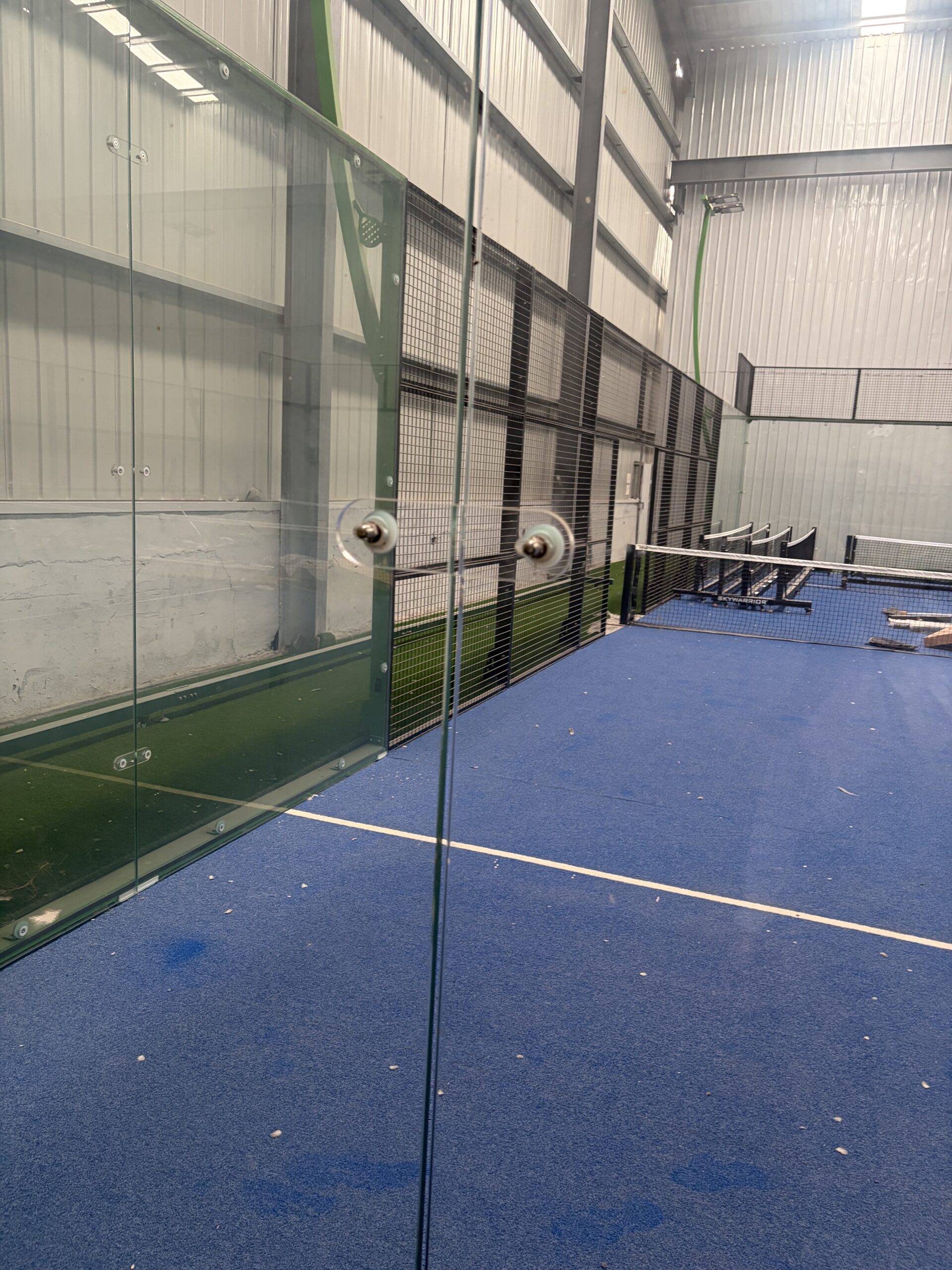
Yes. The glass hangs on posts and beams, so a lighter or less rigid frame lets the whole wall move more under impact and wind. Section sizes, wall thickness, post spacing and base plates all matter, and your local engineer should check them against site loads before you place the order.
- SAPCA recommends a minimum 3 mm thickness for steel profiles.
- The LTA minimum specification gives a 3 mm minimum wall thickness for support posts and floodlight columns.
- SAPCA asks the manufacturer to state the maximum windspeed the court can withstand, and suggests reinforced posts on coastal or exposed sites.
- Posts are fixed to the concrete ring beam through base plates and anchor bolts, with resin anchors also an option.
Here is a real frame line from the same 1 November 2026 P001 quotation: 100 × 100 × 3 mm corner posts, and 50 × 100 × 3 mm intermediate posts, crossbeams and lighting posts. An earlier indoor template of ours used 2.5 mm walls. That is exactly why I tell buyers to compare schedules, not model names: two courts sold under similar names can use different sections, and the padel court glass will feel different on each.
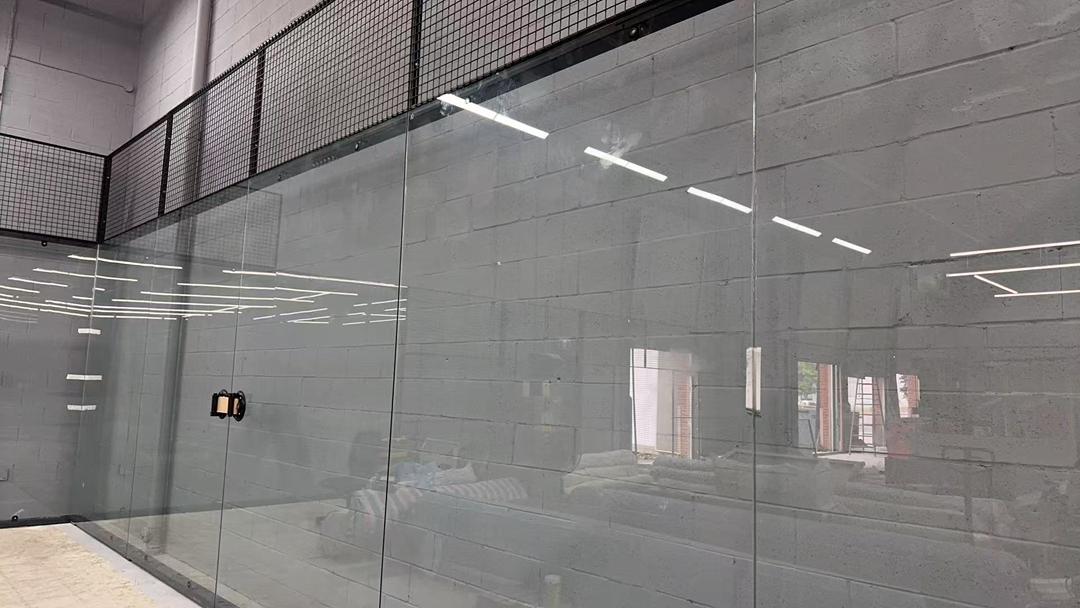
Wind travels through the same glass, fixings, frame and anchors as a smash. Our padel court wind load guide covers site exposure, and the outdoor panoramic padel court structure article explains frame choices for exposed sites. Your engineer confirms the final design.
Can installation or the foundation make padel court glass rattle?
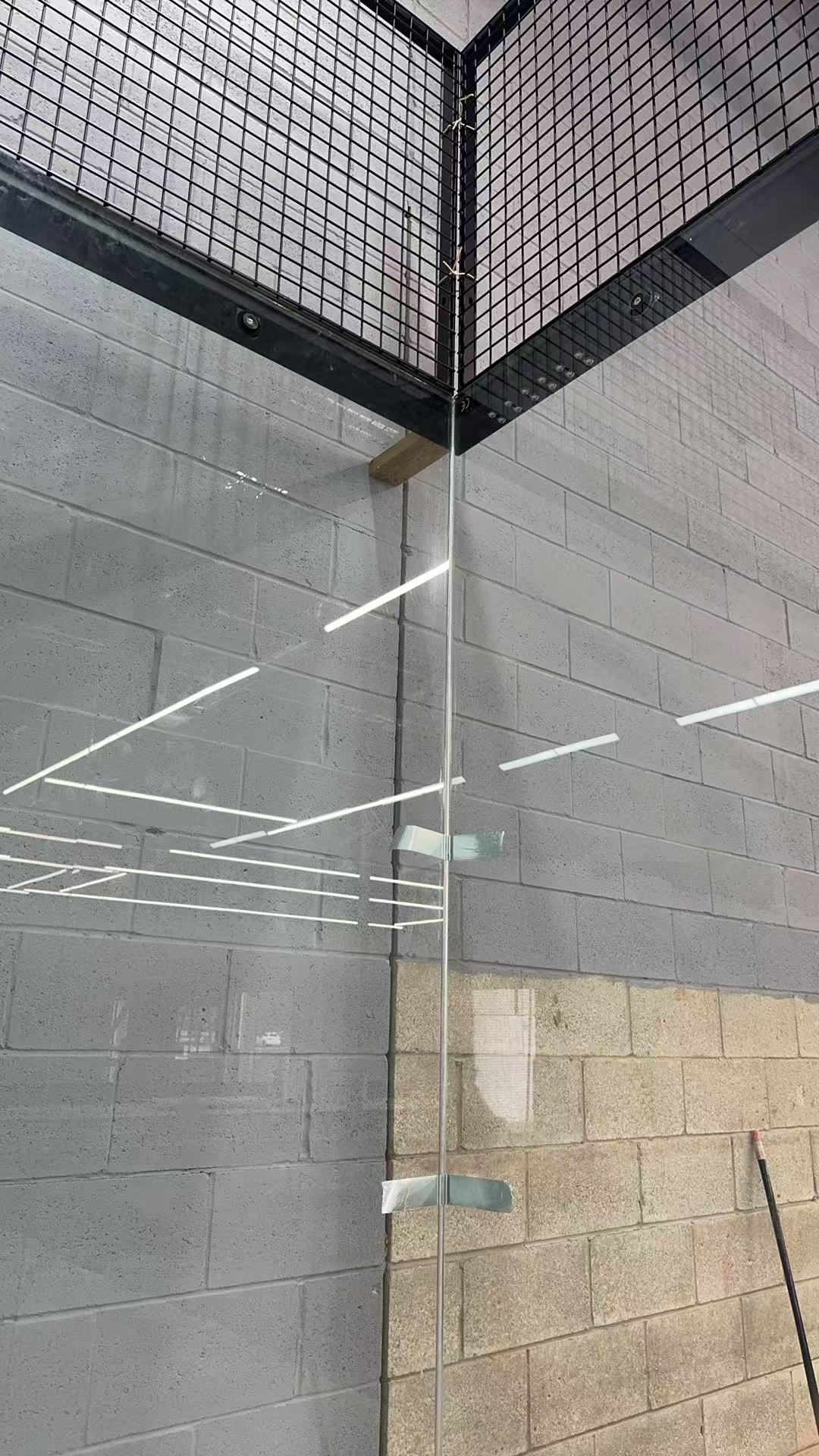
Yes. An uneven slab, misaligned base plates or out-of-plumb posts pull the frame out of line, and the padel court glass follows it: panels touch at joints or bear unevenly on their fixings. Installation faults can look exactly like manufacturing faults, which is why installation records matter as much as factory drawings.
- SAPCA sets the gap between glass panels at no less than 3 mm and no more than 6 mm, uniform along the joint, because tempered glass expands and contracts with temperature.
- Glass and mesh inner faces should finish flush, with neither surface protruding.
- Base plates and anchors connect the frame to the slab, so their position and level affect every panel above them.
- Joint gaps that close up over time are a sign that something in the frame or base has moved.
For one UK indoor project we quoted this autumn, the preliminary flatness target we discussed with the client was no more than 3 mm under a 2 m straightedge, with M14 × 150 mm anchors. Those were inputs for that client’s engineer, not a universal approval, but they show the level of detail the slab conversation needs before a single glass panel is lifted.
Who controls which part of the result?
The manufacturer controls hole positions, fittings, frame sections and the tolerances written on the drawing. The installer controls slab readiness, anchoring, alignment, joint gaps and final tightening. Neither side can fully make up for the other. Our support is guidance and remote help: approved drawings, labelled parts, an installation manual, reference videos, remote technical guidance and an interface checklist that includes glass handling. You agree the local installation team directly. For the full process, see our padel court installation guide, the club owner installation checklist and our padel court foundation requirements.
How often should padel court glass fixings be inspected?
Inspect the glass and its fixings on a fixed schedule, tighten anything loose and keep a written log. UK guidance differs on the interval: SAPCA asks for monthly checks of glass and structure fixings with torque assessed, while the LTA guidance note suggests weekly visual glass checks and bolt checks every 6 to 12 months.
- SAPCA warns that if enclosure fixings are allowed to loosen, the structural integrity of the court can no longer be relied on.
- SAPCA asks for anchor points and base plates to be checked monthly and after storms.
- The LTA note recommends an inspection log and prompt reports to the contractor about any concern.
| Check | SAPCA Code of Practice | LTA guidance note |
|---|---|---|
| Glass fixings | Monthly, torque assessed | Bolts every 6 to 12 months |
| Anchors and base plates | Monthly and after storms | Joints checked for corrosion |
| Glass surface | Not in the cited sections | Weekly, cracks and chips |
Where the two disagree, I suggest the stricter interval unless your installation manual and local contractor agree a documented plan. Neither document publishes torque values, so use the values in your own court’s installation documents rather than a figure found online.
What should a padel court glass defect report include?
If a fixing or panel still looks wrong after tightening, we ask for the order number, component code, photos, installation date, a short description and, ideally, that slow-motion clip. With those in hand, both sides can work out whether the cause is manufacturing, shipping, installation or normal wear, and agree the remedy under the contract.
What padel court glass documents should a manufacturer provide?
Ask for a document register listing each document’s issuer, holder, tested product, standard, date and scope. Alongside it, request the approved drawings, glass test documents for the actual glass source, packing details and the inspection records agreed for your order. A register shows what each paper supports, and just as usefully, what it does not.
- Approved general arrangement and shop drawings, including the glass-connection detail and drilling pattern.
- Glass manufacturer and test documents for the actual glass source, with a note of how the delivered batch is identified.
- A model-specific bill of materials and packing list showing glass, fittings and any agreed spare panels.
- The installation manual and the inspection records agreed for the order.
- Component-level documents or voluntary attestations, labelled as such rather than as approval of the whole court.
Send your engineer the register before you order, not the folder after delivery. If your tender names a specific standard or clause, quote it exactly and ask for an available-document list with a gap register, so missing evidence is visible early.
Which factory checks can you agree before shipment?
For a confirmed order, we agree checks on material and component identity, critical dimensions, mesh-frame diagonals, installation-hole locations, weld finish, coating, glass and hardware matching, labelling and packing. Where a hole-position tolerance is critical, its numeric limit goes on the approved drawing and is measured before coating or packing. Our steel is cut on laser equipment and finished on an automated coating line in Handan, and you can review the stages relevant to your model through factory photos or a live video walk-through.
How is padel court glass protected in transit?
Each panel is individually protected for export, and the 1 November 2026 P001 quotation describes wooden crates and steel banding. Agree glass handling, lifting equipment, arrival inspection and any spare-panel packing before dispatch, so damage on arrival can be recorded and resolved without argument.
How do I compare padel court glass between suppliers fairly?
Ask every supplier for the same items in the same format: glass specification and documents, connection drawing, isolation parts, frame sections, anchors, spare panels and inspection records. Brand names and country of origin do not describe a court. Only a like-for-like schedule shows where the padel court glass and its support really differ.
- Check that the glass, fixings and frame all come from one approved drawing.
- Confirm what each warranty covers for glass, fixings and frame, and what it excludes.
- Review installation scope separately, because the installer affects the result as much as the factory.
- Treat online opinions about named brands as prompts for questions, not as evidence.
| Item | What to request | Why it matters |
|---|---|---|
| Glass | Thickness, type, panel size, standard, report holder | Confirms what is supplied |
| Connection | Drawing with bolt, isolation and hole positions | Shows how the glass is held |
| Frame | Post and beam sections with wall thickness | Affects wall stiffness |
| Records | QC and installation checklists | Shows what was checked |
If you already hold a competing specification, share it and ask each supplier to mark the differences line by line. Real differences, such as a thinner post wall or a missing isolating bush, show up quickly. Removing safety-critical items to lower a headline price is a poor trade. Our panoramic padel court manufacturer checklist and padel court manufacturer page explain how we work with clubs, contractors and distributors.
What else do buyers ask about padel court glass?
Is 10 mm or 12 mm padel court glass better?
For outdoor and canopy courts, 12 mm toughened glass is the UK reference: SAPCA says 10 mm should not be considered for UK wind loading, while it may be considered indoors. The right thickness also depends on the frame, drilling and local wind design, so confirm it on the model drawing and with your engineer rather than choosing by number alone.
Is padel court glass vibration a manufacturing or an installation problem?
It can be either, or both. The manufacturer controls hole positions, fittings, frame sections and drawing tolerances. The installer controls slab readiness, anchoring, alignment, joint gaps and tightening. A slow-motion clip, panel photos and the installation checklist usually show which side to investigate first.
How is padel court glass safety ensured?
Safety comes from several layers working together: toughened glass that breaks into small blunt pieces, countersunk fixings, flush glass and mesh faces, isolation between glass and steel, anchors designed for the site, and regular inspection. No single certificate or component makes a whole court safe on its own.
Who is responsible if padel court glass breaks?
Responsibility follows the signed contracts. The supply contract and warranty schedule define covered defects, exclusions and claim evidence for each component. Transport damage depends on the arrival inspection and its records, and installation workmanship sits with the installer contract. Agree all three before the court ships.
How quickly can a broken glass panel be replaced?
There is no single answer for every site. It depends on whether spare panels were ordered, the production schedule, freight and local fitting. Because toughened glass cannot be drilled after toughening, a replacement must match the original thickness and drilling pattern, so agree spare-panel quantities in the order documents.
Where can I get replacement padel court glass if my court came from China?
Start with the original manufacturer and quote the order number, component code and drawing revision. A local glass processor can only supply a matching panel if it has the exact drilling drawing and drills before toughening. For multi-court sites, agree a spare-parts list before shipment rather than after a breakage.
Can a local crew install padel court glass?
Yes, a competent local team can install the glass when it follows the approved drawings and manual. We support installation with labelled parts, an installation manual, reference videos, remote technical guidance and an interface checklist that covers glass handling. The buyer agrees the installer scope, qualifications and schedule directly.
Should padel court glass be heat-soaked?
Heat soaking is a separate process covered by EN 14179-1 that reduces the risk of spontaneous breakage from inclusions in toughened glass. It is not required by every project, so ask whether your quotation includes it, which standard applies and how the batch is identified, then let your engineer decide whether it is needed.
What should I do before ordering a glass-wall padel court?
Turn the glass question into documents before you sign: a glass schedule in your RFQ, the connection drawing for the exact model, and an agreed installation and inspection plan. Together they show how the padel court glass is held, who checks it and what evidence you receive. These are the seven checks I would run on any supplier, including us.
- Send every supplier the same glass and frame schedule and ask for every line to be completed.
- Request the glass-connection drawing, with isolation parts and hole positions, for your model.
- Check the frame sections and wall thickness on the schedule attached to your quotation.
- Ask for the document register and a gap register against your tender standards.
- Agree the factory checks on hole locations and hardware matching before production.
- Agree the installation checklist, joint gaps and fixing checks with your local installer before assembly.
- Set the inspection interval and log format your venue will use after opening.
If you are comparing quotations now, send me your site location and the model you are considering through our contact page, and ask for the glass-connection drawing and document register for that model. Where a document does not exist yet, the register will say so.