
The padel court manufacturer USA clubs should shortlist is the one that passes five checks before any deposit: a drawing for the exact model, written steel, coating and glass specifications, evidence of trial assembly, a live factory video walk, and a written split of who installs the court and who stamps the engineering. Then compare total landed cost, including US duty on imported courts, not the unit price.
Written by Macy Zhou, Senior Product Manager at PANO (PanoCourt). I have worked in the sports-facility industry for ten years and have led the development of more than ten padel court products at our factory in Handan, Hebei. Last updated: 9 November 2026.
Shortlist three suppliers for an American project and their websites will look almost identical: the same panoramic glass, the same blue turf, the same confident claims. The quotations will not match, and the cheapest is rarely the cheapest court once freight, customs, foundation work, glass packing and installation support are added. I am writing from the factory side, as one of the suppliers you might compare, so I will also tell you where our route adds work for you.
In this guide:
- How to choose a manufacturer
- Key numbers for US buyers
- Manufacturer or reseller
- What to send before a price
- Seven verification checks
- What changes for a US project
- China or Europe
- Comparing quotations
- Red flags
- Buyer questions
- Getting a comparable quote
How do you choose a padel court manufacturer USA clubs can trust?
Judge on evidence you can check, not on the country on the letterhead. A trustworthy padel court manufacturer USA buyers can rely on will show the drawing for your model, put the specifications in writing, prove trial assembly, walk you through the factory live, and state who does what on US soil. If any of those stalls, you have learned something important before paying.
The difference that matters most is whether the company in front of you actually makes the court, or buys it from someone who does and adds a margin, a delay and a layer of translation. For the permit, timeline and build sequence in the United States, see our companion guide on how to build a padel court in the USA; this article stays with choosing the manufacturer.
What key numbers should a US buyer know before talking to a manufacturer?
Anchor on the court dimensions from the FIP rules and on a handful of factory figures you can ask every supplier to state the same way. The figures below are ours, so use them as a benchmark rather than a promise from anyone else. Duty, freight and warranty are confirmed per order, so I have deliberately not printed fixed numbers for them.
| Item | Figure | Source |
|---|---|---|
| Playing area | 20 × 10 m inside the walls, net 0.88 m at the centre | FIP Rules of Padel |
| Glass | 18 tempered panels per panoramic doubles court, about 108 m², 12 mm as standard | PANO model specification |
| Shipping weight | Roughly 6 tonnes per complete court, confirmed by packing list | PANO packing lists |
| Minimum order | One court | PANO commercial terms |
| Production | 20 to 25 working days from confirmed deposit in recent quotations | PANO quotations |
| US import duty | Depends on the HTS line and any additional tariffs; confirm with your broker | US Harmonized Tariff Schedule |
How is a real padel court manufacturer different from a reseller?
A manufacturer owns the production steps that decide whether a court lasts: cutting, welding, surface preparation, coating, trial assembly and packing. A trader or agent can be perfectly honest and still be a middleman who must go back to a factory it does not control when something goes wrong in year three.
| What to check | A real manufacturer | A reseller |
|---|---|---|
| Steel structure | Made in its own plant or under a named partner | Ordered from an unnamed third party |
| Drawings | For your exact model, with anchor positions | Generic photos or another model |
| Technical answers | From engineering or production, in one call | “Let me check with our supplier” |
| Trial assembly | Done and evidenced before packing | First assembly happens on your site |
| Spare parts | Re-orderable for the same model years later | Depends on whether the source factory still supplies |
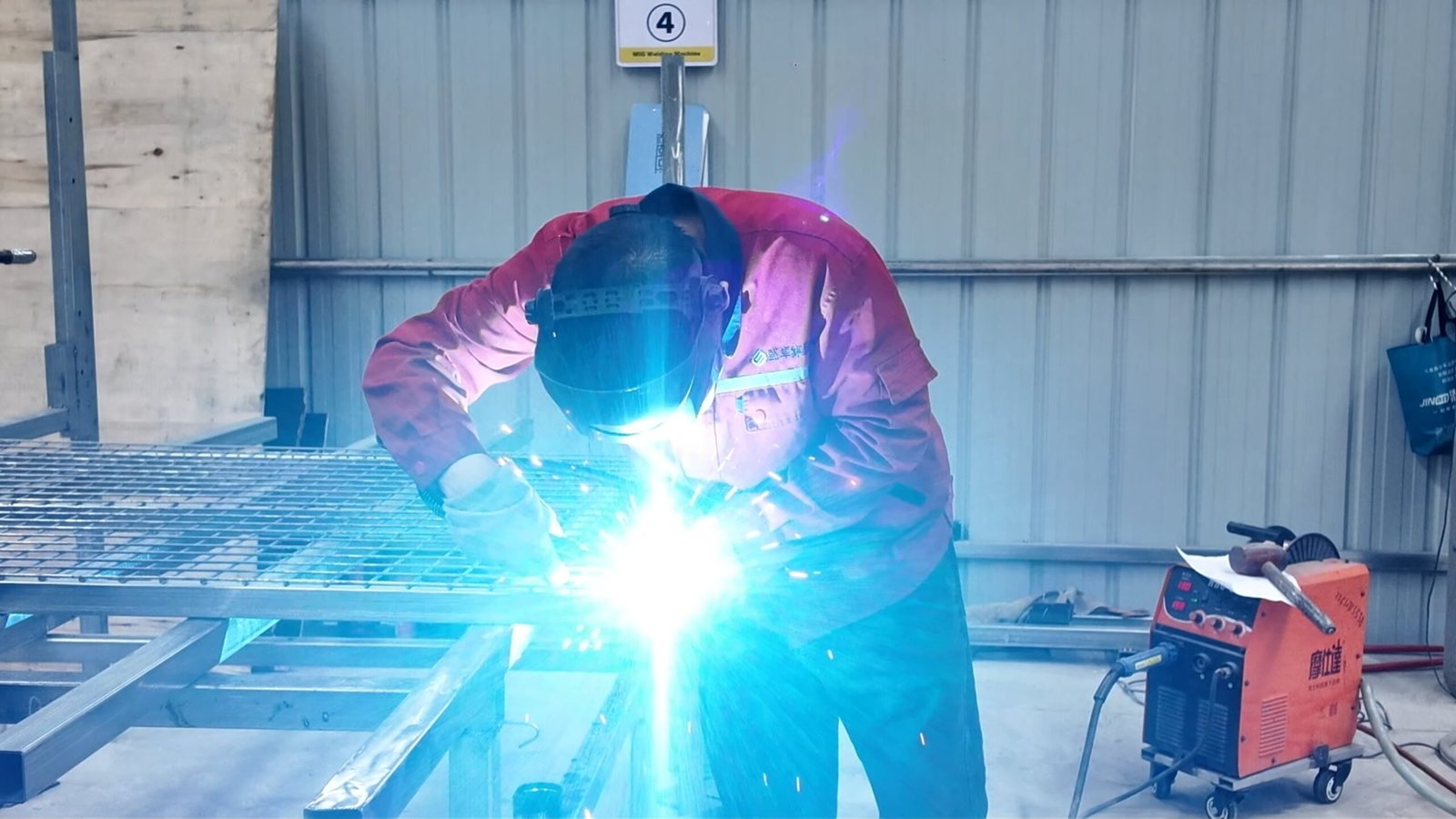
None of this makes a reseller a bad partner; a good local dealer may be exactly right where you need local installation and fast service. The problem is paying a factory-direct price for a reseller service. At our Handan site, cutting, welding, shot blasting, powder coating, trial assembly, inspection and packing happen in-house, and hot-dip galvanizing after fabrication is done with a named partner. That is why we can usually answer a weld or coating question in the same call.
What should you send a padel court manufacturer before asking for a price?
Send a one-page brief: number of courts, indoor or outdoor, site address or region, plot size, whether you need installation or supply only, target opening date, and any non-negotiables such as a panoramic model or a future canopy. Identical briefs are the only way to get comparable quotes from every padel court manufacturer USA importers are considering.
Ask each supplier to confirm the full footprint for its model, not just the 20 × 10 m playing area, because structure, access, drainage and circulation need more room. Court count also changes freight per court more than most buyers expect, so if you are undecided between three and four courts, ask for both quotes and let the freight line inform the decision.
Which seven checks verify a padel court manufacturer for a US project?
Run them in order: an exact-model drawing, written steel, coating and glass specifications, trial-assembly evidence, a live factory walk, documents matched to your model and batch, a packing plan, and a written installation and spare-parts split. A real factory can pass all seven within a week; a reseller usually stalls on the drawing and the live walk.
1. Ask for the drawing before you discuss price
A manufacturer can show the drawing of the exact court you would buy: post positions, glass arrangement, doors, mesh panels, lighting supports and anchor points. That drawing is what your civil contractor needs to build the foundation accurately. If it arrives for a different model, or never arrives, treat that as information.
2. Pin down steel, coating and glass in writing
Ask for the steel grade and section sizes of the main posts, the corrosion route by name, and the glass thickness, treatment and standard, with document numbers you can check. Even within one factory, two quotations under the same model name can carry different post walls, so the schedule attached to your quotation is the one that counts. A supplier who recommends glass thickness without asking about your site has not done the engineering.
3. Ask how the court is checked before it leaves
Trial assembly exists to find a misaligned bolt hole in the factory, where it costs minutes, rather than on your site, where it costs days. Ask whether your order is trial-assembled and whether you can see photos or video of a court at that stage. Our panoramic padel court page shows the model most US clubs start with.
4. Ask for a live look, not an edited video
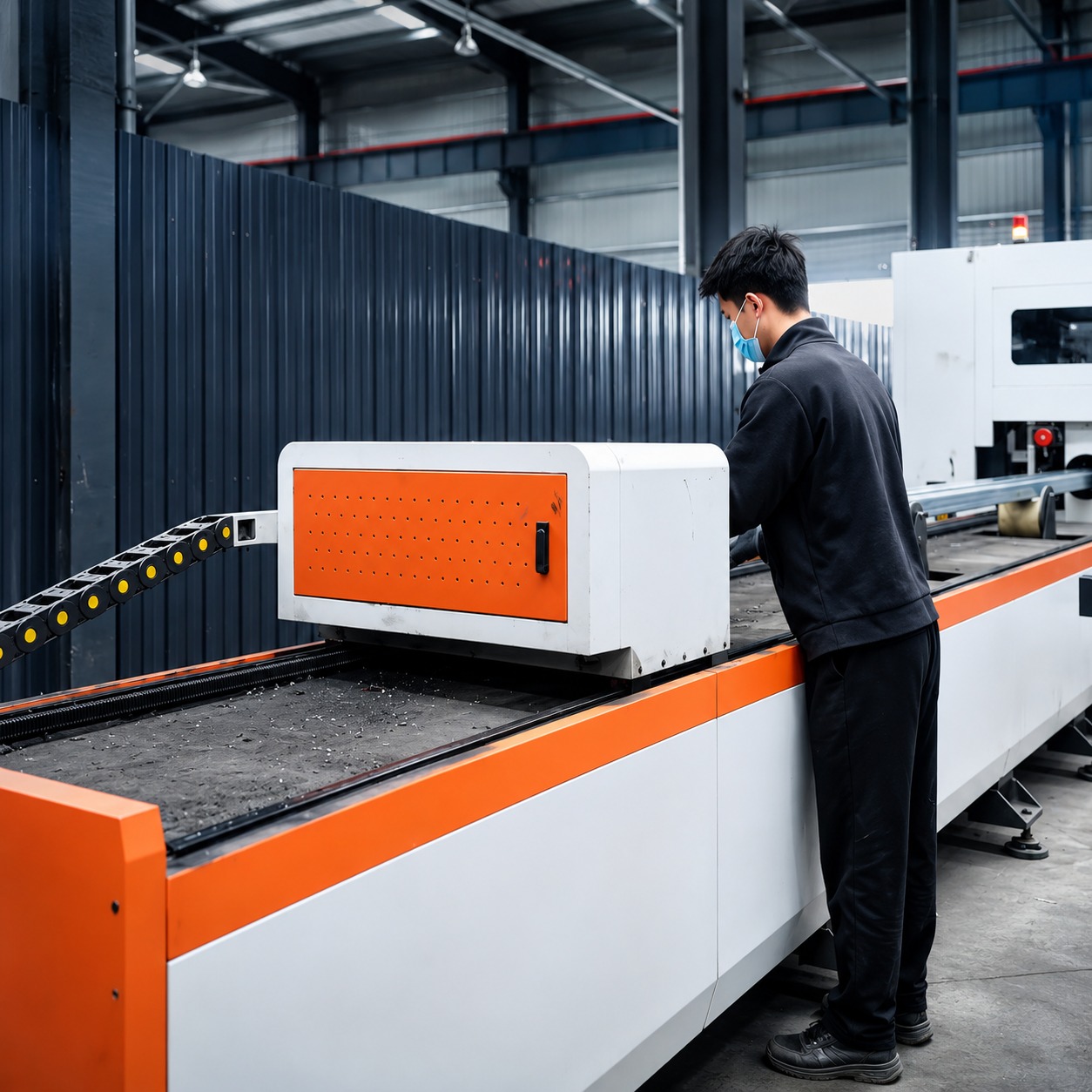
Edited videos prove a company owns a camera. A live, unscheduled walk through steel storage, cutting and welding bays, the coating line, trial assembly and packing proves it owns a factory. You only need one continuous walk in which you can ask the person holding the phone to point at something specific.
5. Check the documents match your order
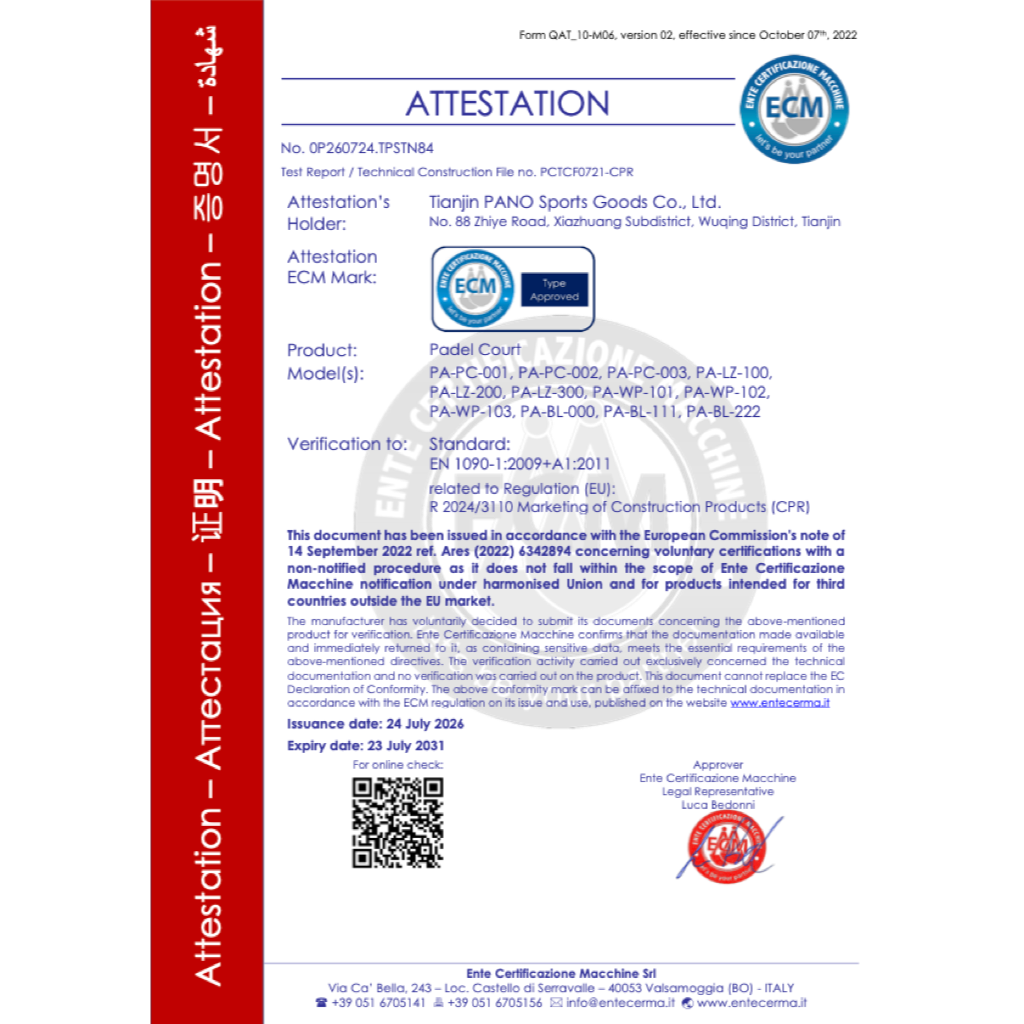
Every document must name your model, materials and batch; a generic certificate is not evidence. Factory documents also do not replace US approval. We hold a voluntary ECM attestation reviewing our technical construction file against EN 1090-1, and it states that it is not an EC Declaration of Conformity. It is useful to your engineer, but it is not a US approval, and our courts are not FIP-certified. If you need tournament certification, say so at the start.
6. Read the packing plan as part of the product
Glass is the part most likely to arrive damaged, and that is almost always a packing failure. Ask how glass is packed, how many packages make up one court, the gross weight and dimensions, and which port and container plan the quote assumes. Plan a forklift for the glass crates on unloading day; that single item prevents most breakage claims.
7. Confirm who installs and who answers in year three
Write installation responsibility down before the shipment leaves. We supply approved drawings, labelled parts, an installation manual, reference videos and remote technical guidance; if you prefer a factory technician on site, that visit is quoted separately for travel, accommodation and daily work. Then ask how you will order a replacement glass panel or fastener set in three years, and from whom. Our padel court installation guide sets out who does what.
What is different about buying from a padel court manufacturer for a US project?
Three things change: the design must be checked under the IBC and ASCE 7 by a US licensed engineer, permits are set by your city or county rather than nationally, and courts made in China can attract additional US duties on top of the base tariff. Plan all three before production starts, not after the container sails.
- Code: outdoor courts are designed under the International Building Code, which points to ASCE 7 for wind; a European document set does not satisfy a US building department on its own.
- Permits: there is no national padel permit, and many local codes do not mention padel at all.
- Import: the factory supplies the court, export documents and packing list; import entry, duties, port handling and inland delivery sit with your importer of record and customs broker.
Our standard panoramic court is verified under our enterprise standard Q/PANO 01S-2019 to a wind basis of 0.68 kN/m², tested by loading each of the six glass ear plates with 680 N for one minute. That is useful evidence for your engineer, but it is a factory test basis, not an ASCE 7 site design; in hurricane-prone locations expect heavier posts, closer anchors or a classic layout. On duty, tariffs on goods of Chinese origin have changed often, so ask your broker to confirm the HTS classification and the full duty stack for your shipment in writing before you sign. The US Harmonized Tariff Schedule is the official reference.
Should US buyers choose a padel court manufacturer in China or Europe?
Choose on evidence, not geography. A China-based padel court manufacturer usually wins on court price, batch capacity and customisation; a European one usually wins on familiar paperwork and shorter service routes. For a US project the deciding line is often duty plus freight, so compare both offers on a delivered and installed basis.
A European brand can supply a poor court and a Chinese factory an excellent one; what decides it is verified engineering, glass safety, corrosion protection, installation support and total landed cost. When US buyers send me a competing quote, the gap is rarely in the court itself. It is usually in three lines: glass thickness, the corrosion route and the warranty scope. Normalise those three first and most price differences shrink or become easy to explain. Our commercial padel court cost guide shows how FOB, CIF, DAP and DDP change who pays for each line.
How do you compare padel court quotations like for like?
Put every quotation into the same table before comparing a single number. If a line is missing, ask whether it is excluded or included elsewhere. Excluded is a legitimate answer, but only if it is written down; two quotations that look far apart usually differ in scope, not margin.
- Court model and structure: steel sections and corrosion route.
- Glass: thickness, treatment, standard and packing.
- Mesh, net, posts and fittings.
- Turf: named product, pile, backing and infill.
- Lighting: luminaire, poles and electrical scope.
- Packing, port, container plan and Incoterm.
- Foundation drawings and anchor details.
- Installation: manual, video, remote support, technician option.
- Warranty scope and period per component, in writing.
- Spare parts, US duty basis and payment milestones.
Which red flags should make you walk away from a supplier?
Walk away, or at least slow down, when a supplier cannot produce the drawing for the model it quoted, answers technical questions only after checking with its own supplier, shows certificate logos without model-linked documents, or pressures you for a deposit before drawings, foundation details and installation scope are agreed.
- A price that moves sharply when you ask what is excluded.
- No trial assembly, no packing description and no spare-parts plan.
- Claims that one document set satisfies every country’s planning, building and structural rules.
- Bank details that change by email without confirmation through a known contact.
What else do US buyers ask a padel court manufacturer?
How do I know if a padel court supplier is a real manufacturer?
Ask for three things together: a drawing for the exact model, a live video walk of production and packing, and documents linked to your model and materials. A real manufacturer can provide all three. A reseller usually struggles with at least two, because it does not control the production it is selling.
Do I need a US dealer to buy a padel court from a factory in China?
No. You can buy factory-direct, with the factory supplying the court, drawings, manual and remote guidance, while your US engineer, customs broker and local crew handle the US work. A dealer is worth paying for when you want local stock, one installation contract or fast local service.
What import duty does a padel court from China pay in the US?
It depends on the HTS line your broker assigns and on any additional tariffs in force on goods of Chinese origin at the date of entry, which have changed often. Ask your customs broker to confirm the classification and full duty stack in writing before you order, and include it in your landed-cost table.
Can a factory abroad supply drawings a US engineer can stamp?
A factory can supply model drawings, anchor positions, loads and test evidence in a form your engineer can check. The US licensed engineer, not the factory, designs the foundation, verifies the structure for your site and stamps the drawings. Be wary of any supplier promising otherwise.
Does PANO install the courts it supplies?
A local crew installs from our approved drawings, labelled parts, installation manual, reference videos and remote technical guidance. If you prefer a PANO technician on site, that visit is quoted separately for travel, accommodation and daily work. Agree the route in writing before shipment.
How long does it take to get a padel court from China to the US?
In our recent quotations, production has been 20 to 25 working days from the confirmed deposit. Add packing, ocean freight from Tianjin to your US port, customs entry and inland delivery, which vary by coast and season. Keep engineering and permits ahead of production so the court is not waiting in port.
What should a padel court quotation for the US include?
The exact model and material specifications, glass and turf details, packing and shipping basis, foundation and anchor drawings, installation scope, warranty per component, spare-parts arrangements, payment milestones and the US duty basis. Anything missing is a question to ask, not a detail to assume.
How do you get a like-for-like quote from a padel court manufacturer for the USA?
Send every supplier, including us, the same one-page brief and ask for the drawing, the specification schedule and written answers to the seven checks above, plus one US-specific question: can your drawings and load information be checked and stamped by my licensed engineer for this site? How a supplier answers tells you more than any brochure.
If you want PANO in that comparison, send your brief through our contact page. I will reply with a model-specific scope, the section schedule, the document register and the open questions for your engineer and broker. For outdoor sites, our guide to specifying an outdoor padel court in the USA covers corrosion, glass and wind, and the padel court manufacturer page explains how we work with US clubs, contractors and distributors.