
When you build a seaside padel court, the first thing to weigh is how high salt spray and a tropical island climate attack the court’s steel and coatings — this is what decides whether the court lasts 3 years or 15.
Worldwide, a seaside padel court currently has only two proven solutions: Option 1, a high-strength steel-structure court given multi-layer anti-corrosion treatment (the Duplex dual-protection system); and Option 2, a pure aluminum-alloy court. The second consideration is the island’s ground conditions (the bearing capacity and uplift resistance of sandy soil), and only third comes the build cost (padel court cost) and the return on investment.
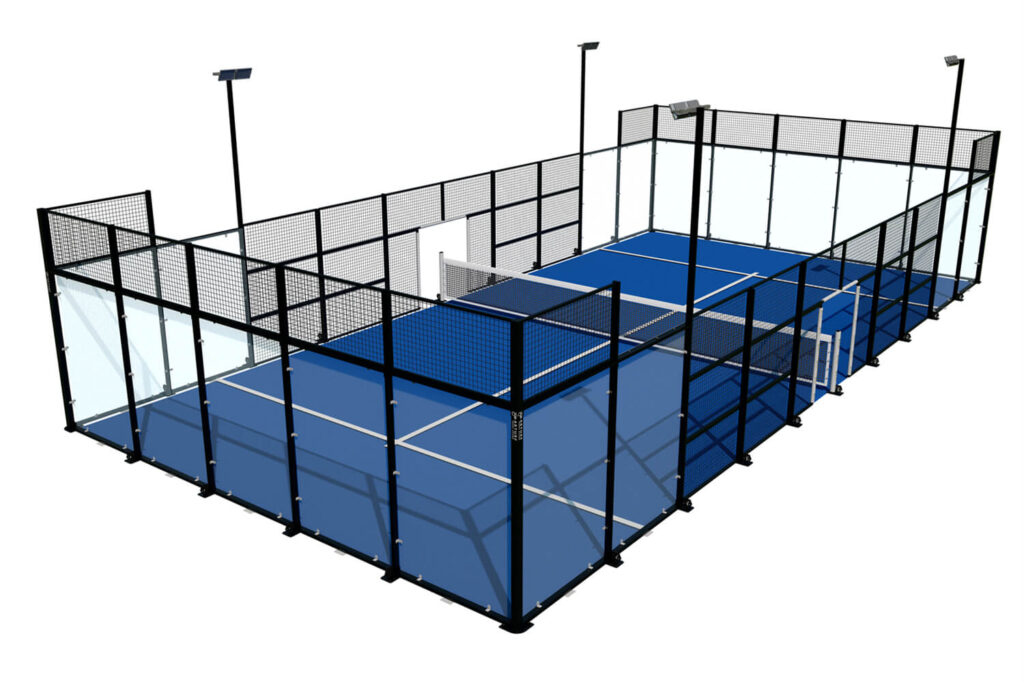
- ✔ The coast falls under the C5-M / CX highest marine corrosion category defined by ISO 12944-2; ordinary galvanized or single-coat sprayed courts typically show rust within 1–3 years by the sea.
- ✔ Tropical seawater stays ≥21 °C year-round, so a zinc layer cannot form the protective patina it develops in temperate climates, and corrosion runs markedly faster than on European coasts.
- ✔ Two viable routes: a multi-layer anti-corrosion steel structure (the value-for-money route) and an aluminum-alloy structure (the premium-price route).
- ✔ Islands are mostly sandy ground, requiring a concrete foundation plus an uplift-anchor design; foundation work is roughly 15–25% of total project spend.
- ✔ padel court cost varies widely: an aluminum build runs about 1.8–2.5× a multi-layer anti-corrosion steel structure.
the selection order is always “process → foundation → cost.” We have seen too many seaside projects choose an ordinary galvanized structure to save 10% of the upfront padel court cost, only to watch rust bleed across a white resort’s timber deck in year two — the rework costs far more than using a marine-grade process from day one.
Which padel court style is best for the seaside?
Both the 3 mm สนามพาโนรามาปาดเดิล and the 3 mm สนามปาดเดิลแบบคลาสสิก suit seaside and coastal climates. Both treat the steel-structure surface with a multi-layer anti-corrosion process and use 12 mm purpose-made tempered glass, which raises the overall service life of the court in high-salt-spray conditions. The panoramic version maximizes the glass viewing area for a premium look, while the classic version keeps a steel-mesh upper section that is lighter and slightly more economical — but on the corrosion-critical points (steel treatment and glass thickness) the two are built to the same coastal standard.
For a project directly on the waterfront, either style works as long as it is ordered in the marine-grade coastal specification. You can compare the two builds in detail on our สนามปาดเดิลแบบคลาสสิก และ สนามพาเดลแบบพาโนรามา product pages.
- ✔ 3 mm panoramic padel court — full-glass walls, maximum spectator visibility, a premium coastal-resort look.
- ✔ 3 mm classic padel court — glass lower section plus a steel-mesh upper section, lighter and more cost-efficient to ship to an island.
- ✔ Shared coastal build — a multi-layer anti-corrosion steel surface and 12 mm special tempered glass for a longer service life in salt-spray environments.
How should you choose a padel court in a high-salt-spray island nation like the Maldives?
In a high-salt-spray island environment such as the Maldives, you should choose a padel court built to the Overall Hot-Dip Galvanizing + Duplex System standard (“overall hot-dip galvanizing + anti-rust primer + topcoat/powder-coat finish,” a dual-protection system): the hot-dip zinc layer can reach 650 g/m² and the salt-spray test (ISO 9227) exceeds 1000 hours. This is the anti-corrosion route commonly used today for European coastlines and offshore infrastructure.
- ✔ The whole of the Maldives sits in a C5-M marine atmosphere — sea on every side, no shelter, and salt spray acting on the structure surface around the clock.
- ✔ The combined service life of a Duplex system can reach 1.5–2.5× the sum of a single galvanized layer or a single coating (ISO 12944 duplex practice).
- ✔ The coating protects the zinc layer from early salt attack, and the zinc in turn stops undercreep rust from spreading at any scratch in the coating — a synergistic effect, not simple addition.
- ✔ Every connecting bolt must be 304 stainless steel, and glass holes must use rubber grommets plus washers for isolation, eliminating dissimilar-metal galvanic corrosion points.
- ✔ On delivery, require the supplier to include the salt-spray test report, zinc-layer thickness records and CE documentation with the shipment.
Practical tip: when asking a supplier for a quote, put three questions directly — “Which galvanizing standard do you follow? How many dips? Can the salt-spray report ship with the goods?” Anyone who cannot answer can basically be ruled out.
Duplex System padel court specification breakdown (real Maldives project configuration)
Below is the real quotation configuration we shipped to a Maldives client in 2026 (the Panoramic full-glass model, a standard 20 m × 10 m court). It can serve as a selection reference for any seaside padel court:
| องค์ประกอบ | ข้อมูลจำเพาะ | Qty |
|---|---|---|
| เสาหัวมุม | Rectangular steel tube 50 × 100 × 2.75 mm × H4000 mm | 4 |
| Raised uprights | 50 × 100 × 2.5 mm × H4000 mm | 12 |
| 20 m-side uprights | 50 × 100 × 2.5 mm × H3000 mm | 12 |
| Upper cross-beams | 50 × 100 × 2.5 mm × L2000 mm (20 m side: 8; 10 m side: 10) | 18 |
| Lower cross-beams | 50 × 100 × 2.5 mm × L2000 mm (20 m side: 8; 10 m side: 10) | 18 |
| Light poles | 50 × 100 × 2.5 mm × H3000 mm | 4 |
| Mesh panels | 20 × 40 × 2 mm steel-tube frame, mesh sheet 2000 × 1000 mm; wire dia. 4 mm, aperture 50 × 50 mm, anti-scrape protected wire ends | 46 |
| กระจกเทมเปอร์ | Purpose-made shatter-resistant tempered glass 12 mm, 1995 × 2995 mm | 18 |
| ระบบแสง | LED 400 W court-dedicated floodlights | 4 |
| สนามหญ้า | Pile height 12 mm, gauge 3/16″, density 52,500 stitches/m², weight 8,000 Dtex, SBR backing, custom colours | 210 m² |
| Fittings | Full set of 304 stainless-steel connecting bolts; glass holes with quality rubber grommets + washers + stainless screws | 2 ชุด |
Data point: mind the wall thickness — for a coastal court the upright wall thickness should not fall below 2.5 mm (corner posts 2.75 mm). Some low-price courts use 1.5–2.0 mm thin-wall tube to cut cost, which sharply shortens fatigue life under the constant vibrating load of sea wind.
Duplex System padel court process breakdown (mapped to European standards)
Anti-corrosion for a seaside padel court is not “one step” but a four-layer system executed to European standards. The following is the core of the process specification for our Maldives project:
| Step | Process layer | European standard | วัตถุประสงค์ |
|---|---|---|---|
| 1 | Abrasive blast-cleaning to Sa 2½ | ISO 8501-1 | Fully removes mill scale, giving a clean roughened surface for metallurgical bonding of the zinc layer |
| 2 | First overall hot-dip galvanizing (whole member dipped) | มาตรฐาน EN ISO 1461 | Sacrificial-anode zinc layer metallurgically bonded to the steel base |
| 3 | Second overall hot-dip galvanizing (double dip, thicker zinc, up to 650 g/m²) | มาตรฐาน EN ISO 1461 | Reinforces zinc thickness for marine exposure |
| 4 | One coat of anti-rust primer | ISO 12944-5 Duplex practice | An adhesion transition layer that seals the zinc against salt spray |
| 5 | Weather- and UV-resistant topcoat / powder coat (custom RAL colours) | ISO 9227 salt-spray ≥1000 h | Outermost barrier against UV, damp heat and chloride ions |
Practical tip: “two overall dips” versus “one dip only” or “local touch-up galvanizing” are entirely different cost and service-life grades. At acceptance, take a coating-thickness gauge to the lower 30 cm of the uprights (where splash-zone salt concentrates) and you can immediately tell the genuine from the fake.
Why not choose an aluminum-alloy padel court?
mature aluminum-alloy courts do exist worldwide (for example adidas-branded AFP Courts, using EN AW-6063 aluminum profile), but their main installation setting is inland cities and indoor venues, not a marine atmosphere like the Maldives. Islands see seasonal wind acting all year; aluminum has only about one-third the elastic modulus of steel and is light, so under the impact loads of intense play plus a constant wind load the whole structure is prone to deformation and vibration (a direct threat to the fatigue life of the 12 mm glass). On top of that, an aluminum-alloy court costs 1.8–2.5× a multi-layer anti-corrosion steel court, which clearly lowers ROI for the investor.
Structural process of an aluminum-alloy padel court:
- ✔ Material: EN AW-6063-T6 / 6061-T6 extruded profile (not the T5 soft temper, whose yield strength is insufficient).
- ✔ Connection: must be bolted assembly plus extruded-slot design — the heat-affected zone of aluminum welds loses about 40% strength, so a seaside court must not rely on welded joints.
- ✔ Surface: anodizing plus powder-coat, a two-layer treatment.
- ✔ Galvanic-corrosion protection: aluminum-to-stainless bolt contact points must add nylon isolation washers, since dissimilar-metal contact accelerates corrosion in a salt-spray environment.
- ✔ Rigidity compensation: under the same wind load, the aluminum profile section must be enlarged versus steel tube to control deflection and vibration.
Price breakdown of an aluminum-alloy padel court (why 1.8–2.5× more):
- ✔ Raw aluminum unit price is about 3× steel per kilo.
- ✔ Rigidity compensation demands larger sections and thicker walls — material volume rises further.
- ✔ Custom extruded profiles need tooling, and the mould cost is amortized into a single court.
- ✔ T6 heat treatment and anodizing both cost more than spray-coating a steel structure.
- ✔ The only cost advantage is sea freight and on-island handling (50–60% lighter), but it is not enough to offset the premium of the structure itself.
Data point: the Maldives has no typhoons (low equatorial latitude, cyclones rarely form), but during the southwest monsoon (May–November) gusts reach 60–80 km/h, and a beachfront court is unsheltered on all sides with a wind load that persists all year — this “not extreme but never-ending” load pattern is exactly the fatigue case a lightweight structure handles worst.
Aluminum alloy vs. multi-layer anti-corrosion steel padel court: full comparison
Direct answer: both solutions can solve the coastal corrosion problem, but they differ significantly in structural stability, price and after-sales upkeep. The comparison below is based on our export-project experience as a padel court manufacturer in China:
| มิติ | Multi-layer anti-corrosion steel padel court | Aluminum-alloy padel court |
|---|---|---|
| วัสดุ | Quality steel tube (corner posts 2.75 mm / uprights 2.5 mm wall), elastic modulus 200 GPa, high wind- and impact-rigidity | EN AW-6063-T6 extruded profile, elastic modulus ~70 GPa (1/3 of steel), needs enlarged sections to compensate |
| Anti-corrosion process | Blast Sa 2½ + two overall hot-dip galvanizing passes (EN ISO 1461, zinc up to 650 g/m²) + anti-rust primer + weather topcoat, salt spray ≥1000 h | Anodizing + powder coat; good natural corrosion resistance, but galvanic-corrosion points must each be isolated |
| Installation cost | Heavier members, needs light lifting gear or several installers; bolt assembly, 5–7 day build | 50–60% lighter, easy to barge to the island; but overall price is 1.8–2.5× the steel structure |
| After-sales upkeep | Fresh-water rinse every 3–6 months; touch-up paint kit shipped with the order, scratches repaired on site | Essentially maintenance-free, but profile damage cannot be repaired on site and needs whole-piece replacement (dependent on the original mould) |
| การรับประกัน | Steel structure 5 years; anti-corrosion coating system (marine spec) 3 years | Structure typically 3–5 years industry-wide, but few marine-environment cases and limited long-term data |
| ROI | padel court cost controllable, short payback, high ROI | 80–150% higher upfront spend, markedly longer payback |
Expert conclusion: Because wind is persistent all year round in island environments, an aluminum-alloy structure needs special engineering design to stay stable owing to its light weight. For seaside padel courts such as those in the Maldives, a steel-tube structure with high strength and a deep multi-layer anti-corrosion treatment (the Duplex system) remains the best balance of stability, service life and cost.
Why choose a PANO seaside padel court?
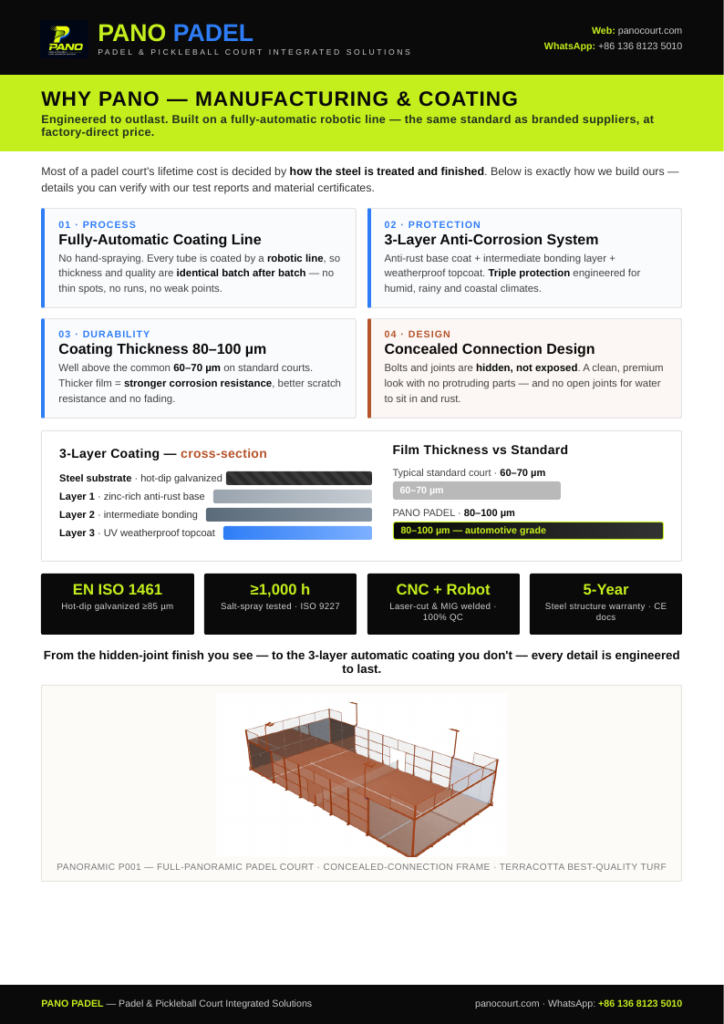
PANO PADEL is a full-court padel-system manufacturer based in China (a padel court China direct factory). Our marine-version courts are designed to the ISO 12944 C5-M highest marine corrosion category, using the same four-layer Duplex anti-corrosion system as European coastal infrastructure, and we provide a complete standard documentation chain for every island project.
- ✔ Four-layer marine anti-corrosion system: blast Sa 2½ (ISO 8501-1) → two overall hot-dip galvanizing passes (EN ISO 1461) → anti-rust primer → weather- and UV-resistant topcoat, with a salt-spray test over 1000 hours (ISO 9227).
- ✔ Whole-court consistency: mesh panels treated to the same system, a full set of 304 stainless bolts that never rust, and glass fittings isolated with rubber — no dissimilar-metal corrosion blind spots.
- ✔ Coastal-environment warranty: the anti-corrosion coating system is warranted for 3 years in direct seaside exposure, and the steel structure for 5 years.
- ✔ Full documentation: salt-spray test report, zinc-thickness records, material certificates and CE documents ship with the order, meeting the audit requirements of resort owners and project supervisors.
- ✔ Factory-direct: shipped direct from the China factory, so at equal marine-grade process the padel court cost is significantly below European brands, with RAL colour and logo customization supported.
Practical tip: if your project is in the Maldives, a Southeast Asian island or the Middle Eastern coast, ask us directly for the Marine Anti-Corrosion Process Specification and a real project quotation configuration — compare on parameters, not on marketing copy.
FAQ: Seaside padel court installation costs
What does the cost structure of a seaside padel court installation look like?
A seaside padel court installation cost usually splits into five buckets: (1) the court system itself (steel structure, 12 mm tempered glass, mesh, turf, lighting) — the largest share; (2) the marine-grade anti-corrosion process (the double hot-dip galvanizing plus Duplex coating premium over a standard court); (3) foundation and groundworks (a concrete slab plus uplift anchors for sandy ground), roughly 15–25% of the project; (4) sea freight and on-island transfer, which rises sharply for remote islands; and (5) on-site installation labour and supervision. On a coastal project it is the anti-corrosion and foundation lines that separate a 3-year court from a 15-year one.
How much more does a seaside padel court cost than an inland court?
For the same panoramic or สนามปาดเดิลแบบคลาสสิก, the coastal marine-grade specification adds a premium over a standard inland build, driven mainly by the extra galvanizing pass, the Duplex coating, 304 stainless fittings throughout, and heavier foundation and anchoring. The exact figure depends on distance from shore, island logistics and glass area, so we quote each seaside project from its real bill of materials rather than a fixed multiplier.
Why is sea freight such a big part of coastal padel courts cost?
Remote islands often need trans-shipment from the main port to the site by barge or small vessel, plus crane or manual handling on arrival. This is the one line where a lighter aluminum structure saves money (50–60% lighter), but the saving rarely offsets the 1.8–2.5× price of the aluminum structure itself, so for most coastal padel courts a marine-grade steel build still gives the better landed cost per year of service life.
Can I lower seaside installation costs without shortening the court’s life?
Yes — the safe savings are in logistics and scope: consolidating shipments, choosing the classic padel court over a full-glass panoramic build, or phasing the lighting. The savings should never come from the anti-corrosion process or the glass thickness. Cutting galvanizing passes or wall thickness to save 10% upfront is exactly what triggers the rust-and-rework spiral in year two.